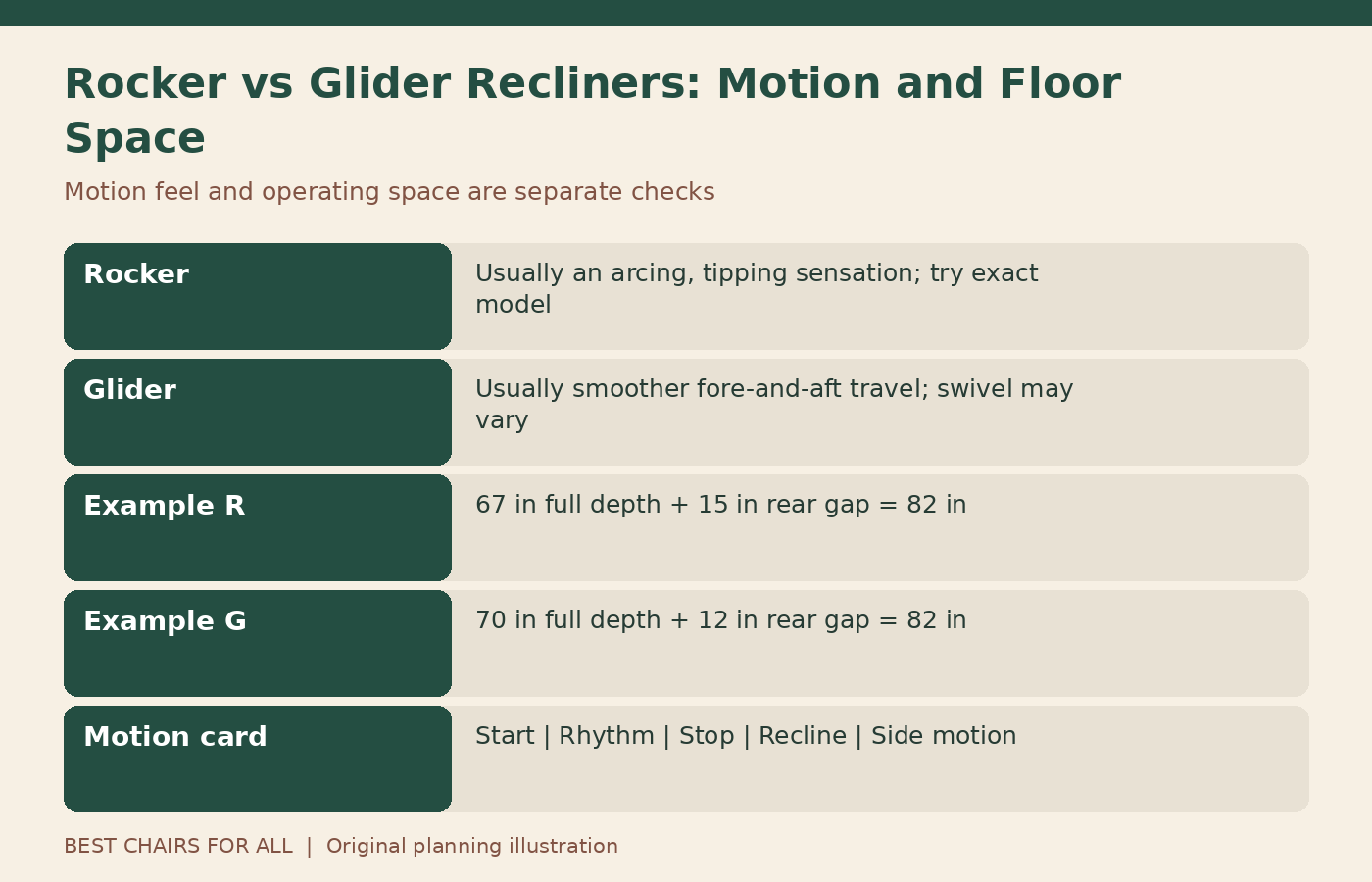
Rocker recliners and glider recliners both add motion to a reclining seat, but they do not necessarily feel the same or occupy the same moving space. A rocker usually produces an arcing, tipping sensation. A glider usually moves the sitting assembly along a smoother forward-and-back path. The exact mechanism matters more than the label, especially when a chair also swivels or changes its motion behavior as the footrest opens.
Choose by trying the actual chair and mapping its permitted movement in the intended room. A compact base is not proof of a compact operating footprint. This guide provides a motion-testing card and a floor-space exercise you can use without inspecting or adjusting the mechanism underneath the chair.
Separate three kinds of movement
Reclining changes the relationship between the back, seat, and footrest. Rocking or gliding adds a repeating movement while the chair is in an allowed position. Swiveling turns the chair toward a different direction. These features can appear in combinations, so the phrase glider recliner may describe more than a single forward-and-back motion.
La-Z-Boy’s recliner guide distinguishes rocking recliners from gliding recliners and describes its gliders as including a swivel function. That does not establish that every glider from every brand turns. Read the exact model’s specification and ask which movements are available upright, partly reclined, and with the footrest extended.
Describe the feel instead of trusting the name
On a showroom trial, use plain observations: the seat tips noticeably, the motion feels mostly level, the chair stops gently, or the movement is difficult to start. These descriptions help distinguish what your body prefers. They are more useful than assuming that all rockers feel old-fashioned or all gliders feel smoother. Cushion firmness and seat geometry can influence the impression as much as the base category.
Try several small motions before testing a larger range. Keep feet and hands where the manufacturer instructs and follow the showroom staff’s guidance. Do not rock aggressively to discover a supposed maximum. The question is whether the normal permitted movement feels comfortable and controllable for you, not how far a display chair can be pushed.
Ask what happens when you recline
Some chairs restrict rocking or gliding when the footrest opens; other designs behave differently. Ask the salesperson to explain that transition on the actual model. Check whether the chair is expected to be stationary before the footrest closes and whether a particular sequence is required. A mechanism’s normal behavior can otherwise be mistaken for a fault after delivery.
Best Home Furnishings’ FAQ explains that mechanism options vary by product. Therefore, a collection name or familiar silhouette is not enough to identify how a chair will move. Write down the mechanism code or full item code of the chair you tried, along with the upholstery and any power options included in the demonstration.
Map the rear sweep before choosing a wall position
Put a temporary outline of the chair’s upright dimensions on the floor. Then add the manufacturer’s rear-clearance requirement for that mechanism. Rocking or gliding can bring the back closer to a wall in a way that the base outline does not show. A narrow gap behind the feet of the chair may therefore give a misleading sense of room.
Best’s Comfort Sync overview specifically distinguishes its SpaceSaver, Swivel Glider, and Rocker bases and notes that the moving bases require more room. Its close-wall figures apply to specified SpaceSaver arrangements, not automatically to the rocker or glider version of an otherwise similar chair. Always confirm the clearance for the selected version.
Include the footrest’s front reach
A rocker can look short while upright yet project well into a room once the leg support opens. Measure the published fully reclined depth and ask how that dimension is referenced. Does it run from the back’s farthest point to the footrest tip? Does the stated operating depth include a required gap behind the back? Clarifying those endpoints prevents double-counting or omitting space.
Keep the coffee table outside the complete movement envelope. Do not assume it can be pushed aside every time unless that is a realistic, safe household routine. If the chair will often be left with its footrest open, evaluate the room in that condition. Another person’s route to a doorway should not depend on stepping over the footrest.
A worked floor-space exercise
Suppose two hypothetical recliners are both 36 inches wide and 40 inches deep while upright. Candidate R requires a confirmed 15-inch rear gap and has a 67-inch fully reclined depth. Candidate G requires 12 inches behind and has a 70-inch reclined depth. If the rear-gap and depth reference points align, each occupies 82 inches from the wall to the front tip when reclined.
Their equal calculated depth does not make them interchangeable. Candidate G might also swivel, requiring a wider turning envelope. Candidate R might approach a nearby curtain during rocking. The exercise shows why comparing only the upright rectangle or only the rear-wall figure can select the wrong chair. These numbers are illustrative and are not specifications or required clearances for a real product.
Build a five-line motion card
For every chair tried, record Start, Rhythm, Stop, Recline transition, and Side motion. Under Start, note how easily you begin normal motion. Under Rhythm, describe the feel. Under Stop, note whether you can settle the chair comfortably. Under Recline transition, record the manufacturer’s allowed sequence. Under Side motion, note whether a swivel feature exists and what limits apply.
Repeat the same sequence for each candidate. A standardized card makes a second showroom visit more productive because it preserves the differences you noticed. Add the full item code and date at the top. If you try a powered version after a manual version, create a new card rather than assuming the base and control experience are identical.
Check the floor as part of the comparison
A level, suitable floor helps a chair behave as designed. Rugs, uneven flooring, and transitions between carpet and hard surfaces can change how stable a chair feels. Ask the manufacturer or retailer about the intended floor setup and approved protection. Do not compensate for unexpected movement by wedging random objects under the base or adding an unapproved platform.
Measure where a rug edge would sit relative to the base through all permitted movement. A rug that barely reaches beneath the front of the chair may be a poor placement even if its color works well. During installation, confirm that the chair sits as the manual requires before judging a noise or uneven movement as a mechanism problem.
Fit the person independently of motion
A pleasant glide cannot fix a seat that is too deep. Sit fully back and assess floor contact, pressure behind the knees, arm position, back support, and control reach. For a shorter person, the effort needed to start or stop movement can change if the feet do not reach the floor comfortably. For a taller person, the head cushion and footrest may need particular attention.
Use your normal indoor footwear and the same posture for each trial. Avoid comparing one chair while perched at the edge with another while sitting fully back. If a medical condition or transfer difficulty affects the evaluation, seek individual advice rather than treating a base category as a health recommendation. Motion preference is personal and does not establish clinical benefit.
Think about the view and nearby objects
A chair facing a television may seem to need only forward-and-back motion. In a room shared with conversation seating, a swivel feature may be useful. It also changes the relationship to side tables, lamps, and power cords. Test where the controls and drink table end up after turning, and follow any swivel limits in the manufacturer’s instructions.
If a powered chair swivels, ask how its cable arrangement accommodates the permitted movement. Do not presume unlimited turns because a sales description mentions a full rotation. The installed power system and the model manual determine what is allowed. Keep cords and loose items outside the moving path and request the approved installation arrangement from the retailer.
Keep children and pets out of every motion path
Neither rocking nor gliding removes the need to manage moving furniture carefully. The upholstered cover can hide linkages and pinch areas. Before operating or moving the chair, make sure children, pets, toys, and loose blankets are clear according to the manufacturer’s warnings. Avoid telling children that one base style is safe to crawl under because its motion feels gentle.
Choose a room arrangement that allows adults to see the area around the chair before operating it. If that cannot be achieved with the intended placement, reconsider the layout. A stationary-looking footrest or quiet motor can still move unexpectedly when a control is pressed. Supervision and following the model’s warnings remain necessary regardless of the marketing category.
Decide with a documented tradeoff
A useful final note might read: the rocker felt easier to settle, but the glider version kept the preferred view and passed the room test. Another household may reach the opposite result. Separate subjective motion preference from objective fit and clearance. That makes the choice explainable and helps you avoid paying for a feature that does not serve the room.
Before ordering, confirm the mechanism code, exact dimensions, rear clearance, permitted motion positions, electrical requirements, and return terms in writing. Keep the motion card and floor sketch with the receipt. On delivery, repeat the ordinary movement sequence with surrounding furniture in place and ask the installer to address unexpected behavior before considering the setup complete. Photograph the final layout from the side and front so you can restore the same clearances after cleaning or rearranging the room. Keep nearby tables in those checked positions.
Something unclear or out of date? Send a correction with this article’s title and the detail to check.
Sources, research & corrections policy ↗