A salon chair's base is both a floor footprint and part of a complete lifting assembly. Round, square, five-star, low-profile, and floor-mounted designs solve different layout problems, but the outline alone does not establish stability, capacity, or minimum seat height. Compare the approved chair-top and base combination, its dimensions, and the actual standing positions around it.
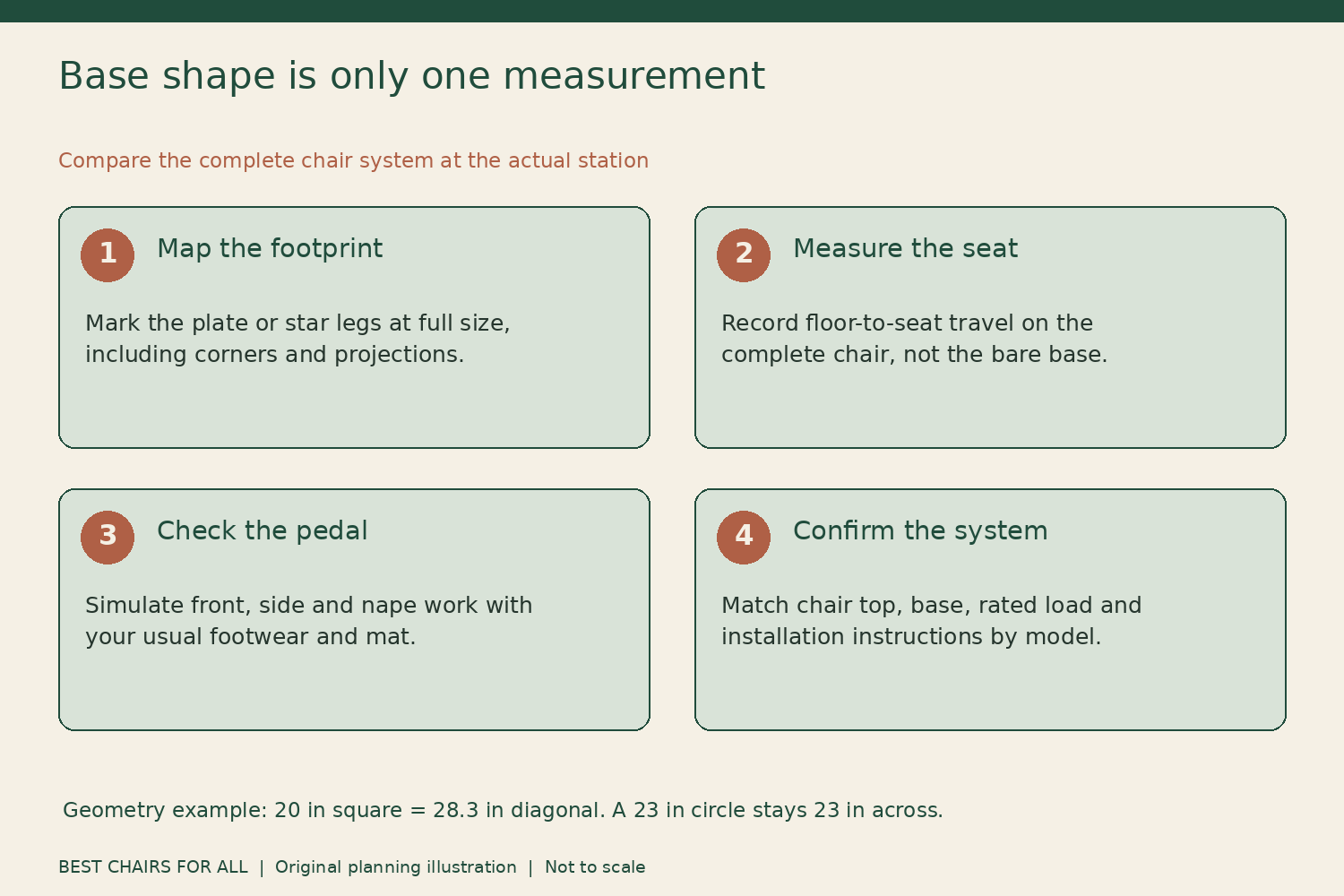
Start with three measurements: the base's full footprint, the complete chair's floor-to-seat height range, and the farthest point reached by the footrest or back when the chair rotates. Those describe different things. A small base does not necessarily produce a small operating envelope, and a low-looking metal plate does not necessarily make the assembled seat low enough for the stylist.
What the common shapes mean
A round plate has a continuous perimeter. A square plate adds corners that deserve attention where the stylist steps close to the seat. A five-star base has projecting legs and gaps between them. Floor-mounted bases use an installation method that requires explicit manufacturer and building information. None of these descriptions supplies a universal ranking of quality.
Compare the edge as well as the outline. Ask about the plate's actual height above the finished floor, any sloped perimeter, the pedal's location, and the underside's approved contact arrangement. These affect foot placement and cleaning access. Do not infer that a heavy-looking cover is the structural base or that a decorative shroud can carry a person's weight.
Minerva's Minerva styling chair base guide distinguishes round, square, five-star, oversized, low-profile, floor-mount, and electric options. Its examples also explain that chair-top geometry changes finished seat height. Use that guide as a map of one manufacturer's system, not permission to mix bases and chairs across brands or generations.
Low profile is a configuration description
“Low profile” often refers to the plate or base construction, while the client sits on the combined height of the base, mounting connection, chair frame, and cushion. Ask for the complete chair's travel range. A base drawing showing ram or mounting height is useful to the supplier, but it cannot substitute for the actual seat measurement.
For example, Minerva publishes a Minerva MBP-5LP-SQ dimension drawing with a 20-inch square plate and a depicted mounting-height range. That drawing describes the base, not every finished chair mounted on it. Its dimensional tolerance is also shown on the sheet. Keep both the base drawing and the chair's final specification rather than combining dimensions from unrelated catalog pages.
Some low-profile systems have a manufacturer-designed collar or spacer option. If that option is relevant, order the desired configuration through the supplier and confirm its final measurements. Do not remove parts based on appearance or substitute a shorter hydraulic unit. The authorized installation method and compatible components belong to the specific model.
Stability cannot be read from a photograph
Stability depends on the complete system and how it is used. The footprint, structural design, approved chair top, load rating, floor condition, and operating position all matter. A square plate does not automatically outperform a round plate, and a five-star shape does not by itself tell you whether the chair can be used for a particular service.
Ask whether the stated rating applies to the full assembled chair with your selected base. Confirm whether recline, rotation, or optional attachments introduce different conditions. If the supplier cannot identify the rated configuration, treat that as an unresolved specification. A general statement that the pump is “heavy duty” is not a usable client-load limit.
On the showroom floor, inspect how the base sits on the surface and have staff demonstrate normal height and rotation controls. You are observing ordinary operation, not conducting a load or tip test. Do not rock an occupied chair deliberately or push beyond the manufacturer's movements to see what happens. Request service for wobble or unusual movement rather than trying to compensate with a larger floor mat.
Compare foot placement around the chair
Draw the base full size with removable tape or a paper template, with the venue's permission. Add the pedal and the front footrest. Wear the shoes used at work and stand in the positions needed for the nape, side sections, and front. Notice whether a corner or star leg occupies the place where your foot naturally lands.
Repeat the exercise with the chair facing the mirror and quarter-turned toward each side. A star base may present different leg positions as the chair rotates, depending on how the assembly is designed. A pedal may remain in a particular floor position or move with part of the system. Confirm the actual product behavior rather than guessing from a top-view photograph.
Include a seated practitioner if that is part of the service. The operator stool's wheels, feet, and knees need space alongside the client's chair. Two pieces of seating that each fit the station individually may conflict when used together. This is particularly easy to miss when choosing a large decorative base for a narrow suite.
Use a footprint worksheet
Record these fields for every candidate: base model, compatible chair top, finish, footprint dimensions, edge height, pedal projection, complete seat-height range, rated client load, and assembly method. Add a column naming the document that supports each entry. An empty cell is a question for the supplier, not a reason to borrow a number from a similar-looking product.
Then record three observations from the floor mockup: closest comfortable standing position, interference with the operator stool, and cleaning access around the perimeter. Mark the observations as site-specific. Another salon with a different floor plan or working technique can reasonably reach a different choice using the same base.
Add a final “change impact” box. If the dealer substitutes another base because of stock or finish availability, which checks need repeating? Usually height, footprint, pedal access, capacity confirmation, and assembly information deserve another look. This prevents a seemingly cosmetic substitution from changing the working station after the buying decision is made.
Worked geometry: square versus round
Suppose two hypothetical bases are listed as 20 inches square and 23 inches in diameter. The square's corner-to-corner distance is approximately 28.3 inches, calculated as 20 multiplied by the square root of two. The circle remains 23 inches across in every direction. This arithmetic describes floor geometry only; it says nothing about which base is more stable or has a higher load rating.
That distinction matters when a corner points toward an aisle or toward the stylist's preferred stance. A buyer comparing only the numbers “20” and “23” could assume the square occupies less space in every direction. A paper template makes the difference visible immediately. Include the pedal, because a projection beyond either outline may become the actual limiting feature.
Now add a hypothetical footrest that reaches 19 inches from the rotation center. Its swept radius extends beyond either base. The chair's practical movement envelope is therefore governed by the footrest in that part of the plan. A smaller plate would not reclaim that operating space. Keep geometric calculations separate from the manufacturer's clearance requirements and the building's circulation requirements.
Floor mounting requires a separate conversation
A floor-mounted chair is not simply a freestanding chair with its plate removed. Ask for the exact installation instructions, floor construction requirements, anchoring design, service access, and installer responsibilities. The building owner may also need to approve the work. Do not choose fasteners by comparing photographs of another salon's installation.
Takara Belmont's Takara Belmont chair-base catalog lists selectable chair bases, including floor-mount and hydraulic options with their own model identities. Its Takara Belmont hydraulic-base manual directory provides the route to model-specific instructions. Those resources reinforce the need to identify the base separately from the upholstery and chair top. Products offered in different regions may have different options and installation documents.
Before committing, ask who will inspect the proposed floor and confirm suitability. A finished tile or vinyl surface does not reveal the support beneath it. Likewise, an existing hole pattern is not proof that a replacement assembly is compatible. Resolve these questions before scheduling delivery, when there is still time to adjust the station plan.
Finishes and everyday ownership
Chrome, brushed stainless steel, and coated finishes can look similar in online photographs while requiring different care. Get cleaning instructions for the actual finish and upholstery. A product suitable for the seat may not be appropriate for a coated metal plate, and a metal polish may be inappropriate near upholstery seams.
Look for places where hair and product residue collect around the pedal and pump cover. Ask whether routine cleaning requires only accessible wiping or any manufacturer-defined user action. Keep cleaning tools away from moving gaps, and do not lift a heavy chair or expose its hydraulic system just to reach a cosmetic surface.
An anti-fatigue mat also belongs in the mockup. Confirm whether its cutout suits the selected base and whether its edge interferes with the pedal or cleaning. A mat should not be used as a shim or to hide an uneven floor. If the chair does not sit properly, have the floor and assembly assessed through the supplier's process.
What to put on the order
Write the complete chair top, base model, finish, approved accessories, and expected finished seat-height range on the order. Request the matching manual and dimension drawings. Specify who assembles the chair, who confirms any floor installation, and who handles service. Keep written confirmation of compatibility if existing components are being retained.
Choose the shape that fits your measured working positions and documented chair system. Appearance can then decide between configurations that meet those requirements. This order of decisions makes a round, square, or five-star base a practical choice with traceable evidence instead of a guess based on showroom styling.
Sources and specifications checked November 6, 2026. Examples are planning exercises, not product testing.
Something unclear or out of date? Send a correction with this article’s title and the detail to check.
Sources, research & corrections policy ↗