A low camping chair is useful when you want to sit close to the ground, keep a low profile at an event, or pair a seat with a low table. A higher chair often makes ordinary sitting and standing more convenient. Neither description guarantees personal fit. The important measurements are the occupied seat position, the front edge, and the space available for your feet and movement.
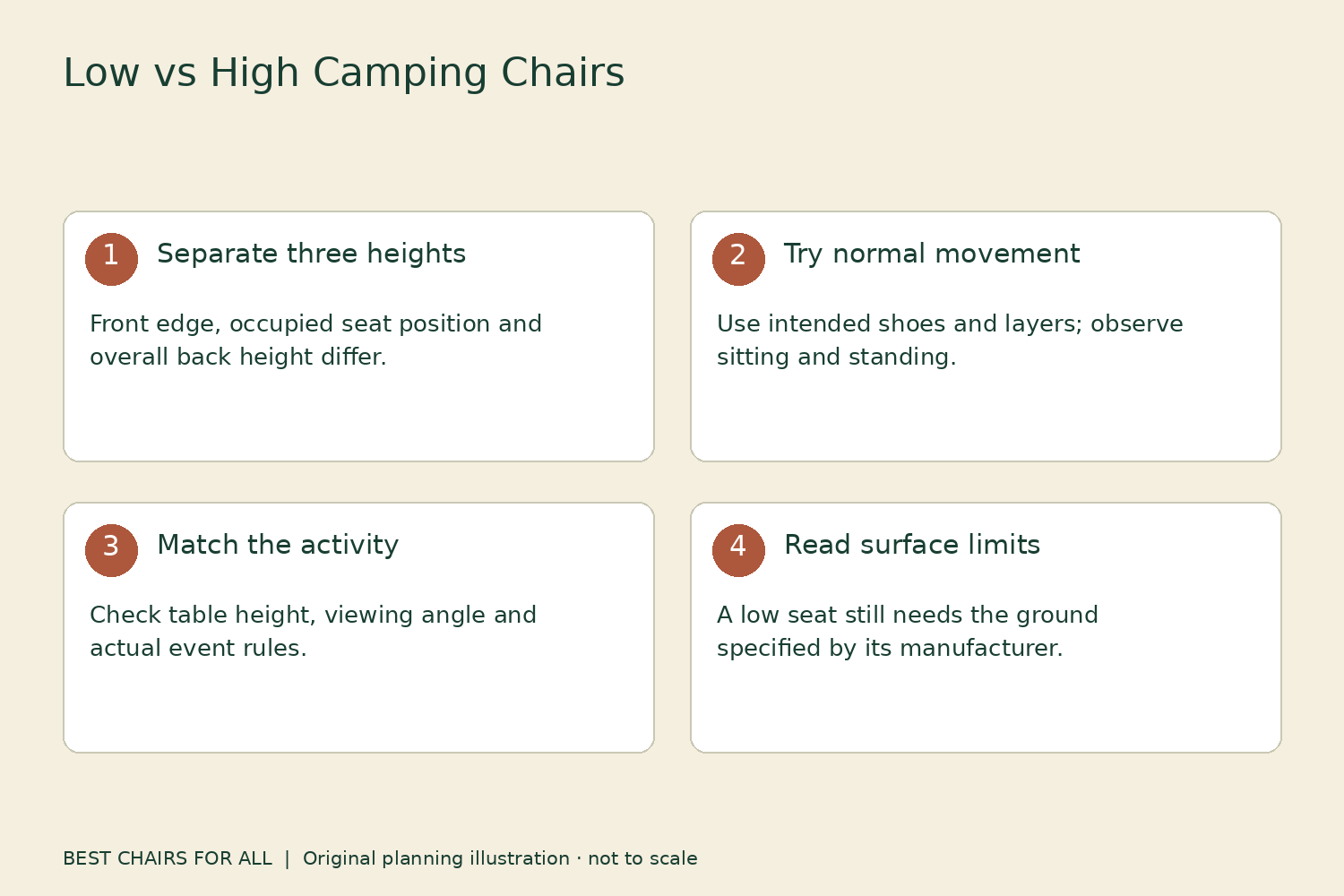
Also distinguish seat height from back height. A tall back can support more of the upper body while the seat remains very low. Conversely, an upright chair can sit relatively high without a headrest. Compare the position your body occupies rather than the apparent height of the folded package or the product photograph.
Define what low and high mean in this comparison
There is no single universal boundary separating every low camping chair from a high one. Use the manufacturer’s actual seat measurement, together with a physical trial. Some chairs have level seats; others form a fabric pocket with a raised front edge and a lower center. Two published seat heights may therefore describe different points on the structure.
Mark three entries in your notes: height at the front edge, height near the place you sit, and overall back height. If a product listing does not explain its measurement, ask before relying on it. Do not substitute overall assembled height for seat height. Product tables sometimes contain ambiguous labels, and an apparently precise number can still answer the wrong question.
REI’s camp chair selection advice identifies standard-height seats as generally easier to enter and leave, while describing reasons campers choose low chairs. Treat this as a useful starting distinction, not a promise about any individual’s movement or a substitute for trying the actual chair.
Run a repeatable sit and stand check
Set up the candidate exactly as instructed on an appropriate level surface. Wear the footwear and layers you will use outside. Sit in your ordinary manner, allow the fabric to settle, and note where your feet land. Then stand normally. You are looking for a chair that fits your existing ability and comfortable movement, not practicing a new technique or attempting a strength test.
If standing requires rocking the whole chair, pulling on a nearby table, or asking someone to hold the frame, mark that as a fit problem. Do not compensate by lifting one end onto blocks or adding improvised leg extensions. Those changes affect the chair’s geometry and stability. Try a different height or design instead. If you need individualized mobility guidance, a relevant qualified professional can help assess suitable seating.
Repeat the trial with the chair in its intended environment only when that environment meets the product’s instructions. A shop floor does not reproduce soft sand, but a sand trial is not permission to use a model that requires firm ground. A companion can observe whether the chair shifts while you move. Stop if the frame is damaged, a foot lifts unexpectedly, or any joint is not seated.
Compare the seat angle as well as its height
A higher front edge with a deep rear pocket can still leave you in a low, reclined position. That can be pleasant for looking upward or resting, yet inconvenient for eating at a dining table. An upright seat brings the activity closer without requiring a forward reach from a deep sling. Neither is automatically more comfortable for everyone.
Think through a full evening. Do you lean back for long periods, turn frequently to talk, work on a camp task, or stand every few minutes? If you often move between chair and table, repeated access can matter more than the first relaxed impression. Try reaching toward an unheated tabletop during the fit trial. Avoid evaluating chair fit while handling hot cooking equipment.
A cushion changes this relationship. A thick pad can lift the body, reduce usable back height, and alter how the arms meet your forearms. Do not assume any loose cushion is an approved way to modify seat height. Use accessories the chair maker permits and check that they remain secure. A cushion also adds another item to dry and pack at the end of the trip.
Match the chair to table and viewing height
Measure the table you already own. Then sit in a candidate at a similar table and check whether the surface is conveniently located for its intended use. A low camp table and a low lounge chair can be a coherent combination. A standard picnic table and a deeply reclined seat may leave you reaching upward and forward, even when both items are comfortable separately.
For concerts and sports, read the specific venue’s current policy. Rules may describe seat height, total height, chair style, or whether attachments are allowed. These are different restrictions. Do not rely on a retailer’s phrase such as “festival friendly” as proof of admission. The actual event rule controls, and it may change between events at the same venue.
A low profile can help preserve the view of people behind you, but your own view depends on the seating area and the people ahead. A tall-backed low chair can still obstruct sightlines. Check the full silhouette, including a canopy or pillow attachment. For ordinary campsite conversation, compare eye level with the other chairs your household uses; a mixed collection can feel very different from a matched set.
Do not confuse low with permission for slopes
A low seat may feel close to the ground, but that does not establish stability on an incline. Foot placement, frame geometry, the surface, and the manufacturer’s restrictions all matter. The Helinox Ground Chair guide, for example, specifies a flat, solid surface. Its low design is not a general authorization for uneven ground.
Check that the complete support footprint lies on the intended surface. A leg sitting on a flat stone beside three feet in soft soil can settle unpredictably. Moving the chair to a suitable patch is preferable to constructing a makeshift leveling platform. Keep away from banks, water edges, paths and places where a person standing up could step into a hole.
Soft-ground accessories address a different problem from seat height. A matching ground sheet or compatible enlarged feet can distribute support, but they do not create a level campsite or change the permitted use of a chair. If beaches are your main destination, evaluate the entire chair and approved accessory combination. Count its packed size and setup steps rather than buying on the “low chair” description alone.
A practical comparison card
| Observation | Low candidate | Higher candidate |
|---|---|---|
| Front edge and occupied position | Record separately | Record separately |
| Feet comfortable in intended shoes | Yes or no | Yes or no |
| Normal entry and exit | Works or does not work | Works or does not work |
| Table activity | Trial at relevant height | Trial at relevant height |
| Ground restrictions | Copy exact manual requirement | Copy exact manual requirement |
| Event policy | Confirmed or unresolved | Confirmed or unresolved |
Use this card with the same clothing and activity for both chairs. Do not compare a brief barefoot sit in one chair with a long trial in boots in another. Record specific observations such as “front edge presses into thighs” or “table sits too high for eating.” Those notes are more useful than a single comfort score, which can hide the reason a candidate does not fit.
The REI Co-op Camp Low Chair illustrates a product intentionally positioned for low-profile lounging. Its use case is a useful comparison point, but the category description cannot settle your own fit. Confirm its current dimensions and the exact version before comparing it with another model. Similar product names can remain in circulation after designs change.
Check carrying and folding consequences
A low chair is not necessarily lighter or smaller when folded. Some low designs fold into broad, flat packages; some higher chairs break into short poles. Measure the actual transport space and compare complete packed dimensions. A chair that works beautifully at camp still needs a manageable way to reach the pitch with your other equipment.
Setup also affects the choice. A chair with several pole connections and a tensioned seat requires assembly, while another may simply unfold and lock. Try the operation yourself, keeping fingers clear of moving joints. If the low candidate is hard to handle when you are tired or wearing gloves, note that as an ownership issue rather than assuming familiarity will solve every difficulty.
Consider wet returns. Seats close to the ground can be near splash, grass moisture or sand, depending on the location. This does not make every low chair harder to maintain, but it gives you another practical question: can you clean and dry the actual materials easily under the maker’s instructions? Keep the carry bag dry and reopen damp equipment after arriving home.
Choose around the movement you repeat
Favor a lower chair when its position suits your activities and you can enter and leave it comfortably. Favor a higher, more upright design when regular access, table use, or your own fit trial points that way. If different household members need different heights, matching fabric colors are less important than making each seat usable.
Include arm spacing in that record as well. Two chairs with equal seat heights can differ substantially in usable width and in the support available beside the seat.
Keep an existing comfortable chair as a reference. Measure its front edge, note its seat angle, and take those observations shopping. They will not identify a perfect camping equivalent, but they narrow the search far more effectively than a vague request for something “high.” The right choice supports your normal outdoor routine without requiring you to work around the chair every time you sit or stand.
Something unclear or out of date? Send a correction with this article’s title and the detail to check.
Sources, research & corrections policy ↗