A reading chair with an ottoman gives you two pieces whose spacing can change. A chaise provides a continuous extended seat in a more committed footprint. Choose between them by testing how you support your legs, change position, reach your book, and move through the room. A chaise is not automatically larger, and a chair with an ottoman is not automatically easier to fit.
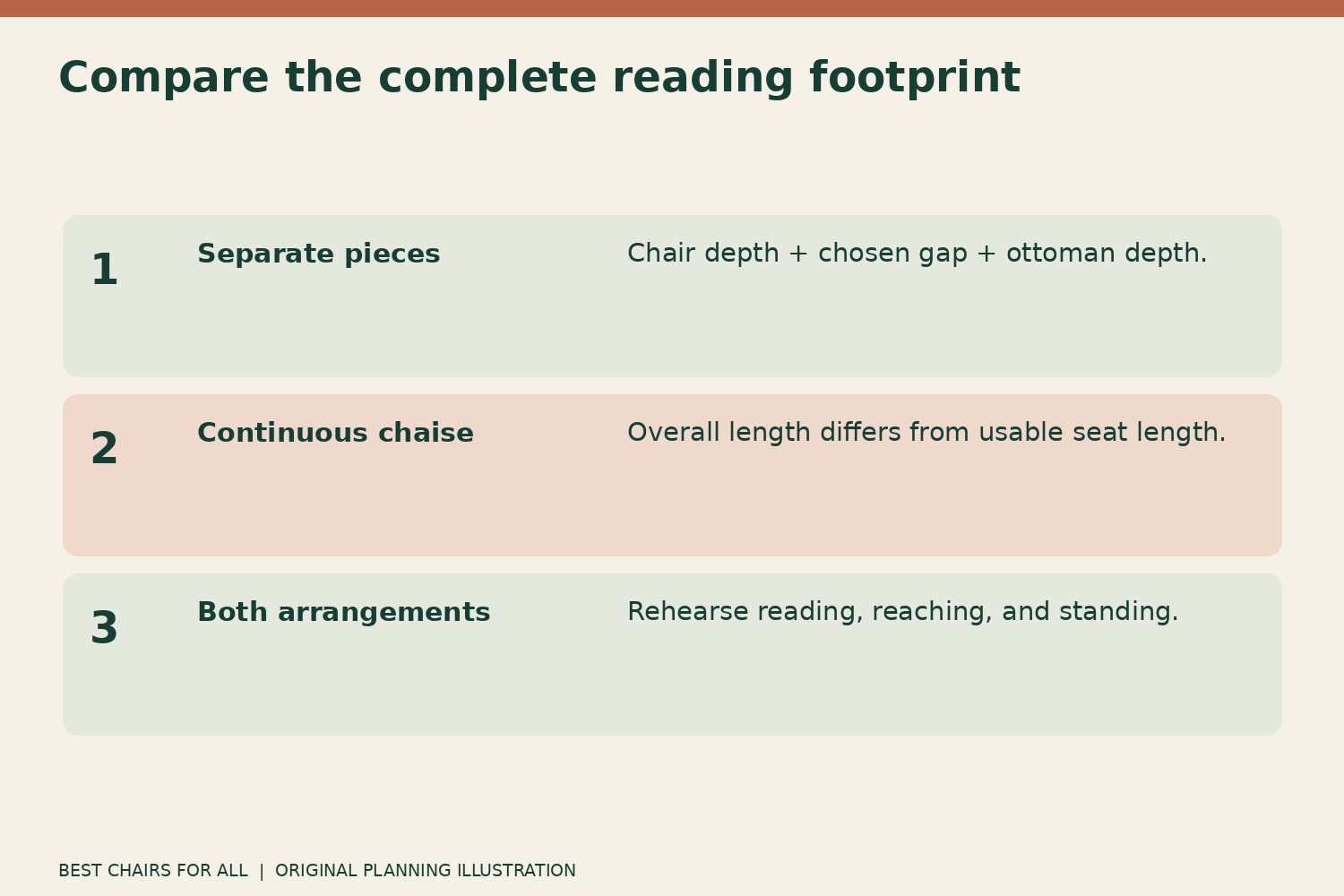
The deciding measurement is often the complete occupied arrangement rather than the chair alone. Include the gap before the ottoman, the place your feet actually reach, the path you use to stand up, and any side table. Comparing only the products’ outside lengths can hide the very differences that matter during reading.
Understand the two support arrangements
With a separate ottoman, the seat supports your pelvis and thighs while the ottoman supports the part of your legs that rests on it. The distance between them is adjustable within the limits of your posture and the room. That flexibility can be valuable when readers have different leg lengths or when one person alternates between feet down and feet up.
A chaise normally extends the seat into a single long platform. Your legs can rest along the upholstery rather than across two pieces. Some have a full back and one arm, others resemble an elongated armless seat, and some are sectional components. Look at the exact construction instead of assuming the name describes a consistent shape.
Neither arrangement guarantees head support, an appropriate back angle, or a good place to hold a book. A chaise with a low back can require a pillow for reclined reading, while a high-backed lounge chair may support the head but position a heavy book awkwardly. Bring the book to the comparison so the support arrangement is tested as a whole.
Where a separate ottoman offers useful flexibility
Move the ottoman during a sitting trial and note where it works. Too far away, it may support only your heels while you stretch to reach it. Too close, it can crowd your knees or interfere with standing. The useful position is personal, so record the gap that feels manageable rather than copying a showroom photograph.
Manufacturers may design an ottoman specifically for a chair. IKEA’s POÄNG chair and ottoman combination is one example of separately constructed pieces intended to work together. Their relationship still needs an occupied trial: a matching frame and cushion do not tell you how the gap or leg position will suit a particular reader.
The ottoman can be shifted aside for conversation or cleaning, provided you have somewhere sensible to put it. It may also be easier to carry through a difficult delivery route than one long chaise. Check actual weight and assembly information; a small-looking upholstered piece can still be awkward to lift, and storage versions add lids or mechanisms.
Do not assume every footstool is an extra seat or a step. Those uses depend on the manufacturer’s design and instructions. Similarly, a tray can turn an ottoman into an occasional surface only if it is stable for that purpose. Moving drinks between foot support and tabletop duty introduces practical compromises that deserve attention before purchase.
Where a continuous chaise seat works better
A chaise may suit someone who wants to shift both legs along a broad padded surface without repositioning a footstool. It can also keep the layout visually simple: one long piece defines the reading area. In a room with an appropriate corner, the extended seat can align with a wall while leaving the open side accessible.
The tradeoff is a fixed length and often a preferred entry side. An arm along one edge can support a book pillow but obstruct entry from that side. A sectional chaise may connect to another piece rather than function independently. Confirm whether the model is freestanding, modular with finished sides, or intended to remain attached to its matching sectional.
Try both a stretched-out posture and a knees-bent posture. Overall chaise length includes the back and frame, so it may overstate the support available from the front of the back cushion to the seat end. If your feet extend beyond the cushion, check how the edge feels. Do not treat a long product name or room photograph as proof of usable length.
Compare the occupied footprint with a worked plan
Use these hypothetical dimensions to understand the calculation. Suppose a chair is 35 inches deep, an ottoman is 21 inches deep, and your comfortable gap between them is 10 inches. Their combined straight-line furniture envelope is 35 + 10 + 21 = 66 inches. That figure excludes the route around them and any space needed to change position.
Now compare a hypothetical chaise that is 64 inches long overall. It is shorter than the chair-and-ottoman arrangement in this example, despite looking like the larger item. But if the chaise has an arm that forces entry from the far side, the room may still favor the separate pieces. Geometry and access must be checked together.
| Planning item | Chair plus ottoman | Chaise |
|---|---|---|
| Overall depth or length | Chair depth + selected gap + ottoman depth | Published overall length |
| Usable leg support | Occupied position across two pieces | Back cushion face to seat end |
| Entry route | Beside chair, with ottoman in use | Open side or permitted end |
| Stored arrangement | Separate parking place for ottoman | Usually same footprint |
| Change of direction | Move ottoman or turn suitable chair | Move whole piece or change posture |
Tape both arrangements on the floor, including the gaps you actually need. Place boxes where the arms and side table would be, then walk from the door to the other seats. A flat taped outline can underestimate how much a tall arm affects passage or reach, so the box exercise makes the plan more realistic.
Check footrest height as part of the angle
Matching nominal heights is not a universal rule. The chair’s seat may slope, the ottoman may angle, and both cushions compress under different loads. Measure at the place you sit and the place your legs rest, then judge the resulting position. A level-looking pair in an empty room may feel quite different once occupied.
Herman Miller’s Eames Lounge Chair and Ottoman product sheet illustrates a designed pair with separately specified dimensions and two chair sizes. This is a useful reminder that the back angle, seat, and ottoman work as a relationship. It is not evidence that another chair should copy those dimensions.
For a chaise, the comparable question is whether the seat’s slope and cushion shape allow your legs to settle comfortably along the extension. Check the junction between the main seat and extended portion on modular designs. A seam, change of firmness, or moving cushion may be noticeable even though there is no open gap.
Rehearse reading, reaching, and standing
Read a few pages in each setup, then put the book down. Check whether the table is within a comfortable reach from the position you actually occupy. A chaise can put you farther from a conventional side table if you move along its length; a chair with an ottoman can keep your torso in a more consistent place.
Next, place both feet down and stand normally. You should not need to step over the ottoman or twist around a fixed arm. If the setup requires moving a heavy footstool every time you rise, count that as a real drawback. Consider where a blanket, glasses, or book pillow will go during the movement rather than balancing them on an arm.
If the chair swivels, test its turning path with the ottoman in position. Feet and footrest do not necessarily turn together, so the comfortable reading direction may differ from the chair’s available rotation. Keep nearby objects outside the actual moving envelope and follow any operating guidance. A stationary chaise avoids that interaction but offers less directional flexibility.
Compare delivery and maintenance before deciding
The Crate & Barrel furniture measuring guide emphasizes the delivery path as well as furniture dimensions. Apply that approach to both options: document doorway openings, turns, stairs, and elevator constraints. Ask the seller for the dimensions of the actual delivered packages and permitted removable parts rather than assuming upholstery can be compressed.
Maintenance differs too. Separate pieces can make the floor between them easier to reach, but they add feet and edges around which to clean. A chaise has a long cushion and may have an asymmetric cover that cannot be flipped. Ask whether cushion covers are removable, whether removal is intended for cleaning, and what the exact fabric instructions allow.
Check replacement options independently for each component. With a separate pair, one cushion may wear before the other because the loads differ. With a chaise, a long replacement cushion may require special ordering. Document the upholstery code and product identification while it is easy to find them, especially if the chair is part of a changing collection.
Make the choice from three ordinary routines
Run through a quiet reading session, a conversation with another person, and an ordinary cleaning day. Favor the chair and ottoman if moving the foot support creates useful flexibility and its parking place is convenient. Favor the chaise if continuous leg support and a stable long footprint better match your habits and room.
For a shared living room, ask every regular user to try the complete arrangement. One reader may value a movable gap while another dislikes separate supports. Keep their observations beside the floor plan and the delivery measurements. The strongest choice is the one that works during these ordinary routines with the fewest daily adjustments, rather than the one that appears more luxurious in an empty showroom.
Something unclear or out of date? Send a correction with this article’s title and the detail to check.
Sources, research & corrections policy ↗