As an Amazon Associate, we earn from qualifying purchases. Read our affiliate disclosure.
At a $200 chair budget, buy the adjustment you will use every evening rather than the longest list of extras. Our research shortlist is RESPAWN 110 for a padded reclining desk chair, IKEA HUVUDSPELARE for a smaller and lower seat, and GTPLAYER GT905 for a fabric chair with a footrest. The strongest choice changes with your desk height and leg length; spending almost the whole allowance is not automatically an improvement.
Manufacturer pages checked November 6, 2026 showed $189.99 for the RESPAWN 110 Gray Fabric, $89.99 for the black HUVUDSPELARE, and $99.99 for the black GT905. These snapshots exclude tax and any delivery charge. We researched published specifications and buying terms rather than conducting hands-on comfort or durability tests. Do not interpret the order below as a numerical performance ranking.
Shortlist: what your money actually buys
| Chair | Observed chair price | Useful distinction | Reason to pass |
|---|---|---|---|
| RESPAWN 110 Gray Fabric | $189.99 | Padded seat; back reclines to 135° | Deep seat, no footrest |
| IKEA HUVUDSPELARE black | $89.99 | 16⅞-inch minimum seat height | Compact fixed seat depth |
| GTPLAYER GT905 black | $99.99 | Fabric, pocket springs, pull-out footrest | Dimensions need confirmation |
RESPAWN 110: the padded option near the budget ceiling
The current RESPAWN 110 page lists a 275-pound capacity, 18.5–22.4-inch seat-height range, and a 21.5-inch-wide by 22.2-inch-deep seat. It specifies a 135-degree backrest recline with an angle lock and a tilt-tension adjustment for rocking. The model in this guide is the redesigned standard 110, not the 110 Pro and not an older chair carrying a similar name.
It makes sense when you want a padded, high-back chair that can move between upright play and a relaxed position. Its integrated headrest and lumbar shaping avoid the need to position several loose pillows every time you sit down. The Gray Fabric variant also provides an alternative to a coated seat for a room where you prefer a textile finish. We cannot infer its precise softness or pressure distribution from the foam description.
The deep seat is the deciding concern. A buyer with shorter thighs may struggle to reach the back support while keeping clearance behind the knees. A pillow placed behind the back would change the fit, but it would also consume space and add cost. Compare the published seat depth with a chair that already fits rather than assuming a 21.5-inch width makes this model suitable for everyone.
The standard 110 does not include the Pro’s footrest. That matters because retailer search results can show both versions together. Before ordering, match the product name, photographs, adjustment list, and current seller specifications. If you actually want feet-up console lounging, do not buy this model expecting a footrest to be hidden underneath. Its value here is the combination of padded desk seating and back adjustment.
Check matching RESPAWN 110 Gray Fabric listings on Amazon (paid link) (search results; verify the exact model and seller).
IKEA HUVUDSPELARE: keep the spare money when the geometry works
IKEA’s US HUVUDSPELARE listing describes a mesh-back chair with a foam seat, upright tilt lock, and manual tilt tension. Its seat measures 18⅛ by 16½ inches, and the seat height adjusts from 16⅞ to 20⅞ inches. IKEA states a tested load of 243 pounds. These are unusually useful measurements for screening a lower-cost chair before visiting a store.
This is the choice to consider when a deep, thickly padded gaming chair would crowd the room or leave your feet hanging. Its shorter seat can work better for some smaller adults, while the mesh back avoids a broad upholstered panel behind you. The useful comparison is with your body and desk, not with how dramatic the chair looks in a promotional photograph.
You are giving up independent seat-depth adjustment, a reclining backrest with a range of selectable angles, and elaborate arm adjustments. If your desk apron catches the arms, the inexpensive price will not help. Test the controls and desk relationship in person when possible. Its upper seat height also may not be enough for a tall desk or a user who needs a much higher sitting position.
Saving roughly half the allowance can make sense if this model fits and the premium candidate does not. Keep that saving available for a genuinely necessary item such as a separate foot support, after checking that the combined setup solves a real problem. It is also reasonable simply to keep the money. A larger budget is a maximum, not a shopping target that must be exhausted.
Check matching IKEA HUVUDSPELARE listings on Amazon (paid link) (search results; verify the exact model and seller).
GTPLAYER GT905: a fabric-and-footrest alternative
The official GT905 listing specifies fabric upholstery, individual pocket springs in the seat, linkage arms, and a pull-out footrest. The manufacturer describes a nylon base with a 300-pound maximum capacity. The black variant showed $99.99 at our check. We did not establish a complete numeric seat-dimension range from the accessible product information, so those dimensions should be requested if fit is uncertain.
The case for this chair is a mixed routine: upright at a desk for active play, then a stationary reclined break with a controller. A footrest can remove the need to store an ottoman, provided the chair has room to extend. Linkage arms follow the recline rather than staying in a separately selected desk position. Think about which part of your evening needs arm support before viewing that movement as an upgrade.
The compromise is precision. A seat-depth slider and independently adjustable arms let you tune a keyboard position more directly than a chair built around linked recline movement. Fabric also needs a realistic cleaning plan around snacks and drinks. The pocket-spring specification does not establish that the chair will suit your preferred firmness, and the published load rating does not establish a wide enough seat for a larger body.
Check matching GTPLAYER GT905 fabric listings on Amazon (paid link) (search results; verify the exact model and seller).
An upgrade-value worksheet for the $200 buyer
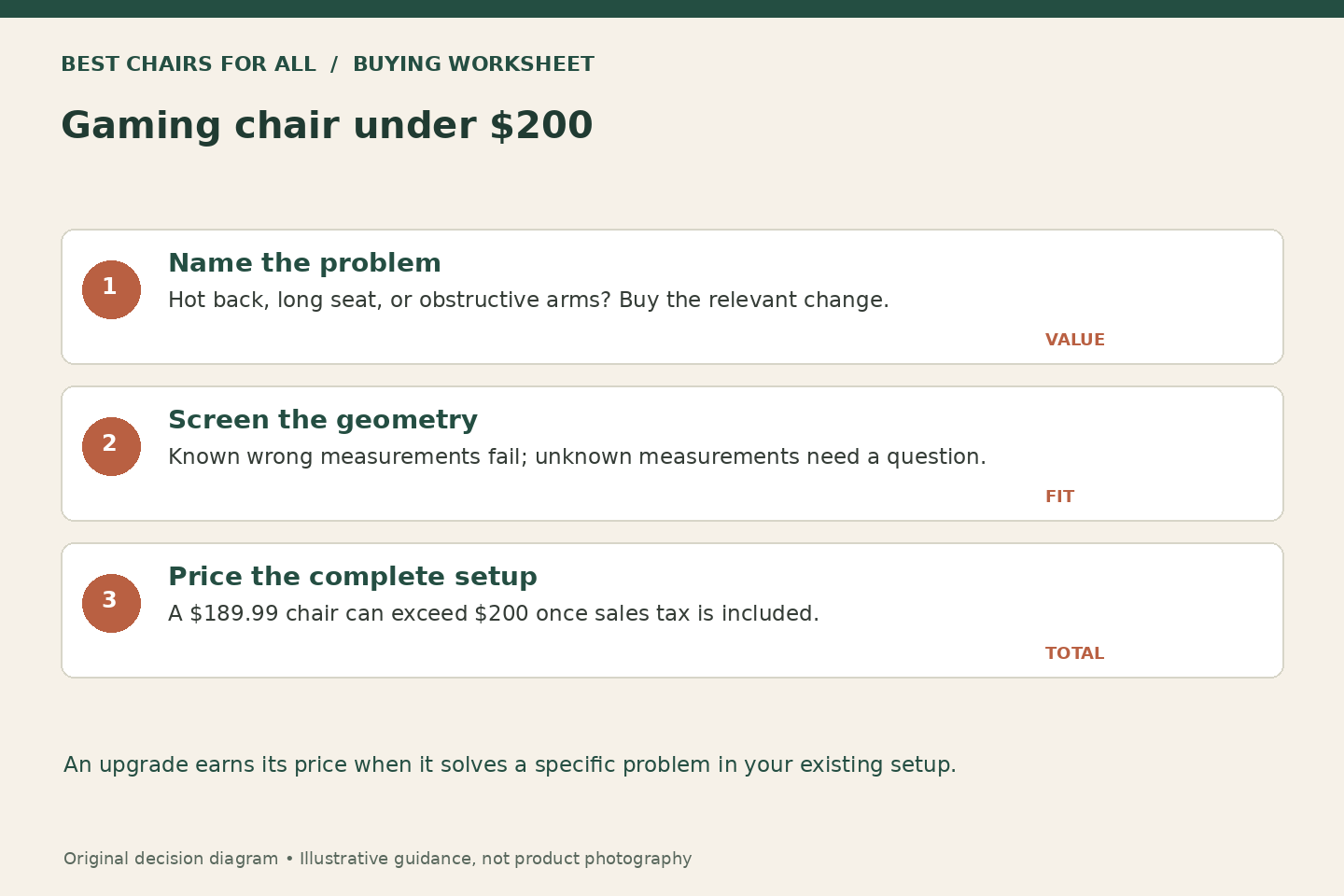
Make two columns headed “current problem” and “specific solution.” If your current problem is a hot back, write “mesh back” beside it. If the front of the seat presses behind your knees, write “shorter usable depth or a depth slider.” If the arms keep the chair too far from the keyboard, write “lower or repositionable arms.” Avoid broad words such as comfortable; they cannot identify which specification will fix the problem.
Now add the three candidates and mark whether each has evidence for that solution. Use “unknown” when the manufacturer does not provide the measurement. Unknown is not a pass and not proof of a bad chair; it is a question for customer support. Reject a model if a known measurement conflicts with your needs. Compare prices only after this first pass, because you cannot price an improvement that does not actually solve the problem.
For example, suppose your existing 19-inch-deep seat feels too long and your seated lower-leg height is comfortable at about 17 inches in shoes. A 22.2-inch-deep seat is unlikely to be the obvious next trial simply because it costs more. HUVUDSPELARE’s published shorter depth offers a more relevant starting point. This is an illustrative screening example, not a fit prescription; cushion compression and the contour of the backrest still require a real trial.
A second example is a buyer whose current chair fits but whose back feels warm against a solid cushion. Changing to a mesh back addresses a different issue from adding a footrest. If the cheaper candidate provides the relevant material change, spending more on recline may not be worthwhile. Separating these decisions keeps the budget available for the part of the setup that most needs attention.
Measure the desk before measuring the room
Set your keyboard and mouse where you actually use them. Measure the clear height beneath the desktop at the front and under any drawer or support bar. The chair needs to approach that opening with your arms in a usable position. A chair that technically slides under the desk when lowered may still sit too low for you to type comfortably, so compare the working setting rather than the storage setting.
Next measure backward from the desk edge to a wall or bed. Leave space to turn, stand, and move the chair away. If the GT905’s footrest interests you, simulate the extended position with a cardboard strip before buying. Include feet and footwear in the imagined footprint. A feature that blocks a bedroom door every time it is used is unlikely to become part of a convenient evening routine.
Check the final price and return friction
A $189.99 chair leaves very little room under $200 after sales tax. If the headline budget means your complete delivered spend, calculate that spend before comparing models. Do not assume free shipping, a regional promotion, or a coupon until it appears in your own checkout. Manufacturer pages and Amazon matching searches can show different sellers, colors, and generations, so the manufacturer snapshot is not a promise about a retailer listing.
Read return conditions with the same care as the warranty. A defect warranty and a comfort return are different protections. Check whether an assembled chair can be returned, whether you must retain its carton, who arranges collection, and whether shipping is deducted. Photograph the model label and keep order records. Those simple steps are particularly valuable when a search page combines several near-identical product names.
Do the controls suit a shared room?
A chair shared between work and gaming may need several adjustments each day. Before paying extra for a mechanism, establish whether you can reach it easily and tell which setting is selected. A straightforward tilt control can be preferable to a more elaborate system that you leave in the wrong position. For a shared chair, record each person’s settings on a small card near the desk. If one person needs the lowest height and another the highest, compare both positions with the keyboard and monitor rather than assuming the range alone makes the whole station adaptable.
A sensible decision order
Choose RESPAWN 110 if the deeper padded seat fits and recline is useful at your desk. Choose HUVUDSPELARE when compact dimensions and a lower seat matter more than extra mechanisms. Choose GT905 when fabric and a footrest are the features you will actually use, after confirming dimensions. If no candidate clears your measurements, wait for a better match rather than spending $200 on the least unsuitable option.
During the first days of ownership, alternate between your normal tasks and short breaks so you can identify fit issues while return options remain available. Adjust only the controls described in the manual, and assemble the chair exactly as instructed. A low price does not justify tolerating an unstable assembly, a faulty control, or a desk position that forces you to reach. Report defects promptly and keep the packaging until the decision is settled.
Something unclear or out of date? Send a correction with this article’s title and the detail to check.
Sources, research & corrections policy ↗