A lift chair is a recliner with an additional powered mechanism that raises and tips the sitting surface to assist a user toward standing. An ordinary power recliner adjusts lounging positions but does not necessarily lift the seat. That extra movement changes the buying decision: fit, control use, electrical supply, room layout, and the user’s ability to use the chair safely all deserve attention.
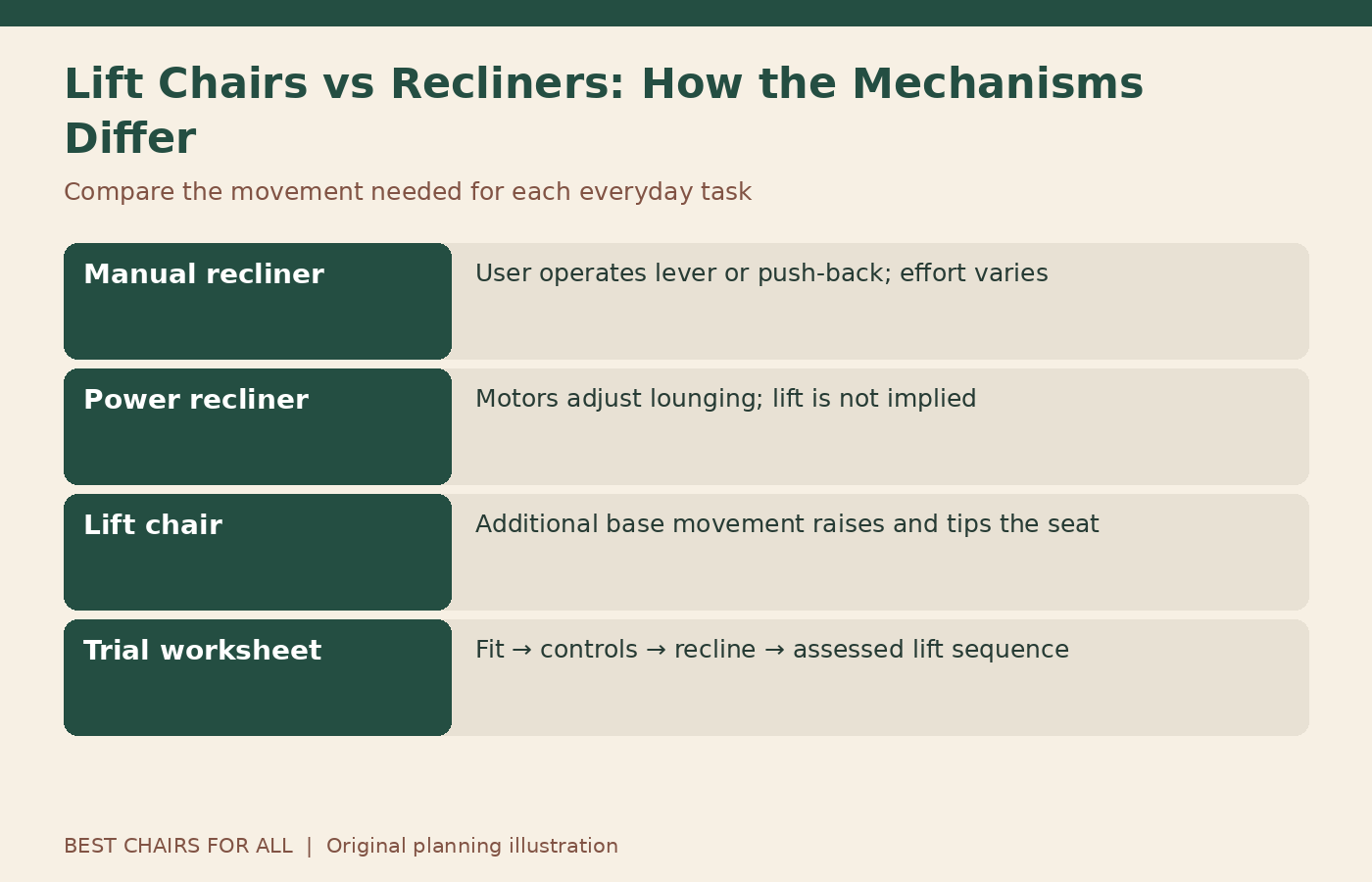
Choose between the two by describing the task you want the chair to perform. Someone who wants a button-operated footrest may need a power recliner. Someone seeking assistance with sitting down or standing up should assess a lift chair with a knowledgeable provider. This comparison explains furniture functions, not whether a particular chair is medically appropriate for a person.
Start with the mechanism, not the remote
A remote control does not identify a lift chair. Many reclining chairs use motors for the back, footrest, lumbar cushion, or headrest while the main base stays at floor level. A lift chair adds movement of the seat assembly relative to its supporting base. Ask the seller to demonstrate lift, sitting, and recline separately rather than pressing a button through the whole sequence too quickly.
La-Z-Boy’s recliner guide lists power lift chairs separately from rocking, gliding, and other recliners. Use that separation when searching specifications. Words such as electric, power, and adjustable describe broad features. They do not establish that a chair can raise its occupant toward a standing position or explain how the movements are controlled.
Manual recliners use the occupant’s effort
A manual recliner may use a handle, a release lever, or a push-back action. The user supplies some of the effort to change position or close the footrest. The amount and direction of that effort vary with the mechanism, spring settings, and upholstery. A showroom demonstration by a salesperson does not establish that you can comfortably repeat it at home.
Try the actual task you need: opening the footrest, making a small back adjustment, returning upright, and closing the footrest. Avoid forcing the mechanism or accepting that a painful motion is simply part of the design. If reaching a side lever is the problem, compare approved handle arrangements and power controls before assuming the lift function is the only solution.
Power reclining and power lifting answer different questions
Power reclining addresses how the chair changes its sitting or lounging position. Lifting addresses how its seat moves when a user approaches standing or sitting. A chair can do both, but an ordinary power recliner may do only the first. The practical difference becomes apparent at the end of the sequence: is the user returning to a normal seated position or entering a raised, tilted seat position?
Pride’s caregiver guide describes a lift chair as a powered recliner with a lifting mechanism. Treat that as a functional description. It does not guarantee an independent transfer for every person. If balance, cognition, strength, or an existing care plan affects use, arrange an individualized demonstration and advice from the appropriate professional.
Position names do not describe every control
Two-position, three-position, and infinite-position are marketing and mechanism categories. They should not be read as meaning that a chair has only two buttons, exactly three stops, or an unrestricted set of positions. Motors may link the back and footrest, or allow them to move separately. Different brands can use similar words for different control arrangements.
Pride’s positions FAQ distinguishes its lift-chair position categories. When comparing another manufacturer, use that manufacturer’s descriptions instead. Ask the salesperson to reproduce your intended reading position, television position, and upright exit position. If one movement always changes another part of the chair, note whether that linked action suits you.
Use a task comparison worksheet
Create four rows on paper: adjust the footrest, adjust the back, reach the controls, and sit down or stand up. Add three columns headed Manual recliner, Power recliner, and Lift chair. Write what you actually observe for each task. Do not fill the last row with a promise that a lift chair will solve a transfer difficulty; record the outcome of a supervised trial instead.
For example, a hypothetical user might comfortably operate a manual lever but dislike the effort needed to close the footrest. A power recliner could address that particular task. Another user might operate all reclining controls but need an assessment of rising from the seat. That directs the next appointment toward a lift-chair demonstration rather than toward more expensive reclining features.
Fit still begins with the seat
A lifting seat does not compensate for an unsuitable sitting surface. Check upright seat height, usable seat depth, space between the arms, back support, and control reach. Sit with the pelvis comfortably back and evaluate floor contact. A seat that encourages constant sliding forward creates a different starting position for the next movement than the manufacturer intended.
Compare measurements on the exact size variation. Petite-wide, tall, and standard versions may differ in width, depth, and back height rather than scaling uniformly. A weight capacity is also a separate specification from physical fit. Ask about both, and include anything the manufacturer says must count toward the load. Avoid selecting solely by a recommended user-height range.
The lift path needs its own room plan
Ordinary recliners need clearance behind the back and in front of the footrest. Lift chairs also need the space used while the seat rises and tips. Plan access to the front of the chair in its seated and lifted positions. Include the route for a walking aid or helper where relevant, using the actual household arrangement rather than a generic furniture aisle calculation.
The Pride owner manual gives model-family placement and operating warnings. Obtain the matching manual for a different chair. Do not borrow a rear-wall distance from another model or assume a wall-hugging description includes every movement. Furniture clearance and an individual’s safe transfer space are related but distinct decisions.
Evaluate the controls as a daily object
Count the actions needed to move from a normal resting position back to sitting. Check whether buttons must be held, whether they are clearly distinguished, and what happens when a button is released. Ask about any lockout or memory functions without assuming those features are standard. An attractive remote may be difficult to identify by touch in a dim room.
Decide where the control will rest between uses. A pocket on the far side may be inaccessible, while a loose remote can slip between cushions. Ask how the supplied control holder should be used. For a person who needs help understanding or operating the chair, include that concern in the assessment before purchasing rather than planning an improvised control system afterward.
Plan electrical supply and outages
Both power recliners and lift chairs need the electrical arrangement specified by their manufacturers. Locate the outlet, transformer, and low-voltage cable before selecting the final position. Keep cables clear of moving parts and walking routes. A chair in the center of a room may need a different approved power solution from a chair beside a suitable wall outlet.
Ask specifically about outage behavior. An emergency backup that returns a chair upright is different from a rechargeable pack designed for routine operation. Some features may not function on backup power. Obtain the exact instructions and replacement schedule for the supplied system. If getting out of the chair depends on powered movement, include an outage assistance plan appropriate to the user.
Compare maintenance and service responsibilities
A manual recliner can still contain loaded springs and moving metal linkages. A powered chair adds electrical components; a lift chair adds another motion system. None of these should be treated as an invitation to repair moving assemblies at home. Ask who provides authorized service, whether visits are available locally, and which costs the warranty covers.
Keep the model number, serial number, receipt, and manual together. If the chair stops moving, useful service information includes whether all functions stopped or only one, whether an indicator light is present, and what happened immediately beforehand. Do not order a motor or hand control merely because a marketplace listing uses the same brand name. Compatibility depends on the exact configuration.
Compare cost by required capability
A meaningful quote identifies the size, upholstery, mechanism, controls, delivery, and service terms. Extra motors, heat, vibration, or powered headrests may add convenience but do not establish that the basic seat fits or that the lift action is suitable. Keep a short list of must-have tasks and price the chairs that perform those tasks successfully.
Avoid treating furniture-store financing, reimbursement, or insurance possibilities as part of the mechanism comparison. Those terms have their own eligibility and documentation requirements and can change. Ask the provider for current written information where relevant. The decision should still make sense as a furniture and access decision before uncertain payment assumptions are added to the worksheet.
A practical demonstration sequence
Begin with the chair stationary and the manufacturer’s instructions explained. Check the seated fit and control reach first. If it is appropriate for the user to continue, demonstrate reclining and returning to the seated position. For a lift chair, have the provider assess and demonstrate the lifting sequence with the support the person needs. Stop if the movement feels unsafe or confusing.
Finish by checking the room, electrical arrangement, and service plan for the exact model demonstrated. Record a clear conclusion: ordinary reclining meets the need, powered reclining addresses the effort problem, or a lift chair deserves further individual assessment. This task-based result is more useful than choosing the chair with the largest number of advertised positions. Ask the provider to leave written operating instructions where the user and any helper can find them. Agree who will be contacted if normal use becomes difficult after delivery, particularly if the user’s abilities or household support change.
Something unclear or out of date? Send a correction with this article’s title and the detail to check.
Sources, research & corrections policy ↗