Camping chair packed size and weight answer different questions. Weight tells you how much you lift and carry. Packed dimensions tell you whether the package fits where it needs to go. A light chair can be too long for a bike bag; a heavier chair can slide neatly into a vehicle slot. Choose by checking both constraints before deciding which deserves priority.
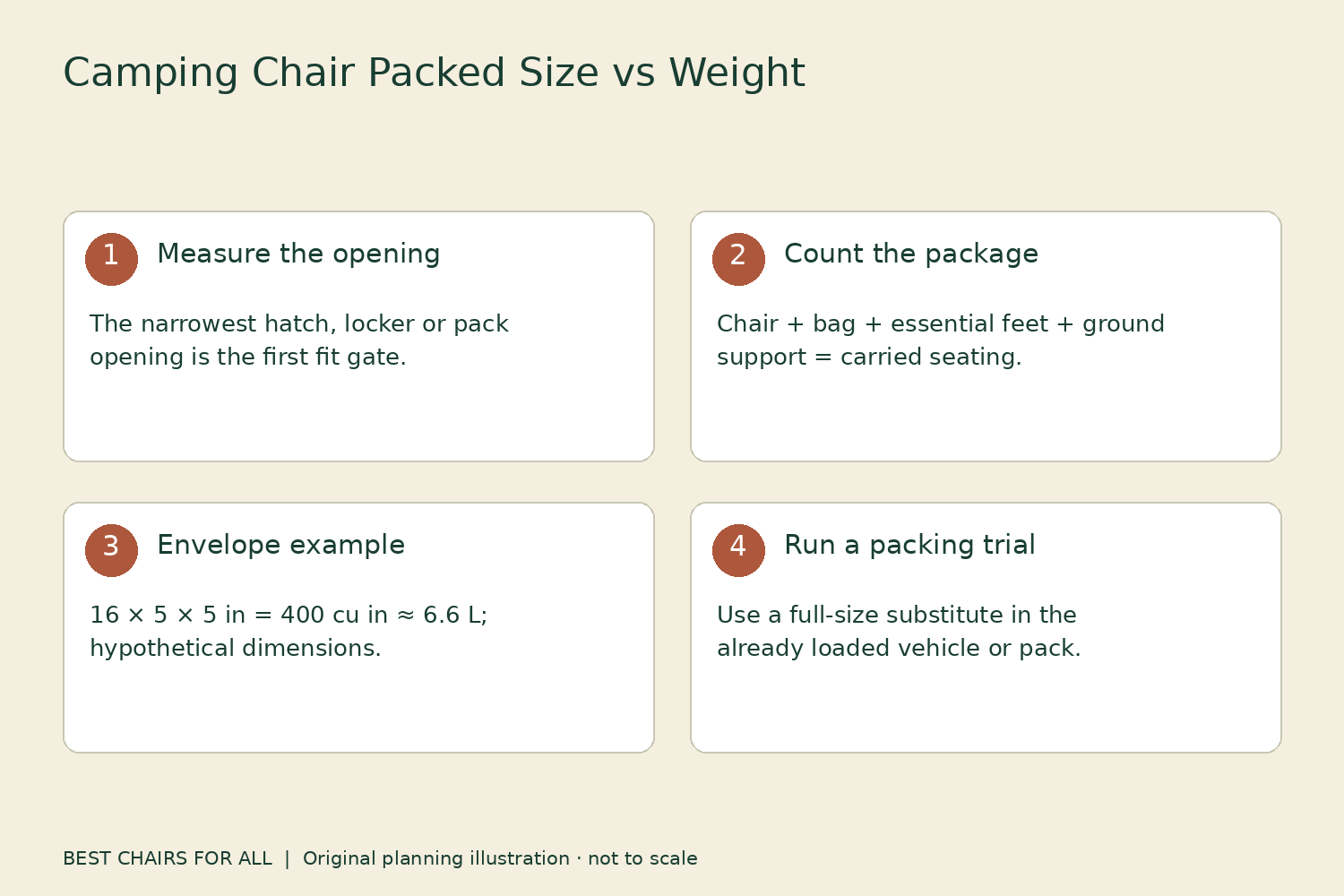
The most useful comparison is the complete package you will actually take. Include the carry bag, ground sheet, extra feet and any other essential accessory. Keep a separate record of how that package behaves during transport. A tidy sack, an awkward flat bundle and a long narrow tube can have similar measured volumes yet be very different to pack.
Start with the limiting opening
Measure the smallest opening the chair must pass through. This might be a hatch, locker door, pannier opening, roof box lip or the space beneath a vehicle platform. Then measure the usable space beyond it. A large storage cavity does not help if a rigid chair package cannot turn through the opening. Include hinges, wheel arches and permanent equipment in your sketch.
Write down dimensions with a clear orientation: maximum length along the vehicle, usable width between the cooler and wall, and height below the shelf. Do not write “lots of room” or rely on the vehicle’s published cargo volume. A chair is an object with a particular shape. Its usable storage position depends on neighboring objects and the route by which you insert it.
If you carry the chair inside a backpack, load the pack with the rest of your equipment first. The remaining space may be a narrow gap rather than a rectangular chamber. If you plan to strap it outside, check the bag’s restraint points and the pack manufacturer’s loading guidance. Do not create a dangling package that swings into your legs or obstructs movement.
Separate packed weight from bare weight
Manufacturers do not always use the same weight convention. One may list a bare frame and seat, another the complete bagged item. Helinox’s Chair One specifications provide separate assembled and packed weights. That distinction is more informative than a single headline number. For a fair comparison, record the exact label beside every figure you copy.
Your own comparison can be simpler: weigh each complete ready-to-carry package on the same scale. This is a household packing measurement, not a certification of the manufacturer’s specification. Keep the unit consistent and note what is included. A ground sheet stored in another pocket still counts toward the carried seating system, even though it is not in the chair bag.
Do not count a removable accessory twice. Make a small inventory with one line for the bagged chair and another for everything carried separately. If several people share a large mat, divide its mass only when planning individual pack loads; the group still carries the whole mat. This distinction matters when comparing one chair plus an accessory against a different chair that needs no separate ground support for the intended surface.
Use volume as a rough screening tool
For a rectangular packed envelope, multiply length by width by depth. In inches, the answer is cubic inches. Dividing by about 61 converts that envelope to liters. A 16 by 5 by 5 inch package has a 400 cubic inch envelope, or about 6.6 liters. These hypothetical dimensions illustrate arithmetic; they do not describe a tested chair.
An envelope is not the same as the material’s displacement or the space you will lose in a real pack. Rounded bags leave gaps. A soft bag may deform slightly; pole sections cannot shorten. Avoid calculating a precise cylindrical volume and treating it as guaranteed backpack space. The longest rigid dimension and the shape of the remaining gap usually matter more than an extra decimal place.
Use the calculation to eliminate obvious mismatches, then make a physical substitute. Rolled towels inside a bag can approximate a rounded package; cardboard can represent a rigid flat fold. Label the substitute with the candidate’s dimensions. Try it in the loaded vehicle or pack, with enough clearance to remove it without unpacking everything else.
A comparison worksheet that exposes the trade
| Field | Candidate A | Candidate B |
|---|---|---|
| Complete carried weight | Measure or confirm | Measure or confirm |
| Longest packed dimension | Record with unit | Record with unit |
| Remaining two dimensions | Record both | Record both |
| Required accessories | Include their weight and bulk | Include their weight and bulk |
| Fits the limiting opening | Yes, no or unresolved | Yes, no or unresolved |
| Carry method works when loaded | Physical trial | Physical trial |
Treat “unresolved” as a question to answer, not a quiet pass. Ask the manufacturer whether its dimensions include the bag, or measure a display example. Record the exact model and generation because a product redesign can change the package. A few descriptive words such as “compact” and “ultralight” do not replace these entries.
When packed shape beats a small weight saving
Consider a hypothetical walking trip in which a long stool fits only on the outside of the pack while a slightly heavier chair fits inside. The internal package may be easier to manage around vegetation and during transport. That does not automatically make it the better choice; it means the decision includes restraint, access and pack organization as well as mass.
The TravelChair Original Slacker is a useful real example of a narrow, elongated folded form. Its listed closed dimensions differ substantially in shape from a short pole-frame chair bag. Compare that geometry with your available space. Do not infer that every stool packs smaller in every useful sense, or that removing a backrest always produces the lightest option.
For car camping, a flat-folding chair might sit against the side of the luggage area while a cylindrical bag competes with sleeping equipment in the center. In another vehicle the opposite may be true. Photograph the successful loading arrangement so the next trip begins with a known place for the chairs. The goal is repeatable access, not merely closing the hatch once.
When weight deserves priority
Long carries make every carried item part of a larger load. Decide the seating allowance alongside shelter, clothing, food and water rather than in isolation. REI’s chair selection guide identifies both weight and packed size as important for backpacking. Your route, existing pack load and willingness to carry a seat determine the acceptable compromise.
Make the weight difference concrete without exaggerating it. If two complete setups differ by eight ounces, that is half a pound carried throughout the route. Whether it is worthwhile depends on what the chair adds to your trip and what else is in the pack. Multiplying weight by distance can illustrate exposure to carrying, but it is not a physiological measure or a reliable prediction of fatigue.
Do not buy a chair solely because it wins the scale comparison if you cannot sit or stand comfortably in it. Equally, do not bring a large lounging chair on a walking trip simply because it feels pleasant at home. A borrowed chair or a local loaded-pack trial can help you understand your own preference before committing to a different packing system.
Include wet and dirty returns
The outgoing package is usually clean and neatly rolled. The return package may carry sand, moisture or mud. Allow a practical way to separate a damp chair from clothing and bedding during transport, then unpack and dry it promptly at home. A temporary transport bag is different from long-term sealed storage. Do not leave wet fabric compressed in the chair bag after the trip.
A chair that barely fits when carefully packed indoors may be frustrating in rain or poor light. Practice folding it according to its instructions, without forcing the zipper over a misaligned pole. Check whether the advertised package is realistic with the supplied bag and all ordinary components. You should not need to bend frame members or leave essential feet behind to achieve it.
Keep detachable feet and ground supports in a small identifiable pouch or the storage arrangement the manufacturer provides. Loose parts disappear easily in a vehicle. If an accessory changes the shape of the bag, update your worksheet. The completed system is what needs a reliable storage position, even if its main chair still matches the catalog dimensions.
Check shared transport honestly
For a household taking several chairs, compare the total package as well as each individual chair. Four small bags may occupy a different arrangement from four flat folds, and the carrying task may fall to one person on arrival. Make a labeled position for every chair in your loading sketch. If the first chair fits only because it occupies the space needed by the next three, the individual fit result is misleading. Keep access to emergency equipment and frequently used luggage in the plan. A seating arrangement that requires unloading the whole vehicle at every stop is a practical cost even when total weight is acceptable.
Decide using two gates
First ask whether the complete package fits and can be restrained and carried appropriately. A failure here removes the candidate regardless of its weight. Then compare the weights of the remaining candidates against comfort, setup and the usual terrain. This order prevents attractive low numbers from hiding an actual packing mismatch.
Keep the worksheet with your equipment list and revise it after a normal trip. Note where the chair traveled, whether access was easy, and whether the complete accessory package came home. That small record is more useful than a theoretical volume ranking. The better chair is the one whose carried mass and packed shape both work in the trip you actually take.
Something unclear or out of date? Send a correction with this article’s title and the detail to check.
Sources, research & corrections policy ↗