A barber chair and a salon styling chair can both raise a client and rotate toward a mirror. The meaningful difference is what happens during the service. A barber chair commonly supports a reclined client with a headrest and an articulated legrest. A styling chair usually prioritizes access around an upright client's hair, with a lower back and a simpler footrest. Neither name guarantees a particular feature, lifting limit, or working height.
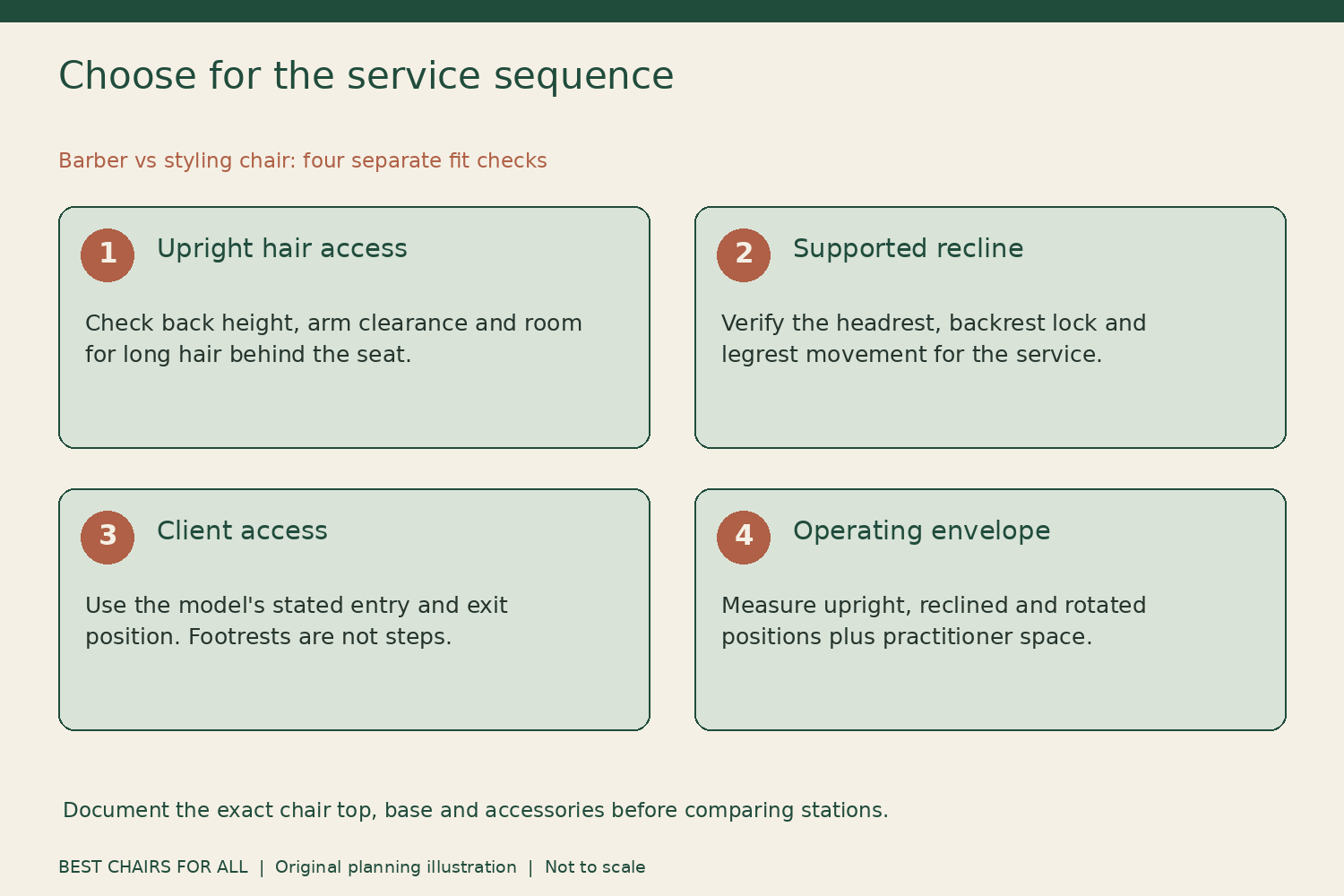
Choose by mapping your actual services to the chair's documented movements. A shop that mainly cuts and colors upright clients may gain little from a large reclining mechanism. A barber who regularly works around the face needs to investigate head support, recline control, and clearance much more closely. An all-purpose chair occupies the middle ground, but its exact limitations still matter.
Start with the service sequence
Write down what the client and practitioner do from arrival to departure. For an upright haircut, the sequence might be sitting down, adjusting the cape, lifting the seat, rotating between the mirror and cutting positions, and lowering the client to exit. For a reclining service, add positioning the headrest, moving the backrest and legrest, checking clearance, returning upright, and restoring the exit position. Every added movement creates a buying question.
For example, does the practitioner need to reach a recline lever while standing on either side? Does the headrest adjust without forcing an awkward client position? Can long hair fall freely behind the backrest? Does a footrest interfere with sweeping or with a seated practitioner moving closer? These questions reveal more than the word “professional” in a product description.
Use your busiest ordinary appointment as the main reference. Then test the less frequent service that demands the most space or movement. Buying only for the common service can leave the occasional service impractical; buying only for the exception can make every normal appointment cumbersome. Sometimes two different station types serve the business better than identical chairs throughout.
What manufacturer examples actually show
Takara Belmont's Harp styling chair lists a low backrest, lockable rotation, and a footrest with stopper. Its published seat height is 515–680 mm on the specified SP-AD base, with a warning that dimensions and weight can differ on another base. Those are configuration-specific facts, not dimensions for every styling chair. See the Takara Belmont Harp specifications.
For contrast, the manufacturer describes its Clipper barber chair with a removable headrest and a reclining backrest synchronized with the legrest. The cited brochure gives upright depth of 48.20 inches and reclined depth of 60.39 inches for the illustrated configuration. That extra envelope is a concrete consequence of the movement, even before space for the practitioner is added. See the Takara Belmont Clipper brochure. This is a documented design example rather than a claim about current availability.
Minerva's Minerva salon chair buying guide also distinguishes styling, barber, and all-purpose designs and encourages comparison of inside-arm width, seat depth, and hydraulic travel. Read those dimensions separately. A generously sized overall chair can still have a relatively narrow space between its arms; a compact-looking seat can sit on a base that occupies substantial floor space.
Recline is a working function
Do not reduce recline to the maximum advertised angle. Ask where the client's face ends up at the height you use, whether the backrest locks in intermediate positions, and whether the legrest moves with it. Two chairs can state similar angles but put the head in very different places because of pivot location, back length, cushion shape, and headrest extension.
In a showroom, have a representative demonstrate the full sequence using the manufacturer's normal operating instructions. Watch where hands and feet must remain clear. Check that the operator can identify the correct control without reaching across a client. A demonstration should feel deliberate and repeatable, not dependent on a particular salesperson knowing a trick.
Recline also changes the room. A chair that fits upright may collide with a wall, trolley, or the neighboring practitioner when moved. Measure the complete operating envelope, including the headrest and footrest. Do not assume the published overall depth includes every optional attachment or a fully extended headrest. Obtain the dimension drawing for the exact combination being quoted.
Headrests, backrests, and hair access
A headrest is useful only when its adjustment and shape suit the service. Record whether it is fixed, height adjustable, removable, or an option. If removing it is an intended user action, ask where it will be stored between uses and how its contact surfaces will be maintained. An accessory that has no planned storage place tends to become clutter around the station.
A lower styling-chair back may make it easier to reach longer hair behind the client, but check the actual back height against your techniques. A tall barber-chair back may support a reclined position while occupying the area where you normally section hair. This is a task-fit tradeoff, not a universal comfort ranking. Client size, clothing, and preferred sitting position also affect the experience.
Photographs often conceal the useful details. Ask for a straight-on view, a side view, and dimensions inside the arms. If a showroom is available, bring a cape and simulate sectioning, brushing, and access around the nape without operating powered tools. Notice whether you keep bumping the arms or reaching around decorative metalwork. Small obstructions become noticeable when repeated all day.
Footrests need their own comparison
A styling-chair footrest may be a fixed T or U shape intended simply to support feet. A barber chair may have a broader assembly, a legrest, or a heel-rest accessory. Confirm what is standard and what is optional. Ask whether the assembly rotates with the seat and which position is specified for entry and exit.
Do not use an ordinary footrest as a step. For example, Minerva's Minerva Figaro assembly and safety instructions explicitly says the footrest is for resting feet and that the chair should be in its lowest position for entering or leaving. That instruction belongs to that model; it is also a useful reminder to read the chosen chair's own access instructions before planning client assistance.
Consider cleaning around the foot assembly and operator shoe clearance. A broad footrest can occupy the place where you stand for front sections. A small footrest can be less useful for a particular client's leg position. Evaluate the whole seat-to-footrest relationship rather than treating either component as an isolated feature.
A service-fit worksheet
Create one row for each service and four columns: required client position, practitioner position, chair feature required, and evidence. For an upright cut, the evidence might be a model drawing plus a demonstration of rotation and usable height. For a facial-hair service, it might be the manual's intended use, headrest adjustment, and a recline demonstration. For color processing, it might focus on accessible hair placement and the upholstery care routine.
Mark each row “documented,” “demonstrated,” or “unresolved.” A verbal promise that a chair “does everything” should not count as evidence. Add the model, base, upholstery code, and accessory list at the top so the worksheet stays attached to a specific configuration. If the dealer changes the base to reduce cost, recheck the rows affected by height and footprint.
Give each service a frequency of daily, weekly, or occasional. Then add a separate pass/fail line for entry, exit, rated load, and room fit. Essential operating requirements should not disappear inside a weighted score. A chair that performs beautifully for a frequent task still needs to meet the requirements for the people and services you intend to accommodate.
Worked example: a mixed-service studio
Imagine a two-station studio that primarily offers upright haircuts and color, with a smaller number of reclining grooming appointments. This is a planning example, not a measured business case. The owner initially wants two matching barber chairs because their appearance suits the room. The worksheet reveals that both stations would need deeper operating envelopes, while long-hair work at either station would happen around a higher back.
The owner tests an alternative: one styling station for the upright workload and one appropriately documented reclining station. They mark both footprints on the floor and simulate trolley placement and practitioner movement. The mixed layout may be more practical, provided the business can schedule the services around those stations. The result comes from service mapping rather than a claim that one category is superior.
The same exercise could reach the opposite decision in a beard-focused shop. If nearly every appointment uses supported recline, the movement is central to the business, and a simpler styling chair would introduce compromises. The goal is to make the reason explicit before comparing upholstery colors, trim, or promotional packages.
Height, load, and ownership details
Compare minimum and maximum seat height on the complete chair, not the bare hydraulic base. Distinguish product weight from maximum client load, and obtain any separate lifting and static-load conditions in writing. A heavy chair does not automatically have a higher client rating, and a broad seat does not establish one either.
Ask who supports the chair locally, which parts are available, how upholstery is identified, and what the warranty requires. An owner should be able to locate the manual and serial label without turning a heavy chair upside down. Keep a photograph of the accessible label and the supplier's written configuration with the purchase record.
Finally, request a delivered and assembled quote that names the base, chair top, headrest, footrest, covers, and any installation work. Compare like with like. The best category choice is the one that supports your documented service sequence, fits the room through every movement, and can be maintained with clear model-specific instructions.
Sources and specifications checked November 6, 2026. Examples are planning exercises, not product testing.
Something unclear or out of date? Send a correction with this article’s title and the detail to check.
Sources, research & corrections policy ↗