Reading chair seat depth is the distance from the front of the usable seat to the back support. It is different from overall depth, which includes the back, frame, and any projecting arms. A shallower usable seat often makes upright reading easier; a deeper one can provide room to tuck up your legs. Neither is inherently more comfortable. The useful depth depends on your legs, back position, cushion compression, and preferred reading posture.
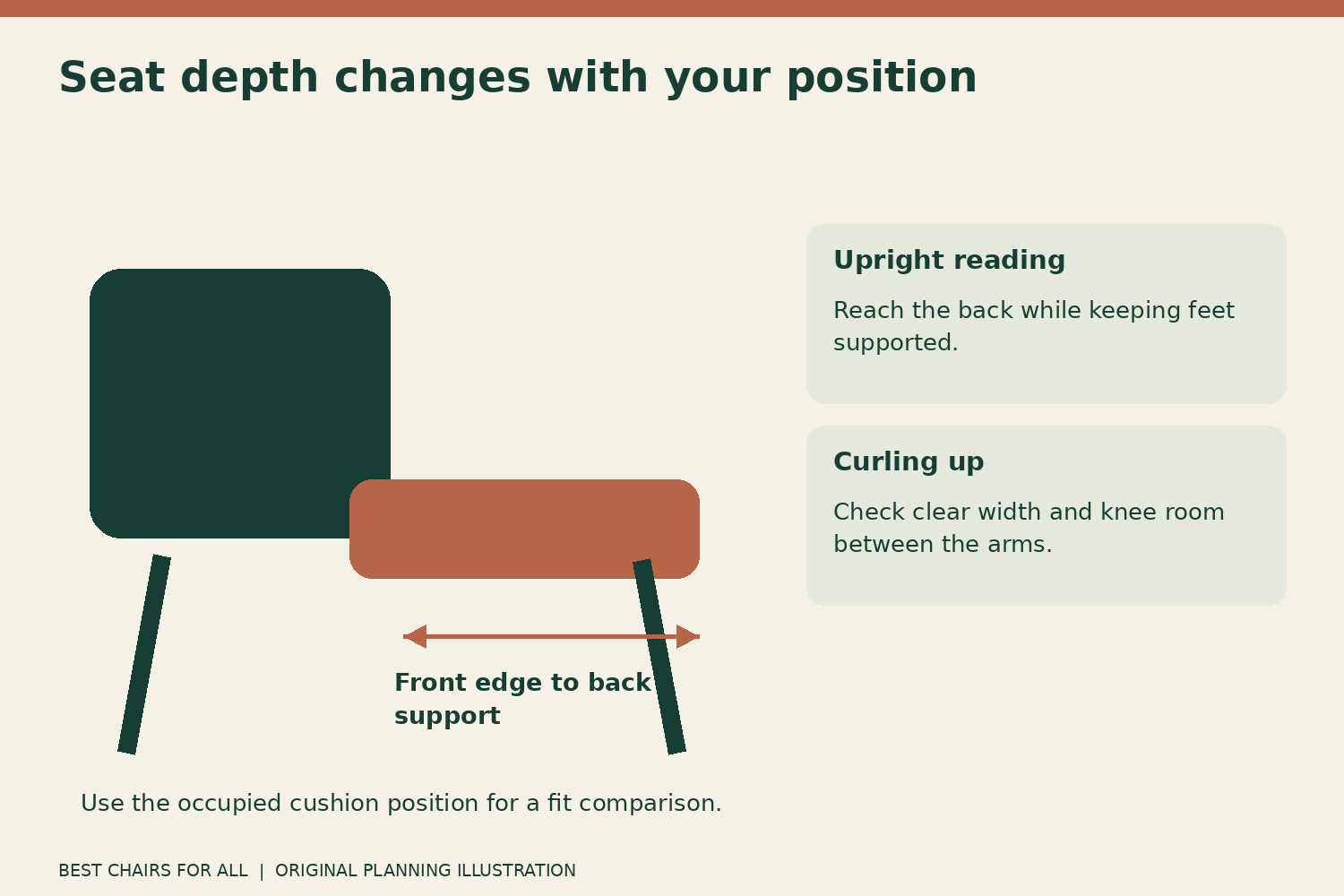
The most reliable starting point is a chair you already enjoy. Measure its usable seat, describe how you sit in it, and compare new chairs against that combination. A number divorced from posture can be misleading: the same 22-inch seat can feel generous to one reader and awkwardly long to another.
Identify exactly what the seller measured
On a dimensional drawing, find the arrow labeled seat depth. Ideally it runs from the seat’s front edge to the face of the back cushion. Some sellers instead describe a seat platform with the loose back cushion removed. Others give only an outside measurement. Ask for clarification whenever the published dimensions do not make the reference points clear.
Room & Board’s sofa and sectional comfort guide defines its depth from the inside of the back cushion to the front edge of the seat and distinguishes shallower upright seating from deeper options. That definition is useful when comparing products, but its categories are the retailer’s shopping framework, not universal body-size standards.
Measure in the center and near your preferred sitting position. A curved back or rounded seat front can create different usable depths across the cushion. On a barrel chair, the diagonal sitting area may be much longer than the center line, while the arms constrain your knees. Record a small sketch rather than forcing an irregular seat into a single unexplained number.
Separate seat depth from the room footprint
A chair’s outside depth determines how far it projects into the room. The usable seat depth determines where your thighs and back meet it. Thick back padding, a strongly sloped back, or a deep frame can create a large outside dimension without providing an unusually long seat. Conversely, slim construction can preserve more usable sitting space within a compact outline.
For a documented example, IKEA’s STRANDMON in Vibberbo black/beige lists an overall depth of 37¾ inches and a seat depth of 21¼ inches. Its seat width is listed separately at 19¼ inches. Those three figures answer different questions; the overall depth cannot tell you whether you can comfortably curl up sideways.
Use outside dimensions to tape a footprint onto the floor, then use seat dimensions to shortlist a sitting trial. Do not subtract the overall depth of one chair from another and assume that difference is usable leg support. A thick wingback and an open bentwood chair can devote very different amounts of their footprint to the back structure.
For upright reading, check the knee gap while sitting back
Sit against the back support with feet resting on the floor or the footrest you intend to use. Notice the space between the front edge and the backs of your knees. You should be able to reach the backrest without the edge pressing into that area. If you slide forward simply to place your feet down, the depth and height combination deserves closer attention.
The Canadian Centre for Occupational Health and Safety’s chair guidance discusses supporting the back and thighs without pressure behind the knees. Its context is work seating, so it should inform an upright fit check rather than dictate a lounge chair’s angle or dimensions. It also emphasizes that a chair labeled ergonomic may not suit every user.
Do the check with your actual reading activity. A paperback held close to the body may let you remain against the back, while a large illustrated book can pull you forward. If your natural response is to perch, note whether that is an occasional change of posture or the only way the chair works. A reading chair should allow more than one comfortable position.
For curling up, add width and arm geometry to the decision
A deeper seat gives your legs somewhere to go, but depth alone does not create a useful curled-up position. Measure clear width between the arms at cushion level and again where your knees would rest. A broad outside width may mostly consist of padded arms. Narrow inward-sloping arms can make a deep chair feel much smaller than expected.
Try your ordinary curled posture without forcing your knees into an unfamiliar position. Check where your ankle rests and whether a seam, zipper, or hard arm edge sits beneath it. Then unfold your legs and return to upright reading. A chair chosen solely for one pose may be frustrating when you want to change position halfway through a chapter.
Consider the upholstery as part of this geometry. A soft, thick cushion may compress around a tucked foot; a firm platform may feel more restrictive even with identical catalog measurements. A slippery surface may let a back cushion move, increasing the effective depth as you settle. These are reasons to trial the exact upholstery and cushion configuration where possible.
Understand how loose cushions alter usable depth
A back pillow occupies part of the seat. Its uncompressed thickness is only an estimate of how much depth it removes, because filling compresses unevenly and the pillow can angle. If you add a cushion to shorten a seat, repeat the foot and knee checks while occupied. Also check whether the cushion supports the whole intended back area or creates a concentrated pressure point.
Keep the cushion stable without making structural changes to the chair. If it slides as soon as you open a book, it is not a dependable fitting solution. A large pillow may also push you beyond the supported area of the seat cushion or raise your shoulders relative to the arms. Judge the resulting chair as a new setup, not as the original chair plus a harmless accessory.
Removing a manufacturer’s back cushion can expose a firm frame or alter the intended support. Do not assume a cushion is optional because it is loose. Check the product instructions and trial the chair as designed first. If the only comfortable version omits an important component, compare a different model with an appropriate usable depth from the outset.
A two-reader depth worksheet
Use this original worksheet to turn preferences into a comparison. The numbers below are hypothetical measurements, not specifications for a body type. They demonstrate why height labels such as petite or tall are weaker evidence than an occupied trial. Different people with the same standing height can have different thigh lengths and preferred sitting positions.
| Observation | Reader A | Reader B |
|---|---|---|
| Existing comfortable usable depth | 19 inches, feet down | 23 inches, usually curled up |
| Candidate usable depth | 22 inches | 22 inches |
| Trial observation | Slides forward to reach floor | Legs fit but arms constrain knees |
| Next useful check | Try supported feet and a stable back cushion | Measure clear width and arm shape |
| Decision condition | Back and feet supported together | Can curl up and unfold comfortably |
For each candidate, add seat height, usable width, back angle, and cushion type. Write the measurement method beside the depth: for example, “center front to compressed back pillow while seated.” That record is more valuable than a bare 22-inch figure because it makes later comparisons repeatable. A photograph of the tape’s endpoints can help if the retailer permits it.
Compare depth without confusing softness with fit
Soft upholstery can initially disguise a seat that is too long, because sinking into it feels enveloping. After settling, you may find the edge higher relative to your thighs or the back farther away than expected. A firmer chair can feel less plush at first yet make reading easier because the body and book remain where you expect them to be.
Give each chair time to settle during the trial and change positions more than once. Check the edge again after leaning back, then after reaching for a side table. If possible, have each regular reader use the same sequence. Avoid comparing one chair while wearing shoes and another while barefoot when foot contact is central to the decision.
Online purchases need a different evidence plan. Request seat measurements, close photographs of the back cushion, and details of cushion construction. Check whether a showroom or comparable model is available locally. Read return terms for the exact item, especially custom upholstery, and keep packaging instructions until the fit is resolved. A good diagram reduces uncertainty but cannot duplicate an occupied trial.
Use depth as one part of a complete reading setup
A chair that fits your legs may still have arms that are too high for your book or a back that positions your head awkwardly. Once depth looks promising, read several pages with your usual book, look toward the room, and put the book down. Include the ottoman if you plan to use one. Its spacing changes your leg position and can change how far back you settle.
Then check the outside footprint, delivery route, and operating clearance. A deep reading chair may fit your preferred posture yet block a door or leave no path around an ottoman. Preserve both sets of measurements: usable seat dimensions for your body and overall dimensions for your home. The right depth is the one that supports the positions you actually use within a setup you can comfortably enter, leave, and maintain.
If you are replacing a worn chair, compare the new candidate with both the old cushion’s current feel and its original support. A sagging cushion can make a familiar chair seem deeper or lower than it was when new. Record sagging as a condition problem rather than treating the damaged dimensions as your ideal specification.
Something unclear or out of date? Send a correction with this article’s title and the detail to check.
Sources, research & corrections policy ↗