As an Amazon Associate, we earn from qualifying purchases. Read our affiliate disclosure. Amazon buttons open matching-model searches; verify the seller, exact version and checkout total.
Choose the room layout before the upholstery
The best home theater chair is the one that preserves a clear view and an accessible way out when every footrest is extended. For a dedicated room, start with Octane Bolt XS400 if row width is tight; compare Valencia Tuscany when independent head and lumbar adjustment matters more; consider Seatcraft Equinox if you want a powered seat with an optional tactile-audio system. These are conditional recommendations rather than a universal comfort ranking.
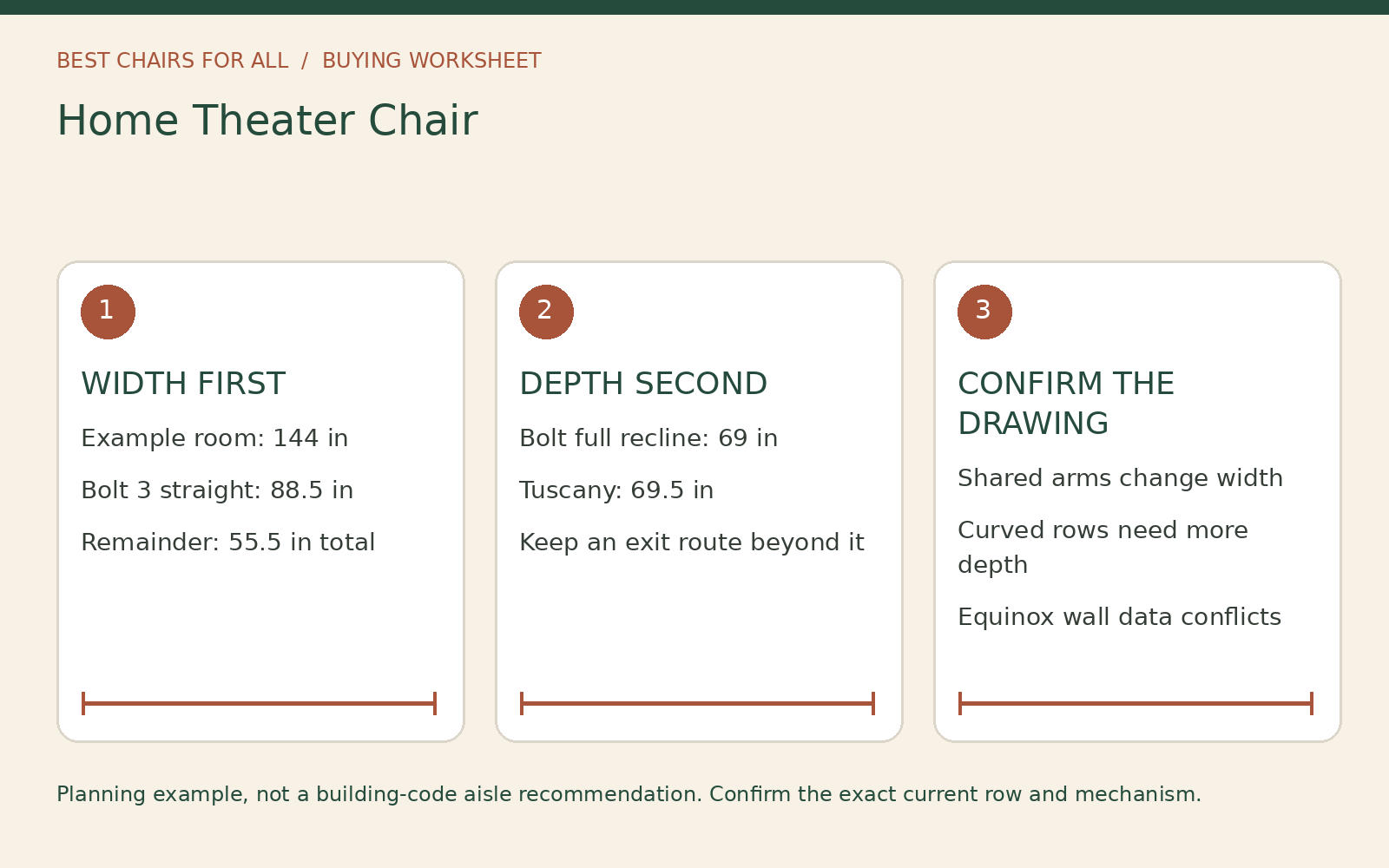
A chair that feels generous in isolation can make a three-seat row unworkable. Shared arms, loveseat openings, wedge arms, doors and side speakers change the installation. This guide treats a single seat, a row and a room as different measurements, then works through a purchasing worksheet you can use with a dealer.
This is a research-based buying guide, not a hands-on test. We compared the linked manufacturer specifications and current product documentation on November 6, 2026. Recommendations reflect the fit and ownership tradeoffs below; published dimensions do not establish personal comfort, long-term durability or a medical outcome.
Chairs worth comparing for this use
1. Octane Bolt XS400
Best for: For a narrower dedicated row.
Bolt XS400 is the first series to investigate when fitting usable seats into a fixed-width room is the central problem. Its 33.5-inch single-chair width contains a 23.5-inch seat, so less of the footprint is consumed by wide outer arms.
Bolt XS400 uses slim arms and an accessory dock beside its cupholders. Power and manual versions and different upholstery grades exist, so the series name alone is insufficient to identify the order. The 22-inch seat height needs particular attention if shorter viewers will use the room. A slim frame is useful only when the occupants can sit back without dangling feet in the upright position. Confirm the chosen row dimensions because current web layouts and older brochures differ slightly. See the model-specific source linked below.
Product Details
| Brand | Octane |
|---|---|
| Overall single-chair size | 33.5 W × 39.5 D × 44 H inches |
| Seat width | 23.5 inches |
| Seat height | 22 inches |
| Reclined depth | 69 inches |
| Wall clearance | 4 inches |
Pros
- Slim arms leave more usable seat width within a restrained overall frame
- Accessory dock makes trays optional instead of permanently occupying the lap area
Cons
- Power recline is configuration dependent
- Tall seat height may fail shorter viewers
Choose this after the actual row drawing passes your doorway and aisle checks, and test the fixed head-support contour with your screen height.
Octane Bolt XS400 specifications and source details
2. Valencia Tuscany Regular
Best for: For individually adjustable viewing posture.
Tuscany Regular suits a theater where each viewer wants to recline without losing a view of the screen. The independent powered headrest is particularly useful to compare when a low screen and a relaxed back angle otherwise pull the eyes away from the picture.
Tuscany Regular combines power recline, headrest and lumbar adjustment. Valencia identifies Italian Nappa 11,000 top-grain leather on its product page; confirm the chosen cover and configuration on the invoice. The 24-inch seat width is generous, but that number excludes the arms. Specify the exact row and cover rather than calculating a sofa width from seat width alone. A 69.5-inch reclined depth needs a genuine front clearance plan. See the model-specific source linked below.
Product Details
| Brand | Valencia |
|---|---|
| Seat width | 24 inches |
| Seat depth | 22.5 inches |
| Seat height | 21 inches |
| Reclined depth | 69.5 inches |
| Wall clearance | 4.75 inches |
Pros
- Separate headrest and lumbar controls allow a more detailed fit trial
- Arm storage can contain remotes without a side table between viewers
Cons
- More controls create more components to service
- Leather description and pricing depend on the selected configuration
This is a strong candidate for regular adult movie nights if the powered headrest fits your neck, while the arm shape still lets you hold a drink naturally.
Valencia Tuscany Regular specifications and source details
3. Seatcraft Equinox
Best for: For an optional tactile-audio setup.
Equinox is worth comparing when the chair is part of the entertainment equipment. Its built-in transducer creates a route into tactile audio, and its powered adjustments make it a more flexible starting point than a fixed-headrest theater chair.
Equinox supplies power headrest, lumbar and recline, cupholders, arm storage and a built-in SoundShaker transducer. The amplifier needed to use SoundShaker is an additional purchase, so a transducer alone does not create a working tactile audio system. There is a planning problem to resolve before purchase: the current page mentions 2.2 inches behind the chair in its description and 6 inches in its specification block. Reserve the larger figure until Seatcraft supplies written confirmation for your exact mechanism. See the model-specific source linked below.
Product Details
| Brand | Seatcraft |
|---|---|
| Reclined depth | 67.5 inches |
| Upright depth | 43 inches |
| Capacity | 350 pounds |
| Wall clearance | Conflicting 2.2-inch / 6-inch figures; confirm before ordering |
Pros
- Power head and lumbar adjustment help separate screen alignment from leg position
- Storage and charging reduce the need for extra room furniture
Cons
- SoundShaker needs the separately purchased amplifier
- Conflicting wall figures prevent a close-clearance purchase from specifications alone
Buy this for the complete system you intend to use. If tactile audio is irrelevant, weigh its ordinary seating fit against simpler alternatives rather than paying for an unused feature.
Seatcraft Equinox specifications and source details
The room worksheet: three seats in a 12-foot-wide room
Consider an illustrative room with 144 inches of clear width. Octane’s current web page lists a three-seat straight Bolt row at 88.5 inches. Subtracting leaves 55.5 inches in total, or 27.75 inches on each side if centered. That calculation describes leftover floor, not a guaranteed suitable aisle. Wall trim, acoustic panels, door swings and a person walking past can consume it. Local access and egress requirements may require a different arrangement.
An older Bolt brochure gives a slightly different straight-row figure. The difference is small enough to overlook in casual shopping and large enough to matter beside fixed cabinetry. Have the dealer mark the current drawing with the exact arms and seat count. Do not order by adding three 33.5-inch single chairs: shared arms change the total. The worksheet is useful precisely because it forces you to reconcile the configuration rather than trusting a familiar product name.
Measure at floor level and at arm height. A radiator or wall-mounted speaker can restrict the upper space even when the tape measure fits across the floor. For a curved row, use the widest and deepest points on its drawing; a curve consumes more than the straight-row rectangle. Add any tray or phone holder in its deployed position before deciding that the remaining space is available for walking.
Reclined depth does not include every circulation need
Mark the front of the closed seat, the extended footrest and the back clearance with painter’s tape. Bolt lists 69 inches of reclined depth, Tuscany 69.5 inches and Equinox 67.5 inches. Those are product dimensions, not a universal recommendation for row spacing. A person still needs to enter and leave, and any rear row may need an entirely separate route around the seats.
If two rows are planned, ask an installer to check sight lines using actual seated eye heights and the intended screen position. A high back can obscure a rear viewer even when the upright chair appears low enough on a showroom floor. Do not treat a riser as an automatic fix: its height, step position, headroom and access all need a room-specific design. The chair drawing cannot settle those construction questions.
Keep the side table out of the moving legrest envelope. A cupholder solves the beverage problem more efficiently than a table wedged between a powered seat and a wall. Loose charging cables must not cross the footrest linkage or become a trip path. The entertainment benefit of a powered chair depends on keeping its movement area predictable.
A viewing trial that separates the important controls
During an in-store trial, begin upright with the screen or an approximate target in front of you. Raise the legrest while leaving the back relatively upright. Then move the back and headrest in separate steps. Check whether your eyes remain naturally aimed toward the middle of the picture rather than whether the chair reaches its most dramatic recline angle. A fixed headrest can be perfect for one viewer and intrusive for another.
Repeat with glasses if you wear them. Multifocal lenses can make a slight change in neck position more noticeable. Ask another household member to try the same sequence instead of assuming your preferred settings represent everyone. For a shared theater, a chair that accommodates different proportions may be more useful than one that feels exceptionally plush to a single buyer for five minutes.
Try the controls in low light without watching your hand. Check whether the lights can be dimmed or switched off, whether a tray blocks the controls, and whether the cupholder accepts your normal bottle without catching it. A motor demonstration with no one sitting in the chair does not answer these ordinary-use questions.
Build the delivered-system price
Get a quote for the complete row, chosen upholstery, delivery level, assembly, accessory mounts and any amplifier. A headline price beside a row-of-three selector should not be treated as a single-chair price. The same principle applies to promotional images showing several seats: verify what quantity is included. This guide makes no live budget promise for these configurable theater systems.
Ask what happens if one motor fails after installation. The practical questions are who diagnoses the problem, who ships the part, whether labor is included, and how a chair is removed from an interconnected row. A warranty title alone does not identify those costs. Photograph the control and transformer labels at delivery, and keep the exact row drawing with your receipt.
For a first dedicated theater, prioritize correct fit and space before accessories. A tray can be added to a compatible dock later; a row that blocks a door is much harder to correct. Choose Bolt for restrained width, Tuscany for detailed posture adjustment, or Equinox for a deliberate tactile-audio plan only after that basic room test passes.
The final row approval
Ask the theater dealer for one annotated drawing showing the exact arm arrangement, power-cable route and largest reclined footprint. Compare that drawing with the marks in the finished room, including acoustic panels and doors. Resolve the Equinox wall-clearance discrepancy in writing if it is the selected seat. For Bolt, specify the current straight-row dimensions rather than an old brochure figure. For Tuscany, identify Regular versus XL before approving the order. Keep this drawing as the installation reference; a photograph of an attractive row cannot show whether its seats, arms and mechanism are the ones you selected.
Research sources
Sources were checked November 6, 2026. Configuration, stock and prices may change. Octane Bolt XS400 dimensions and layouts; Valencia Tuscany Regular specifications; Seatcraft Equinox product specifications.
Something unclear or out of date? Send a correction with this article’s title and the detail to check.
Sources, research & corrections policy ↗