A recliner has to fit three things: the person using it, the room while it moves, and the route into the home. Measure these separately. A chair can clear the front door yet block a hallway when its footrest opens, or fit the room while leaving its owner sliding forward to reach the floor. The useful result is a small measurement packet, not a single maximum chair width.
Start with a tape measure, paper, a firm chair, and the exact recliner specification sheet. Bring another person if that makes measuring easier. The examples below are invented planning exercises, not recommended body dimensions or specifications for a particular recliner. Confirm final clearances and delivery arrangements with the retailer before ordering.
Make three columns before shopping
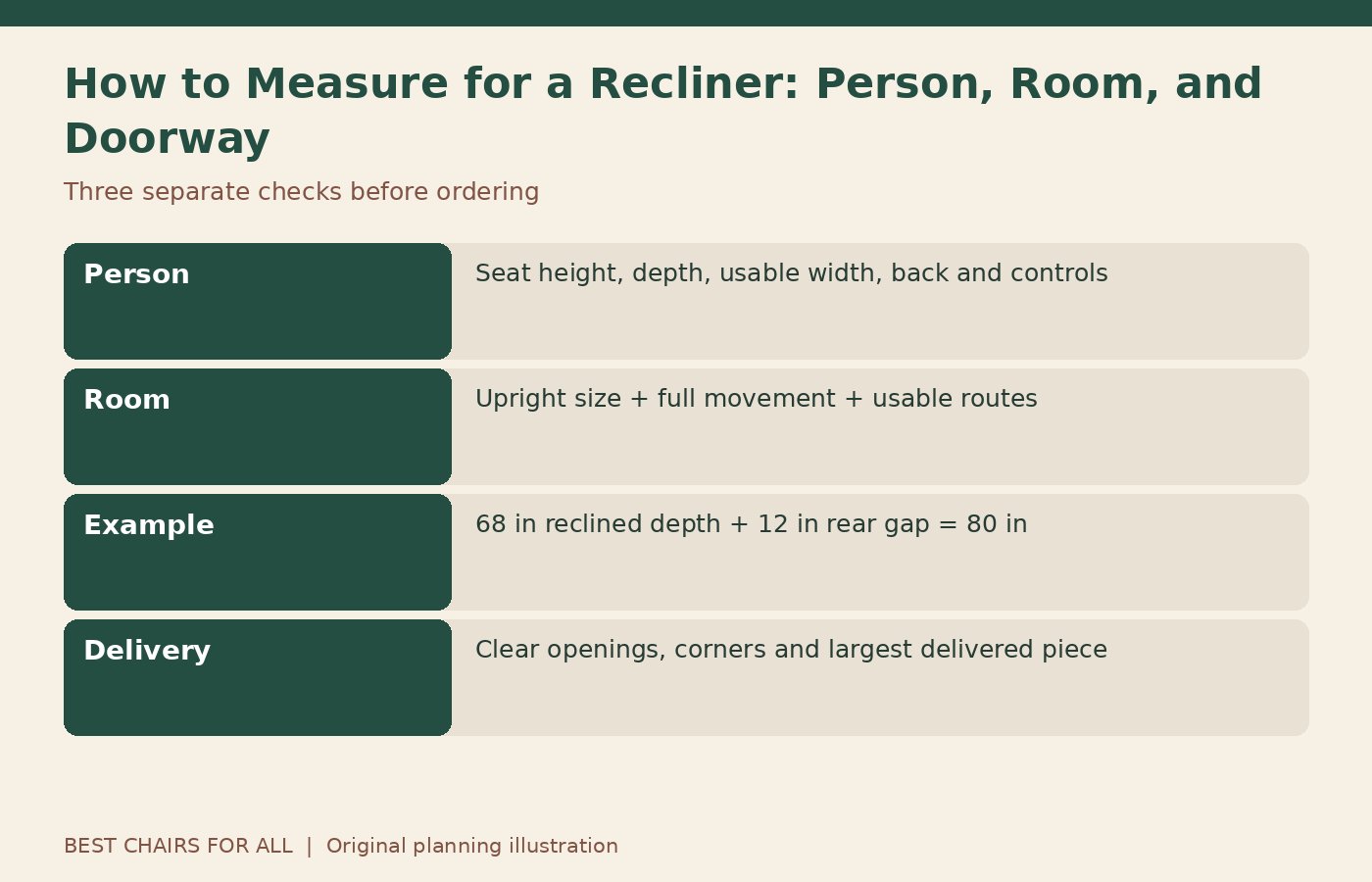
Label a page Person, Operating space, and Delivery route. Under Person, record seat height, seat depth, usable width, back support, and control reach. Under Operating space, record upright size, fully reclined size, required rear clearance, and the space needed for the base to rock or swivel. Under Delivery route, record clear openings, turns, stairs, and the dimensions of the actual delivery pieces.
Keep inches and centimeters in different columns if you need both. Do not mix the units in calculations. Note where each measurement begins and ends: a backrest height measured from the floor is different from one measured from the seat. Photograph the manufacturer’s dimension drawing so that you can return to those reference points later.
Measure the person in an ordinary sitting position
Sit on a firm chair with your usual indoor footwear and feet supported. Have a helper measure the lower leg from the floor to the back of the knee, the horizontal distance from the back of the seated body to the back of the knee, and seated hip width. Treat these as starting observations. Cushions compress, seat fronts have different shapes, and bodies do not fit a single mathematical rule.
Pride’s sizing FAQ identifies seat height, seat depth, seated width, and backrest height as separate measurements. That distinction is useful beyond lift chairs. Record where your head rests relative to the back cushion as well. A high overall chair back does not prove that its head cushion meets your head comfortably.
Separate usable seat size from overall size
Overall width includes the arms; seat width usually describes the opening between them. A bulky recliner can provide less sitting room than a slimmer model. Measure your existing comfortable seat between the arm surfaces, rather than across the outside of the furniture. If the arms taper inward, record both the opening at hip level and the narrower area near the elbows.
Seat depth also needs a definition. A catalog may measure to the upholstered back rather than to the position your body actually occupies after settling into the cushion. Compare the published number with a seated trial. If a store chair uses a different cushion or upholstery package from the one you will buy, ask whether the fit or dimensions change.
Test fit before testing maximum recline
Sit fully back without perching at the front. Check whether your feet can rest comfortably when the chair is upright, whether the front edge presses behind the knees, and whether you can reach the handle or buttons without leaning sideways. Move the back and footrest through the positions you expect to use. A fit that works upright can change considerably when the seat tilts.
La-Z-Boy’s recliner guide recommends an in-store personalized fit assessment. Make that visit practical by bringing your measurement page and usual footwear. Have the salesperson explain the controls, then operate them yourself if you can do so safely. Record observations in ordinary language, such as feet supported upright or remote difficult to retrieve.
Draw the operating footprint
Measure the proposed room with the existing furniture still in it. Mark the chair’s upright rectangle using painter’s tape that will not damage the floor. Then mark its fully extended front edge and the manufacturer’s required distance behind it. Include nearby doors, curtains, radiator covers, outlets, and the table you expect to use. Check where the chair back actually moves, rather than assuming that recline only adds length at the front.
La-Z-Boy Australia’s space guide discusses body fit and room placement together. Model-specific dimensions remain essential: a wall recliner and a rocker can share a similar upright size while requiring different operating space. Leave your plan provisional until you have the exact base and mechanism configuration.
Use a worked room calculation
Imagine a room section measures 114 inches from the wall behind the chair to the edge of a fixed cabinet opposite it. A candidate’s retailer confirms a fully reclined front-to-back depth of 68 inches and a required rear gap of 12 inches, measured from that same rear reference point. The planned occupied depth is therefore 80 inches, leaving 34 inches between the reclined chair and cabinet.
That remaining distance is a planning result, not a universal adequate walkway or an accessibility determination. Place tape at the 80-inch line and try the actual route with the people and equipment that use it. If the manufacturer’s diagram already includes rear clearance in an operating envelope, do not add it a second time. Ask the retailer to identify precisely what the drawing includes.
Account for sideways movement
A swivel recliner needs space around its turning path. Trace the farthest projecting corners of the arms, back, and footrest in the orientations the manufacturer permits. A circular base does not mean the upholstered body stays inside that circle. Likewise, a rocker or glider can approach the wall differently while upright than while reclining. Do not push a moving chair toward a wall simply because the base itself clears it.
A floor lamp and small side table can be easy to overlook on a tape outline. Check their bases as well as their tops. Keep drink tables and loose objects clear of moving parts. For a powered chair, include the transformer and cord route in the drawing so the outlet location does not become an afterthought after delivery.
Measure clear openings on the delivery route
Measure the actual open doorway between the narrowest obstructions. Door trim, hinges, handles, and a door that cannot open fully can reduce usable width. Record opening height too. Then follow the route from the vehicle access point to the room, measuring gates, landings, elevator openings, and corridors. A wide front entrance does not resolve a tight turn farther inside.
Write down floor protection needs and any building delivery rules. Send the retailer photographs of difficult turns with dimensions visible. Ask who makes the final delivery assessment and whether a failed delivery creates a charge. A sales page’s overall chair dimensions cannot answer every access problem, especially where the delivery team must rotate a large piece beneath a low ceiling.
Ask what is actually being delivered
Some recliners arrive with removable backs; others arrive assembled or in several cartons. Obtain the dimensions and weight of the largest delivery component and its packaging. Ask whether assembly is included and whether the delivery crew is authorized to remove and refit the back for access. A removable back is helpful only when that specific chair supports the procedure and the responsible team will perform it.
Do not treat an online video for a similar recliner as permission to dismantle yours. Powered and lift mechanisms introduce wiring and moving structures. Tell the retailer about your route and let them specify the approved delivery method. If they cannot establish that the item will pass safely, resolve access before making a nonreturnable order.
Build a shortlist with confidence labels
For each candidate, make five entries: seat measurements confirmed, occupied room depth confirmed, side movement confirmed, delivery pieces confirmed, and controls tried. Use Confirmed, Awaiting answer, or Failed beside each. This prevents a chair with a beautiful upholstery sample from quietly bypassing an unresolved access issue. Keep written answers with the model code and date, because a collection name can cover multiple mechanisms.
An example shortlist might show Candidate A passing body fit but awaiting delivery-piece dimensions, while Candidate B clears the doorway but fails control reach. Neither is ready to order merely because four other boxes look favorable. The unresolved issue tells you the next useful action, rather than requiring another broad shopping search.
Check the room in everyday conditions
A tape outline should be tested when the room is used normally. Open the nearby door, draw the curtains, and put the ottoman or coffee table where it usually stands. Check whether another person can pass when the chair is occupied. If a mobility aid or caregiver will be involved, include that actual arrangement and seek an individual assessment when transfers or support needs are uncertain.
For shared seating, repeat the person-fit check for each main user. The taller person’s footrest fit and the shorter person’s upright floor contact may point in different directions. Adjustable headrests or independent controls can help some differences, but they do not change every seat dimension. Record the compromise explicitly instead of assuming one size will become comfortable for everyone.
Confirm before and after delivery
Before purchase, send the final model code, upholstery choice, mechanism choice, room diagram, and access notes to the retailer. Ask for the manufacturer’s current manual or dimension sheet and clarify returns, restocking charges, and who handles a fit problem. Keep your original figures even if a salesperson suggests a different placement; they provide a reference for discussing the change.
At delivery, check the installed operating envelope with the crew before surrounding the chair with tables. Confirm that cords are routed as the manual requires and that the chair operates without hitting nearby objects. Revisit the fit after a normal sitting session. A useful measurement process ends with a chair that fits its intended use, not with a tape measure put away as soon as the carton arrives.
Something unclear or out of date? Send a correction with this article’s title and the detail to check.
Sources, research & corrections policy ↗