A reading chair succeeds when it supports the way you actually hold a book. A deep seat can look inviting yet leave your feet hovering; a firm upright armchair can fit your legs but put its arms too low to help with a heavy hardback. Start with your usual reading position, then judge the seat, back, arms, foot support, lighting, and surrounding space as one setup.
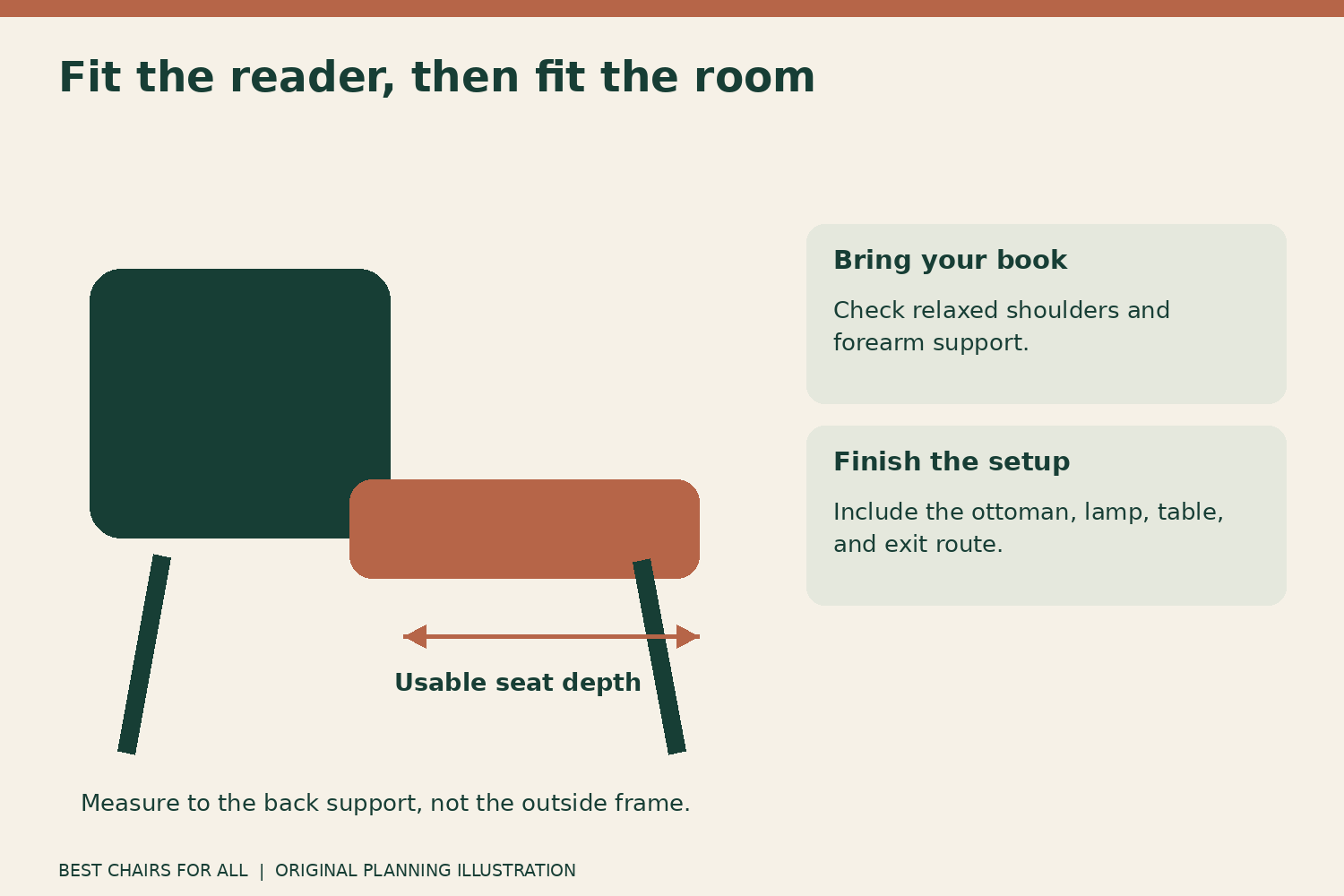
This guide is a fitting method rather than a claim that one chair prevents pain. Comfort is personal, cushion compression changes the numbers, and office ergonomics guidance does not certify living room furniture. Use the checks below to compare chairs on a consistent basis, and stop a sitting trial if a position causes discomfort.
Choose a reading position before choosing a silhouette
Write down what happens during a normal reading session. Do you sit upright with a paperback, lean back with an e-reader, or alternate between reading and talking? Do both feet stay down, do you use an ottoman, or do you like to tuck one leg beside you? An honest description is more useful than a style label such as lounge, accent, or ergonomic.
For upright reading, prioritize a back you can reach while keeping your feet supported and a front edge that does not press into the backs of your knees. For reclining, investigate how the book stays visible without holding it high throughout the session. For curling up, test usable seat width as well as depth: thick arms can consume much of a chair’s outside width.
A shared chair involves competing requirements. A tall household member may welcome a longer seat while a shorter reader needs a substantial back cushion to reach the floor. That can be workable, provided the cushion stays secure and does not push the reader onto the very front edge. If every person needs a pile of improvised supports, compare another chair shape.
Read the dimensions in the right order
Overall width and depth describe the furniture’s outside envelope. Seat width and seat depth describe the sitting area. Seat height is normally measured from the floor to the seat surface, but a manufacturer’s reference point may differ and a soft cushion drops under load. Record each number separately instead of treating an overall depth as a proxy for legroom.
For example, IKEA’s POÄNG in birch veneer with the Knisa light beige cushion lists an overall depth of 32¼ inches and a seat depth of 19⅝ inches. The difference contains the frame and back geometry; it is not extra usable seat. The model illustrates why a slim-looking chair can still need a meaningful floor footprint.
Use that distinction when filtering an online shortlist. A chair that fits a 34-inch-deep taped rectangle may still be too deep for your legs, while a compact external frame can have broad usable seating. Ask the retailer how the seat depth was measured and whether a loose back cushion was included. Save the exact upholstery and configuration with the dimensions.
Fit feet and knees before adding pillows
Sit against the back in the shoes or slippers you usually wear. Let your feet land naturally. Check whether the front edge touches the backs of your knees and whether you can shift position without sliding your back away from support. If your feet dangle, try the intended footrest during the same trial rather than assuming one will solve everything later.
OSHA’s workstation chair guidance discusses supported feet and seat depth that allows the user to reach the backrest. Those are useful observations for evaluating an upright reading position, although a reclined lounge chair serves a different task. A chair does not become a suitable reading chair merely because a listing borrows ergonomic language.
Notice the leading edge after sitting for a while. A rounded upholstered edge may feel different from a taut cushion stretched over a rigid rail. Check both the center and the place your legs actually rest. If your preferred position is slightly diagonal, the effective seat depth and arm contact will differ from the catalog’s straight measurement.
Test the back with your book in hand
A high back is useful only when its contours meet your body comfortably. Look for the point where your shoulders settle and whether a head cushion pushes your head forward. A low back may suit short upright reading sessions but provide little support when you lean back. Do not judge back height solely from a photograph showing a model of unknown height.
Bring a book of realistic size and weight to the showroom. Open it in your ordinary grip, turn pages, and look up toward the room. Then try an e-reader or tablet if that is part of your routine. A chair can feel excellent with empty hands while leaving you with no comfortable place to support your forearms when reading.
A small reading pillow or stable book support can reduce the need to hold a book continuously. Evaluate it as part of the purchase, especially in a steeply reclined chair. Make sure it does not occupy the entire lap, prevent position changes, or leave a hot device pressed into upholstery. Follow the device manufacturer’s ventilation instructions for electronics.
Make the arms earn their floor space
Armrests serve several different jobs: supporting forearms, giving a place to rest a book pillow, defining a curled-up seat, and providing a stable contact point when changing position. They do not need to do all those jobs, but you should know which ones matter. Wide upholstered arms can be comfortable and still reduce access to the seat.
With the book open, let your shoulders relax. If resting an elbow makes your shoulder rise, the arm may be too high for this task. If your forearm hangs far above it, the arm may contribute little. Test the entire arm length; a stylish sloping arm can support your elbow in one spot but leave your wrist unsupported elsewhere.
Also rehearse getting in and out. A deep bucket shape, low seat, or slippery fabric may make the movement awkward for a particular person. Do not assume that a decorative arm or a removable cushion is designed to bear body weight during standing. Ask for the manufacturer’s instructions and choose a chair whose normal use feels manageable.
Decide whether separate foot support helps
An ottoman lets you alter the distance between seat and foot support. That can help a household with different leg lengths, but it also adds another object to the walkway. A matching ottoman is a starting point, not proof that its height and spacing suit everyone. Try moving it closer and farther while keeping a clear route out of the chair.
Purpose-designed lounge combinations may deliberately use different heights. Herman Miller’s Eames Lounge Chair and Ottoman product sheet shows separate chair and ottoman dimensions and two chair sizes. That is a reminder to evaluate the entire seating geometry rather than applying a rule that every footrest must exactly match a nominal seat height.
A chaise removes the movable gap but commits more floor length to one orientation. A recliner introduces moving clearances and controls. Neither automatically gives better reading support. The better option is the one that keeps your book accessible, permits easy position changes, and fits the room through its full operating range.
Use a realistic fifteen-minute fitting worksheet
The following trial is an original comparison exercise, not a laboratory test. Use the same book and sequence for each candidate. Allow enough time to notice small annoyances, but do not interpret a comfortable short trial as a guarantee of all-day comfort. Record observations in words rather than awarding an unsupported numerical comfort score.
| Stage | Action | Record |
|---|---|---|
| Arrival | Sit back with feet in the intended position. | Foot support, knee contact, cushion drop. |
| Open book | Read with your usual grip. | Elbow contact and book height. |
| Position change | Shift from reading to looking across the room. | Back contact and arm obstruction. |
| Footrest trial | Use the actual ottoman if relevant. | Preferred distance and remaining walkway. |
| Exit | Put down the book and stand normally. | Stable access and usable hand contacts. |
For a worked example, imagine Reader A likes a 20-inch usable depth in an existing chair, but a candidate has a loose back cushion that leaves only 18 inches after settling. Reader A should compare the occupied feel, not reject or accept it from the overall depth. Reader B may prefer that shorter effective depth. The worksheet makes the disagreement understandable.
Plan the reading corner as a small working area
Tape out the chair, footrest, lamp base, and side table together. Leave space to reach the chair without stepping over the ottoman or threading between a lamp cord and a table leg. A swivel chair needs its turning envelope checked; a rocker needs clearance through motion. The chair’s parked rectangle is only part of the plan.
Place a table where the reader can put down a book or drink without a long sideways reach. Check the lamp while holding the book in its actual position. Reflections on a screen, shadows from a high wing, and light aimed directly at another seat are all easier to solve before the furniture arrives. Route electrical cords according to the lamp’s instructions.
Finally, examine the exact fabric’s care directions and the return conditions. A removable cover may have restrictions; a photograph cannot tell you whether a surface is washable. Keep the model number, swatch, measurements, delivery access notes, and completed trial sheet together. Choose the candidate with the fewest unresolved fit problems, then use its first days at home to confirm the setup while any applicable return window remains open.
Something unclear or out of date? Send a correction with this article’s title and the detail to check.
Sources, research & corrections policy ↗