As an Amazon Associate, we earn from qualifying purchases. Read our affiliate disclosure. Retailer buttons search for matching model listings; verify the exact size before buying.
The best telescopic folding stool is the one whose actual sitting height, seat shape, and packed length fit your trip. For a conventional tripod, I would start with the Walkstool Comfort 45 for a lower full-height seat, the Comfort 55 for a taller perch, or the Basic 50 for occasional use when its smaller seat and ordinary feet suit the setting. These are research-based selections, not hands-on test results.
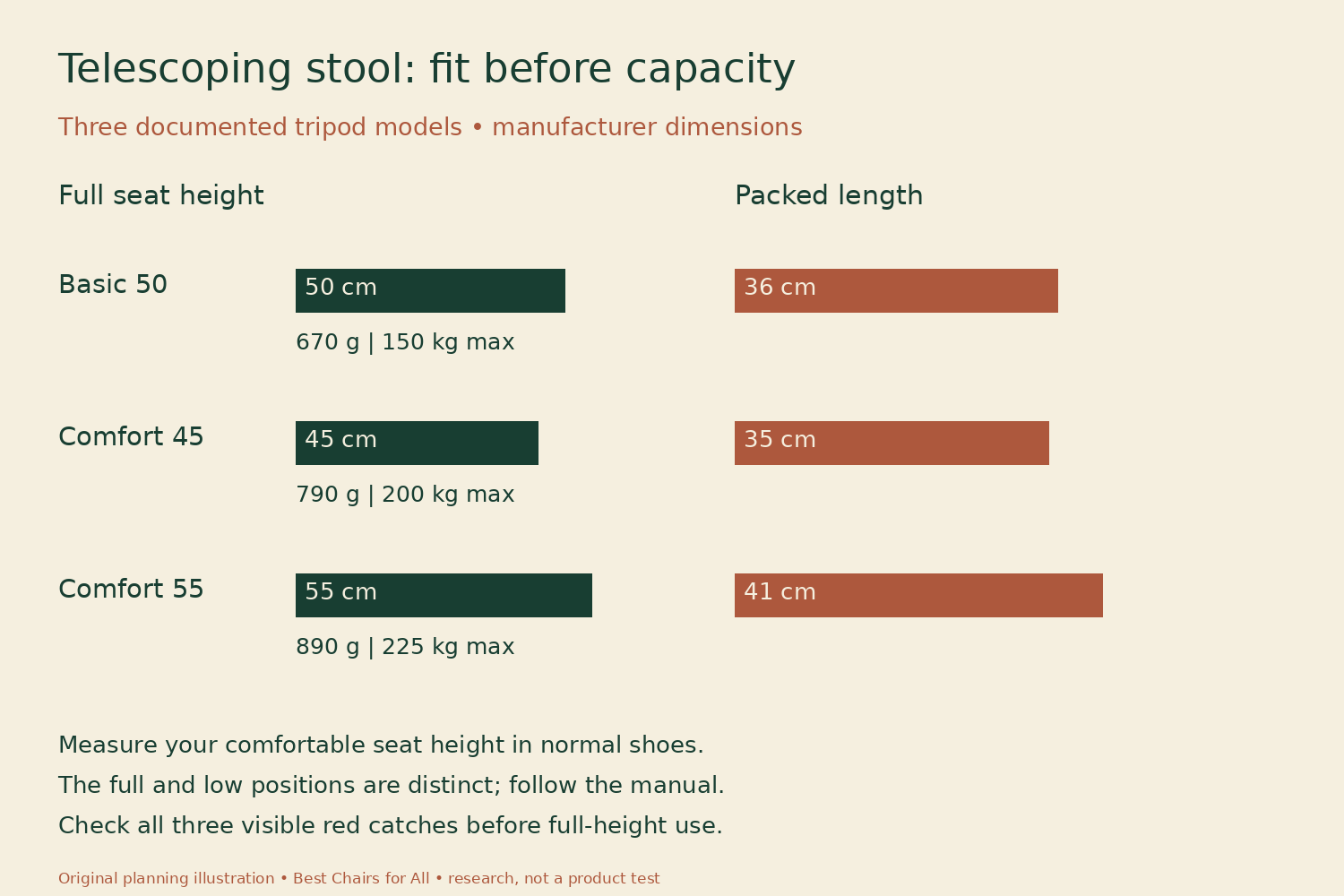
This is deliberately a narrow, documented shortlist of three real models in one product family. It does not pretend to rank every circular plastic telescoping stool sold online. A product name or impressive load number alone is insufficient evidence for explaining its locking procedure. Buyers specifically wanting a round, disc-shaped stool should obtain that exact brand’s current instructions before treating it as interchangeable with these tripods.
What “telescopic” changes about the purchase
A stool can fold without having telescopic legs. Here, the lower leg sections retract into the upper sections, reducing the carried length. The seat still has a triangular shape, and you must be comfortable sitting without a backrest. A telescoping tripod also differs from a single-leg leaning seat: the latter depends on a different posture and contact arrangement. Decide which experience you want before comparing carry sizes.
The manufacturer’s Basic specifications and Comfort specifications supply the figures in the product details below. We use their metric weights because some rounded US weights and older seller listings differ. Walkstool’s model comparison also makes clear that buying a taller Comfort changes the seat size as well as the height. Model numbers therefore represent meaningful fit differences.
1. Walkstool Basic 50
Best for: occasional short stops with a compact tripod.
The Basic 50 is my research-based starting point for someone who wants a proper three-legged seat for occasional waiting, photography stops, or day trips. It removes the backrest and armrests from the packing equation, so it makes sense when you can remain comfortably upright without them.
Its limitation is the smaller seat and standard feet. Consider where your thighs meet the fabric edges and whether your intended stopping places provide suitable support. A lighter bag is useful only if the seat feels usable when you arrive; saving a few ounces does not compensate for a poor fit.
Product Details
| Brand | Walkstool |
|---|---|
| Full / low sitting height | 50 / 30 cm |
| Packed length | 36 cm |
| Seat size | 32.5 cm |
| Weight | 670 g |
| Maximum load | 150 kg / manufacturer lists 330 lb |
| Feet | Standard plastic |
Pros
- A straightforward choice when the ordinary full-height position suits you.
- The simpler seat is worth considering for infrequent use.
Cons
- No backrest for supported lounging.
- Standard feet deserve particular attention on soft surfaces.
Choose this model for brief seated pauses after checking your required height and load. Choose a Comfort model when its different seat or feet solve a specific problem, rather than buying the Basic solely because it is the smallest purchase.
2. Walkstool Comfort 45
Best for: a lower full-height seat and short packed length.
The Comfort 45 is the most attractive of these three for a buyer who wants a lower ordinary sitting position. It is also the shortest packed option here. Those two advantages belong together: it can suit a compact day bag without forcing the buyer into the taller posture of the Comfort 55.
The larger feet and mesh distinguish the Comfort family from Basic. They do not turn the stool into a level platform on a hillside. My preference for this version depends on fitting the user and the bag; it is not evidence that a lower stool is universally more comfortable or safer.
Product Details
| Brand | Walkstool |
|---|---|
| Full / low sitting height | 45 / 28 cm |
| Packed length | 35 cm |
| Seat size | 35 cm |
| Weight | 790 g |
| Maximum load | 200 kg / manufacturer lists 440 lb |
| Feet | Large TPE |
Pros
- A useful candidate when a higher perch leaves your feet poorly supported.
- Short packed length can be easier to accommodate inside a bag.
Cons
- A lower seat can be inconvenient for someone who dislikes lowering themselves.
- The high published load limit does not establish personal comfort.
Try the full-height posture against a familiar seat before ordering. If you need a taller position for a specific viewing or working task, compare the 55 rather than assuming the smallest Comfort is automatically the best.
3. Walkstool Comfort 55
Best for: a taller perch with more seat fabric.
The Comfort 55 is my pick within this shortlist for a buyer who has already established that a taller stool fits their task. The extra seat size is also worth a personal comparison. Photographers should check the resulting eye line against the actual tripod or viewing opening rather than choosing by body height alone.
The tradeoff is a longer package and additional carry weight. This can be entirely reasonable for a car-to-viewpoint trip and less attractive in a tightly packed shoulder bag. Do not treat its two sitting positions as permission to stop the telescopic legs at arbitrary intermediate extensions.
Product Details
| Brand | Walkstool |
|---|---|
| Full / low sitting height | 55 / 33 cm |
| Packed length | 41 cm |
| Seat size | 37.5 cm |
| Weight | 890 g |
| Maximum load | 225 kg / manufacturer lists 495 lb |
| Feet | Large TPE |
Pros
- The taller seated position may match a particular work surface or viewing task.
- More seat fabric offers another fit option within the same folding system.
Cons
- Longest package of this three-model shortlist.
- Still provides no back support during a long wait.
Choose it after confirming the tall posture and measuring the bag opening. If your plan actually involves leaning back for a whole afternoon, the better purchase may be a chair with a backrest instead of any stool.
A two-measurement fitting exercise before checkout
First, measure a familiar firm seat that you can comfortably use without leaning on its back. Wear the footwear you expect to use outdoors. Record floor-to-seat height, then sit normally with your feet where you would actually place them. Note whether the seat feels too low, too high, or workable. This supplies a personal reference; it does not reproduce the flex or triangular fabric shape of the stool.
Second, identify the posture the trip requires. Someone watching a low riverbank may want a different eye line from someone observing over a crowd barrier. If using a camera, set the tripod and camera to their intended operating position first. Measure the viewing height that works from your reference seat. Do not buy a taller stool simply because a general height chart includes you in its taller-user group.
Our original fitting worksheet has four entries: reference-seat height; intended task; actual bag opening; and acceptable carried package. Fill them in before looking at load ratings. If the reference height is close to the Comfort 45 but the task requires the eye line of a higher seat, that is a real conflict to resolve in person. A higher maximum load cannot resolve it for you.
Seat-size figures deserve a separate check. The listed triangular seat measurement is not the width of a rectangular dining seat. Make a rough paper triangle using the manufacturer’s stated size as a visual prompt, then compare that shape with where your legs normally rest. This is only a screening sketch, not a prediction of pressure distribution. An in-person sit or a usable return policy remains more informative.
Worked packing example: a 38 cm internal opening
Suppose your day bag has a clear internal length of 38 cm, measured with the zipper fully open and the normal contents already inside. Against the listed packed lengths, the 35 cm Comfort 45 leaves a nominal 3 cm, the 36 cm Basic 50 leaves 2 cm, and the 41 cm Comfort 55 exceeds that straight length by 3 cm. These are arithmetic comparisons, not a guarantee that either shorter model fits.
Now make three cardboard strips of those lengths. The strips help test the opening and possible storage direction without ordering three stools. Add a rough allowance representing the bundled seat and feet; do not use a thin strip alone to claim a full package fits. A diagonal position can work in some bags but may interfere with a water bottle or force the zipper against the stool.
For an externally carried stool, inspect how the bag retains long objects. A loose strap that only encircles the middle may allow the bundle to slide downward. Use an intended attachment arrangement and confirm that it stays clear of your walking movement. The aim of the exercise is to discover whether the stool has a repeatable home, not merely whether you can force it into an empty bag once.
Weight can then break a tie between models that already fit. The difference between 670 g and 890 g is 220 g, calculated from the current manufacturer figures. Ask what you gain for carrying it: the seat geometry, height, and feet may be relevant, or they may be unnecessary for your trip. This is a more useful question than assuming the heaviest stool is the premium answer for everyone.
Read the locking instructions as a purchase requirement
Walkstool’s current manual says to check that the red safety catch is correctly positioned and visible after extending the legs. It also warns against concentrating pressure on only one or two legs on uneven ground. That instruction is more useful than a generic claim that telescopic stools are stable. Before the first outing, become familiar with the catches while the stool is unloaded and fully visible.
The same manual describes releasing and rinsing the telescopic sections for cleaning. Follow its illustrated procedure for the exact stool. The manufacturer FAQ says these stools operate without oil or other lubricants. Do not borrow maintenance advice from a different folding mechanism or introduce a lubricant simply because a dusty leg feels gritty.
If a catch is obscured, a section will not engage as described, or a component looks damaged, stop and ask the manufacturer about the part. A stool that takes less space is useful only while its mechanism remains inspectable. Avoid improvising a replacement catch, drilling a new position, or using tape to keep a reluctant leg extended.
Ground contact and the limits of a load number
Large feet spread contact differently from small tips, but soft ground still needs judgment at the actual site. Check all contact points before sitting, and relocate when a foot sinks, slips, or cannot settle properly. Do not level one leg on a loose stone or assume that independent-looking telescopic sections are approved terrain adjusters. No uneven-ground capacity has been established by this guide.
The Trionic US stool guide provides another practical reference for Comfort models and illustrates their normal and low positions. Its page also discusses other Trionic equipment. Keep those products’ certifications and capacities separate: a walker’s test standard does not become a stool certification merely because both appear on the same website.
Treat a maximum load as a limit under the manufacturer’s use conditions, not a comfort score or permission to drop heavily into the seat. Count the person and anything they carry while seated. A heavy backpack can change both loading and posture; placing it somewhere suitable before sitting may be more workable than keeping it on your shoulders. Do not use a stool as a step or elevated platform.
When the shortlist should lead you to a different category
A stool makes most sense when pauses are short, the carried package matters, and unsupported upright sitting suits you. For reading, eating slowly, or waiting through an entire game, a backrest may matter more than the space saved. Compare our camping chair versus backpacking stool guide if that is your actual decision.
Someone needing physical assistance to sit or rise should evaluate the real movement with an appropriate chair and suitable support; an unusually high capacity does not establish that a backless tripod meets that need. Likewise, a stool is not a substitute for a walking aid. Keep the buying question tied to the task the product is designed to perform.
For the three models here, make the final choice in this order: workable full-height posture, acceptable seat contact, documented maximum load, and a packed shape you can transport repeatedly. Then confirm the exact model number on the listing and the supplied instructions. The right outcome may be a modest Basic for occasional stops, a lower Comfort for a compact bag, or a taller Comfort for a particular viewing position. It may also be deciding that your outing deserves a full chair.
Something unclear or out of date? Send a correction with this article’s title and the detail to check.
Sources, research & corrections policy ↗