Choose dining-chair cushions by matching the seat shape, checking how the cushion attaches, and testing the occupied height at the table. A pad can soften a suitable chair, but it cannot reliably correct a chair that is too deep, too high, unstable, or damaged. Read the exact care instructions before buying, because removable, reversible, and machine washable describe different features.
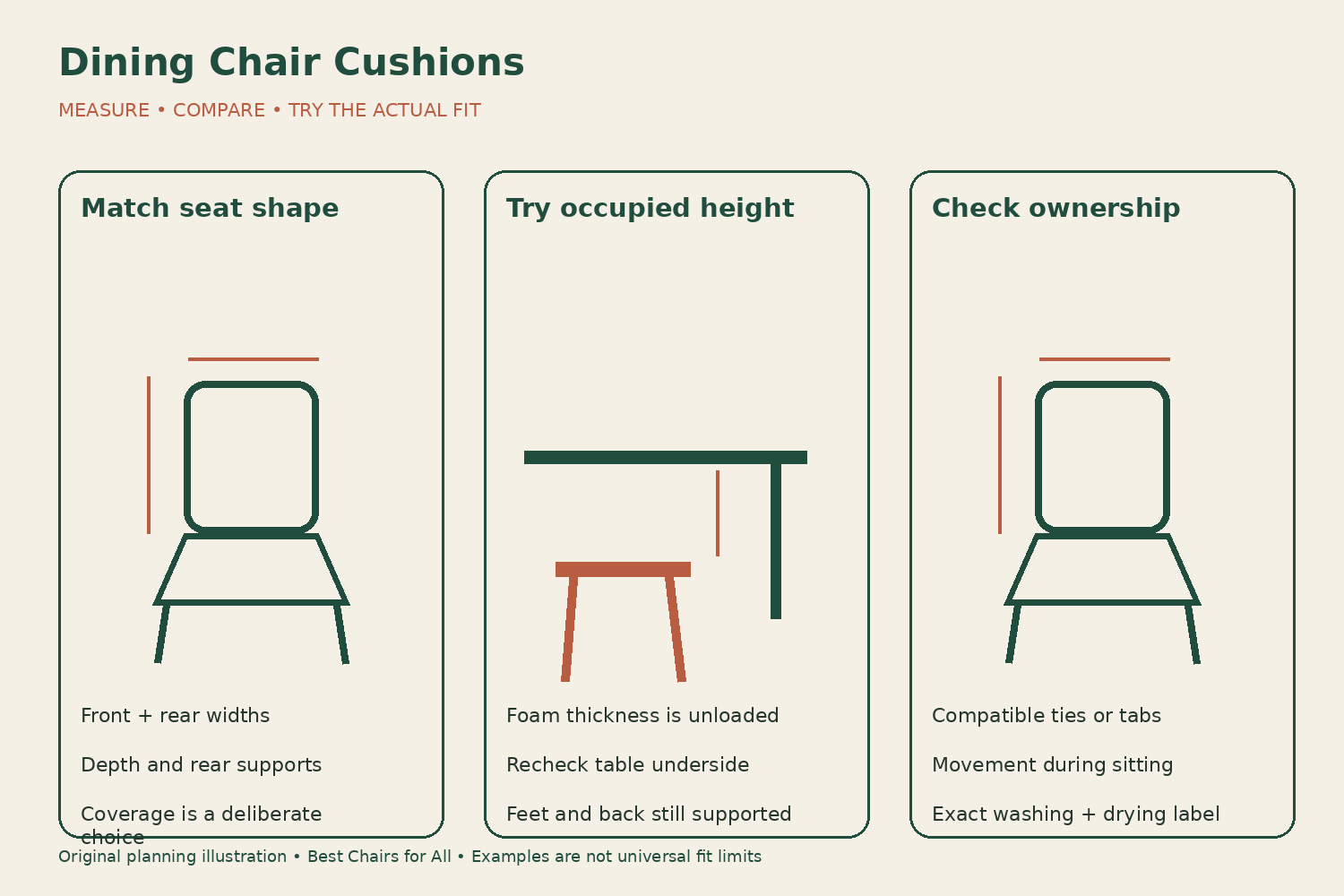
Start with the chair’s usable surface
Measure seat width at the front and near the back, depth, and any curved or angled corners. Record whether the seat is flat, contoured, tapered, round, or divided by rails. A cushion sold by one maximum width may overhang a narrow rear section or leave a large exposed area at the front. Draw the shape instead of treating every dining seat as a square.
Check the space around the back supports and arms. A pad may need notches or a particular rear shape to sit fully on the seat. Do not force a rectangular cushion around structural parts or let it bridge an opening the product is not designed to span. The cushion should have appropriate support beneath it and sit in the intended position.
For a round seat, compare diameter and edge profile; for a trapezoid, compare both widths. A paper template can help a supplier understand an unusual chair. Mark front and back and keep the template flat. Measure the chair itself rather than an old cushion that may have stretched, compressed, or never fitted properly.
Read multi-number dimensions correctly
The IKEA JUSTINA gray-blue pad lists a maximum width of 17 inches, minimum width of 14 inches, depth of 16 inches, and thickness of 2 inches. Those numbers describe a tapered pad rather than a simple 17-inch square. Read the product drawing to see how the shape corresponds to your seat.
This is a product example, not a claim that JUSTINA fits every IKEA chair or every seat within one width. Compare all relevant dimensions, attachment locations, and the chair’s contour. A pad that partly covers a seat may be acceptable for one intended use and unsuitable for another, so make the expected coverage explicit before ordering.
Ask whether stated thickness is unloaded. A two-inch pad does not necessarily raise the occupied sitter by two inches, and two cushions of the same advertised thickness can compress differently. Avoid choosing a thickness by arithmetic alone when the resulting dining position matters.
Check what the cushion changes at the table
Measure the chair’s seat height and the table’s surface and underside heights before adding the pad. Then try the complete padded arrangement. Notice eating reach, room beneath the apron, back contact, and supported feet. A cushion can improve the contact feel while reducing thigh clearance or moving the body away from the most useful part of the backrest.
For a worked example, suppose a bare seat is 18 inches high and the table underside is 27 inches. The unpadded difference is 9 inches. Adding a pad changes the occupied relationship by the amount it actually retains under the sitter, which must be observed rather than assumed from its uncompressed thickness. The calculation identifies what to recheck; it does not prescribe a cushion height.
OSHA’s chair-fit guidance emphasizes supported feet and a seat that suits the user’s dimensions within a workstation setting. Those general relationships are useful reminders, but they are not a dining-cushion approval or a medical prescription. A person with specific pain or pressure-management needs should seek appropriate individual assessment.
Treat attachment as a functional feature
Find out whether the cushion uses ties, hook-and-loop tabs, another designed attachment, or no attachment. Compare the attachment points with the chair’s actual frame. A tie that reaches a convenient spindle is not automatically intended to fasten there. Follow the cushion maker’s fitting instructions and avoid pulling against delicate decorative parts.
JUSTINA’s referenced listing identifies hook-and-loop fasteners. That feature still needs a compatible place on the chair and a correct fitting method. Do not assume that a fastening system shown on one display chair works equally well on a shell chair, a chair with no rear gap, or a seat with an integrated upholstered back.
Keep straps clear of folding linkages, swivels, and any moving parts. Do not use a cushion tie to lock a mechanism or to join two chairs together. Excess length should be managed only as the product instructions allow, so it does not hang into a footpath or become caught during normal movement.
Test movement during ordinary use
Sit and stand normally with the correctly fitted cushion in place. Notice whether it shifts forward, curls at the edge, or changes the way the feet reach the floor. Try the normal approach to the table and a modest turn of the body during conversation. A pad that looks centered while empty may behave differently under a person.
Do not add improvised anti-slip layers, adhesive, or rubber mats without checking compatibility with the cushion and chair finish. Such materials can change movement, leave residue, or affect the surface. If a pad will not stay as intended, seek a compatible design or guidance rather than constructing a hidden stack of unapproved materials.
Try the users who will sit there regularly. One person’s weight, proportions, clothing, and movement can produce a different result from another’s. Record specific observations instead of calling the cushion universally secure or comfortable. A successful fit is a relationship among person, pad, chair, and table.
Compare support and softness honestly
A plush cushion can feel pleasant in the hand while compressing enough that the sitter still notices the hard seat beneath. Another pad may feel firmer but maintain a shape the user prefers. Ask about the intended use and material, then try it if possible. Do not invent foam-density benefits or service-life predictions from a product’s marketing adjective.
Look at the edges and tufting as part of the sitting surface. A thick bound edge, deep buttoning, or strong contour can be noticeable during a meal. A flatter pad may suit one user better, while another prefers a shaped cushion. Keep appearance and occupied comfort as separate observations.
Avoid stacking multiple cushions to raise a person to the table. The stack changes stability, depth, arm relationship, and entry all at once. If the chair is fundamentally unsuitable in height or dimensions, choose a more appropriate chair or obtain assessed advice rather than treating extra padding as a general height-adjustment system.
Check washing at the product level
JUSTINA’s gray-blue care instructions permit machine washing warm but prohibit bleach, tumble drying, ironing, and dry cleaning. Those directions apply to that pad. Another color, filling, or product may have different instructions, so keep the label and verify the exact item instead of copying a routine from a similar-looking cushion.
A removable cover is a separate feature from a washable complete pad. A zip may be provided for manufacturing or service rather than home laundering. Ask whether the insert and cover can be separated by the owner, which parts can be cleaned, and how to refit them. Do not put a foam insert in a washer simply because the cover can be washed.
Sunbrella’s upholstery-care guidance says furniture construction matters when deciding whether to remove and wash casings. This principle is useful for custom cushions too: the fabric’s capability does not alone establish the approved cleaning method for the finished pad, its seams, filling, attachments, and any backing.
Plan for spills, drying, and rotation
Read the allowed spill response and routine cleaning method before placing cushions at a frequently used table. Keep the chair’s own finish guidance alongside it, since a wet pad can hold moisture against wood. Remove and dry items only as instructed, and do not return damp components to ordinary use before the approved drying process is complete.
If a pad is reversible, use that feature according to its design; a pad with a special underside may not be intended to turn over. JUSTINA’s listing explicitly describes two identical sides, which is stronger evidence than assuming every cushion can be flipped. Check attachment orientation when turning a permitted pad.
Consider whether you need spare cushions while a set is being cleaned. Verify model and size compatibility rather than buying a similar replacement that changes seat height or fastening. Store spare pads clean and appropriately dry, away from conditions their material instructions discourage.
Use a cushion comparison card
Record chair shape and dimensions, table opening, cushion dimensions, occupied-height observations, attachment method, movement during use, and exact care instructions. Add the product code and a photograph of the fitted pad. This makes a successful setup repeatable if a household member removes the cushion for cleaning.
Compare coverage, comfort, security, and maintenance separately. A pad that covers every inch may be harder to fit around the back supports; a smaller pad may feel suitable but look different from what you expected. Decide those tradeoffs deliberately instead of treating the largest or thickest option as automatically better.
Before buying a full set, trial one pad where practical within the seller’s terms. Confirm it sits as intended, does not interfere with the chair, and leaves a usable dining position. The successful cushion adds a comfortable surface to a sound, suitable chair while remaining straightforward to attach, clean, dry, and refit.
For a tapered seat, compare the pad and chair at matching distances from the front. A pad may match both maximum and minimum widths yet taper at a different rate, leaving its sides unsupported in the middle. Lay a paper outline on the chair to see that relationship before purchase, without attaching tape to a sensitive finish. This is especially helpful when ordering a custom pad from a supplier who cannot inspect the chair directly.
Something unclear or out of date? Send a correction with this article’s title and the detail to check.
Sources, research & corrections policy ↗