A transfer bench can interrupt the line of an ordinary shower curtain because part of the bench remains outside the tub. Manage that relationship through the exact bench’s design and the person’s assessed bathing setup. Keep the liner directing water into the tub, preserve the required supports and access, and investigate any water outside before the route is used.
Separate the water barrier from the seating system
The bench supports an assessed bathing and access arrangement; the curtain contains spray and runoff. A curtain that closes attractively cannot compensate for a bench that does not fit or has unstable feet. A correctly fitted bench can still create a water-management problem if the liner hangs outside the tub around it. Evaluate both systems without asking one to perform the other’s role.
Begin with the exact bench model, its instructions and the bathroom layout already reviewed for the person. If the equipment or access arrangement remains unresolved, settle that with the provider or occupational therapist before optimizing the liner. Do not move a required support, change leg height arbitrarily or remove a backrest simply to make fabric hang more neatly.
Use a designed curtain opening when the model provides one
The Drive Splash Defense RTL12032KDR page describes a U-shaped opening intended to let the curtain liner remain within the tub while the bench spans its edge. That is a feature of this design. It is not a general instruction to cut an opening in another bench or route fabric through a random gap in its frame.
Read the matching instructions and ask the provider to demonstrate the liner relationship on the assembled empty product. Confirm the intended orientation and how the liner avoids the sitting area, attachment points and feet. If the chosen liner cannot follow the documented arrangement without interfering with support or access, ask about a suitable liner or another approved solution rather than forcing it.
A solid-seat bench needs its own containment plan
A bench without a designed curtain opening can interrupt the liner differently. Ask its manufacturer and the assessing therapist how the specific product and enclosure should be arranged. A specialized curtain may be an option only when its dimensions and use suit the equipment and individual plan. Do not assume a curtain advertised for transfer benches fits every seat width or bathroom.
Avoid placing an ordinary liner beneath the person, draping it across the seat or trapping it under a leg to hold it in place. Fabric can change the seating or contact relationship and obstruct the assessed routine. Do not cut, drill or remove a structural bench section. A water barrier should be accommodated within the approved equipment arrangement, not created by altering the part supporting the person.
Trace the escape path rather than adding towels
When water appears outside, identify where it originated. Spray can pass an open edge, runoff can follow fabric that hangs outside, water can travel along an exposed bench surface, or a hose or fitting may leak independently. These are different problems. Record the location and timing during the established supported routine, without creating an extra occupied test or asking the user to reach toward the leak.
A towel on the floor absorbs some water but does not establish that the source is controlled. A loose or saturated towel can also obstruct the access route. Do not keep adding fabric around the bench as the only response to recurring escape. Use the observation to ask the provider about liner positioning, product compatibility or the relevant plumbing repair, depending on the actual source.
Check liner length and the tub-side destination
Look at where water running down the liner will go. The lower edge should follow the arrangement specified for the equipment and remain directed into the bathing area, rather than resting outside where drips reach the bathroom floor. A longer liner is not automatically better if excess material bunches around feet, supports or the person’s access area.
Compare the liner’s actual dimensions with the assembled bench and enclosure. Note hooks or a rod position that prevent it from closing in the intended way, but do not assume the rod can be used as a grab support. Any change to a fixed screen, rod or building feature should be appropriately assessed and installed. Keep the user’s support plan separate from curtain hardware.
Keep every foot and attachment free of fabric
The Splash Defense owner instructions require secure assembly and all four specified leg contacts, and advise against using compromised equipment. Use that complete-product guidance when checking a curtain arrangement. A liner held beneath a rubber tip or suction cup can interfere with the surface relationship; a fold caught around an adjustment point can conceal whether it is correctly engaged.
Inspect with the bench empty and safely positioned. Do not pull fabric from beneath an occupied support or reach into a moving or uncertain assembly. If the liner has become trapped, pause the routine and have the appropriate assistance restore the documented setup. Changing the curtain should leave the bench’s required contact, fastening and assessed height intact.
Coordinate access and bathing positions with the therapist
The liner may need a different position while the person accesses the bench than while showering. Ask the occupational therapist to include that handling task in the individual plan: who moves the fabric, where it is held clear and how it returns to the water-containing arrangement. This article does not prescribe the person’s transfer steps.
Keep the intended operator’s reach and abilities in view. A clever curtain arrangement that requires the user to twist beyond their supported position or a caregiver to step into a blocked space may not be workable. Request a demonstration of the complete routine with suitable professional guidance. The plan should preserve privacy and the person’s participation while keeping the required support and assistance available.
Treat the outside floor as a separate completion check
MedlinePlus bathroom-safety guidance advises keeping the floor outside the tub or shower dry. A curtain system should therefore be followed by an actual floor check, not a claim that a specialized bench guarantees no water escapes. The area beside the bench, the route to other equipment and the space near the bathroom door all matter.
Arrange who addresses water without asking the person using the bench to bend or reach into an unassessed position. Keep supplies available within the agreed routine, then restore a clear dry route before it is used. If water repeatedly reaches the same place, record the pattern and resolve its source. The existence of a cleanup routine does not remove the need to correct a persistent leak or unsuitable liner arrangement.
Clean, dry and restore the setup consistently
Follow the liner’s own care directions and the bench manufacturer’s cleaning instructions separately. Do not assume that a curtain cleaner is suitable for the bench’s rubber, plastic or metal components. After permitted care, check that the liner is rehung as intended and that the bench returns to its assessed position with all parts secure.
In a shared bathroom, explain which curtain and equipment arrangement must be restored after another person showers or cleans. Keep a labeled photograph of the correct empty setup if useful. Recheck after a new liner, changed rod height, replacement bench part or bathroom modification. A small change in fabric length or equipment position can move the runoff path even when the room looks essentially the same.
Transfer-bench curtain and water-path checklist
| Check | Evidence and decision |
|---|---|
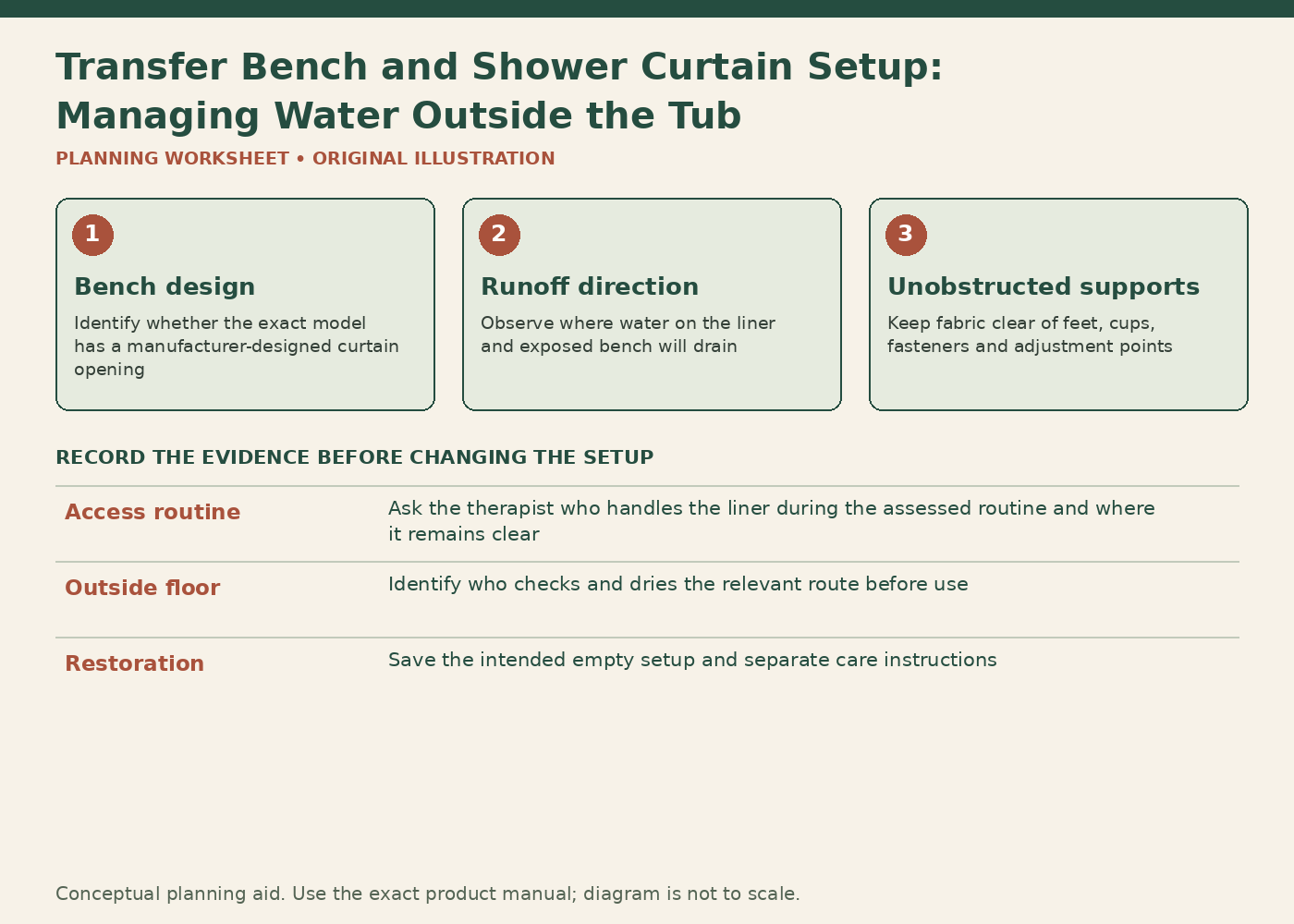
| Bench design | Identify whether the exact model has a manufacturer-designed curtain opening. Use the matching directions. Do not cut a solid seat or treat an accidental frame gap as a liner channel. |
| Runoff direction | Observe where water on the liner and exposed bench will drain. Note an outside lower edge, open side or separate hose leak. Solve the identified path rather than relying on a generic towel barrier. |
| Unobstructed supports | Keep fabric clear of feet, cups, fasteners and adjustment points. Check the empty product’s required contacts. Do not pull a trapped liner from beneath an occupied support. |
| Access routine | Ask the therapist who handles the liner during the assessed routine and where it remains clear. A water barrier should not require awkward reach, obscure support or replace an individual transfer plan. |
| Outside floor | Identify who checks and dries the relevant route before use. Keep loose saturated fabric from becoming an obstacle. Repeated wetting needs source correction even when cleanup has been arranged. |
| Restoration | Save the intended empty setup and separate care instructions. Recheck after a replacement liner or equipment change. Curtain convenience does not authorize changing the bench’s prescribed configuration. |
Worked example
In a hypothetical bathroom, the liner closes around a transfer bench but its lower section remains outside the tub beside the outer seat. Water running down that section reaches the floor. Adding a towel catches some drips, but the observation identifies a runoff path that still needs correction. The provider reviews whether the liner can follow the bench’s documented arrangement or whether another compatible water-management solution is needed.
A different household uses a bench with a designed U-shaped curtain opening. That feature can guide the liner inside as intended, yet the household still checks that fabric is not beneath a foot, the seating area remains clear and no water escapes from another source. Neither a closed curtain nor a specialized cutout proves the whole routine is ready. The completed worksheet records the specific bench, liner path, support checks and dry-floor responsibility so the setup can be restored after cleaning or shared use.
Sources checked November 6, 2026
Use the current document for the exact model, market and production revision. These sources establish the cited instructions and distinctions; they do not certify an individual chair or replace a personal assessment where one is needed.
- Drive Medical: Splash Defense RTL12032KDR specifications
- Drive Medical: Splash Defense RTL12032KDR owner instructions
- MedlinePlus: Bathroom safety for adults, including keeping the outside floor dry
- Drive DeVilbiss: Bathroom safety guides and product questions
Something unclear or out of date? Send a correction with this article’s title and the detail to check.
Sources, research & corrections policy ↗