A shower chair’s height range is a product capability, not a recommended setting for every user. Ask an occupational therapist to consider the person’s support, access and assistance needs in the actual bathroom, then confirm that the selected chair can provide the assessed arrangement within its manufacturer’s instructions.
State what the height change is meant to solve
Begin with the actual difficulty: feet not supported, an awkward approach, discomfort in sitting, trouble using the installed supports or an access barrier at the tub. These observations can have different causes, so raising the chair should not be the automatic response. Tell the therapist when the problem occurs and whether it began after an illness, surgery, equipment change or change in assistance.
Do not use an adjustment as an unsupervised test of the person’s ability to stand or transfer. The clinician can evaluate those tasks and specify the support or assistance needed. An article cannot establish a safe personal setting from total height or a diagnosis. The useful starting question is which relationship needs assessment, not which numbered hole is normally used by people of the same age.
Define the floor reference before taking a number
Seat-to-floor height should identify which supporting surface and which point on the seat are being measured. A chair inside a bathtub stands on the tub floor, which can be at a different level from the bathroom floor. A spanning bench relates to both sides of the tub and has its own documented leg and seat geometry. Do not copy a chair’s measurement into a bench setup without clarifying the references.
Record whether the figure is an unloaded product specification or a measurement of the actual setup. A shaped seat may not be equally high at every edge. Ask the therapist or supplier where they want the measurement taken. Mark the location on a drawing so another caregiver can reproduce it without guessing which corner of the seat was used.
Bring the complete sitting and access arrangement
Tell the therapist whether the person will ordinarily be barefoot, which mobility equipment they use nearby and what prescribed supports are involved. Include the location of grab bars, the shower control, the tub edge and any assistance. A height that seems convenient beside a dry bathroom chair may not represent the actual bathing arrangement.
Seat width, depth, arms and back support should be considered alongside height. A user may move forward because of seat depth or missing support rather than because the seat is too high. Do not add an ordinary cushion, remove an armrest or raise the whole product on blocks to make the trial look better. Any accessory should be intended for that chair and approved within the individual plan.
Compare available ranges before selecting a model
Etac’s Swift page distinguishes regular and low variants with different seat-height ranges. That is a useful reason to check the exact article number, rather than assuming one product-family name covers every required setting. An adjustable design still has a lower and upper limit; not every person or bathroom can be accommodated by the same variant.
Ask the supplier for the usable settings of the actual ordered chair, including how arms, back and any approved pad affect the arrangement. A range printed in a retailer listing should be reconciled with the current manufacturer document. Do not buy a taller version on the assumption that a leg can be cut down, or a lower version expecting an extension beyond the specified holes.
Learn how secure engagement is recognized
The Medic Therapeutics instructions require the adjustment buttons to protrude through their holes and all four tipped legs to contact the floor together. For that chair, the visible engagement and contact conditions are part of setup. Other models can use different indicators or mechanisms, so ask the provider to demonstrate the actual design.
Adjust only with the product empty and as its instructions permit. Keep fingers away from moving joints and do not put a person into a partly engaged setup to see whether it holds. If a button does not emerge, a leg slips or the assembly remains loose, stop and seek service. More body weight on the seat is not a method for forcing a latch into engagement.
Do not turn one chair’s leveling rule into a universal method
A simple chair, a flexible shower stool and a transfer bench can have different permitted support arrangements. Read the exact instructions for leg settings, floor conditions and any designed seat inclination. Do not arbitrarily use unequal extensions to compensate for a tub slope or copy a setting from a different model.
Etac describes a specifically designed forward-tilt option for certain Swift configurations. That feature is not permission to tilt every shower chair or a recommendation that the person needs that position. If considered, the therapist and provider should establish its suitability and the manufacturer’s constraints. An unstable chair is not corrected merely by finding a combination that looks level from one viewpoint. The required engagement and contact conditions must still be met.
Check how height affects footprint and surrounding space
The Drive Splash Defense specifications list a height range and half-inch adjustment increments for that bench alongside separate tub-compatibility conditions. The height figure does not replace the tub measurements. Similarly, a shower chair’s support footprint and upper clearance can vary with the selected arrangement.
After a proposed setting is chosen, verify the feet, tub walls, backrest and nearby screen in that configuration. An arm may approach a faucet or the seat may no longer align with the intended support arrangement. Do not reduce the stance or remove required parts to keep a preferred height. If the product cannot achieve the complete assessed setup within its limits, discuss a different model or bathroom solution.
Ask for a written setting and a clear review trigger
At the end of the assessment, request a record that identifies the chair, its required supports, the selected setting and the reference surface. Include who may adjust it and what checks must follow. A photograph can supplement that record if it clearly shows the relevant features, but a cropped view of one leg is not the complete configuration.
Ask when the arrangement should be reviewed: a change in mobility, discomfort, a different assistance routine or a replacement part may matter. Do not continue changing height repeatedly to compensate for an unresolved functional problem. Make the review request specific, describing what is now different from the agreed setup. This helps the clinician distinguish an equipment fault from a changed support need.
Plan for cleaning and shared bathrooms
If another household member moves or adjusts the chair, the next use should begin with restoration of the assessed configuration and the manual’s checks. Label or record settings in a way that does not obstruct adjustment holes, damage the product or create a loose small part. Keep the manufacturer label readable.
For two users, obtain separate assessments rather than assuming one compromise height suits both. Confirm who resets the chair, how the correct configuration is recognized and whether moving it is practical in the room. A shared product’s capacity and range alone do not establish that it provides the required support for each person. If safe restoration cannot be made reliable, the household needs another plan with the provider.
Questions and measurements for the occupational therapist
| Check | Evidence and decision |
|---|---|
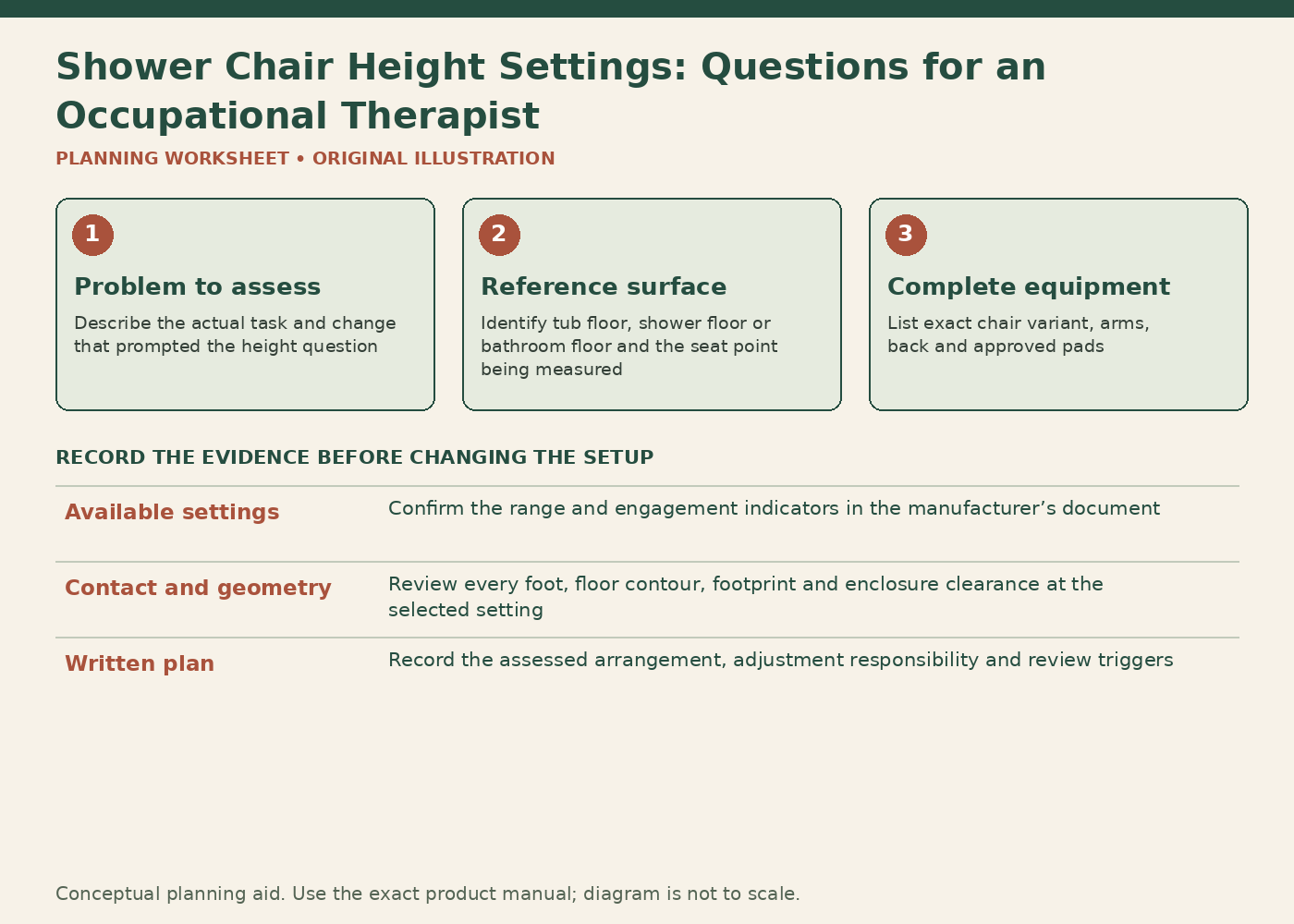
| Problem to assess | Describe the actual task and change that prompted the height question. Separate discomfort, foot support and access barriers. Do not choose a setting from age, total height or another user’s photograph alone. |
| Reference surface | Identify tub floor, shower floor or bathroom floor and the seat point being measured. Preserve units and location. A number taken outside the tub can describe a different relationship from seat-to-supporting-floor height. |
| Complete equipment | List exact chair variant, arms, back and approved pads. Bring nearby mobility equipment and support information to the therapist. Do not add an ordinary cushion or remove required supports to force a trial fit. |
| Available settings | Confirm the range and engagement indicators in the manufacturer’s document. Have the provider demonstrate them on the empty product. A partly emerged button or slipping extension is a service concern, not a usable setting. |
| Contact and geometry | Review every foot, floor contour, footprint and enclosure clearance at the selected setting. Follow only the model’s permitted leg relationship. Do not level with blocks or copy another design’s inclination feature. |
| Written plan | Record the assessed arrangement, adjustment responsibility and review triggers. Restore that configuration after cleaning or shared use. A changed function or unstable product needs reassessment rather than repeated unsupervised height experiments. |
Worked example
A hypothetical chair has a seat 18 inches above the tub floor. If that tub floor is three inches higher than the nearby bathroom floor, the seat is 21 inches above the bathroom floor at that location. Both descriptions can be mathematically consistent, yet they refer to different surfaces. Neither number by itself establishes a suitable personal height.
The therapist asks for the actual supporting-floor reference, the complete chair configuration and the person’s assessed task. The supplier confirms the selected model’s permitted settings and secure engagement. If another family member later says the chair was moved to “the 18-inch setting,” the saved drawing prevents confusion about which floor and seat point were measured. These invented dimensions illustrate why reference points matter; they are not a prescription, a transfer instruction or a recommendation to use either height.
Sources checked November 6, 2026
Use the current document for the exact model, market and production revision. These sources establish the cited instructions and distinctions; they do not certify an individual chair or replace a personal assessment where one is needed.
- Etac: Swift height variants, adjustment features and user documents
- Medic Therapeutics: Adjustable bath and shower chair instructions
- Drive Medical: Splash Defense RTL12032KDR specifications
- Drive DeVilbiss: Bathroom safety guides and product questions
Something unclear or out of date? Send a correction with this article’s title and the detail to check.
Sources, research & corrections policy ↗