A bedside commode provides a toileting arrangement away from a fixed toilet. A shower commode is specifically intended for the documented wet-area tasks as well. Some products combine these roles, but “3-in-1,” a removable bucket or metal construction does not by itself authorize shower use. Check the exact model’s intended-use instructions.
Read the role before comparing the shape
A seat with arms, four legs and a pan can resemble another product with a different intended environment. Start with the manufacturer’s product identity and intended-use section, not a generic marketplace category. Write the activities needed: bedside toileting, positioning over an existing toilet, showering and any movement between locations. These are separate requests.
A product can meet one request without meeting the others. A bathroom chair does not automatically function over a toilet, and an over-toilet commode does not automatically permit shower exposure. A broad label such as multipurpose is a prompt to read the mode descriptions, not permission to supply your own list of uses. Ask the manufacturer when the manual does not clearly cover a required task.
Some models explicitly support multiple settings
The Etac Swift Commode manual describes that product as a shower commode for use as a stand-alone toilet, over a toilet or in the shower, in its documented arrangements. This is an example of explicit intended use. It is not evidence that every bedside commode from Etac or another company has the same permission.
Identify the actual model, variant and supplied components before relying on that description. Older manuals or a different market version can differ. Have the supplier provide the appropriate document for the chair in front of you. A secondhand seller’s recollection that it was “used in the shower” does not establish that the manufacturer intended or approved that use.
A product-family FAQ is a starting point, not the final manual
Drive Medical’s commode FAQ directs shower-use questions toward its shower-commode range and separately discusses ordinary commode accessories and care. Its 2026 commode catalog identifies dedicated shower-commode models. The useful next step is to locate the exact model’s instructions, rather than applying the whole range’s possible uses to one familiar frame.
Send the model number and a clear label photograph to the manufacturer if the wording remains unclear. Ask whether the proposed wet environment and configuration are intended uses, which components are required and how the product is cleaned afterward. Keep that answer with the manual. A reassuring description from an unrelated retailer is weaker evidence than the responsible manufacturer’s instructions for the same product.
Distinguish the pan from an over-toilet arrangement
A removable pan collects waste in the stand-alone arrangement. A splash guard, where specified, serves a different role over an existing toilet. The actual manual determines which parts are installed in each mode and how the product relates to the toilet beneath it. Do not assume removing the pan automatically creates a suitable over-toilet seat.
Measure the existing toilet, nearby cistern, seat, floor and surrounding approach, then compare the exact product drawing. Check whether the prescribed arms, back and support footprint fit the room. Do not raise the commode on blocks or remove a structural brace to clear the toilet. The toilet relationship is a compatibility question separate from the user’s seating and transfer assessment.
Stationary and wheeled products need different plans
Wheels can change a product’s intended task, overall footprint, controls and required support. They are not a general upgrade for a stationary commode. The Drive FAQ says it does not offer or advise wheels for its standard 3-in-1 commodes. Follow the exact product’s instructions rather than fitting generic casters into its legs.
If occupied movement is required, discuss a specifically intended system with the clinician and supplier. A chair being light enough to carry empty does not establish permission to move it with a person seated. Ask about the documented movement conditions, braking or parking functions, supports and operator training for the selected model. This article does not prescribe a transfer method or teach pushing an occupied shower commode through a bathroom.
Wet-area permission does not settle individual suitability
A manufacturer’s shower-use statement addresses the product’s intended environment. The person still needs an appropriate assessment of sitting support, skin and comfort concerns, access, assistance and the bathing task. An occupational therapist or another qualified clinician can connect those needs to the seat, arms, back and any additional prescribed components.
Do not select a product from load capacity alone or add an ordinary cushion over a hygiene opening to make it more comfortable. Ask which pads and supports are designed for the model and suit the clinical plan. A cutout, soft pad or removable arm can have a specific role; changing it can affect the intended support and access arrangement. Keep personal support needs visible alongside the manufacturer’s environmental permission.
Survey shower geometry and the approach
For an intended shower commode, map the enclosure opening, floor slope, threshold, drainage and space around the person and any assistant. A wheeled product may need a different route and turning arrangement from a stationary chair, while a stationary model still needs correct foot contact. Check the full external dimensions with required supports installed.
A product fitting beside the bed may not fit through the shower door or over the toilet. Do not remove a needed support to pass through a narrow gap or try an occupied maneuver to see whether it will work. Share the room drawing and equipment dimensions with the clinical team. An environmental constraint can require a different documented product or an appropriately assessed room arrangement.
Clean and inspect according to the actual material and mode
A commode used in a bedroom and a product intended for shower exposure can have different care and drying requirements. Follow the manufacturer’s cleaning and disinfection instructions, including any restrictions on pads, pans and metal parts. Do not import a strong bathroom cleaner or another chair’s disinfecting process simply because both products are white plastic.
Check the frame, attachments, feet or casters, seat, pan retention and any locking mechanisms as specified. Report corrosion, cracks, looseness or damaged upholstery to the supplier and stop use when the manual requires it. Visible deterioration should not be dismissed as normal because the product has been wet. A coating claim or a corrosion-resistant material does not remove the need to inspect the complete assembly.
Preserve the configuration when changing location
If the approved product is used in several locations, document what changes between modes and what remains installed. Identify who removes or restores the pan, pad or other permitted component and which checks follow. Do not let an incomplete cleaning configuration become the next toileting or bathing setup. Keep model-specific parts together and labeled for the responsible caregiver.
For a shared or secondhand product, obtain the complete parts list and have the arrangement reviewed before use. Ask the provider to demonstrate required setup and service boundaries. A useful decision records explicit intended use, appropriate individual fit, room compatibility and a repeatable care routine. It does not rely on a single category name to promise every function a household hopes to combine.
Commode intended-use and configuration matrix
| Check | Evidence and decision |
|---|---|
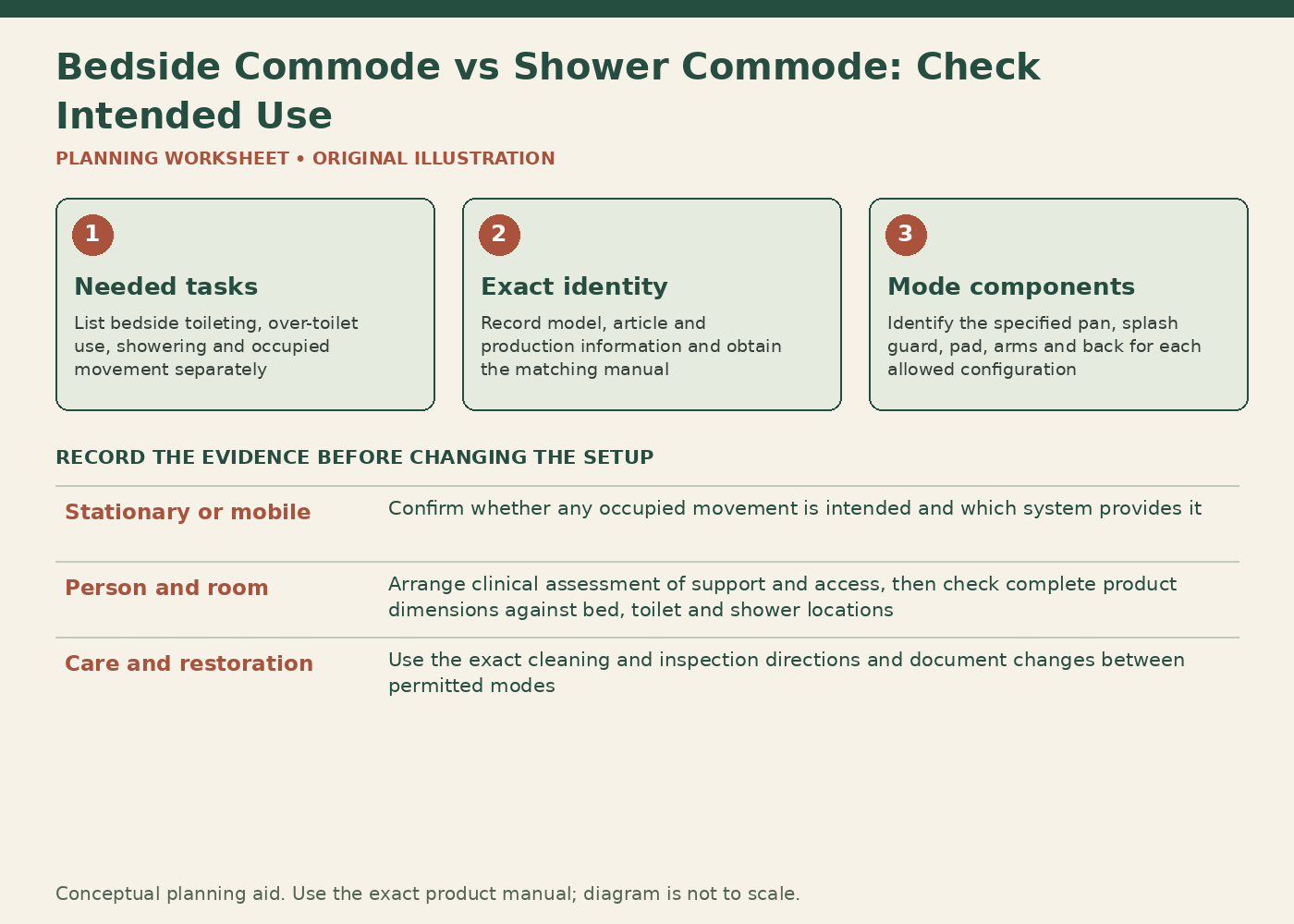
| Needed tasks | List bedside toileting, over-toilet use, showering and occupied movement separately. Ask for explicit manufacturer permission for each required task. A three-in-one sales label is not your completed intended-use table. |
| Exact identity | Record model, article and production information and obtain the matching manual. Do not infer shower permission from another chair in the same brand family or a previous owner’s practice. |
| Mode components | Identify the specified pan, splash guard, pad, arms and back for each allowed configuration. Removing a bucket alone does not establish over-toilet fit, and adding a pad does not create a suitable shower seat. |
| Stationary or mobile | Confirm whether any occupied movement is intended and which system provides it. Do not retrofit wheels onto a stationary commode. Empty-product carrying and seated-user transport are different permissions. |
| Person and room | Arrange clinical assessment of support and access, then check complete product dimensions against bed, toilet and shower locations. Manufacturer wet-use permission does not prove personal suitability or bathroom clearance. |
| Care and restoration | Use the exact cleaning and inspection directions and document changes between permitted modes. Keep required parts available. An incomplete configuration or damaged component needs correction before the next use. |
Worked example
A household already owns a hypothetical bedside commode advertised as 3-in-1 and wants to place it in the shower. The manual clearly describes toileting modes but does not establish shower use. The appropriate entry in the comparison table is “manufacturer confirmation needed,” not an assumed yes based on the removable pan or frame material. The household asks about the exact model and considers a documented shower-commode alternative.
A different product, such as the Swift Commode described in its matching manual, can explicitly include showering. That resolves the intended-environment question but leaves individual support, room dimensions and the actual configuration to assess. If it will be used over a toilet as well, the supplier checks that relationship independently. These two cases demonstrate why neither a blanket rule against all bedside commodes in showers nor a blanket approval of multipurpose frames is accurate. The decision follows the specific product and person.
Sources checked November 6, 2026
Use the current document for the exact model, market and production revision. These sources establish the cited instructions and distinctions; they do not certify an individual chair or replace a personal assessment where one is needed.
- Etac: Swift Commode user manual
- Drive Medical: Commode intended-use and accessory questions
- Drive Medical: 2026 commode catalog, dedicated shower-commode models
- Drive DeVilbiss: Bathroom safety guides and product questions
Something unclear or out of date? Send a correction with this article’s title and the detail to check.
Sources, research & corrections policy ↗