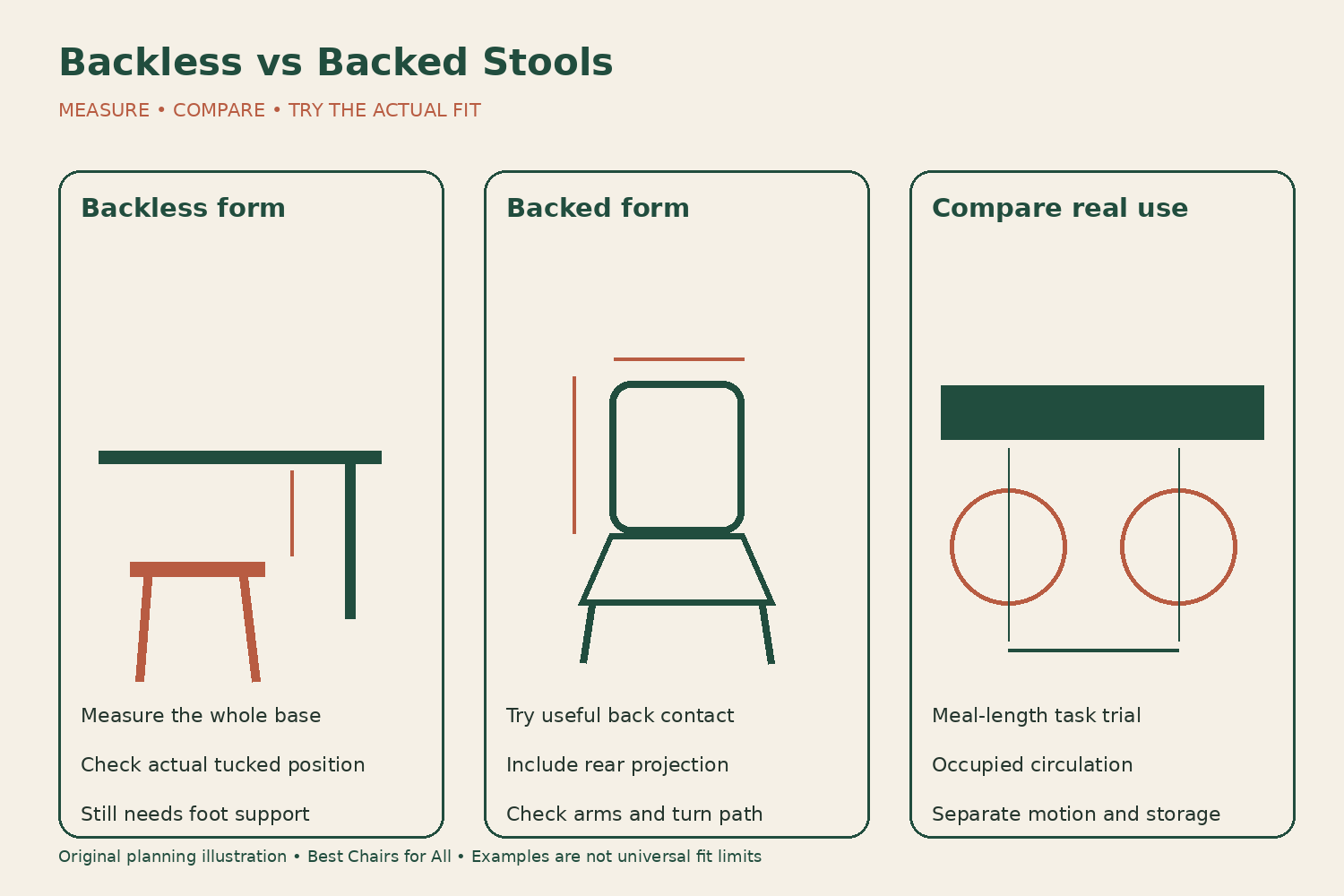
Backless stools can keep a view open and may tuck beneath a counter, while backed stools offer a surface to lean against. The better choice depends on how the island is used and whether the complete stool fits the person and room. Compare actual height, depth, foot support, and movement. A backrest does not guarantee comfort, and its absence does not guarantee a smaller footprint.
Define the job before choosing the silhouette
Write down the longest routine use of the island: a quick coffee, breakfast, a full meal, conversation while cooking, or an occasional laptop session. A stool chosen only to complete a photograph may not suit the activity that happens every day. Try the candidate for the actual kind of use rather than deciding from the first few seconds of softness.
For someone who likes to lean back during a meal, an appropriately fitted backrest may be a useful feature. For a brief perch that is stored under the counter, an open backless form may be practical. These are preferences to evaluate with the intended users, not universal rules about how long anyone can sit in either style.
If a person has specific mobility, support, pain, or pressure concerns, obtain appropriate individual advice. A general comparison cannot establish therapeutic benefit or suitability for a transfer routine. Keep those needs separate from the decorative question of whether the chair backs interrupt a sightline.
Measure storage clearance honestly
For a backless stool, compare seat height and the highest fixed part with the counter’s lowest underside obstruction. Then compare the entire base and seat depth with the usable overhang and cabinet face. A stool may fit vertically while its legs remain in the room. “Tucks under” needs a measured stored position, not an assumption from the missing backrest.
For a backed stool, record overall height, back projection, and any arms. The back may remain outside the counter while the seat moves beneath it, or it may stop the whole chair farther out. Measure the resulting projection from the counter edge. Do not treat the seat’s depth alone as the amount of floor space the stored chair occupies.
Check counter supports, plinths, and footrests during the storage trial. A rail may hit cabinetry before the seat reaches the intended position. Avoid pushing the stool against the cabinet as a stop; repeated contact can damage both finishes. The usable stored arrangement should preserve appropriate clearance without force.
Compare documented product forms
The IKEA DALFRED listing describes an adjustable backless stool with a seat-height range of 24¾–29⅛ inches and a 19⅝-inch width and depth. Its seat diameter is listed separately. That distinction demonstrates why a small round seat should not be mistaken for the whole floor footprint.
The IKEA FRANKLIN counter-height listing identifies a backed, folding stool with a 24¾-inch seat and a footrest. A back does not prevent a separate folding-storage strategy. The comparison must include how each product is stored, not just whether its upright form has a backrest.
The Holland Bar Stool C8C1 is a backless swivel design offered in 25- and 30-inch seat heights. This adds another independent feature: backless does not mean fixed, and backed does not mean swivel. Keep back style, height, motion, and storage as separate decisions on your shortlist.
Try the seat shape independently of the back
Sit at a matching counter height with feet on the intended support. Notice usable seat width and depth, front-edge contact, and the position of the pelvis. A contoured wood seat, a thick upholstered pad, and a shallow molded seat can feel different even when they share a backless outline. Padding alone does not reveal the occupied fit.
For a backed stool, check whether the back meets you in the place you naturally use. If the seat is too deep, you may have to choose between reaching the back and reaching the footrest. A tall back can look supportive while sitting too far away. Test the exact upholstery and height version rather than inferring fit from the design family.
For a backless stool, notice whether you can sit normally for the intended task without constant repositioning that you find uncomfortable. Do not force a rigid posture to make the trial look successful. A useful shopping observation describes what you experience, without converting it into a medical claim about posture or spinal health.
Check foot support on both styles
A backrest cannot compensate for a footrest that is difficult to reach. Measure seat and footrest heights from the same floor and compare their difference, then check horizontal reach. A rail located behind the heels or too far forward changes the sitting position even if the vertical measurement seems plausible.
Try the normal household footwear. Keep both feet on the intended support where comfortable, and check whether the knees clear the underside and cabinet face. Do not use a structural stretcher as a footrest unless the maker intends it for that purpose. Do not stand on a rail as a step unless the product explicitly supports that use.
If the stool adjusts, follow the footrest relationship across the settings you expect to use. Seat and support may move together or differently. A higher seat setting can improve reach to the counter while worsening the foot relationship. Back style does not resolve that tradeoff; the complete setting needs its own trial.
Assess entry and exit without assumptions
A backless seat can sometimes be approached from several directions, but the base, footrest, and counter still constrain the route. A backed chair may offer a clear orientation while requiring more space behind it. Try arriving, sitting, turning if applicable, and leaving. A stored footprint is not an occupied access measurement.
For swivels, check the upper seat or back as it turns near the counter and neighboring stools. A backless model may still have a broad rotating cushion, while a backed model may swing its back outward. Observe the normal movement gently and stop before contact. Do not assume the base remaining stationary means the stool requires no surrounding room.
A person who relies on a particular handhold or assistance routine should evaluate it with appropriate advice. A backrest is not automatically designed as a grab handle, and an upholstered edge is not necessarily a safe lifting point. Follow the maker’s handling and use instructions rather than inventing support functions for convenient-looking parts.
Compare occupied circulation
Place the stools where the users actually sit, then assess the route behind them. Open the refrigerator, nearby drawers, and doors normally used in that area, keeping the trial clear of hot cookware and other hazards. The missing backrest may improve visibility, but the seated person and base still occupy the room.
A backed stool’s visual height may matter in an open-plan room, yet visibility and physical clearance are different decisions. A low back can preserve a view while projecting significantly behind the seat. A tall but narrow back may occupy less width than a broad upholstered bucket. Measure the actual envelope instead of equating visual lightness with usable space.
Check the row with all intended places occupied. A backrest that feels pleasant alone may narrow elbow room, while backless stools placed too close together can also be uncomfortable. Count usable places according to normal eating and independent entry, not simply how many seat centers fit along the counter edge.
Account for cleaning and everyday handling
Backed stools add surfaces, seams, and possibly upholstery to care for. Backless stools may expose the whole seat to frequent handling and spills. Compare the exact materials and approved cleaning methods, including footrest and frame finishes. Neither category is inherently wipe-clean or washable.
Consider how the stool is moved for cleaning. Ask for product weight and an approved handling point. A back can make a convenient-looking handhold but should not be used that way unless suitable for the design. Lift or move the stool according to the maker’s guidance and the floor’s requirements, keeping protectors clean and secure.
For folding models, follow the locking and folding instructions and inspect the storage arrangement separately. Do not assume that every backed stool folds or every backless stool stacks. Stacking requires an explicit manufacturer statement and any applicable limits. A compact silhouette is not itself a storage instruction.
Use a task-and-storage comparison sheet
Create rows for daily task, longest sitting occasion, desired back contact, seat fit, footrest reach, entry route, stored projection, and occupied circulation. Put the exact backed and backless candidates in columns. Add the height version and motion feature so you do not compare an adjustable swivel against a fixed stool while attributing every difference to the back.
Record concrete observations: “rear legs remain six inches beyond the edge in the stored position,” or “back touches the next chair during normal turn.” These are example note formats, not target clearances. The worksheet should preserve what happened in your room rather than assign an unsupported universal comfort score.
If both styles work, let the main task decide the priority. You may choose a backed everyday place and a separately stored backless perch, but verify both rather than assuming a mixed row automatically suits everyone. A useful island seat is one people can comfortably approach, use, and leave; its appearance when empty is only one part of that decision.
Photograph the sightline from the room where visual openness matters, then photograph the same arrangement with diners seated. A backless stool may disappear when empty while the occupied kitchen looks much the same either way. Keeping those two views separate helps decide whether the visual preference deserves to outweigh a useful backrest for daily meals. It also prevents a storage photograph from becoming the only evidence used for the whole seating decision.
Something unclear or out of date? Send a correction with this article’s title and the detail to check.
Sources, research & corrections policy ↗