Affiliate disclosure: As an Amazon Associate, Best Chairs for All earns from qualifying purchases. Read our disclosure. Amazon links below open matching US search listings; check the exact model, seller, configuration, availability, and checkout terms.
The best office chair with a footrest must work in two states: ordinary desk sitting with the support stored, and an intended supported break with it extended. Sihoo C300 Footrest is the first dedicated model to compare, HBADA E3 Pro 2026 with Footrest adds a different set of seat adjustments, and FlexiSpot C7B-MESH-FT is a conditional candidate requiring exact-SKU clarification. The leg pad has to meet your body in a useful place.
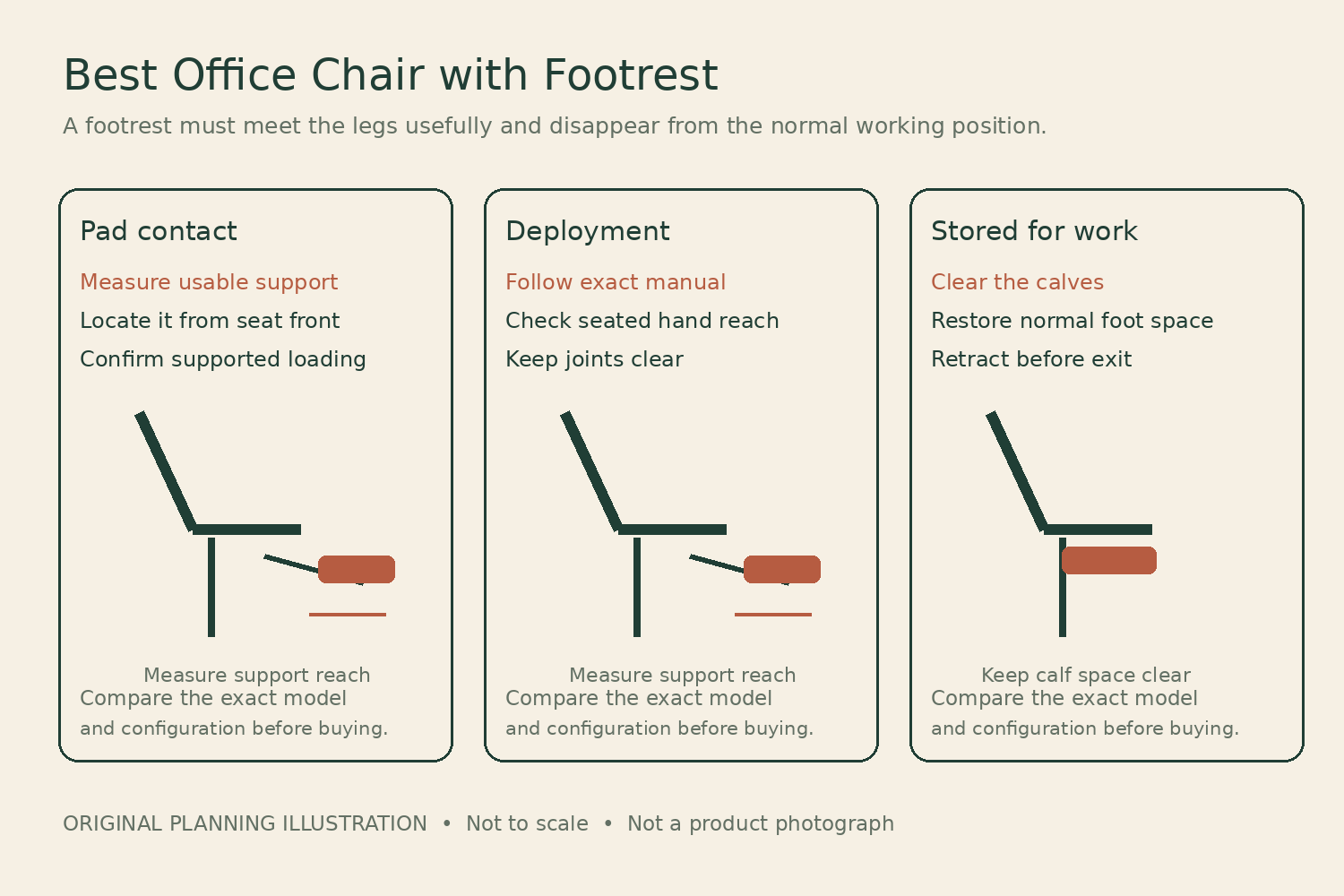
Our online research was checked November 6, 2026. We have not tested the leg-rest mechanisms or measured support pressure. This guide concerns integrated pull-out supports. A floor footrest used to support the feet while typing serves a different purpose, and a drafting chair’s footring is different again. If your main question concerns the back mechanism, use our reclining office-chair comparison.
First identify which foot-support problem you have
If your feet do not reach an appropriate support in the working position, an integrated leg rest intended for leaning back may not solve the mismatch. A suitable floor footrest or a lower-fitting chair can be the more relevant arrangement. OSHA’s chair guidance places foot support within the seated workstation fit; it does not establish that a pull-out calf support is a universal substitute.
If you want to lean back and support part of the lower legs during a break, pad position becomes the shopping question. Ask whether the support reaches beneath the calves, heels, or another intended area for your proportions. Manufacturer photographs show one person or a rendering, not a range of verified body fits. The absence of a dimension should lead to a measurement request.
Compare the version you can actually order
| Exact candidate | Main reason to try it | Published seat clue | Leg-rest question to resolve |
|---|---|---|---|
| C300 Footrest | Dedicated mesh footrest version | 18.11 in published seat depth | What is the pad reach and operating limit? |
| E3 Pro 2026, with footrest | Seat slide and adjustable contact system | 17.7–19.7 in depth | Does stored pad clear the calves? |
| C7B-MESH-FT | Extend-and-rotate support operation | 17–20 in manufacturer depth | Can the user deploy and store it comfortably? |
Start with Sihoo’s dedicated page, HBADA’s generation-specific configuration, and the C7 operation manual. These documents establish model distinctions, not the comfort of the pad against your own legs.
1. Sihoo Doro C300 Ergonomic Office Chair Footrest Version
Best for: Best first comparison for an explicitly identified mesh footrest model.
C300 Footrest is the starting shortlist candidate because Sihoo gives the leg-support version its own US product page. That matters in a range containing Standard, Pro, Pro Footrest, and Pro V2 names. A photograph of a C300 family chair is not enough to establish that the pull-out support is included. Specify C300 Footrest on the invoice and compare the actual model label when it arrives.
The dedicated page lists a 330-pound capacity, mesh seat and back, and three-year warranty. Its dimensional text gives a single 18.11-inch seat depth and a 20.28-inch maximum hip-width label. The page does not establish a seat-depth adjustment range for this version. It does not provide enough leg-rest-pad geometry to establish where the support meets a particular person's calves. The checked US page had an active cart for the displayed white selection. Ask for the loaded seat-height range and extended support dimensions before ordering near a fit limit.
Product Details
| Brand | Sihoo |
|---|---|
| Exact variant | C300 Footrest; not Standard, Pro, or Pro V2 |
| Published overall dimensions | 28 W × 28 D × 42–49 H inches |
| Maximum hip width | 20.28 inches, manufacturer label |
| Capacity | 330 lb |
| Warranty | 3 years; terms apply |
| Published seat depth | 18.11 inches on current footrest page; no adjustment range established |
Pros
- Dedicated footrest product identity reduces family confusion
- Mesh seat and back provide a distinct material option
- Current US page offered the identified version for purchase
Cons
- Pad reach and supported loading need seller clarification
- Do not transplant Pro dimensions onto this model
Choose C300 Footrest when the ordinary chair fit and the extended pad contact both pass a trial. Request the current operation guide for this version rather than following a similarly named model's video. The three-year warranty is separate from a comfort return, and the full-chair capacity should never be treated as a rating for standing or sitting on the extended support.
2. HBADA E3 Pro 2026 Edition With Footrest
Best for: Best when independent seat adjustment matters as much as the leg support.
E3 Pro 2026 with Footrest is worth a fitting when the ordinary seat needs depth adjustment and you also want an integrated leg support for a break. The current generation's drawing lists a 20.3-inch-wide seat, 17.7–19.7-inch depth, and an 18.1–21.5-inch height range. Establish those contacts first. A correctly positioned leg rest cannot compensate for a main cushion that is too high or a lumbar surface that feels wrong.
The with-footrest and without-footrest choices appear separately on the current US page. It also mixes a sold-out label with purchase controls, so confirm the exact color and style's dispatch before treating it as available. The visible dimensional drawing does not settle the pad's usable length, extension distance, or separate loading limit. Obtain those details directly and demonstrate storage with your feet in the ordinary position, not only the fully extended pose.
Product Details
| Brand | HBADA |
|---|---|
| Footrest selection | With Footrest must be chosen |
| Seat width/depth | 20.3 W × 17.7–19.7 D inches, drawing |
| Seat height | 18.1–21.5 inches, drawing |
| Capacity | 330 lb |
| Warranty | 5 years core base/lift/casters; 3 years other components |
Pros
- Published 2026 seat slide supports a deliberate main-seat fitting
- Footrest option is explicitly separated in ordering
- Headrest and arm adjustments can be evaluated with leg elevation
Cons
- High minimum must suit normal sitting
- Precise pad and inventory questions remain before purchase
Choose the 2026 footrest configuration only with a useful fit return and written variant confirmation. Mechanism, arms, and backrest have three-year coverage under the actual HBADA policy, while base, lift, and casters receive five years. Ask which category covers the footrest itself. Do not turn the five-year headline into an unsupported five-year promise for every moving support part.
3. FlexiSpot C7B-MESH-FT Office Chair with Footrest
Best for: Best conditional comparison for a support that extends and rotates for storage.
C7 provides a useful design to demonstrate because its manufacturer manual shows a footrest that pulls outward and rotates for use and storage. That movement should be tested by the intended user while seated. If reaching below the cushion is awkward, the presence of a concealed support may be less convenient than a suitable separate foot support. The stored position also needs to remain clear of your ordinary foot placement.
The direct US C7 page gives a 21-inch seat width and 17–20-inch depth. Its optional-footrest label means a basic C7 order is insufficient. We found a current US retail listing explicitly identifying C7B-MESH-FT, but its height endpoints differ from the direct table. Obtain the current SKU-specific drawing instead of silently combining those measurements. This is a conditional recommendation for a verified configuration, not a claim that every C7 has identical height or leg-rest geometry.
Product Details
| Brand | FlexiSpot |
|---|---|
| Identified US retail SKU | C7B-MESH-FT |
| Manufacturer seat dimensions | 21 inches wide; 17–20 inches depth |
| Capacity | 300 lb |
| Height specification | Direct 18.31–21.65 in; retail differs—confirm exact SKU |
| Warranty | 10-year limited listing; obtain applicable terms |
Pros
- Manufacturer manual illustrates the deployment movement
- Exact US retail SKU identifies mesh and footrest
- Seat slide offers another fit variable to evaluate
Cons
- Direct and retail height information needs reconciliation
- Stored support clearance cannot be inferred from the word hidden
Choose C7B-MESH-FT only after the seller answers the height and pad-reach questions and confirms current delivery. Listings describe ten-year limited coverage; request the component terms and approved claim route. The manufacturer page also has conflicting recline angles, so use its exact operation instructions and clarified specifications rather than selecting it for an unverified maximum recline claim.
The pad-contact and storage worksheet
Use this worksheet after fitting the ordinary seat. Have the actual user operate the mechanism under the supplier’s instructions. A helper demonstrating a smooth deployment is not enough if the buyer cannot reach the same handle or safely manage the movement. Record both the extension state and the stored state rather than merely checking that the pad exists.
- Main seat: establish height and depth with ordinary foot support. Write down the loaded setting and whether the stored hardware is visible or touching the legs.
- Pad geometry: request usable width, pad length, extension distance from the front of the seat, and supported loading. Mark which measurement refers to the cushion and which to the metal rails.
- Contact location: during a permitted trial, record where the pad meets your legs and whether the contact remains comfortable in the intended back position.
- Operation: extend, position, and retract the support according to the manual. Check hand reach and keep fingers clear of sliding or rotating joints.
- Storage: return the feet to the normal work position and move them through the space used when sitting down and leaving. Check calf clearance and the path to the controls.
A worked screening example: a buyer measures a comfortable support location twelve inches forward of the front edge of the correctly fitted seat. A product’s overall depth of 28 inches does not answer whether its pad reaches that point. Nor does a picture of the footrest fully extended. The needed figure is the pad’s actual working position relative to the seat, followed by a trial. If the supplier cannot provide it, keep the candidate conditional rather than replacing the missing measurement with an estimate.
Another user may find the pad reaches appropriately but the stored assembly rubs the calves while typing. That is a failure in the chair’s primary state. A product can be pleasant during a break and still be the wrong desk chair. Do not accept a daily obstruction because deployment works well occasionally.
The lower legs are not the only moving parts
Extending the support changes the occupied floor area. Reclining the back can add space behind as well. Ask for the complete operating envelope and mark it in the room. A support that fits in front of an empty desk may strike a drawer pedestal, desk leg, or crossbar when the chair swivels. Leave a clear place to return upright and stand.
Check cords, a floor mat edge, and items stored under the desk. The footrest should not catch a cable or require you to move a box every time. If the support only works after rearranging the entire room, a separate appropriate rest used elsewhere may be more practical. Convenience depends on deployment in the actual space, not on how neatly it hides in a promotional photograph.
A chair rating is not a footrest rating
The shortlisted chairs have published whole-chair capacities, but those do not authorize using the extended support as a step, independent seat, or lifting point. Request the model-specific limit and follow its instructions. Keep children and pets away from moving hardware, and do not improvise a stronger rail or add an unsupported extension to make a short pad reach farther.
Before leaving, restore the chair as instructed and use a normal supported exit. Avoid attempting to stand with the support trapping the feet in front. If mobility or reach makes the procedure difficult, that is meaningful buying information. A powered or manual mechanism that looks effortless for another person may be unsuitable for your needs.
Materials and cleaning belong in the comparison
C300 and the selected mesh C7 use suspended seat materials, while the pad may have a different covering and foam. Ask how both are cleaned and whether the pad is replaceable. The footrest is a contact surface that can encounter footwear, seams, and frequent handling. Do not apply a cleaner approved for one surface to every component automatically.
Record whether you intend to use the support with ordinary work shoes, slippers, or without shoes, then check that the practice is consistent with the care instructions. This is not a recommendation to put dirty footwear on upholstery. It is a way to discover whether the intended routine and the material-care requirements are compatible before purchase.
Clarify the warranty for the actual support
Sihoo states three-year coverage for the dedicated model. HBADA’s component policy gives different terms for core components and mechanisms, so ask explicitly where the leg-rest assembly falls. C7 listings state ten-year limited coverage but still require exact-SKU terms. A general warranty headline does not explain whether a replacement pad, rail, pivot, or installation labor is included.
Availability also varies by version. The checked Sihoo page had an active white-variant cart; HBADA’s page mixed stock labels and purchase controls; the identified C7 had a current US retail listing. Confirm the selected finish, footrest inclusion, delivery date, and seller warranty eligibility. An Amazon search for the family can return a chair without the accessory, and a low price can describe that different configuration.
Choose the candidate whose pad geometry, storage, and operation pass your worksheet while the main seat still fits. The most useful integrated footrest is one you can deploy comfortably, store completely, and service through a documented purchase channel. More recline or thicker padding should not override those three requirements.
Something unclear or out of date? Send a correction with this article’s title and the detail to check.
Sources, research & corrections policy ↗