As an Amazon Associate, we earn from qualifying purchases. Read our affiliate disclosure. Amazon links below search for matching model listings; verify the seller, model and pack size before ordering.
The best folding chair for an outdoor event depends first on whether you are a spectator bringing one seat or a host setting up many. Our research-based shortlist has two distinct choices: Coleman Utopia Breeze for a low personal seat and Lifetime Classic Commercial 80359G for hosts who need unupholstered chairs around tables or in a planned seating area.
We have not tested these chairs. We compared current product information, seating formats, transport dimensions and documented indoor/outdoor use. No chair is universally approved for concerts or festivals, and none of these recommendations overrides an event's current rules. Check the specific venue before buying. Prices, stock and delivery vary, so no hard budget or availability promise is included.
Choose the event format before the chair
For a personal outing, the key questions are permitted seat and back height, carrying distance, packed size, individual fit and the actual ground. For a host, the problem expands to setup quantities, storage, transport carts, table fit and the approved seating layout. A soft camp chair and a rigid folding table chair are useful in different versions of the same event.
Start with any restrictions supplied by the organizer. A low seat-height label is not the same thing as a low overall back height, and an acceptable chair at one venue may be refused at another. If the rules are unclear, send the organizer the exact model dimensions rather than relying on a seller's “festival chair” phrase.
Then decide how much time is spent carrying versus sitting. A chair can be easy to unfold but awkward to move through a crowd, particularly if its packed bundle is long. A host may care more about safely moving a batch along a clear route than shaving a small amount from one chair's mass.
Coleman Utopia Breeze: low-seat candidate for personal outings
The Coleman Utopia Breeze official description and dimensional fields describes a low sling chair with a powder-coated steel frame, a 21-inch seat, cup holder, seatback pocket, carry bag and 250-pound capacity. Its listed weight is 6.65 pounds. The description calls the sitting height 10 inches, while the specification section lists 10.6 inches. Treat that as a small source discrepancy requiring confirmation if an exact limit is decisive.
Its reason for inclusion is the low sitting position. If an event permits this format and you enjoy sitting near the ground, it gives you a concrete alternative to a standard-height camp chair. A 21-inch advertised seat also provides a starting question for personal fit rather than leaving you with only the frame's outside dimensions.
The low position is equally the main reason to skip it. It may not suit someone who prefers a higher seat for sitting and standing, and it is not a substitute for an appropriately fitted access arrangement. Do not buy it solely because a venue asks for low chairs if you cannot comfortably use that format. Consider the event's available seating or another permitted option instead.
Exact overall dimensions need care too. Coleman's page mixes descriptive and specification fields, and a prior customer-support answer gives another overall-height figure. We would not certify venue compliance from those fields without model-specific confirmation. For this recommendation, the dependable comparison is that the chair is explicitly presented as low, with a stated 250-pound limit and documented product mass.
Check matching Coleman Utopia Breeze Beach Sling Chair listings on Amazon (paid link)
Lifetime Classic Commercial 80359G: host's table-seating option
The Lifetime 80359G official mixed-setting specifications identifies model 80359G with HDPE seat and back, a powder-coated steel frame and indoor/outdoor use. Listed open dimensions are 21.4 by 19.1 by 34 inches; folded dimensions are 6.4 by 19.1 by 43.5 inches, with product weight of 10.5 pounds. These figures apply to that named configuration rather than every Lifetime chair.
The reason to include it is a host's different workflow. An unupholstered rigid chair can be a more relevant candidate around event tables than a low sling or suspended camp seat. It also avoids requiring each guest to bring a personal chair. For recurring gatherings, a consistent model can make table trials, replacement parts and storage planning easier to organize.
It is not the obvious personal carry choice here. At 10.5 pounds with a 43.5-inch folded height, it creates a different transport problem from a bagged camp chair. The folded depth also needs a real storage plan. Do not assume that multiple chairs nest at the single-chair depth or can be stacked in any convenient way.
A host should confirm the current complete-chair capacity, permitted storage equipment and any applicable event requirements with the supplier and organizer. We are not treating an older syndicated answer on a product page as sufficient evidence for every capacity-critical batch purchase. The recommendation is based on the documented model, rigid format and indoor/outdoor designation, with the remaining checks made explicit.
Check matching Lifetime 80359G Classic Commercial Folding Chair listings on Amazon (paid link)
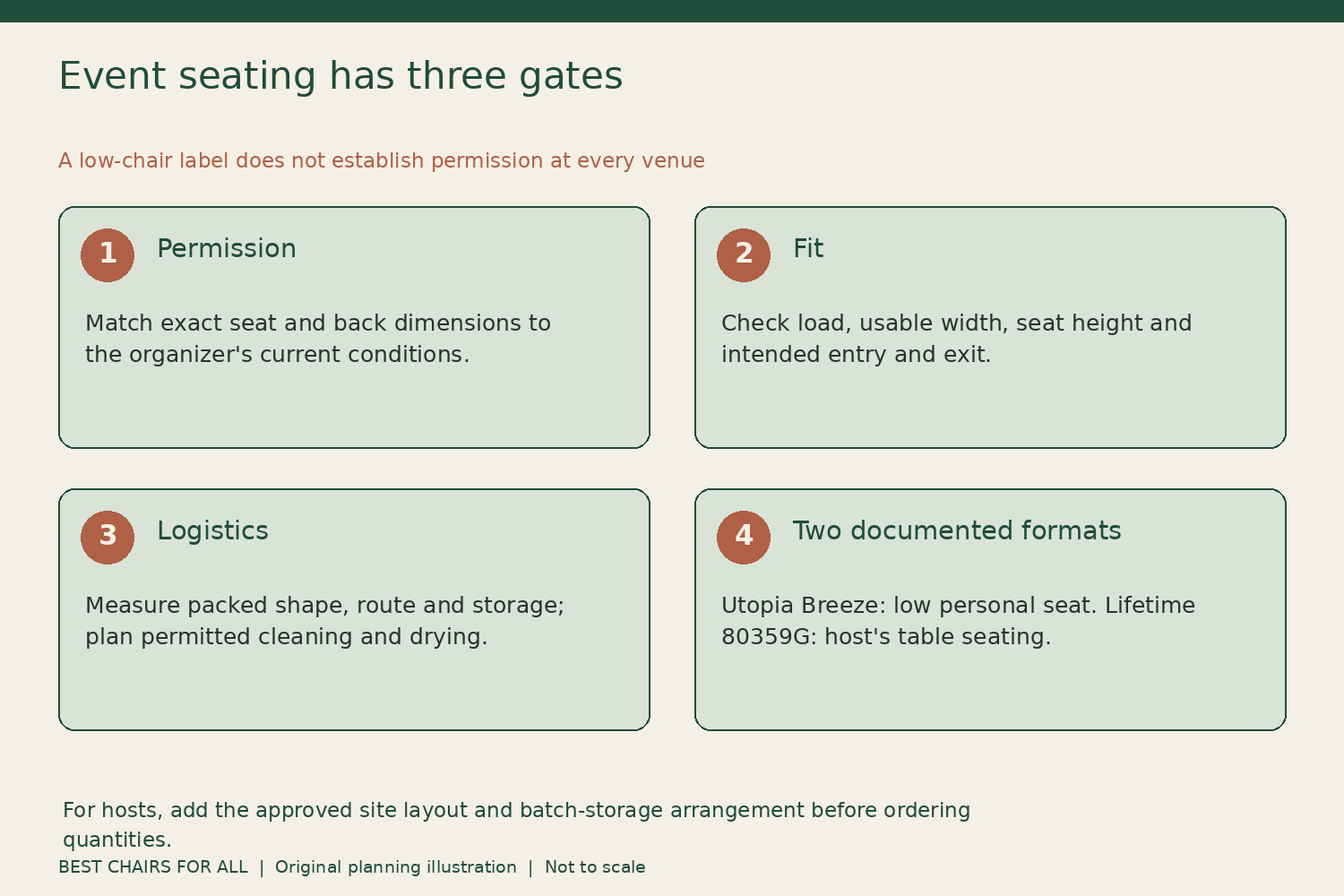
A three-gate event worksheet
Use three gates called permission, personal or guest fit, and logistics. Permission records the organizer's current chair conditions and the exact dimensions they refer to. Fit records capacity, usable seat dimensions, sitting height and normal entry and exit. Logistics records packed dimensions, carrying route, storage and weather-related care requirements.
A chair must satisfy all three. A product that fits the trunk but is refused at the entrance is unsuitable for the trip. A chair that meets the venue's dimensional rule but does not fit the user also fails. A suitable seat that cannot be transported through the actual route needs another logistics plan before purchase.
For hosts, add a fourth field identifying who approves the room or site layout. This article does not supply aisle, row or emergency-route dimensions. Keep applicable site requirements separate from a manufacturer's furniture footprint and from the host's preferred spacing.
Worked comparison: a personal lawn seat versus hosted table seating
Imagine a spectator choosing a personal chair for a picnic with no chair-height restriction. They already enjoy low seating and can comfortably sit down and stand up from that position, so Utopia Breeze is a relevant candidate to trial. A second spectator who prefers a higher position should not treat the same low chair as an automatic choice. These two recommendations do not cover every sitting preference; the event's provided seating or a separately documented permitted format may be more useful for that person.
Now imagine a different lawn event with a published restriction that needs exact seat and overall-height information. The buyer should compare the organizer's wording with confirmed product measurements. The Utopia's description-versus-specification seat-height discrepancy becomes worth resolving. Calling it a low beach chair does not prove it passes the event's particular rule.
For a host arranging table seating, the low-seat comparison does not answer the problem. The Lifetime format becomes relevant because the group needs consistent chairs at a table, with a batch setup and storage plan. The same outdoor setting therefore produces different sensible purchases depending on who supplies the seating and what happens during the event.
Ground conditions do not disappear with a capacity rating
Confirm the surfaces permitted by the chair instructions and inspect the intended setup area before use. A rating for the occupant is not an approval for unstable, steep or softened ground. Do not assume narrow feet, a loop frame or a wide-looking base can handle every location, and do not improvise wedges or blocks to make a poor site work.
If the event area is unsuitable for the chair or the user's access needs, choose another approved seating location or equipment arrangement. A sales photograph on grass cannot establish the condition of a specific lawn after rain. Discuss site limitations with the organizer rather than arriving with a chair and expecting the frame to solve them.
Set up the chair fully using its instructions, keep fingers clear of hinges and avoid placing bags where they obstruct the mechanism or route. A folding chair should not be used as a step, shared beyond its intended occupancy or leaned onto two legs. Ordinary use provides enough information for a fit trial without stress-testing the equipment.
A host's loading estimate
Use the exact single-chair mass to estimate batch weight before arranging transport. For a worked example, twenty-four Lifetime 80359G chairs at the published 10.5 pounds each total 252 pounds of chairs alone. That arithmetic does not authorize loading one cart with the batch. Add the cart's own mass and other equipment where relevant, then check the permitted load, approved chair arrangement and route with the equipment supplier. A chair rating for an occupant and a cart's transport limit are separate specifications.
Count serviceable chairs before the event, rather than counting packages or assuming every stored chair is ready. If twenty-four seats are needed and two of the stored chairs need assessment, the available number is twenty-two. Arrange approved replacements before setup; do not count damaged equipment as a reserve. Labeling the exact model, purchase unit and service status makes this simple arithmetic useful to the next crew as well.
Plan the return journey
At the end of an event, the chair may be damp or dirty and the person carrying it may already be tired. Record where it will travel in the vehicle and how it will be cleaned and dried according to the manufacturer's directions before storage. Outdoor use does not necessarily mean permanent outdoor storage is appropriate.
For the Lifetime chairs, the Lifetime official chair-surface cleaning guidance recommends mild dish soap and a damp cloth for routine surface cleaning. That guidance is relevant after outdoor food service, when a rigid HDPE seat may return with ordinary food residues. Keep this chair-surface routine separate from care for Coleman's fabric and from any additional site requirements. Choose the equipment partly by whether you can complete its actual cleaning routine between events.
For a batch, separate damaged chairs from ready stock and record the fault. Do not return an unstable chair to a general pile where the next setup crew assumes it is usable. Ask the supplier about approved replacement glides, bags or other user-serviceable parts rather than substituting whatever looks similar.
A carry bag also needs to fit the exact model. Tightening straps around an incorrectly folded chair is not an alternative folding method. If it will not close normally, clear the area and inspect it through the permitted instructions before transport.
Order the correct quantity and version
Compare a single-chair offer with a case or multi-pack carefully. Event hosts can mistake a case-level description for an individual chair, so check the seller's actual purchase unit, exact model, delivered charge and return terms together. A shipping carton measurement describes a different object from an occupied chair or a folded chair; keep those measurement labels intact when planning the order.
The Amazon links search for matching listings; they do not verify stock, seller identity or identical construction. Match the product code and dimensions to the source before buying, and check the organizer's latest requirements close enough to the event to make the information useful.
For a low personal outdoor seat, investigate the Utopia Breeze after checking fit and any exact-height rule. For a host's consistent table-seating plan, compare the Lifetime 80359G. The best event chair is the one that can enter the venue, fit its user and complete the journey home without an unresolved assumption.
Manufacturer specifications and cited listings checked November 6, 2026. Research-based selection; no hands-on testing or current-price guarantee.
Something unclear or out of date? Send a correction with this article’s title and the detail to check.
Sources, research & corrections policy ↗