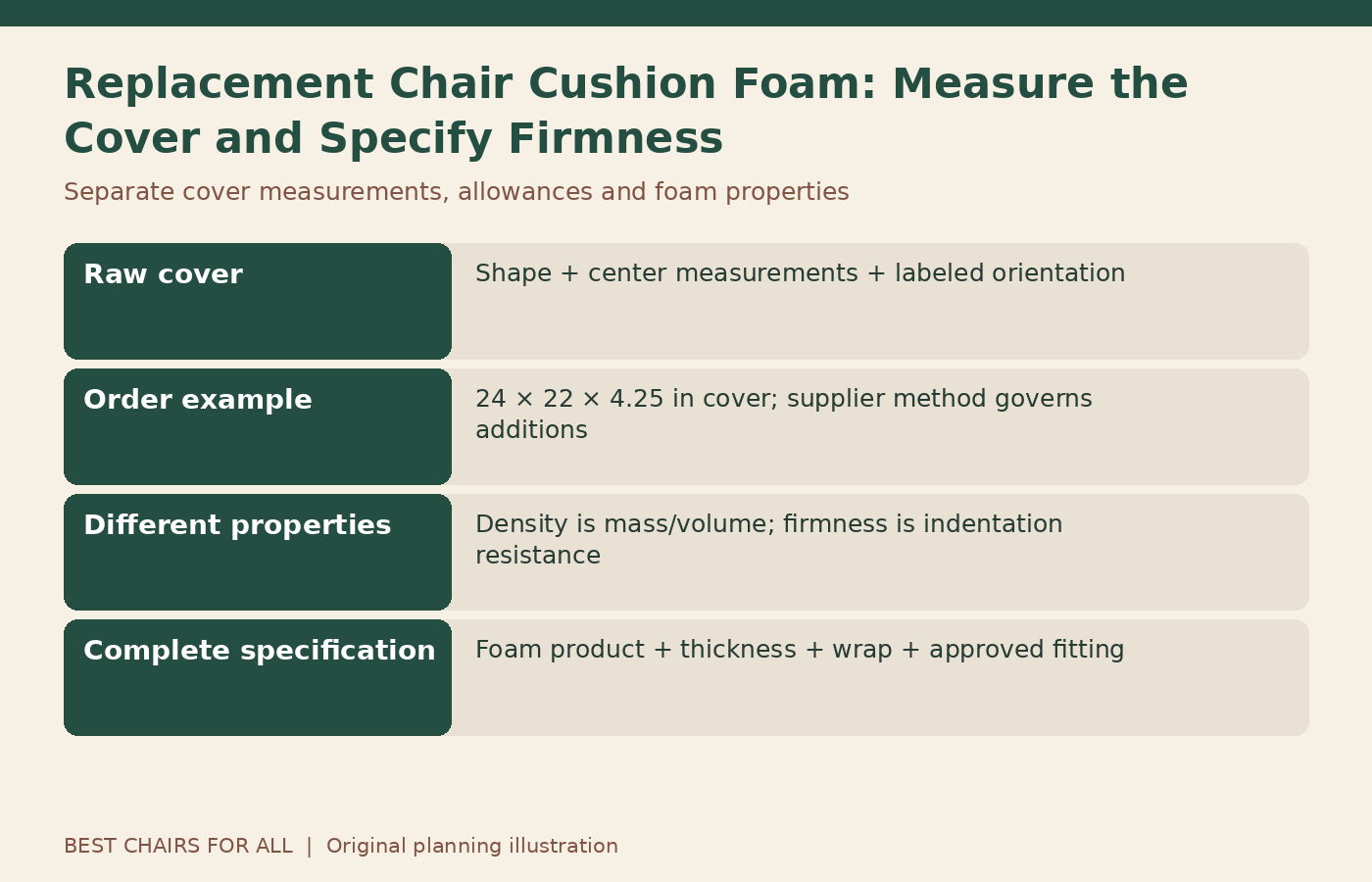
Measure replacement chair-cushion foam from the intended cover shape and the supplier’s ordering method, not only from the worn insert. Old foam can be compressed, rounded, or damaged, so copying its smallest dimensions may reproduce an underfilled cushion. Keep measured cover dimensions, supplier allowances, foam properties, and any wrap as separate entries in an order worksheet.
This process applies to an accessible loose cushion whose insert can be removed under the chair maker’s instructions. A fixed upholstered seat, spring-core cushion, medical support cushion, or powered mechanism needs a different assessment. Do not cut into upholstery or remove structural parts to turn an unknown seat into a simple foam-replacement project.
Confirm what is inside before ordering
Identify the chair and cushion construction through the manufacturer, label, or upholsterer. Some cushions contain a single foam block, while others combine foam, fiber, down envelopes, internal springs, or multiple layers. A zipper does not prove that every internal component is intended for owner replacement. Ask whether a factory replacement is available before commissioning a different construction.
Photograph the cushion on the chair, including front, top, side, and any identifying tag. Record which edge faces forward and whether the left and right sides differ. A T-shaped cushion, wedge, or rounded front requires more information than width by depth by thickness. Establish that shape first so later measurements have meaningful labels.
Inspect the cover’s condition
Check accessible seams, zipper, lining, and fabric for damage. Replacement foam will not repair a weakened seam, stretched casing, or failing zipper. If the cover has changed shape through washing or heavy use, ask an upholsterer whether it remains a suitable pattern. Do not assume its current dimensions represent the chair’s original design.
Also inspect the accessible seat deck without dismantling it. A sagging support system can make a good cushion feel inadequate, while new firmer foam may conceal rather than solve that problem. Stop for exposed hardware, instability, or structural damage and obtain professional advice. The foam order should proceed only when the cushion project and chair condition are understood.
Choose the supplier’s measurement diagram
Foam By Mail’s measurement guide begins by matching the cushion to an ordering shape and labeling the required dimensions. Use the diagram from the supplier you will actually order from. Do not combine a trapezoid sketch from one company with another company’s unexplained width field and assume the reference points match.
Draw the cushion and copy each dimension label onto it. Mark front, rear, left, right, top, and bottom where relevant. For a taper, record front and rear widths independently. For a curved or unusual shape, ask whether the supplier wants a template or additional photographs. An accurately labeled question is more useful than an approximate rectangular order.
Measure the cover without stretching it
Where removal is permitted, take out the old insert carefully and place the empty cover on a clean firm surface. Smooth wrinkles without pulling the cloth taut. Follow the chosen supplier’s endpoints. Foam By Mail’s cited method measures across the center rather than relying on reinforced corners, which can give a different result. Record the raw measurements before applying any adjustment.
Measure twice and compare the results. If the cover is asymmetric, do not average away a meaningful difference. Ask whether that asymmetry is intended or reflects damage. Keep the old insert intact until the replacement is confirmed; it can still provide information about layering, contours, and orientation even though its worn size is not the sole ordering reference.
Keep measured and order dimensions separate
Create columns for Dimension label, Measured cover, Supplier adjustment, and Final order. This prevents an allowance from being added twice. A note such as width 24 inches is ambiguous if it is unclear whether the value is a raw cover width or an adjusted cutting dimension. Include units on every sketch and use the supplier’s rounding convention.
Do not apply a universal add-half-an-inch rule. The correct allowance depends on the supplier, shape, cover, and intended construction. Foam By Mail currently publishes a specific addition and thickness-rounding method for its orders. Other suppliers or upholsterers may use different instructions. Confirm the method in writing if the cover is unusual, fragile, or already stretched.
A supplier-specific worked example
Using Foam By Mail’s cited ordering method as an example, imagine a permitted removable rectangular cover measures 24 inches wide, 22 inches deep, and 4.25 inches thick under that method. Its published half-inch addition produces 24.5 by 22.5 inches in plan. For thickness, 4.25 plus 0.5 is 4.75, which its stated rounding method takes to 5 inches.
Those are invented cover dimensions demonstrating one supplier’s published method, not a universal foam prescription. Before ordering, confirm that the selected foam, wrap, and cover follow that same system. The useful artifact is the visible calculation with raw and final dimensions separated. It lets the supplier spot an error before a custom-cut item becomes difficult to return.
Understand density and firmness independently
Density describes foam mass per unit volume, commonly expressed in pounds per cubic foot for US upholstery foam. Firmness describes resistance to indentation under a specified test. They are different properties: a denser foam is not automatically the firmer option. Ask for the actual product data rather than treating high-density as a complete feel description.
Foam By Mail’s cushion FAQ distinguishes density from Indentation Load Deflection, or ILD. Use that distinction in the worksheet. Record density, firmness value and test information, product name, and thickness separately. Avoid translating one supplier’s soft or firm label into another’s without comparable data or a practical sample discussion.
Account for thickness and the complete seat
The same foam family can feel different at different thicknesses and on different support systems. A thin cushion over a firm platform differs from a thicker cushion over a sprung deck. The cover’s tension and any fiber or down layer also affect the experience. Do not promise that a particular ILD number will reproduce an existing chair’s feel in every configuration.
Describe what you want to change: less sinking, a softer surface, better shape recovery, or a closer match to the original. Give that description to the supplier with the chair and cushion information. Where personal positioning or a medical condition is involved, seek individual advice rather than using a furniture-foam specification as a clinical recommendation.
Specify wrap as a separate construction choice
Fiberfill or batting can soften edges and create a fuller profile. Ask which faces it covers, its type, and how it is included in the supplier’s sizing method. Do not automatically subtract wrap thickness from the foam order. Foam By Mail’s cited FAQ expressly explains its approach to compressible fiberfill; that instruction belongs with its ordering system.
Sailrite’s upholstery-foam guide also discusses different foam and layered constructions. A layered cushion is a design choice, not proof that more materials always improve comfort. Ask the supplier or upholsterer to specify the complete assembly and compatible materials rather than independently combining scraps, adhesives, and wraps without a coherent plan.
Ask for a meaningful sample or trial
A small sample helps compare surface feel and recovery, but it does not reproduce a full cushion’s thickness, area, cover tension, and supporting deck. Ask whether a larger trial or in-person comparison is available and what it can establish. Record the sample’s exact product identity so a later order uses the same foam rather than a generic firmness description.
If matching an existing comfortable cushion, provide the original specifications where available and describe its construction. A supplier may suggest an alternative, but obtain the reasons and limitations. Avoid buying the firmest option solely because the old cushion feels soft. The original problem may involve age, thickness, cover shape, or support rather than an initially unsuitable firmness.
Check custom-cut tolerances and returns
Ask the supplier about cutting tolerances, maximum sheet sizes, seams or bonded sections, and the return policy for custom work. Confirm whether the quoted dimensions refer to bare foam or a wrapped finished insert. For multiple cushions, label each one separately rather than assuming apparently similar covers are identical. Save the final approved drawing with the order.
If a dimension changes during discussion, update the worksheet and mark the previous version superseded. A message saying make it a little larger can create confusion when several dimensions are involved. Use an exact revised value, units, and orientation. Ask for confirmation before cutting, especially for shaped cushions or orders based on a physical template.
Decide whether fitting belongs with an upholsterer
An ordinary accessible loose cushion may permit straightforward insert replacement, but a fragile cover or complex layered insert can need professional handling. Do not force foam through a small zipper opening, use sharp tools to push it into corners, or cut the cover to make insertion easier. Ask for the supplier’s approved fitting method or have the cushion assembled professionally.
This article does not require a home cutting or gluing operation. Custom cutting can remove that task entirely. If a professional identifies spring, deck, or frame work, keep it separate from the foam specification and quote. Avoid turning a cushion-refresh project into an unplanned structural repair based on the presence of an accessible zipper.
Inspect the delivered insert against the order
Check the product label, quantity, shape, dimensions under the supplier’s measurement method, and wrap arrangement before altering anything. Follow any unpacking or recovery instructions supplied with compressed foam. If the shape or firmness product appears wrong, photograph it and contact the supplier before cutting or forcing it into the cover.
After approved fitting, assess the cushion on the actual chair in normal sitting use. Check seam strain, front-edge shape, and whether the cover is appropriately filled. Contact the supplier about a mismatch rather than immediately trimming an edge. Keeping the raw measurements and final order separate makes that conversation much easier to resolve.
Retain a complete replacement specification
Save the chair model, cover sketch, raw dimensions, supplier allowance, final dimensions, foam product, density, firmness, thickness, wrap, and fitting record. Add the order date and any later adjustment. That packet allows a future replacement to begin from evidence instead of from another worn cushion and an uncertain memory of what was purchased.
A successful replacement is not defined by the biggest density number or the tightest-looking cover. It is a coherent combination of sound chair support, suitable cover geometry, a documented supplier method, and a cushion feel that works for its intended use. Measurements and specifications should make that combination reviewable before the foam is cut.
Something unclear or out of date? Send a correction with this article’s title and the detail to check.
Sources, research & corrections policy ↗