As an Amazon Associate, we earn from qualifying purchases. Read our affiliate disclosure. Amazon links below search for matching model listings; verify the seller, model and pack size before ordering.
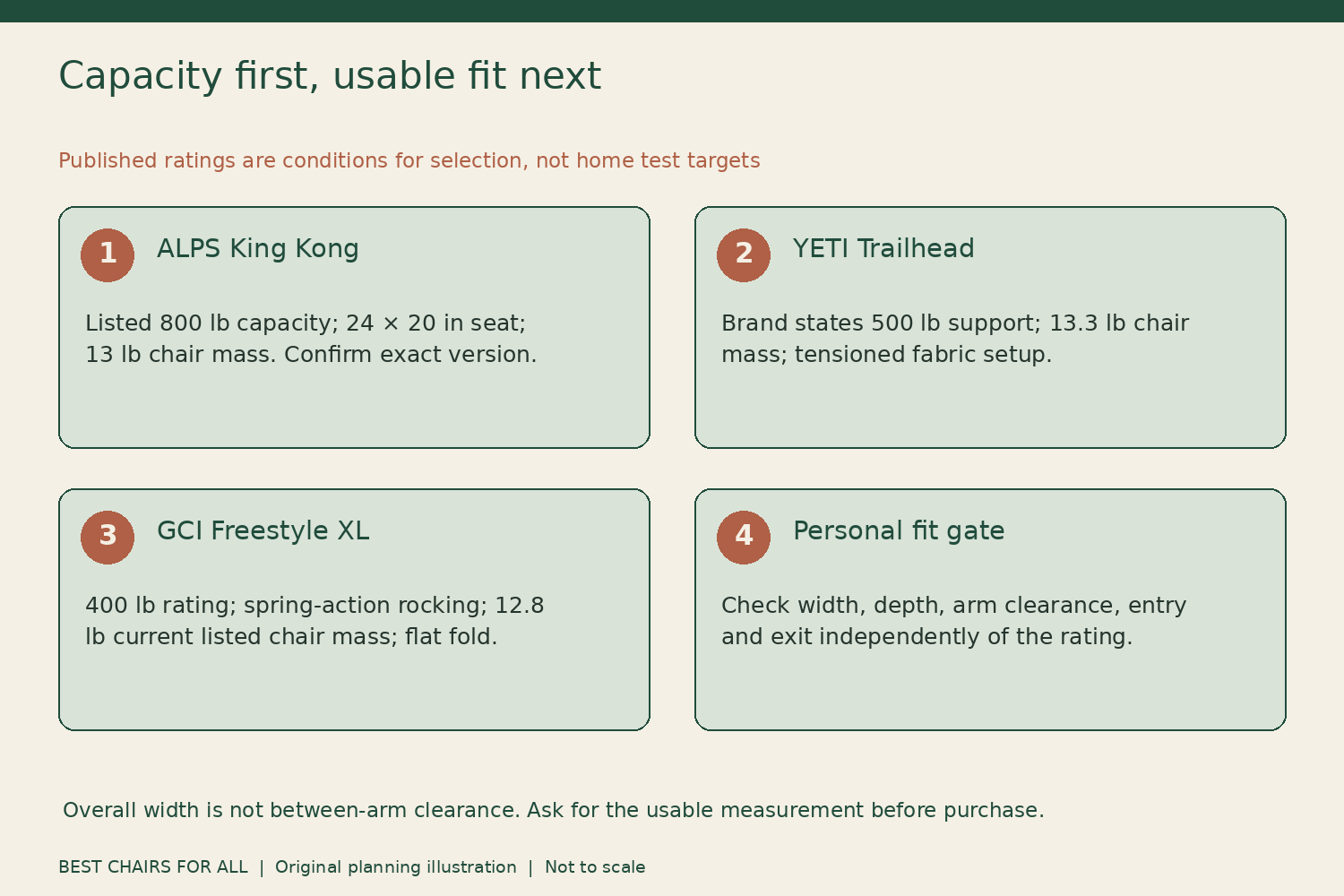
For a folding chair for heavier people, start with the exact permitted user load and usable sitting space, then assess whether the chair can be carried and entered comfortably. Our researched shortlist is the ALPS Mountaineering King Kong for its listed 800-pound capacity and broad seat, the YETI Trailhead Camp Chair for a 500-pound brand rating and tensioned fabric design, and the GCI Freestyle Rocker XL for people within its 400-pound rating who specifically want rocking motion.
Inspect folding chair locking mechanisms as directed by the manufacturer before use, rather than judging readiness by the open appearance alone.
These are different products for different priorities, not a ranking that says every larger person needs the largest frame. We have not tested them or verified a medical benefit. Published ratings are manufacturer or supplier claims under their stated conditions, not permission to exceed a limit, share one seat, or conduct a home load test. No fixed budget or current-price promise is made.
Apply capacity as a gate before scoring features
Write the required capacity first and exclude any chair that does not meet it under the manufacturer's conditions. Do not average a high-capacity claim with appealing features to make a chair qualify. The GCI option belongs only in a shortlist where its 400-pound rating is sufficient; someone needing more should consider a different product.
Then check seat width, depth and the gap between the arms. Overall frame width can include storage pockets, cup holders and structural members that do not add usable sitting space. A generous load rating cannot tell you whether the front edge, arm position or back contour suits your proportions.
Keep your own preferences central. Some people want an upright, firmer-feeling position; others prefer more suspended fabric or gentle motion. Greater width can be welcome, but armrests placed farther apart are not automatically more comfortable. A useful chair fits the actual person rather than a generalized picture of what a heavier user should prefer.
ALPS Mountaineering King Kong: strongest capacity-first candidate here
The ALPS King Kong current listed seat dimensions at Scheels lists the standard King Kong at an 800-pound capacity, with a 24-inch seat width, 20-inch depth, 19-inch seat height and 13-pound chair weight. Its packed size is 40 by 8 by 9 inches. The listing identifies a powder-coated steel frame, beverage holders and storage pockets. The ALPS manufacturer catalog with King Kong rating and construction corroborates the model family's 800-pound claim and steel construction, while representing older manufacturer literature.
Its reason for inclusion is unusually clear: the combination of a substantial stated rating and documented seat dimensions gives a buyer concrete questions to compare against an existing comfortable chair. The seat width and depth are more useful for personal fit than the product's bold name. Ask the seller to confirm that the exact current color and item code retain the cited dimensions.
The main compromise is a large, heavy package. A 13-pound chair may be practical beside a vehicle but burdensome for someone also carrying food and other gear over a long route. The 40-inch bag also needs a suitable storage slot. We would choose it for capacity and room only when that transport cost is acceptable.
The 20-inch seat depth deserves attention for shorter users. A deep seat can encourage a person to sit forward of the backrest if their legs do not comfortably reach the front edge. That is a fit observation to check through an ordinary trial, not a claim that the chair causes a problem. Also distinguish the standard King Kong from XXL and loveseat versions; shared branding does not establish identical specifications.
Check matching ALPS Mountaineering King Kong Chair listings on Amazon (paid link)
YETI Trailhead Camp Chair: tensioned-fabric alternative within a 500-pound rating
The YETI Trailhead current US specifications states support up to 500 pounds, a 13.3-pound product weight and external dimensions of 24 inches wide, 29.9 inches deep and 36.3 inches high. It describes FlexGrid fabric, a crossover frame, back and arm tensioners, an included carry bag and a movable cup holder. Those facts identify the current US product rather than a generic YETI chair.
The reason to compare the Trailhead with the King Kong is its construction approach. A tensioned seat with defined setup steps offers a different sitting experience from a conventional loose quad-fold seat. Someone who dislikes sinking into their current chair may want to try this format, but we cannot promise a particular amount of sag or firmness without a personal demonstration.
The published 24-inch external width is not a stated 24-inch usable seat width. Do not copy that number into a hip-clearance box. Ask YETI for the relevant sitting dimensions or assess the actual chair. The brand's pressure-point language is marketing, and we are not presenting it as an independently verified health outcome.
The carrying mass is comparable to the ALPS listed mass, so this is not the lighter-weight answer in the comparison. Its setup also needs to be learned: the tensioners are part of the intended complete operation, not optional accessories to ignore for faster use. Follow the supplied instructions and confirm the chair is ready before sitting.
Check matching YETI Trailhead Camp Chair listings on Amazon (paid link)
GCI Freestyle Rocker XL: only if you want motion and fit its rating
The GCI Freestyle Rocker XL official model specifications lists a 400-pound capacity, 12.8-pound chair weight and a spring-action rocking design. Its open dimensions are 26.4 inches wide, 25 inches deep and 34.8 inches high; folded dimensions are 4.9 by 25 by 34.8 inches. It includes padded armrests, a mesh back, beverage holder, phone pocket and carrying handle. The current main product page gives the 12.8-pound figure; other brand variant listings have shown 13.4 pounds, so confirm the selected version if carrying weight is decisive.
This is a specialist choice within the shortlist. Rocking is a meaningful difference if it is the experience you want, and a reason to skip the chair if you prefer a stationary seat. It should not be added to a capacity-only comparison as if motion were a minor decorative feature. Check the intended surface and movement instructions before deciding it fits your location.
Its flat folded form may suit storage along a wall better than a long bag, but it remains a broad object. A 4.9-inch thickness does not mean the chair fits into every narrow travel space; the 25-inch dimension still matters. Rehearse the actual route using its complete folded rectangle rather than comparing one small number with another chair's bag diameter.
As with the YETI, the overall width is not the same as a confirmed between-arm measurement. Ask for that dimension if it matters. And do not use this option when a 400-pound rating is insufficient simply because the name includes XL. This recommendation is conditional on the rating, fit, desire for rocking and appropriate setting all being satisfied.
Check matching GCI Outdoor Freestyle Rocker XL Chair listings on Amazon (paid link)
A fitting worksheet that keeps load and space separate
Create a sheet with distinct fields for permitted user load, model and version, usable seat width, seat depth, between-arm clearance, seat height, back contact and entry and exit. Put chair weight and packed dimensions in another section. This prevents a large capacity number from overshadowing a practical fit mismatch.
Measure a familiar comfortable chair for reference, labeling the exact points used. A rectangular hard-seat measurement and the curved usable area of suspended fabric are not identical, so use the reference as a question rather than a guaranteed match. Avoid stretching upholstery or altering the frame to obtain a more favorable measurement.
During a normal supplier-permitted trial, sit and leave the chair only as intended. Note whether the arms constrain movement, the front edge presses uncomfortably, or the back can be used without sliding forward. Stop if the equipment appears damaged or unstable. There is no need to bounce, rock a stationary chair or exceed the load rating to learn whether the fit works.
Worked decision: choosing among qualifying chairs
Imagine a buyer who needs a capacity above 400 pounds and wants stationary camp seating. The GCI is excluded on the rating alone, even before its rocking action is considered. The YETI and standard King Kong remain candidates if their documented conditions meet the requirement. The next comparison concerns usable fit, desired fabric behavior and transport.
Suppose the buyer also needs a confirmed wide sitting area and cannot obtain a Trailhead between-arm measurement before a nonreturnable purchase. The missing dimension matters; it is not reasonable to substitute the YETI's external width. The King Kong's listed seat dimensions offer a clearer starting point, while still needing exact-version confirmation and a practical fit check.
A second buyer within the GCI rating who specifically enjoys rocking might reach a different answer. The movement becomes a benefit to investigate rather than a compromise. This example shows why capacity is a first gate and personal preference is the next decision, instead of treating every product above a threshold as interchangeable.
Do not turn a test figure into a user limit
Online listings can mix maximum user capacity, test load, static load and shipping weight. Preserve the exact wording and ask the manufacturer to resolve ambiguity. A product surviving a particular test does not authorize every use at that figure. The complete chair's permitted use is the relevant reference.
Similarly, stronger-looking tubing or a higher-rated component does not establish a new capacity for a repaired chair. Do not substitute generic feet, fasteners or fabric and assume the original rating still applies. Use approved replacement parts and obtain service advice when structural or support components are damaged.
For an older chair, inspect condition according to the manual and remove it from use if a fault is found. A label remains a description of an intended product, not proof that a damaged or modified example is suitable. Avoid informal experiments that ask a person to act as a test weight.
Transport can decide between otherwise suitable options
All three listed chairs are around thirteen pounds. That makes the carrying arrangement, folded shape and walking route particularly relevant. A shoulder bag, backpack-style bag and integrated handle distribute the task differently. We have not compared their comfort, so try the actual arrangement if carrying ability is a deciding factor.
Record how far the chair must travel, what else you carry and whether you need a hand free. A short unobstructed path from a vehicle is different from stairs, public transport or a long walk across a field. Do not attach the chair to a mobility device or another support unless that use is specifically approved by the relevant manufacturers.
If the chair's mass makes the journey impractical, continue the search for equipment that meets both capacity and carrying needs. A lower-rated lightweight chair is not a solution to that mismatch. A suitable transport plan or different product is preferable to disregarding the load requirement.
Ordering without an expensive model mix-up
Match the exact name, series, model and accessories before ordering. The linked Amazon searches may include different generations, oversized variants, bundles or similarly named products. Check capacity and dimensions against the source for the actual item. A search result is not a verified match or an inventory guarantee.
Review the return conditions for an ordinary fit trial, especially if the seller charges return freight on a large item. Ask which measurements can be confirmed in writing before shipping. Keep the product document and purchase record together so later part or care questions refer to the correct chair.
Start with the standard King Kong for the highest stated capacity and documented room in this shortlist. Compare the Trailhead when its 500-pound rating is sufficient and you want to investigate a tensioned-fabric seat. Consider the Freestyle Rocker XL only when its 400-pound rating, motion and flat-fold package suit you. The best result meets the load requirement and respects the person's own fit and transport priorities.
Manufacturer specifications and cited listings checked November 6, 2026. Research-based selection; no hands-on testing or current-price guarantee.
Something unclear or out of date? Send a correction with this article’s title and the detail to check.
Sources, research & corrections policy ↗