As an Amazon Associate, we earn from qualifying purchases. Read our affiliate disclosure. Amazon buttons below search for matching listings; they do not confirm stock, an exact seller, or a current price.
The best manicure chair for a customer is the seat that fits the person and works with the table, hand support, and technician’s position. A comfortable-looking chair can still be unsuitable if its arms hit the table or its seat height places the hands awkwardly. Our manufacturer-researched client-seat shortlist is Belava Cozy, J&A Monaco Customer Chair, and J&A YL Glide Customer Chair. Technician stools serve a different role and should be specified separately.
We checked primary manufacturer and occupational guidance on November 6, 2026. We have not performed manicures using these chairs, tested their upholstery, or measured their rolling behavior. Current prices, stock, and delivered totals are unverified. We make no promise that a chair prevents pain or fits every customer. Missing dimensions remain supplier questions rather than estimates invented from photographs.
The customer chair is part of a two-person workstation
At a manicure station, the customer’s hands are the work area, while the technician needs an appropriate relationship to that work. Customer seat height, table height and depth, hand-rest height, technician seating, and under-table space all interact. Buying the customer chair independently can create a problem that neither chair’s controls can fix. Start with the table and the service arrangement that will remain.
Write down which people use the station and which services are common. Include the need to reach a lamp, place both hands appropriately, use the curing device if applicable, and enter or leave the chair. A broad lounge-style seat may look attractive but stop too far from the table. A compact task-chair shape may approach more closely while offering a different support and access arrangement.
If the intended purchase is actually for the nail technician, change the brief before ordering. The technician’s chair needs its own evaluation of working height, support, control access, and task fit. A customer chair’s decorative arms or high back may obstruct professional work. The models compared here are identified by their manufacturers as customer seating; they should not be treated as interchangeable with technician equipment.
Three manufacturer-documented customer options
| Model | Verified distinction | Reason to investigate | Unresolved point to confirm |
|---|---|---|---|
| Belava Cozy | 19–24-inch adjustable seat; rotating wheeled layout | A documented seat-height range for the table comparison | Usable arm clearance and exact base dimensions |
| J&A Monaco | Gas lift, casters, and low/medium/high piston options | Selectable height configuration | Actual seat-height range of the quoted piston |
| J&A YL Glide | YL-6028 model with chrome or gold frame choices | A different customer-seat format and appearance | Seat height, control details, and full operating geometry |
Belava Cozy: use the published seat range, then verify the rest
The Cozy manufacturer page identifies CH-CZY-BK with a 19–24-inch adjustable seat, five casters, rotation, and a 250-pound capacity. It lists overall dimensions of 25 by 26 by 36 inches. The page’s base measurement wording needs clarification before using it as a planning dimension.
Investigate Cozy when the documented range suggests a useful match to the existing table and customer support needs. Its limitation is that the overall chair width does not establish inside-arm space or under-table clearance. Ask the supplier for those dimensions and the actual base footprint. Have the complete chair demonstrated at the intended table, with the hand support in place. Do not assume a generous cushion or rotation feature establishes comfort for every client.
Check matching Belava Cozy customer manicure chair listings on Amazon (paid link)
J&A Monaco: order the piston configuration you evaluated
J&A’s Monaco Customer Chair page describes leatherette upholstery, a gas lift, casters, and low, medium, and high piston options. Its listed 40.5–44-inch overall-height range is a chair-height measurement, not a verified seat-height range. Obtain the actual seat heights for the selected piston before comparing it with Cozy.
Monaco is worth investigating when a selectable height configuration could solve a table-fit problem. Its limitation is the risk of ordering by model name while leaving the piston unspecified. Ask the supplier to identify the exact assembly, lowest and highest seat settings, arm geometry, approved load, and matching instructions. A different piston option can change the comparison even when upholstery and product photographs look identical. Confirm the delivered chair matches the version demonstrated.
Check matching J and A Monaco Customer Chair listings on Amazon (paid link)
J&A YL Glide: a candidate that needs a complete dimensional brief
The YL Glide manufacturer listing identifies YL-6028 with several upholstery colors and chrome or gold frame choices. The page provides a short dimensional description but does not establish a complete seat-height and operating specification. Ask for the current manufacturer drawing and manual rather than inferring the mechanism from the word Glide.
Consider it when the customer-seat form and finish fit the salon’s brief and the supplier can establish the missing functional details. Its limitation is the smaller amount of public technical information compared with the documented Cozy seat range. Do not shortlist it as a confirmed table fit until the seat height, arm clearances, frame outline, controls, and approved load are supplied. Appearance is a valid preference after those essential questions have answers.
Check matching J and A YL Glide YL 6028 customer chair listings on Amazon (paid link)
Original artifact: the hand-surface measurement chain
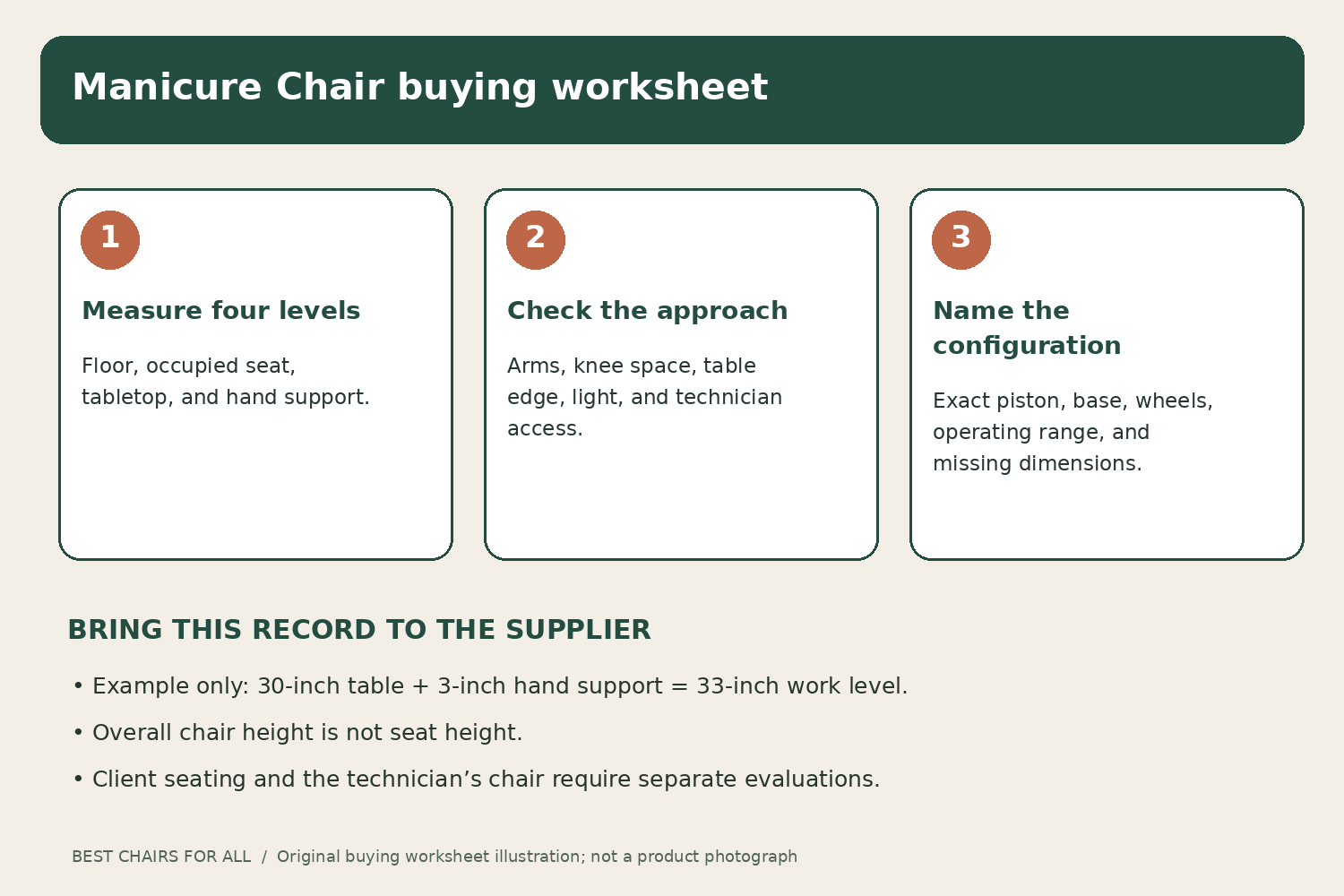
Create a side-view sketch with four labeled levels: floor, occupied seat, tabletop, and hand-support surface. Add the height of the customer’s ordinary seated hand position during the intended service as observed in a proper demonstration. Do not prescribe a universal anatomical angle from the diagram. Its purpose is to keep the equipment measurements and the observed task relationship separate.
For an invented example, a table might be 30 inches high and a hand support might add three inches, putting the work surface at 33 inches. That does not mean the chair should be raised by three inches or that a particular seat setting is appropriate. It identifies why comparing only the customer seat and tabletop can miss the actual working level. Have the technician and customer evaluate the complete arrangement.
Add a top-down drawing for table depth, hand-rest position, technician approach, lamp, curing device, and supplies. A thick table edge or drawer can constrain knee space. Broad arms may strike the tabletop before the customer can approach. A chair can therefore pass the height comparison and still fail the reach or clearance comparison. Record those as separate outcomes.
The final column is the exact model configuration demonstrated. Write the piston option for Monaco, seat setting and wheel option for Cozy, or confirmed configuration for YL Glide. If a measurement is missing, mark it unknown. A reliable purchase record should make it impossible for a seller to substitute a different height configuration without the salon noticing.
Test the task, not just a seated first impression
A quick sit can reveal a preference for cushion shape, but it cannot establish the entire service arrangement. During the demonstration, reproduce the ordinary tabletop layout and observe whether the necessary positions are achievable with the approved controls. Ask the supplier to identify any limits on rotation, adjustment, and ordinary use. The evaluation should not involve stress testing or improvising a load.
Include different regular technicians where the station is shared. A customer chair must work with their professional seating and access to the hands. OSHA’s nail-salon positions-and-motion guidance discusses prolonged leaning, repetitive work, and contact with hard edges as workplace concerns. That guidance supports evaluating the whole task; it does not certify a particular customer chair or prove that one purchase eliminates those concerns.
If a technician has persistent symptoms, seek appropriate professional advice rather than repeatedly raising the customer’s chair without understanding the station. Changes to table, hand support, technician seat, lighting, or work organization may also be relevant. Record the practical difficulty and equipment dimensions so a professional can evaluate the actual arrangement.
Arms, wheels, and entry need separate consideration
Armrests can support some customers but obstruct approach or access for others. Ask for inside-arm width, arm height, and whether any movement or removal is manufacturer-approved. Do not remove an arm simply because a fastener is visible. A customer’s individual access needs should be discussed respectfully, with appropriate professional advice when the arrangement is uncertain.
Wheeled seating needs to suit the floor and the manufacturer’s intended use. A caster description such as smooth or nonmarking is not a guarantee about every surface. Ask which supplied wheel option is appropriate and whether any locking behavior is provided. Do not assume that a customer’s use of the chair during a manicure is equivalent to transporting someone across the salon while seated.
Keep entry, exit, and nearby circulation on the floor plan. The station should not require customers to squeeze between a trolley and an open drawer to reach the seat. Where premises-accessibility questions arise, obtain advice about the actual space and relevant requirements. A product advertised as a salon chair does not establish that the whole service route is accessible.
Cleaning and cosmetic chemistry belong in the specification
Ask the manufacturer which care process is permitted for the upholstery, arms, frame, and controls. Acetone resistance of a table surface does not establish acetone resistance of a chair. Nail products, disinfectants, and general cleaning solvents must be considered separately. Choose a finish only after confirming that the salon’s required process is compatible with the actual material.
Document how the routine cleaning and disinfection procedure reaches contact surfaces, seams, controls, and accessible frame areas. Follow applicable professional requirements and both equipment and disinfectant directions. Do not reduce a required contact time to protect upholstery or apply an improvised chemical mixture. If the manufacturer guidance and necessary hygiene process conflict, resolve the issue before ordering.
Ask about replacements for damaged upholstery and worn wheels. A protective cover should be approved and should not conceal tears, an unsecured support, or another equipment problem. The person cleaning the station needs the exact model and current care instructions, not a generic rule for everything described as vinyl. Keep those documents with the table-and-chair record.
Quote and accept a complete station match
A written quotation should state model, piston or base option, upholstery, wheels, approved accessories, delivery, assembly, and return terms. These are especially important where public technical information is incomplete. We have not verified a current price or availability; compare the actual supplied configurations rather than old starting prices. Confirm whether unused or custom-color equipment can be returned before payment.
At delivery, compare the assembly with the hand-surface chain and quote. Confirm the relevant seat settings and table clearances through the supplier’s ordinary demonstration. Refer abnormal lowering, looseness, or control faults to authorized support and do not open a pressurized lift. Keep the component identity for future service, especially when different piston options exist.
Start with Cozy when its published seat range and demonstrated geometry fit. Investigate Monaco when a specified piston configuration offers a better match. Consider YL Glide only after the supplier supplies the missing functional specification and the table trial succeeds. The best manicure chair purchase supports the actual two-person workstation while preserving each customer’s appropriate seating and access arrangement.
Something unclear or out of date? Send a correction with this article’s title and the detail to check.
Sources, research & corrections policy ↗