Swing-away wheelchair footrests move their supporting assembly out of the front access area; fixed arrangements keep their frame relationship in place, although a footplate may still flip up or use another documented design. Choose with the seating team and compare the exact mechanism, required supports and transport task before treating either style as more convenient.
Identify which part actually moves
A footplate is the surface beneath the foot. Its hanger or support assembly connects it to the wheelchair. A plate can flip upward while its hanger remains in front of the chair; a swing-away hanger can rotate the assembly aside; a removable assembly may detach under its own instructions. These are different operations. Write them separately when comparing a chair.
Do not infer the complete feature from a photograph showing the plates folded up. Ask the supplier to demonstrate the permitted movements on the empty chair and identify the latch, receiver and approved storage position. Some chairs have separate left and right supports; others have a platform. The relevant question is how the actual prescribed arrangement works for the user’s tasks, not which design appears easiest to move in a catalog.
Access is an assessment question, not a transfer lesson
NSW Agency for Clinical Innovation’s configuration guide relates wheelchair configuration to support, function and transfer requirements. A swing-away component can clear a physical obstruction, but it does not establish that an individual can transfer safely or how they should do so. The person’s therapist or other qualified professional should assess the approach and provide the required training.
Bring a description of the usual bed, chair, toilet or vehicle task to that assessment. Explain whether a support obstructs the path, is difficult for the intended operator to release or is routinely misplaced. Do not attempt an unfamiliar transfer to test a proposed footrest or remove needed support while the user remains positioned without appropriate assistance. Ask the provider to connect the equipment demonstration to the individual plan.
The Medline example has model-specific release and storage features
The Medline Ultralight Transport Chair instructions cover specified MDS808200F3 models and illustrate swing-away supports with a release lock and Stow-N-Go storage clips. The manual also warns against standing on footrests and lifting the chair by detachable components. Those details show why an ordinary support-looking tube should not be treated as a step or carrying handle.
Use that manual only for the covered chair. Another brand may release in a different direction, use a different hinge arrangement or lack the same storage feature. If an assembly does not latch as shown, stop and contact the supplier. Do not bend a latch, file a receiver or add a bungee to make a mismatched support stay in place. A convenient fit onto a pin is not enough evidence of compatibility.
Fixed supports can still offer different access features
Sunrise Medical’s manual wheelchair options catalog distinguishes hangers, folding and rigid footplates and other foot-support options. A fixed-front chair does not necessarily mean every surface at the front is immovable. Conversely, an advertised flip-up plate does not imply that the whole front frame swings aside. Ask about the exact order combination.
Compare the usable opening after the permitted movement, the hardware still present and who can operate it. Keep the frame design separate from the foot-support decision: a folding main frame can have a fixed front, and a different chair can use another combination. The seating team and supplier can explain which options meet the user’s support and access needs without assuming that one broad category answers both.
Fit adjustments affect more than the front opening
Foot-support height, angle and position are part of the complete seating setup. Changing them can change how the legs relate to the seat and how much clearance remains above the floor. Do not use a universal distance or a setting copied from another user as the prescription. Follow the exact manufacturer’s constraints and the clinical team’s fitting instructions.
If feet lose support, a plate contacts the ground or the user reports discomfort, record the condition and request a review. Do not shorten a support, drill extra holes or adjust a structural tube to accommodate a single doorway or car-loading problem. Keep fit changes with the responsible team, particularly after a cushion, shoe, seating or functional change. An access improvement should preserve the support arrangement established in the assessment.
Component limits can differ from the chair’s headline capacity
The QUICKIE 2/2HD owner’s manual lists option-specific capacity restrictions as well as overall chair limits; its listed Z-Finity footrest option has its own lower limit. This is an example of why the exact configuration matters. A headline load figure for a frame cannot automatically be assigned to every optional support fitted to it.
Ask the supplier to identify any option restrictions that apply to the actual order. Preserve the component name and part number beside the chair model. Do not combine an assembly from another generation because the mounting points look similar, and do not rely on a reseller’s “universal” description without manufacturer confirmation. Compatibility includes the model, mounting hardware, configuration and stated limits, not appearance alone.
Transport planning includes both the chair and loose supports
A removable pair can reduce one bundle’s dimensions but creates separate items to carry, protect and reinstall. A fixed arrangement may remain attached and change the shape that must pass through the vehicle opening. Measure the permitted transport configuration and account for every component. Do not compare one chair stripped of its supports with another fully assembled without labeling that difference.
Ask the provider which parts are intended for routine removal and which require service tools. Keep detached assemblies where they cannot be damaged or become loose cargo, following the relevant transport instructions. After unloading, restore the complete prescribed arrangement and perform the specified attachment checks before use. If a required support is left behind, do not improvise a substitute from another chair for the day.
Inspection should focus on engagement and condition
Using the model’s maintenance directions, inspect the plates, hangers, receivers, release parts and any specified retention features. Look for cracks, missing hardware, unusual movement, wear or a latch that does not engage normally. Do not ask someone to stand on the support as a strength test. A support can look intact while its connection requires service.
If the chair has recently been transported or a component was removed for cleaning, check the restored connection as the manual requires. For a used chair, verify that both assemblies belong to the model and match the approved arrangement. A bag of spare supports from the same brand is not a parts inventory. Send label and hardware photographs to the manufacturer or supplier when identity is uncertain.
Write the selection around the actual operator
A support that works well in a supplier demonstration may be awkward for the user or the caregiver who will handle it. Ask for training with the exact mechanism and assess whether the planned operator can perform the permitted task within their abilities. Identify a backup assistance arrangement when needed. Do not disable a retention feature to reduce operating effort.
Record the agreed front configuration, approved parts, fitting responsibility, transport routine and service contact. This creates a practical explanation of why the chosen style fits the individual plan. It also prevents a future replacement request from collapsing into “send a swing-away footrest” without enough information to identify the correct assembly. The useful choice preserves both everyday support and workable access.
Footrest access, fit and transport worksheet
| Check | Evidence and decision |
|---|---|
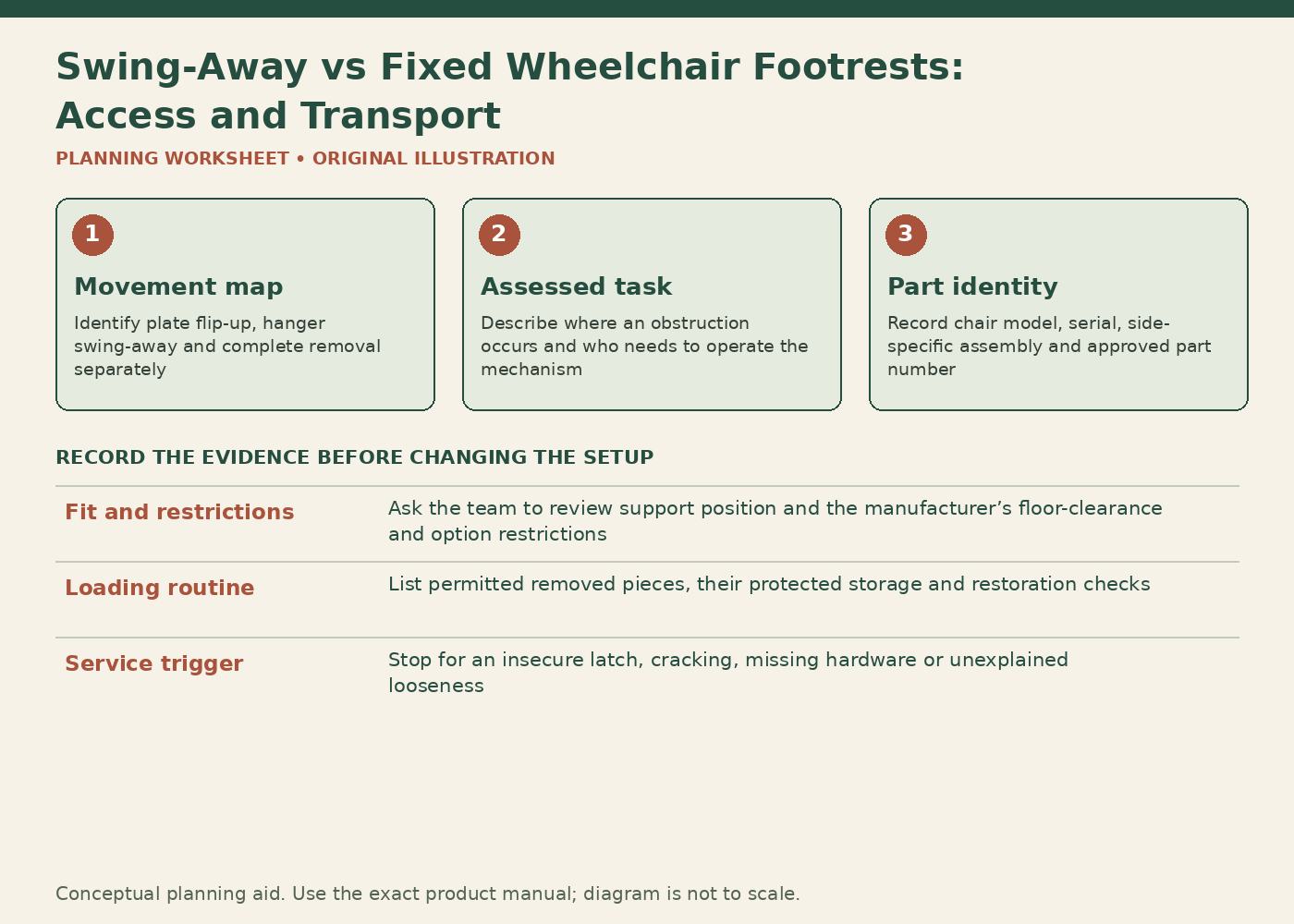
| Movement map | Identify plate flip-up, hanger swing-away and complete removal separately. Ask which operations the exact manual permits. A photograph of a raised plate does not show whether the front assembly moves aside. |
| Assessed task | Describe where an obstruction occurs and who needs to operate the mechanism. Bring that task to the seating team. Clearing a component does not establish an individual transfer method or permission to attempt one. |
| Part identity | Record chair model, serial, side-specific assembly and approved part number. Confirm receivers and hardware. Physical attachment is not sufficient evidence that a replacement is compatible with the complete configuration. |
| Fit and restrictions | Ask the team to review support position and the manufacturer’s floor-clearance and option restrictions. Do not change a fitted support by drilling, shortening or substituting parts to gain transport space. |
| Loading routine | List permitted removed pieces, their protected storage and restoration checks. Include the attached front frame in transport dimensions. The chair must return to its complete prescribed setup before use. |
| Service trigger | Stop for an insecure latch, cracking, missing hardware or unexplained looseness. Follow the manual’s inspection and service process. A footrest is neither a standing platform nor an assumed carrying handle. |
Worked example
A caregiver compares two hypothetical chairs. On Chair A, both plates flip upward but the supporting frame remains in front. On Chair B, approved hangers swing aside and can be removed for the documented transport routine. The first description does not mean A offers the same front opening as B, and B’s removability does not automatically make it better for the user’s assessed task.
The supplier demonstrates each empty-chair mechanism and the seating team reviews the person’s access and support requirements. The family also checks whether detached parts can be stored and restored reliably during travel. If B’s support is frequently misplaced or its latch cannot be operated by the intended caregiver, the routine needs a solution before ordering. The decision is therefore recorded as a complete configuration and operating plan rather than a preference for the word swing-away.
Sources checked November 6, 2026
Use the current document for the exact model, market and production revision. These sources establish the cited instructions and distinctions; they do not certify an individual chair or replace a personal assessment where one is needed.
- Medline: Ultralight Transport Chair user instructions
- Sunrise Medical: Manual wheelchair options and accessories
- Sunrise Medical: QUICKIE 2 and 2HD owner’s manual, revision G
- NSW Agency for Clinical Innovation: Wheelchair configuration and individual fit
Something unclear or out of date? Send a correction with this article’s title and the detail to check.
Sources, research & corrections policy ↗