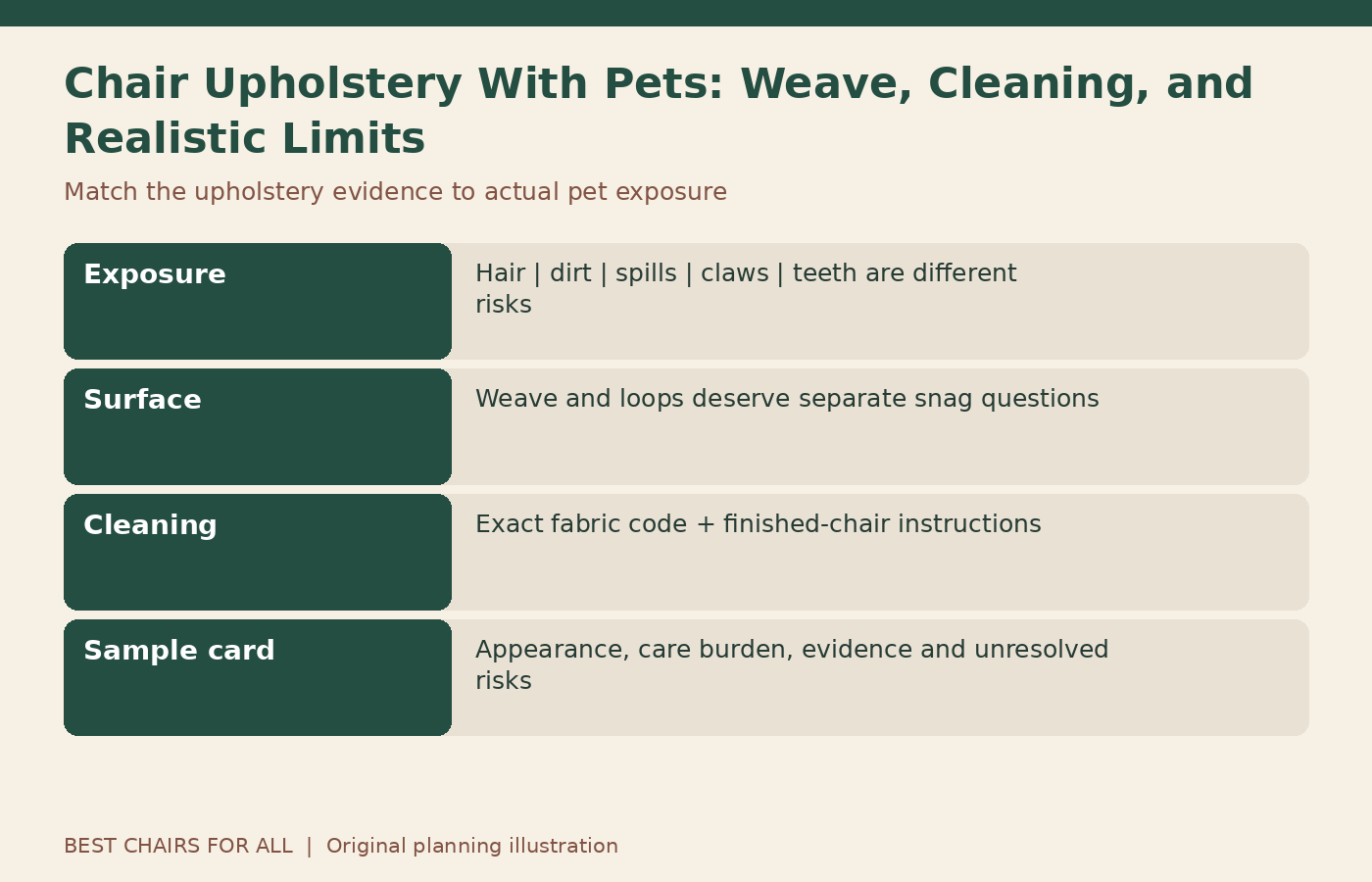
Choose chair upholstery for the particular problems your pets create: loose hair, tracked dirt, spills, scratching, chewing, or repeated cleaning. Those are different demands. A fabric that releases a water-based spill easily may still snag on a claw, and a high abrasion score does not prove resistance to scratching. Start with an exposure worksheet and the exact fabric’s care instructions, then examine samples before ordering.
No upholstery is petproof. The practical aim is a chair whose construction, cleaning method, appearance, and replacement options suit the household. This guide explains how to compare evidence without turning a performance label into a promise that covers every accident or behavior.
Describe the pet’s contact with the chair
Write down what actually happens during an ordinary week. Does a dog sleep on the seat after outdoor walks? Does a cat climb the arms or knead a cushion? Is the chair mainly exposed to fine pale hair, coarse dark hair, or both? Record the contact zones and the cleanup task rather than simply writing pets in the requirements column.
Separate occasional accidents from routine exposure. A washable throw may address a chosen resting area, while persistent clawing needs a household management solution beyond fabric selection. Do not expect an upholstery purchase to change animal behavior. Use the worksheet to decide which product evidence matters most and which risks remain outside any reasonable fabric claim.
Read the exact performance claim
Ask what stain-resistant, water-repellent, easy-clean, or pet-friendly means for the specific fabric code. Does the claim concern liquid beading, release after cleaning, a defined warranty, or an abrasion test? Those are different statements. Save the manufacturer’s technical sheet and care guide with the upholstery sample so the claim can be checked later.
Sunbrella’s pet-friendly performance-fabric discussion presents its own material approach. Treat manufacturer marketing as a starting point for questions, then verify the selected fabric and assembled chair. A brand family can contain different textures, and the chair’s seams, backing, cushioning, and frame are not established by a fabric-only claim.
Examine surface structure without damaging the sample
Look closely at the face and feel it lightly. Note prominent loops, loose decorative yarns, raised texture, a smooth woven surface, or a pile that changes direction. A surface with obvious openings gives you a reason to ask about snag resistance; it does not justify a home claw test with keys or scissors. Destructive sample experiments are not standardized evidence.
Ask whether the manufacturer publishes a snagging result for that exact textile. If it does not, record snag resistance not established rather than guessing from fiber content. Polyester, acrylic, cotton, and blends can be made into very different constructions. A fiber name alone cannot tell you how a specific weave will respond to a pet climbing an arm.
Compare hair visibility and removal separately
Place approved samples in the room’s daylight and evening light. Compare them with the colors of hair normally found in the household. A mid-tone or mixed pattern may disguise some hair without making it easier to remove. A dark solid can conceal one pet’s coat while highlighting another’s. Photographing the samples in the room can help preserve the comparison.
If the retailer permits a sample cleaning trial, use only an allowed method and record the tool and observation. Do not claim a general laboratory result from removing a few hairs. The useful question is whether your ordinary approved cleanup routine feels manageable. Avoid aggressive rubber scraping, stiff brushes, or adhesive products unless the fabric maker says they are suitable.
Find out how the whole chair can be cleaned
A fabric’s care guide may allow a method that the assembled chair restricts because of backing, foam, trim, or construction. Ask the furniture manufacturer which instructions govern the finished item. A removable-looking zipper does not establish that a cushion cover can be machine washed. Some zippers exist for manufacturing or service access only.
Sunbrella’s upholstery-cleaning guidance provides methods for its fabrics and directs attention to the appropriate application. Use the exact current instructions and chair-maker limitations rather than borrowing a stronger cleaner from another performance brand. Cleaning compatibility should be confirmed before a spill occurs, not after several products have already been tried.
Compare a second performance system on its own terms
The Crypton Home cleaning-and-care guide gives its own process and product guidance. Do not combine its cleaning directions with Sunbrella’s because both are sold as performance upholstery. The products, fabric treatments, and approved procedures are distinct. Keep the guide associated with the chosen fabric code and furniture item.
When comparing two samples, list permitted cleaning methods side by side. Add whether professional cleaning is advised, what residues must be removed, and which chemicals are prohibited. An easy-to-understand method that fits your household routine may be more valuable than a broad stain claim with unclear aftercare. Leave unanswered questions visible rather than assuming all performance fabrics are interchangeable.
Ask what happens below the surface
A liquid-resistant textile does not automatically make every seam, zipper, cushion insert, or frame cavity waterproof. Ask whether the claim applies to the fabric surface, includes a barrier, or covers the assembled cushion. Avoid using a water-pouring demonstration as proof that pet accidents cannot reach the filling. The route through stitching or an opening may differ from the middle of a sample.
If an accident reaches the cushion interior, follow the furniture maker’s instructions and seek professional advice where required. Do not saturate the chair to flush it out or assume a surface deodorizer resolves contamination below. This uncertainty is worth discussing before purchase if frequent accidents are a realistic concern. A replaceable cushion arrangement may then deserve particular attention.
Evaluate seams, piping, and contact edges
Inspect the chair design as well as the cloth. Raised piping, decorative buttons, exposed wood, and projecting corners create different contact points for paws and teeth. A tightly woven seat fabric does not protect a wooden leg from chewing. Look at the zones identified in your exposure worksheet and ask whether the design places vulnerable details directly in those areas.
A loose cushion can sometimes be serviced separately, while a fixed upholstered seat may require a larger repair job. Verify actual replacement availability and access rather than assuming a loose cushion means a washable or reversible cover. Ask whether the fabric code can be reordered and whether color matching is guaranteed; later production lots may not look identical.
Keep abrasion in the right role
Abrasion testing concerns repeated rubbing under a defined method. It does not reproduce claws, urine, teeth, heavy dirt, or every household cleaning cycle. Ask for the test method as well as the result. A large number without an identified method is hard to interpret, and different test systems should not be converted through an invented multiplier.
Use abrasion as one row in the worksheet beside snag information, pilling, colorfastness, cleaning, and replacement access. Do not select the highest number while ignoring a loose looped texture that conflicts with the pet’s contact pattern. If a retailer calls a fabric commercial grade, ask for the actual supporting specification instead of treating the phrase as a complete durability assessment.
Build a three-sample comparison card
For Samples A, B, and C, record fabric code, surface description, hair contrast, approved routine cleaning, accident-cleaning limits, documented durability evidence, and unresolved risks. Add the full chair model because the same cloth on two different cushion constructions may create different maintenance tasks. Use plain observations rather than a single star score.
A hypothetical result could read: A hides pale hair but has prominent loops; B shows hair but permits a manageable approved cleaning routine; C has a smooth face but requires professional care for the likely spills. The point is to expose tradeoffs. These are invented comparison notes, not test results or recommendations for any named fabric.
Read the pet-related warranty language
Ask whether scratching, chewing, stains, odors, or damage from bodily fluids are covered, excluded, or addressed only through a separate protection plan. A fabric warranty may concern defined manufacturing performance rather than every accident. Read any reporting deadline and required cleaning procedure before relying on the coverage. Keep the full terms rather than a salesperson’s summary.
The chair warranty and fabric warranty may also have different claim routes. Ask who inspects the problem and whether labor, shipping, or upholstery replacement is included. A covered cloth defect does not necessarily provide a free complete chair. Do not use an unapproved cleaner because you expect a protection plan to pay if the finish changes.
Decide whether a removable protector helps
A suitable protector can create a defined resting surface and simplify some routine cleanup, but it needs its own care and compatibility checks. Ask whether its backing can affect the upholstery finish, whether it transfers dye, and whether it stays in place without damaging attachments. A cover should not hide a structural or moisture problem that needs assessment.
For a moving chair, keep loose fabric and straps clear of mechanisms and follow both manufacturers’ instructions. Do not tie a protector to arbitrary frame hardware. For a stationary chair, check whether bunching changes how the person sits. A washable protector is useful only if it can be removed, cleaned, dried, and refitted realistically by the household.
Set an achievable care routine
Use the approved routine for loose hair and soil, and keep the correct spill instructions accessible. Inspect high-contact zones while cleaning so an emerging seam problem or snag is noticed early. Keep products labeled and do not mix cleaning chemicals. Record any professional treatment and revised advice for the particular fabric.
The routine should also recognize household limits. If a fabric requires care that will rarely happen, choose another option rather than assuming a busy week will become less busy after delivery. A chair that visibly shows hair but cleans predictably may be a better practical match than one that hides hair while making every accident difficult to handle.
Make a decision that includes realistic limits
Write a final sentence explaining the choice in relation to the exposure worksheet: selected smooth surface, manageable approved cleaning, acceptable hair visibility, and confirmed cushion service route. Also record the remaining risk, such as no documented claw resistance. That makes the decision honest and gives future cleaning or repair conversations a useful reference.
Keep the fabric sample, code, exact care guide, chair instructions, and warranty together. Reassess if the household’s pets or routines change. The best upholstery choice is supported by specific evidence and a workable care plan, while recognizing that scratching, chewing, accidents, and everyday wear cannot be eliminated by a pet-friendly label.
Something unclear or out of date? Send a correction with this article’s title and the detail to check.
Sources, research & corrections policy ↗