Foam density and firmness describe different properties. Density is mass per unit volume; firmness describes resistance to a defined indentation or compression test. A higher-density foam can be soft or firm. Neither number, by itself, tells you how a complete office chair will feel or how long its cushion will remain suitable. Read the material specification, then evaluate the cushion as part of the seat.
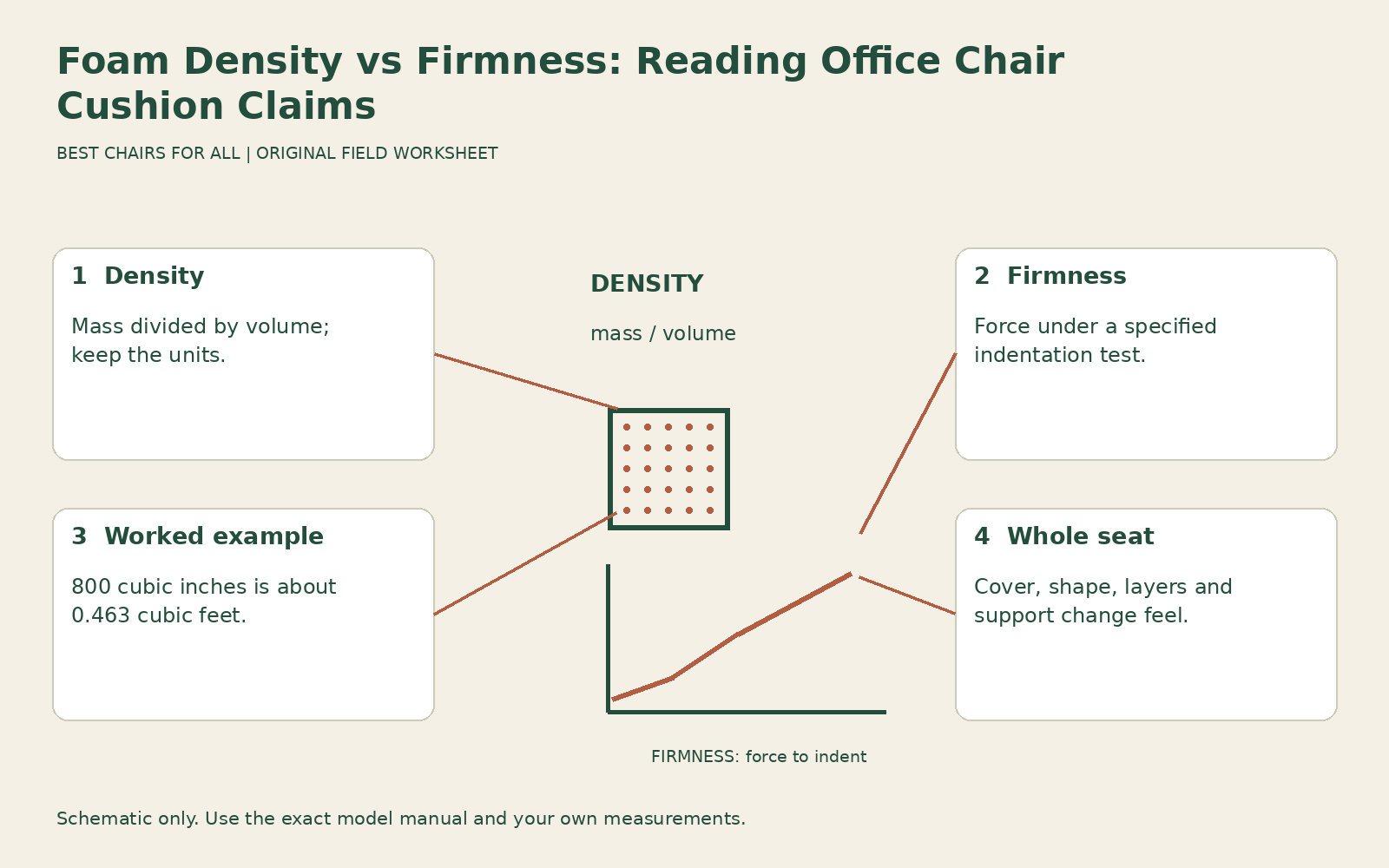
This guide provides a specification-reading worksheet and a worked density calculation. It is for understanding sales claims and discussing an approved replacement seat, not for cutting open a chair or choosing a universal foam grade. Office-chair cushions can be shaped, layered, bonded, and paired with flexible structures, so a generic rectangular foam listing is not automatically an equivalent replacement.
Keep the units attached to every number
Density is commonly expressed in pounds per cubic foot or kilograms per cubic meter. Firmness may be stated as force under a particular test, often described as indentation force deflection, or IFD. Retailers also use terms such as ILD and simple soft-to-firm descriptions. Ask for the actual method and conditions instead of assuming every figure represents the same test.
The Polyurethane Foam Association performance definitions explicitly distinguishes density from firmness. Its overview also separates support factor from surface firmness, showing why a single number cannot summarize the whole response. Use the definitions to interpret a document, without turning them into a universal minimum specification for an office chair. Material type, formulation, geometry, thickness, and the rest of the seat still matter.
Copy the units and test label into your comparison sheet. “Density 2.5” is incomplete without the unit and material context. “Firmness 30” is incomplete without the method and compression conditions. A rounded marketing phrase such as high density may provide no actual measurement at all. Mark that as unspecified rather than assigning a typical value from another product.
Work through a simple density example
Imagine a hypothetical rectangular foam sample measuring twenty inches by twenty inches by two inches. Its volume is eight hundred cubic inches. Since a cubic foot contains 1,728 cubic inches, the sample volume is about 0.463 cubic feet. If that foam sample alone weighs approximately 1.157 pounds, dividing mass by volume gives a density of about 2.5 pounds per cubic foot.
For a metric comparison, one pound per cubic foot is approximately sixteen kilograms per cubic meter, so the hypothetical 2.5-pound density is approximately forty kilograms per cubic meter. The unit conversion does not change the foam or its firmness. A seller quoting forty in metric units is not describing sixteen times the quality of a seller quoting 2.5 in customary units; the figures may describe approximately the same density.
This calculation explains the unit; it is not a home test for the foam inside your chair. A complete seat includes upholstery, a pan, fasteners, adhesive, and possibly other layers. Weighing that assembly and dividing by the outside dimensions cannot isolate foam density. A sculpted cushion also does not have the volume of a simple rectangle unless its shape is accounted for.
Notice that the calculation contains no indentation force. You could know the density accurately while still knowing nothing about the sample’s surface firmness. Likewise, pressing a cushion with your hand cannot measure its density. The worked example helps you identify the kind of evidence a claim needs rather than encouraging destructive measurement of a finished product.
Use a real specification to separate the properties
The Carpenter foam property sheets including Serene grades includes a useful example in its Serene material sheets: two grades have the same nominal density of 2.50 pounds per cubic foot while listing different minimum 25-percent IFD values, twelve and twenty-two pounds-force. That is direct manufacturer evidence that identical density does not require identical firmness. The sheets describe foam products for bedding-related applications, not recommendations for office-chair replacement cushions.
Read the qualifications as carefully as the values. Nominal density and minimum firmness are not identical kinds of tolerance statement. Typical physical property values also should not be mistaken for a guaranteed measurement on every finished item. If a chair supplier provides a foam grade, ask what its quoted values mean and whether they describe the actual production material in your seat.
Do not compare the higher firmness number as automatically better. It means a different measured response under the stated conditions. Your preferred seat response depends on the complete construction and occupied fit. A laboratory material value can help explain a difference but cannot decide whether your thighs, sitting area, or movement will be comfortable on the finished chair.
Distinguish initial feel from deeper support
A surface can feel soft under light contact yet provide increasing resistance as it compresses. Another can feel firm initially while offering a different response deeper into the cushion. A single surface-firmness result does not describe the whole force-versus-deflection curve. This is why a quick hand press or a short showroom sit can provide only part of the useful information.
For a shopper, the practical question is whether the occupied cushion offers comfortable support without an intrusive hard area or an unsuitable amount of sinking. Record what you experience during ordinary work rather than inventing an engineering diagnosis. “Feel the underlying front structure while seated normally” is an observation. “Foam density too low” is a conclusion that needs material evidence you may not have.
If you discuss the seat with a supplier, distinguish the symptom from the property. Ask whether the cushion construction, thickness, or approved replacement version differs, and whether a trial is available. Do not order a denser material solely because the seat feels hard, or a softer material solely because you want more durability. Those requests confuse separate characteristics.
Account for the complete sitting system
Polyurethane Foam Association foam in furniture design describes upholstery comfort as a combination of materials, geometry, construction, and movement. A foam layer interacts with its cover and support structure rather than behaving like an isolated laboratory sample. This is especially relevant to office chairs, where a thin sculpted cushion on a flexible pan can feel different from a thick block on a rigid base.
Write down whether the seat is molded or cut, single-layer or layered, and paired with a flexible or rigid support when the manufacturer provides that information. Do not assume that cold-cured, molded, memory, or high-resilience wording supplies all the missing performance values. Each term should lead to a material or construction explanation, not an automatic quality ranking.
The covering matters too. A taut or less yielding upholstery can affect how you experience the cushion. If two showroom chairs differ in fabric, geometry, and foam, you cannot attribute every difference to density. Record the complete configuration and test the version you intend to buy. A review of another covering can be informative without establishing an identical feel.
Separate durability evidence from comfort preference
Density can be relevant to durability within an appropriate material comparison, but formulation, fatigue performance, environment, and use also matter. Do not convert a density value directly into a promised number of service years. A high-density cushion can still be uncomfortable for you, while a comfortable initial sit does not establish how well the seat will retain its properties.
Ask what evidence supports a retention or fatigue claim. The supplier may have a material test, a finished-seat test, a warranty term, or only a descriptive assertion. These are different evidence types. A material’s performance under a defined repeated test should be stated with the method and result; it should not become a guarantee of your exact workday experience.
Also distinguish changes in foam from changes elsewhere. A seat that feels lower might have a different height setting, a sinking lift, a failing support structure, or cushion compression. If the whole seat moves downward, investigate the height mechanism separately. Our sinking-chair guide addresses that symptom without asking you to dismantle the lift.
Build a cushion specification worksheet
Use rows for foam type, density and units, firmness and method, thickness or shape, layers, cover, support pan, and fatigue evidence. Add a column for the source of each answer: manufacturer sheet, supplier response, or observation. Keep “not disclosed” visible. A document with several missing fields is less informative, but missing data does not authorize you to fill the gaps from a different chair.
An illustrative comparison might list Candidate A as a named foam grade with density and IFD documentation, but no finished-seat trial, and Candidate B as an unspecified foam with a well-fitting occupied trial and an approved replacement seat route. The worksheet does not declare either a universal winner. It reveals which uncertainties matter for your purchase and what question could resolve them.
For a replacement request, add the chair model, production version, existing seat part reference, and the observed problem. Ask whether the proposed assembly preserves intended fit and compatibility. A generic cushion with a matching outside width may change the seat height, depth, front-edge shape, or mounting relationship. Treat those changes as design questions rather than a simple foam upgrade.
Make the purchasing conclusion precise
If you prefer a firmer occupied feel, say so and test the complete seat. If you want evidence of property retention, ask for relevant documentation and support arrangements. If you need a replacement, seek a compatible approved assembly or qualified upholstery guidance. Do not use a density label to answer all three questions.
The useful conclusion is specific: which material information is known, which occupied response you prefer, and which compatibility or durability questions remain. Density and firmness become helpful when they stay attached to their units, test conditions, and intended application. They become misleading when either is treated as a universal score for comfort, quality, or office-chair lifespan.
Something unclear or out of date? Send a correction with this article’s title and the detail to check.
Sources, research & corrections policy ↗