You cannot safely measure an office chair’s weight capacity at home by adding weights until it bends or fails. Capacity is a documented manufacturer specification for a complete chair in its intended use. Your practical task is to identify the exact chair, verify the applicable rating, check that the configuration has not been changed, and confirm that the seat and adjustments fit the user. A tape measure can establish dimensions; it cannot establish a structural load rating.
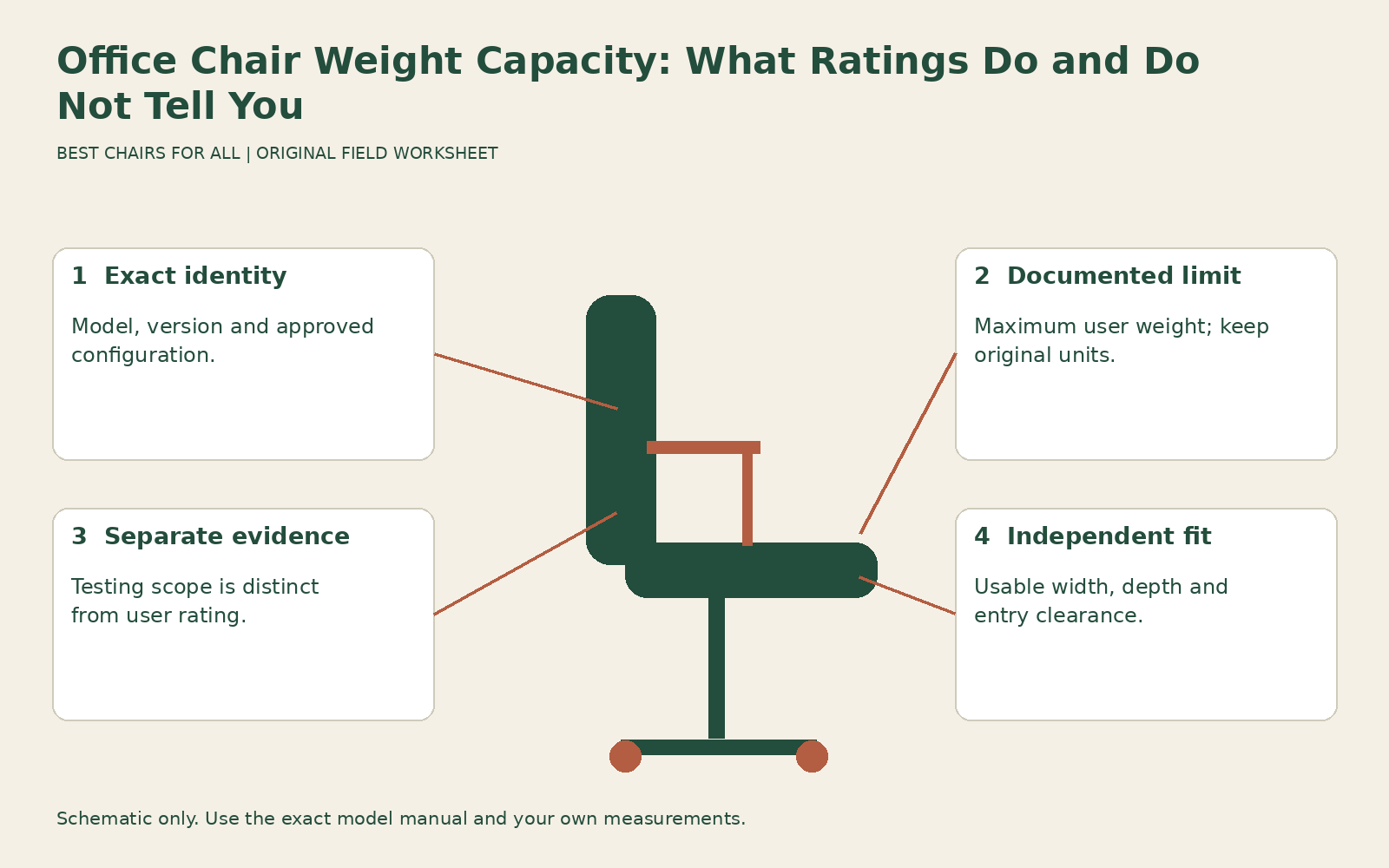
This guide provides a rating-verification worksheet. It is useful for an online purchase, a secondhand chair, or a workplace inventory where labels and sales descriptions disagree. It deliberately separates three questions: what the manufacturer permits, what testing evidence supports the product, and whether the chair offers enough usable room. Answering only one leaves an important gap.
Identify the complete chair before reading a number
Find the brand, model, version, and identifying label. A family name may include a standard chair, a larger occupant model, a stool, and a lounge version with different constructions. Photograph the label and complete chair without placing yourself underneath an unstable seat. Retain the model code and date information so the manufacturer can identify the relevant documentation.
Do not copy a rating from a visually similar chair. Office seating often has common silhouettes, and replacement parts can make two different models look alike. A seller’s phrase such as “heavy duty” or “commercial quality” is a description, not a verified maximum user weight. Ask for a product document naming the exact model and configuration that will be supplied.
As a concrete example, Steelcase Leap and Leap Plus manufacturer specifications explicitly identifies Leap Plus as supporting users up to 500 pounds. That does not mean every chair carrying the Leap name has that rating. The Plus distinction is part of the specification. A photograph showing a wider seat is not enough to establish that a used chair is the Plus version, and a generic listing title should not override a manufacturer label.
Distinguish a user rating from other weight figures
A product page may show net weight, shipping weight, package weight, and maximum user weight in the same table. Net weight tells you how heavy the furniture is. Shipping weight includes packing or other shipped components. Neither tells you how much user weight the chair is intended to support. Copy the field label together with the number into your worksheet.
Check the units carefully. Pounds and kilograms are not interchangeable, and a small unit label can disappear when a retailer copies a table. If you convert a figure for comparison, retain the original unit and avoid rounding upward to create a more favorable capacity. When documentation is inconsistent, ask the manufacturer which figure applies instead of averaging the claims.
Also ask whether a number refers to a single occupant, a component test, a distributed load, or a complete product. A cylinder supplier’s load claim is not automatically the user rating of the chair that contains it. The base, seat structure, backrest, fasteners, and overall geometry still matter. Capacity belongs to the approved assembly rather than whichever replacement component has the largest advertised number.
Understand what a standards reference contributes
A statement that a chair was tested to a seating standard can provide useful evidence of mechanical performance. It is not a universal comfort rating, a medical endorsement, or a substitute for model identification. The BIFMA Compliant program and mechanical standards distinguishes several mechanical standards, including general-purpose office chairs and large-occupant office chairs. Scope matters: different kinds of seating are not all evaluated under one identical set of assumptions.
Ask for the standard designation, relevant edition, and documentation connecting the claim to the product. “BIFMA tested” on its own leaves questions about which tests, which model, and what result. If a seller cites a program listing, check the listing rather than treating a logo pasted into an image as verification. A testing standard and a manufacturer’s stated user limit are related information, but they answer different questions.
Do not reverse-engineer a rating by looking up an individual test load and treating that as permissible user weight. Test procedures can include repeated loading, particular fixtures, or forces applied at specific points. Those conditions do not translate into a home experiment involving a person sitting, leaning, or dropping onto a chair. This worksheet needs a documented user specification, not an improvised engineering calculation.
Record intended use as well as capacity
Ask whether the chair is intended for your environment and pattern of use. A standard office application, a shared shift workspace, and a specialist industrial station may create different purchasing requirements. Do not assume that a high user-weight figure also establishes suitability for continuous multi-shift operation. Look for explicit manufacturer guidance or obtain written confirmation for the intended application.
Use the chair only as instructed. A rated seat is not a step stool, a platform for carrying furniture, or permission for two people to share one sitting position. Standing, dropping into the seat, leaning on a single arm, and sitting on the backrest involve different loads from ordinary seated use. A generous capacity number does not make those activities approved.
For a workplace, provide the supplier with the use description without collecting more personal information than needed. “Shared computer workstation used across three shifts; required capacity to be confirmed privately with procurement” can be a better starting point than circulating employees’ body weights. The organization needs an appropriate product specification, while individual measurements can remain with the person responsible for fitting or purchasing.
Measure fit independently of the rating
A chair can meet a documented weight requirement and still be too narrow, too deep, or too high. Measure usable sitting width between obstructions rather than overall chair width across the arms. Check whether arm spacing allows entry, exit, and relaxed working positions. A broad seat with narrowly fixed arm supports may provide less practical room than its headline dimensions suggest.
Seat depth also matters. A wider large-occupant chair can have a depth that does not suit a shorter user’s thighs. Conversely, a tall user may need more depth without needing extra width. OSHA computer workstation chairs discusses seat sizing, back support access, and arm positioning as separate elements of workstation fit. Use those relationships to evaluate the occupied chair after verifying the capacity.
When testing an approved chair, sit and move normally within its instructions. Do not bounce, load one edge to see whether it tips, or recruit additional people to check its strength. A showroom fitting exercise should establish access, support, and usable adjustment. It cannot certify the structure, and it should never be used to investigate a rating that remains undocumented.
Handle used and modified chairs cautiously
A used chair retains its model identity, but its condition and parts history can be uncertain. Ask whether the base, cylinder, casters, seat pan, arms, or tilt mechanism have been replaced. Seek part references and service records where available. A replacement described as stronger does not automatically preserve the original rating or increase it; compatibility requires more than visual fit.
If the identifying label is missing and the manufacturer cannot confirm the product, mark capacity as unverified. Do not assign a number based on the chair’s weight, upholstery thickness, or the seller’s estimate. Lack of documentation is a purchasing limitation, even when the chair feels solid during a brief sit. You can choose a better documented option without proving that the unidentified chair is defective.
Visible cracks, bent parts, missing fasteners, unexpected play, or a mechanism that will not hold its normal setting need assessment before use. A documented original rating does not make a damaged chair acceptable. Likewise, a successful repair should restore the approved configuration and operation; it should not produce a new capacity figure invented by the owner or repair marketplace.
Use this evidence worksheet
Create a row for model identity and enter the label code, manufacturer document, and whether both agree. Add a row for maximum user weight with the exact wording and units. Add a third row for intended environment and usage. A fourth row records testing or compliance evidence, including where it can be verified. A fifth records any replacement components and who confirmed their compatibility.
Finish with three fit rows: useful seat width, useful depth, and entry or exit access. These are observed dimensions and experiences, not evidence of capacity. Keep them separate so a comfortable seat does not turn an undocumented structural claim into a pass. Each row should have an evidence field and a decision field: verified, unresolved, or unsuitable.
For an illustrative purchase, imagine a listing advertising 400 pounds while the exact manufacturer document supplied by the seller names a different model. The answer is “unresolved,” even if the chair is wide enough. Ask for corrected documentation and an order confirmation matching that model. If the seller cannot provide it, remove the offer from the shortlist rather than assuming the higher number wins.
Send one precise verification request
A useful message reads: “Please confirm the maximum user weight and intended usage for model code X in the configuration supplied, including its cylinder, base, and casters. Please link the manufacturer’s specification and identify any replacement parts. If the sales listing differs, which rating will appear on the order confirmation?” This asks for evidence rather than a general reassurance about quality.
Save the response with the invoice and product document. If the chair will serve several users, ensure the responsible purchaser can access the specification later without depending on a disappearing marketplace page. Recheck the record when making significant repairs or relocating the chair to a different application.
The correct outcome is a verified limit and a suitable fit, not a home-measured breaking point. When the rating cannot be established, the chair has unresolved suitability for the proposed user. When it can be established, continue checking condition, intended use, and comfort on their own terms. Those separate decisions make a weight-capacity claim useful without asking it to promise things it cannot tell you.
Something unclear or out of date? Send a correction with this article’s title and the detail to check.
Sources, research & corrections policy ↗