As an Amazon Associate, we earn from qualifying purchases. Read our affiliate disclosure. Amazon buttons open searches for matching listings; they do not confirm seller, configuration, price or stock.
Use capacity as a gate, then measure the sitting space
The best office chair for heavy people must meet the user’s weight requirement and provide enough usable width, suitable depth and workable arm clearance. Our shortlist is Haworth Soji XL, Steelcase Leap Plus and Safco Vue 3397BL. These are specifically identified higher-capacity products, not standard chairs selected because they look broad or have thick padding.
Official sources checked online on November 6, 2026 list 600 pounds for Soji XL and 500 pounds for Leap Plus and Vue. Those are manufacturer ratings, not results of load tests performed by us. The exact product, configuration and intended use must match the rating. Capacity alone does not guarantee comfort or appropriate body fit, and a large person is not necessarily tall or long-legged.
| Model | Official capacity | Published seat-width screen | Important qualification |
|---|---|---|---|
| Haworth Soji XL | 600 lb | 24.5 inches | US store arm-opening data needs confirmation |
| Steelcase Leap Plus | 500 lb | 22.75 inches in brochure | Plus is different from standard Leap |
| Safco Vue 3397BL | 500 lb | 20.5 inches | Deep fixed seat; optional arms |
The three higher-capacity candidates
Treat the model names as part of the recommendation. Standard Soji and Soji XL are not interchangeable, nor are Leap and Leap Plus. Vue is also offered as an extended-height stool, which is a different purchase from the task chair. A broad marketplace heading such as big and tall does not answer these distinctions.
Model specifications and ordering details were checked against Haworth Soji XL official US specifications, Steelcase Leap US adjustment features, Steelcase Leap and Leap Plus dimensions, Safco Vue 3397 official product page, Safco Vue 3397BL/BV model-specific technical flyer. These manufacturer documents support the configuration notes in this comparison; retrieved November 6, 2026.
1. Haworth Soji XL
Best for: a wide-seat 600-pound candidate pending arm-clearance confirmation.
Soji XL has a manufacturer-listed 600-pound capacity and 24.5-inch-wide seat, with 16.4–21-inch height and 16.25–18.75-inch listed depth. The substantial width and sliding seat make it worth investigating when standard chairs lack the required room and rating.
The US store simultaneously lists a 17.1–20.1-inch arm opening. That is a fit-critical inconsistency for an XL chair, so we require a current drawing and confirmation of actual upright spacing before recommending it to someone needing wider clearance. Do not assume that seat width equals the arm entry opening.
Product Details
| Brand | Haworth |
|---|---|
| Seat width | 24.5 inches |
| Seat depth | 16.25–18.75 inches |
| Seat height | 16.4–21 inches |
| Capacity | 600 lb; confirm exact ordered model |
Pros
- Highest published capacity in this shortlist
- Wide seat with depth adjustment
Cons
- Arm-opening data needs clarification
- 32.5-inch overall width affects delivery and room fit
A conditional shortlist choice until Haworth resolves the actual arm-clearance measurement for your selected build.
2. Steelcase Leap Plus
Best for: a broader upholstered seat with adjustable depth.
Leap Plus is the 500-pound model, with a 22.75-inch seat width and 16.75–18.75-inch functional depth in Steelcase's brochure. The listed height range for that configuration is 15.5–19.5 inches, making it worth comparing for users who need capacity without an especially high minimum.
Confirm the Plus identity, current dimensions and arm package on the order. Standard Leap dimensions and capacity must not be substituted. The broader cushion still needs a usable-width and arm-opening check, and the lower maximum height may be limiting for a tall desk or long-legged user.
Product Details
| Brand | Steelcase |
|---|---|
| Seat width | 22.75 inches |
| Functional seat depth | 16.75–18.75 inches |
| Seat height | 15.5–19.5 inches |
| Capacity | 500 lb, Plus configuration |
Pros
- Broader seat than standard Leap
- Sliding functional depth
Cons
- Plus-specific inventory and pricing need confirmation
- Height range may not suit a tall setup
Compare the exact Plus chair when width and a relatively short adjustable seat matter together.
3. Safco Vue 3397BL
Best for: a simpler 500-pound mesh-back chair when its seat fits.
Safco Vue 3397BL is rated up to 500 pounds and has a 20.5-by-20-inch seat in the official technical flyer. Its height-adjustable mesh back and optional 3399BL arms provide a different format from an executive chair with thick fixed arms.
The 20-inch depth and narrower width are decisive limitations for some heavier readers. Safco documents have differed on seat-height figures across revisions and upholstery versions, so confirm the current BL build rather than relying on an old catalog range. The optional arm kit also changes cost and clearance.
Product Details
| Brand | Safco |
|---|---|
| Seat size | 20.5 inches wide × 20 inches deep |
| Capacity | 500 lb |
| Back | Mesh, height adjustable |
| Arms | Optional 3399BL kit |
Pros
- Model-specific 500-pound rating
- Optional adjustable arm kit
Cons
- Narrower and deeper seat than some users need
- Current height specification should be confirmed
Worth considering for someone who fits the measured seat, rather than as a universal wide-chair recommendation.
Four measurements that a weight rating cannot supply
Start with comfortable seated hip and thigh width in ordinary working clothes. Use an existing broad stable seat or obtain help measuring the actual sitting envelope. Do not compress the body to make a catalog width appear to fit. Consider where side bolsters, rigid frames and arm uprights reduce the space available, because the nominal cushion width may include sloped or inaccessible edges.
Next measure useful seat depth from a supported back to behind the knee. A deep pan can be wrong for a heavier short-legged person even if its width and capacity are generous. The front edge should not prevent reaching the backrest. A seat slider is valuable when it offers a suitable minimum, but a slider that starts too deep remains too deep.
Then measure the clear opening between arm supports at the level your body must pass through, not simply the distance between the tops of movable pads. Some pads adjust outward while the structural uprights stay closer together. Ask for both measurements if the opening matters. The path for sitting down and standing up can require more space than the final seated position.
Finally record your comfortable working height and the desk’s thigh clearance. A low minimum can matter as much as a high maximum. Check whether the desk opening, room route and doorway can accommodate the complete chair. Soji XL’s listed overall width of 32.5 inches is a delivery and layout consideration separate from its 24.5-inch seat width.
The Soji XL arm-width discrepancy is a real purchase gate
Haworth’s US store lists a 24.5-inch Soji XL seat and 32.5-inch overall width, but the same dimensions section gives 17.1–20.1 inches between armrests. That arm figure matches the narrower regular Soji listing and needs clarification for the XL configuration. We are not assuming which value is a site error, a pad position or a different measurement reference.
If you need an arm opening wider than 20.1 inches, do not treat the broad seat as proof that the opening will fit. Ask Haworth for the current XL drawing showing structural arm spacing and pad travel, plus confirmation for the actual SKU. An answer from a reseller that merely repeats seat width has not resolved the issue. This recommendation remains conditional on that clarification.
The discrepancy illustrates a general buying lesson: a higher capacity does not remove the need to audit the dimensions. Where published fields conflict, preserve the uncertainty instead of inventing a reassuring number. A documented fit-critical answer is worth more than a confident but unsupported ranking.
A worked width-and-depth comparison
Consider a reader weighing 420 pounds who finds that a 22-inch-wide sitting surface works well, with a useful depth around 18 inches. All three listed capacities pass the initial weight screen. Their geometry does not produce the same outcome. Vue’s 20.5-inch seat may fail the width requirement before its lower purchase cost is considered.
Leap Plus lists a 22.75-inch seat and 16.75–18.75-inch functional depth in the manufacturer brochure. That makes it a more promising dimensional candidate for this example, subject to the real usable width and arm opening. Soji XL’s 24.5-inch seat and listed 16.25–18.75-inch depth offer another possibility, but the unresolved arm-spacing field is important if this user needs a wider entry path.
Now change the example to a 320-pound reader with narrower hips and long thighs. A 24.5-inch seat is not automatically a benefit; arm support may end up too far away. A standard chair with verified appropriate capacity and better dimensions could be more suitable. The goal is sufficient room and support, rather than selecting the largest product in every dimension.
Build a capacity-and-fit verification sheet
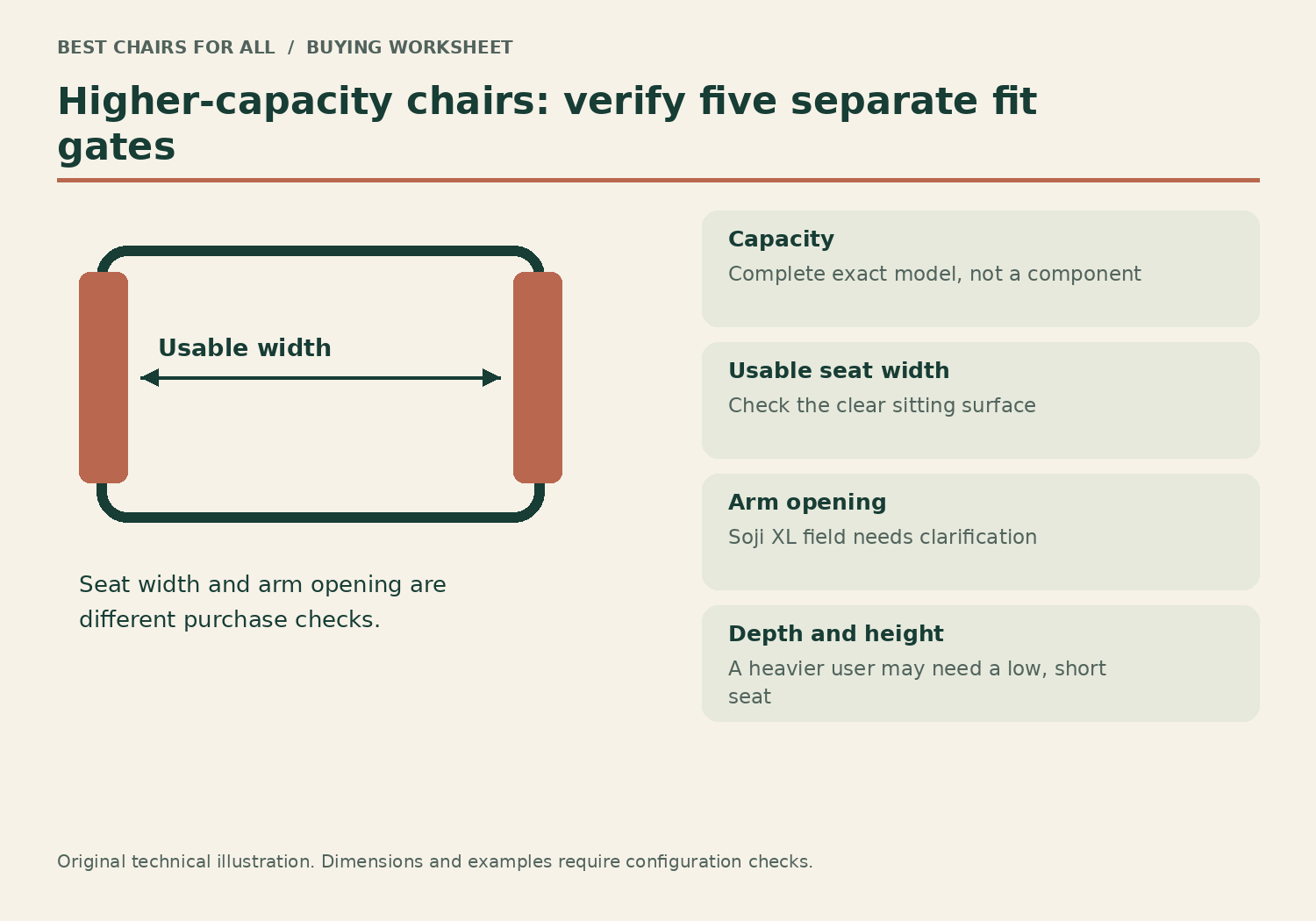
Ask the seller to complete the following before placing an expensive or custom order. Keep the answers with the invoice. Do not accept a capacity copied from a similar model, an unspecified chair series or a replacement cylinder advertised independently of the complete chair. The rating belongs to the complete documented product and use conditions.
| Purchase gate | Evidence to retain | Reject or clarify when |
|---|---|---|
| Exact model and capacity | Manufacturer sheet plus complete SKU | Standard and Plus/XL names are mixed |
| Usable seat width | Drawing showing clear sitting area | Only overall width is supplied |
| Arm opening | Inside uprights and pad adjustment | Seat width is offered as the answer |
| Depth and height | Correct cylinder and slider ranges | Stool figures appear on task-chair listing |
| Intended use | Warranty and use restrictions | A capacity claim has no model-specific support |
Durability, use conditions and replacement planning
A weight rating is not a reason to apply a home proof load or exceed the stated limit. Use the chair according to its instructions, and contact the manufacturer if the intended schedule or environment falls outside normal office use. If multiple shifts will share it, ask about that use explicitly rather than transferring a twenty-four-hour claim from another model in the range.
On arrival, inspect the carton and parts before assembly, follow the specified sequence and retain the model label. If a base, arm support or mechanism is damaged or unexpectedly unstable, stop using the chair and contact the seller. Do not attempt to increase capacity by fitting a different gas cylinder, reinforcing a component or mixing parts from unrelated chairs.
Ask who can supply replacement casters, arm pads and seat components, and whether authorized service is needed. Component availability helps explain long-term ownership cost, but we have not measured service life for these models. Likewise, a warranty duration describes contractual coverage under its terms; it is not a guarantee that every surface will remain comfortable indefinitely.
The delivery and return questions deserve early attention
A larger chair can be difficult to move through a house or return after assembly. Measure the route from delivery point to desk, including turns and stairs, and compare it with both package and assembled dimensions. Establish whether delivery means curbside, doorstep or placement in the room. Where handling help is needed, arrange it before arrival rather than improvising with a bulky assembled chair.
Ask whether a configured XL or Plus model can be returned for fit, how return freight is arranged and whether the original carton is required. A custom upholstery choice may affect eligibility. If you are buying refurbished, confirm that the higher-capacity model identity remains intact and that replacement parts are appropriate to that version. A generic standard-chair photograph is inadequate evidence.
The OSHA chair guidance recognizes the need for seat pans large enough for the user while also considering depth, support and arms. Apply those principles to the complete body-and-desk relationship. Soji XL offers the highest stated capacity here, Leap Plus combines a broader seat with depth adjustment, and Vue offers a simpler mesh-back alternative for users who fit its narrower, deeper seat. Buy the configuration that passes all the gates, not merely the largest number.
Something unclear or out of date? Send a correction with this article’s title and the detail to check.
Sources, research & corrections policy ↗