Affiliate disclosure: As an Amazon Associate, Best Chairs for All earns from qualifying purchases. Read our disclosure. Amazon links below open matching US search listings; check the exact model, seller, configuration, availability, and checkout terms.
The best office chair for big and tall users must pass several independent checks: approved user load, usable seat width, appropriate seat height and depth, arm clearance, and back contact. Steelcase Leap Plus is the wider-seat starting comparison, Concept Seating 3150HR offers a different depth and height envelope, and current US Aeron Size C is the suspended-seat alternative within its own rating. No model wins solely because it has the highest capacity.
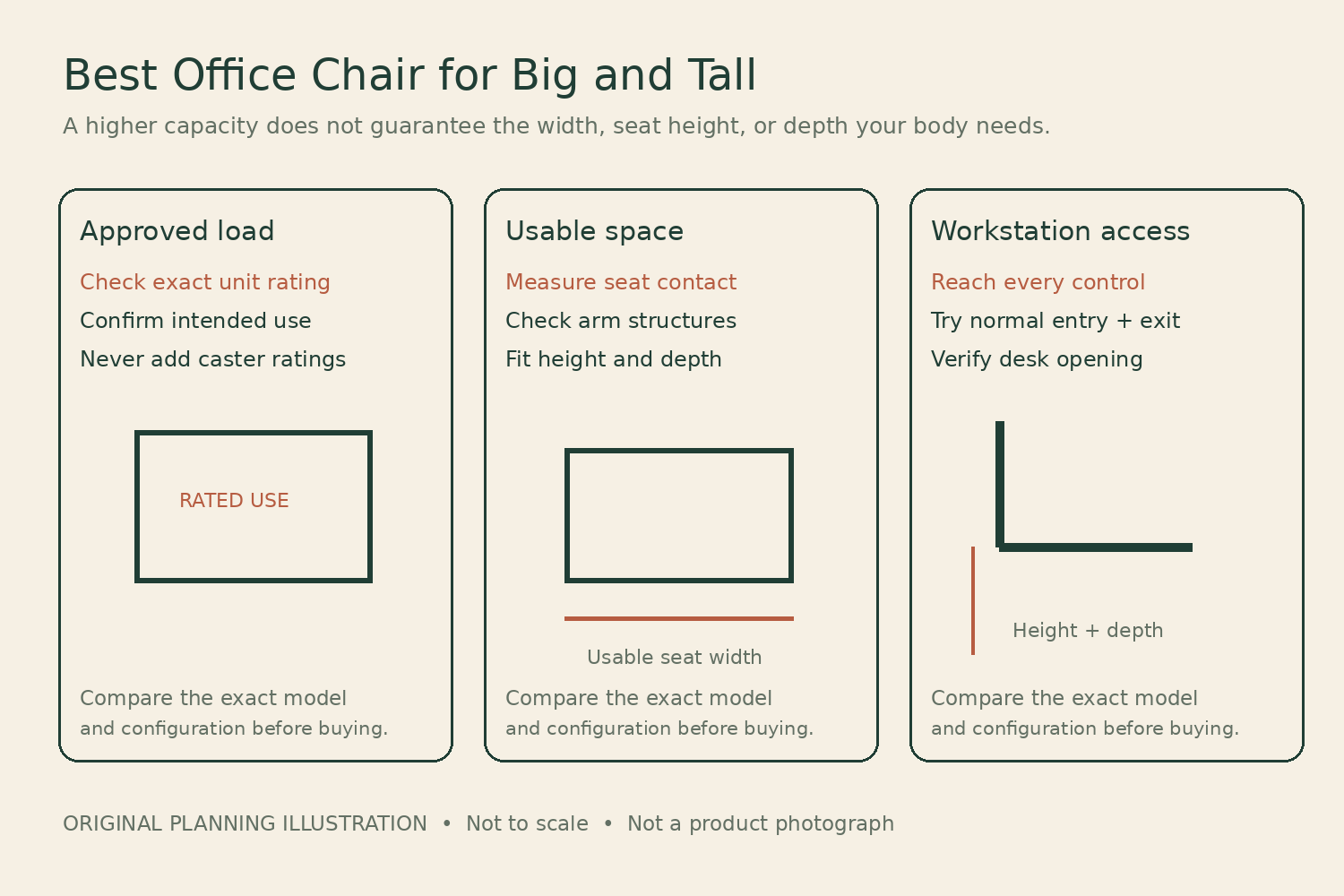
This guide focuses on buyers who need to examine load and body dimensions together. It differs from a tall-user guide where weight and width may already fit ordinary chairs. We checked manufacturer documents and current US purchasing pages on November 6,2026. We have not tested structural loads, durability, comfort, or medical outcomes, and manufacturer ratings are reported without an invented extra safety margin.
Capacity and fit answer different questions
A chair rated for your intended use can still be too narrow, too low, too deep, or hard to leave. Conversely, a seat that looks roomy does not establish its load rating. Check the manufacturer-approved capacity for the exact chair, cylinder, base, and use conditions. Do not add together individual caster ratings or convert a laboratory base-test load into an occupant limit.
Height is also not a single body measurement. Two people of similar standing height can have different thigh lengths, lower-leg lengths, and seated torso heights. One may need a wider low seat; another may need a taller lift and long depth without additional width. The label big and tall should trigger several measurements, not an instruction to choose the largest object.
Compare separate fitting dimensions
| Candidate | Published load | Width evidence | Height caution |
|---|---|---|---|
| Leap Plus | 500 lb | 22.75-inch seat in current US retail table | Standard 15.5–19.5-inch range |
| 3150HR | 550 lb multi-shift | 21-inch seat | 18.5–22.75 envelope depends on cylinder |
| Current Aeron C | 400 lb | 28.25 is overall width; obtain usable width | 16–20.5-inch seat range |
Check Steelcase’s current Plus identification and the US configuration listing, the July 2026 Concept sheet, and Aeron’s current US size table. Do not replace an uncertain usable-width figure with overall width because it makes a comparison table look more complete.
1. Steelcase Leap Plus Office Chair
Best for: Best wider-seat comparison when the standard low-range cylinder fits.
Leap Plus is the first candidate when the main constraint is width and capacity rather than simply a taller back. Steelcase's current manufacturer page explicitly identifies Plus as the 500-pound version of Leap. It is a separate model, so a standard Leap listing or a familiar used Leap photograph does not establish the same rating or dimensions. Keep Plus in the written product description and model record.
The current Human Solution US listing gives a 22.75-inch seat width,20.5–24.5 inches between arms, and a 15.5–19.5-inch standard seat-height range. That last figure is a crucial limitation for some tall users. A wider chair does not necessarily rise higher. The listing offered configurable ordering with a lead time; obtain a current manufacturer-approved cylinder and dimensional drawing if the standard range misses your working height.
Product Details
| Brand | Steelcase |
|---|---|
| US retailer seat width | 22.75 inches |
| US retailer standard seat height | 15.5–19.5 inches |
| US retailer width between arms | 20.5–24.5 inches |
| Back height from seat | 24.5 inches, retailer |
| Warranty | 12-year limited retailer description; verify current manufacturer terms |
Pros
- Separate500-pound manufacturer-rated model
- Broad published seat and arm-spacing dimensions
- Adjustable support in a conventional upholstered layout
Cons
- Standard19.5-inch maximum can fail a taller seated target
- Width does not establish adequate depth or torso support
Choose Leap Plus after a fitting that checks both the broad seat and its height. The retailer describes twelve-year limited coverage and eligible returns; request the actual terms for your configuration. Ask specifically about any higher-cylinder proposal rather than fitting an aftermarket extension. The quoted dimensions describe the checked US listing, not every international Plus configuration.
2. Concept Seating 3150HR Chair
Best for: Best deeper-seat and higher-range heavy-duty configuration to assess.
3150HR is the comparison when the depth range, higher seat envelope, and documented heavy-duty service arrangement matter. The current July 2026 manufacturer sheet rates it to 550 pounds in a multi-shift environment. It publishes a 21-inch-wide seat with 18.5–21-inch depth endpoints. That narrower width can disqualify it for someone who needs the wider Leap Plus surface, even though its load rating is higher.
Concept gives an 18.5–22.75-inch height envelope depending on cylinder. Request the actual cylinder's endpoints rather than assuming one unit covers every option in the family envelope. Its articulating headrest and height-adjustable back provide additional contacts to fit. The current manufacturer page offered quotation and buying routes; upholstery, approved casters, arm style, and cylinder must be specified to obtain a meaningful US lead time.
Product Details
| Brand | Concept Seating |
|---|---|
| Seat width | 21 inches |
| Seat-depth endpoints | 18.5–21 inches, July2026 sheet |
| Seat-height envelope | 18.5–22.75 inches, depending on cylinder |
| Base | 28-inch seven-leg base |
| Warranty | Lifetime steel seat frame/base portion;6 years other parts |
Pros
- Published deeper-seat endpoint and higher height envelope
- Current550-pound multi-shift rating
- Replaceable covers and explicit current service framework
Cons
- 21-inch seat is not the widest option
- Cylinder selection and back contact still require personal fitting
Choose 3150HR only if its usable width, selected cylinder, and control reach fit. The current warranty covers the steel seat frame and steel portion of the base for product life, with six years for other parts and approved US claim shipping. Older retailer summaries can show an obsolete ten-year frame term. Its circulation and fatigue claims are not validated by this guide.
3. Herman Miller Aeron Chair Size C Current US Configuration
Best for: Best suspended-seat comparison only when its fixed geometry fits.
Current US Aeron Size C belongs on the shortlist for someone within its 400-pound rating who wants to assess a suspended seat rather than a wide foam cushion. It is not a 550-pound alternative, and the rating must not be inferred from a different chair's test or an old product generation. The checked current US listing separates A, B, and C capacities and dimensions.
Size C is listed at 16–20.5 inches of seat height and 18.5 inches of depth. Its 28.25-inch overall width is not the width of the usable seat between the frame edges. Ask for the actual seating-area dimension and try the fixed frame with your own thighs and hips. There is no depth slider to shorten or lengthen it around you. The US store provided active ordering with a configuration-specific ship estimate.
Product Details
| Brand | Herman Miller |
|---|---|
| Current SizeC capacity | 400 lb |
| Seat height | 16–20.5 inches |
| Published SizeC depth | 18.5 inches |
| Published overall width | 28.25 inches; not usable seat width |
| Seat construction | Fixed-size suspended seat; no depth slider |
| Warranty | 12 years; eligible purchase terms apply |
Pros
- Different suspended-seat contact from the padded candidates
- Current US page separates size-specific ratings
- Factory support and caster choices can be specified
Cons
- Fixed frame and depth can fail despite adequate capacity
- Maximum seat height may miss some tall users
Choose Size C only after a full fit trial and confirmation of the exact current rating. Herman Miller gives twelve-year warranty coverage under its terms. Do not order C merely because a height chart calls you tall, or borrow its current 400-pound rating for a used earlier model. A different size or chair may suit your dimensions better even when C looks like the category's obvious choice.
The load-width-height-depth worksheet
Use a suitable fitting appointment or permitted trial with a surface and chair approved for your needs. Do not improvise a test platform from furniture with an unknown rating. Record your requirements without relying on a generic standing-height recommendation. Keep clothing, shoes, and any routinely worn work equipment consistent with the intended use.
- Approved load: record the actual intended user’s load and the manufacturer’s applicable rating. Confirm whether multi-shift use, accessories, or configuration change the approval.
- Usable width: establish comfortable support with room for ordinary movement. Measure the useful cushion or suspension area and the clear width between arm structures, not only the outer chair width.
- Loaded height: establish a comfortable supported position and record it. Compare the actual selected cylinder’s low and high endpoints, including your floor and footwear.
- Functional depth: establish supported thighs with appropriate room behind the knees while meeting the back. Record the useful setting and reserve adjustment for the tasks you perform.
- Upper contacts and exit: assess lumbar and shoulder contact, arm support, control reach, and a normal entry and exit. Then verify the desk opening and the room’s travel path.
Consider a hypothetical buyer who needs a seat about 22 inches wide, a loaded height near 22 inches, and an approved rating above 400 pounds. Leap Plus passes the reported width and load screens but its checked standard cylinder misses the height target. Concept passes the load and possible height screens but its 21-inch seat misses the initial width requirement. Aeron C fails the specified load condition. None is an automatic winner. The next step is a verified approved configuration or another chair, not rounding one failed requirement away.
The example is deliberately unresolved. A useful buying guide should expose the intersection of requirements even when no shortlisted model satisfies it. Do not let a high maximum rating override an uncomfortable seat or accept an unapproved cylinder simply to complete the match.
Check arms at both hip and elbow level
A wide cushion beneath narrow fixed arm structures can still restrict the body. Record the clear width where the hips pass, where the forearms rest, and during entry. Moving arm pads outward may change elbow support without removing the lower structure beside the seat. Ask the fitter to demonstrate the relevant clearance rather than quoting one maximum arm-pad spacing.
Also check how close the chair can approach the desk. An arm that sits comfortably beside the body may strike an apron or drawer at the work height. Removing arms should be an approved configuration choice with a useful task arrangement, not an improvised way to squeeze a chair into a desk. If the chair meets your body but the desk opening fails, document that furniture mismatch before buying.
Back height is not headrest fit
A high advertised overall chair height can include a cylinder position, decorative frame, or headrest at its upper stop. It does not show whether the lumbar and shoulder areas meet your body. Try the back through ordinary upright and leaning-back tasks. A tall headrest that misses your head or pushes it forward should not be treated as a premium feature.
Concept’s articulating headrest provides another fitting variable, while Aeron does not offer a factory headrest in the compared configuration. Leap Plus must be checked as its own model rather than borrowing accessories from a standard Leap. Ask the manufacturer which parts and options are approved. A third-party attachment’s marketing compatibility is not a manufacturer fit confirmation.
Entry, floor movement, and controls deserve a trial
Try sitting down and standing up using the chair as instructed. Ensure the floor contacts are appropriate for the actual surface and the chair remains predictable. Concept describes unloaded-braking safety casters; understand that behavior before using the chair. A large base can provide its intended support while still obstructing a small workstation or the foot positions used to leave.
Reach each control while seated. A knob hidden under a wider cushion or behind an arm may be difficult for the intended user to operate. A highly adjustable chair has little practical value if important settings cannot be changed comfortably. Ask for an appropriate alternative control arrangement where offered rather than expecting another person to reset the chair every time.
Buy a documented configuration and service route
Leap Plus had a current US retailer configuration with a stated lead time, Concept provided quotation and buying routes, and Aeron had active direct ordering. These establish current purchase paths, not immediate delivery of every option or guaranteed Amazon stock. Get the exact chair name, cylinder, arms, base, wheels, upholstery, and rating written into the quote.
Concept’s current warranty covers the steel seat frame and steel base portion for product life and other parts for six years; older summaries differ. Steelcase and Herman Miller have their own eligible-purchase terms. Ask how service is carried out for a substantial chair and whether parts, labor, and freight are included. A defect warranty is not a promise that an unsuitable fit can be returned.
Start with Leap Plus for a verified wider padded seat,3150HR for its deeper adjustable envelope and heavy-duty framework, or current Aeron C for a suspended-seat fitting within its rating. Keep every worksheet gate independent. The right big-and-tall purchase is the documented intersection of load, body fit, workstation clearance, and an accessible service route.
Something unclear or out of date? Send a correction with this article’s title and the detail to check.
Sources, research & corrections policy ↗