Affiliate disclosure: As an Amazon Associate, Best Chairs for All earns from qualifying purchases. Read our disclosure. Amazon links below open matching US search listings; check the exact model, seller, configuration, availability, and checkout terms.
The best mesh office chair depends on which surface you want to change. For suspension on both seat and back, compare Herman Miller Aeron and Sihoo Doro C300 Standard. If you want a mesh back while keeping a padded seat, Haworth Zody is the more relevant comparison. These are different material-and-fit choices, not simply expensive and inexpensive versions of the same chair.
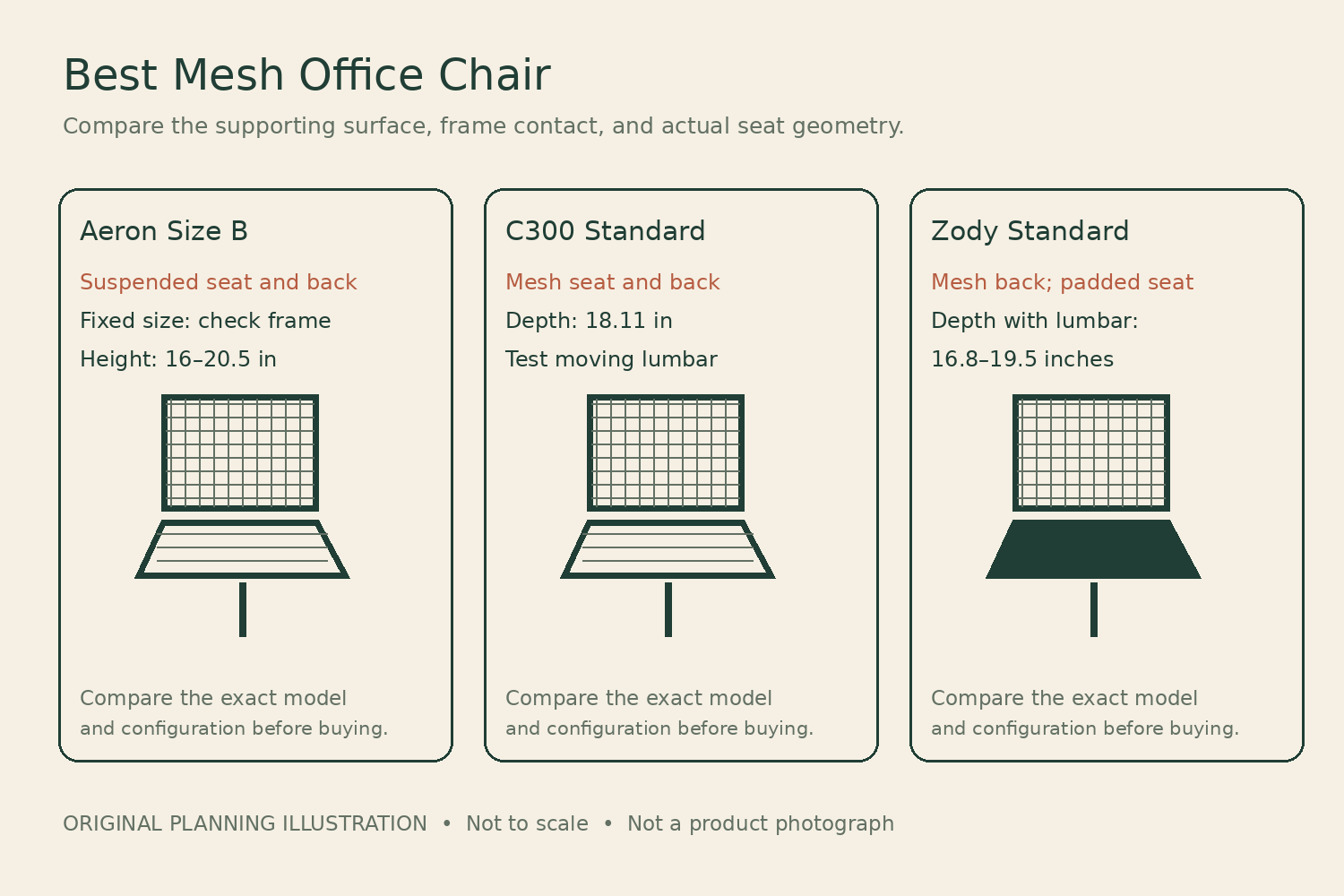
We researched manufacturer specifications and active US product pages on November 6, 2026. We have not measured airflow, surface temperature, stretching, pressure, or long-term wear. Mesh can be a useful material preference, but this guide does not claim that it prevents sweating, improves circulation, or stays comfortable for every user. The frame and adjustment range remain as important as the woven surface.
Full suspension versus mesh back
A suspension seat stretches material across a supporting frame. A padded seat rests on a different underlying structure, even if a thin fabric cover looks perforated. Product photography can hide that distinction. Look at the underside, front edge, and material description to establish what actually supports your thighs and pelvis.
For the backrest, mesh can be flat, zoned, shaped, or backed by separate support parts. A lower-back pad can change the contact considerably. Someone shopping for less intrusive support might not enjoy an adaptive lumbar section simply because the area above it is mesh. Compare the entire back assembly rather than assuming all woven backs feel open and unobtrusive.
Choose the surface arrangement first
| Chair | Seat/back arrangement | Fit variable | Potential reason to pass |
|---|---|---|---|
| Aeron Size B, current US | Suspension/suspension | Three-size family | Perimeter contact or fixed depth |
| C300 Standard | Mesh/mesh | 18.11-in published depth | Depth or adaptive lumbar mismatch |
| Zody, mesh-back configuration | Upholstered seat/mesh back | Sliding depth with lumbar option | Buyer specifically wants suspended seat |
Compare the current Aeron listing, C300 Standard specifications, and Zody option table. Width, depth, and support configuration are not interchangeable across all versions of a familiar model name.
1. Herman Miller Aeron Chair Size B
Best for: Best for deliberately choosing suspension on both surfaces.
Aeron is the premium comparison if the point of buying mesh is to avoid a conventional padded seat as well as a padded back. Its 8Z Pellicle supports the body within a defined frame. That creates a different edge and contact pattern from foam under fabric. Choose it because you like that physical arrangement, not because the word mesh guarantees a lower measured temperature.
For the current US Size B listing, the seat-height range is 16–20.5 inches and the listed depth is 16.75 inches. Sizes A and C change the geometry rather than adding a seat slider to B. The practical limitation is the perimeter: a seat that fits upright can still become uncomfortable when you shift sideways or sit with one leg tucked. Try the actual size and generation in the positions you use at work.
Product Details
| Brand | Herman Miller |
|---|---|
| Seat and back | 8Z Pellicle suspension |
| Current US Size B seat height | 16–20.5 inches |
| Current US Size B listed depth | 16.75 inches |
| Current US Size B capacity | 350 lb |
| Warranty | 12-year limited; eligible purchases |
Pros
- Suspension on seat and back
- Three sizes provide distinct fixed-seat geometry
- Current US specifications and 12-year warranty information
Cons
- Defined perimeter needs a careful sit
- No sliding seat to correct an unsuitable size
Choose Aeron after checking frame contact through ordinary clothing. The current direct listing accepted orders with lead time. Confirm the Amazon seller's exact generation, size, back support, and condition. An older or refurbished Aeron may be a valid purchase, but it should be compared using its own dimensions and written service terms.
2. Sihoo Doro C300 Ergonomic Office Chair Standard
Best for: Best for comparing an all-mesh seat with moving lumbar support.
C300 Standard is the all-mesh alternative to investigate when you want a headrest and a self-adapting lumbar section. Sihoo lists mesh on both seat and back, an 18.11-inch seat depth, and a 20.28-inch maximum hip-width figure. Treat those numbers as screening dimensions. Neither says how much the tensioned surface will deflect beneath you or whether its front edge suits your thighs.
Its support arrangement means the lumbar region is not simply a flat mesh panel. A buyer who dislikes prominent lower-back contact should try the chair's changing contact as they recline and return to work. The manufacturer lists a 330-pound capacity and three-year warranty. The current US Standard listing offered ordering. C300 Pro and newer variants may have different adjustment features, so do not copy their sliding-seat claims onto this Standard model.
Product Details
| Brand | Sihoo |
|---|---|
| Seat and back | Mesh |
| Published seat depth | 18.11 inches |
| Published maximum hip width | 20.28 inches |
| Overall dimensions | 28 W × 28 D × 42–49 H inches |
| Capacity | 330 lb |
| Warranty | 3 years; terms apply |
Pros
- Mesh seat as well as back
- Headrest and moving-lumbar arrangement
- Specific seat-depth information for the Standard model
Cons
- Fixed published depth needs a body check
- Adaptive lumbar contact is a preference to test
Choose C300 if its suspension seat and support pattern fit you at the desk. Check the current exact model and cover rather than searching only for Sihoo mesh chair. A footrest version adds another mechanism but does not establish that the underlying seat depth or lower-back contact will be comfortable.
3. Haworth Zody Office Chair Mesh Back Standard Posture
Best for: Best when you want a mesh back and a padded seat.
Zody is the useful reminder that a mesh office chair need not suspend the seat. In a mesh-back, upholstered-seat configuration, it provides a different combination for someone who likes a cushioned sitting surface but wants a back with less solid upholstery. The current US Standard Posture range is 16–21 inches in seat height, with 16.8–19.5 inches of seat depth when lumbar support is fitted.
The seat is 19.5 inches wide, and Haworth publishes separate depth ranges with and without lumbar support. That matters when comparing the same chair across configurations. Its PAL system allows asymmetric lumbar adjustment, which is a support feature rather than a property of mesh itself. The listed capacity also changes with forward tilt: 350 pounds without that option and 325 with it. The checked US store offered ordering and a twelve-year warranty description.
Product Details
| Brand | Haworth |
|---|---|
| Surface arrangement | Mesh back with upholstered seat configuration |
| Standard seat height | 16–21 inches |
| Seat width | 19.5 inches |
| Depth with lumbar | 16.8–19.5 inches |
| Capacity | 350 lb without forward tilt; 325 lb with forward tilt |
| Warranty | 12-year limited; terms apply |
Pros
- Padded-seat alternative within mesh-back seating
- Adjustable depth with configuration-specific figures
- Independent lumbar adjustment on either side
Cons
- Not an all-mesh seat
- Options change measurements and rating
Choose Zody if your dislike of a full-mesh chair concerns the seat edge or tensioned surface rather than its back. Order the mesh-back configuration intentionally; knit and leather choices are also offered. Confirm whether you are buying Standard or Dual Posture, since their height ranges serve different workstation arrangements.
The mesh-contact fitting worksheet
Use your ordinary work clothes during a trial. A thick trouser seam, a short skirt, and a soft sweatshirt can interact differently with a tensioned surface or prominent frame edge. The purpose of this worksheet is to locate the contact you like or dislike, not to label any particular posture correct for everyone.
- Surface: identify whether the seat is suspended mesh, foam under fabric, or another construction. Write down the front-edge material and whether a firm perimeter is exposed to your legs.
- Upright contact: sit back at the height needed for your desk and check the thighs, hips, and lower back. Note the exact location of pressure instead of recording only firm or soft.
- Depth: check clearance behind the knees without sliding your body forward to escape an edge. If the model has adjustable depth, try the intended working setting rather than its shortest demonstration position.
- Movement: recline, return upright, and reach for a nearby notebook. Record whether a frame edge or support component appears during the movement.
- Clothing: repeat the sit with the clothing you use most frequently, and check whether seams, pockets, or fabric friction change the contact.
- Workstation: confirm that the arms and height allow close access to the keyboard. A material improvement should not cost you a usable desk position.
For example, a buyer may find that a mesh back feels pleasant but a suspended seat presses at its side frame when they turn slightly to answer a second screen. That evidence points toward a mesh-back chair with a padded seat, not automatically toward a larger full-mesh model. A second buyer may dislike foam compression and prefer the consistent shape of a suspension seat. Both conclusions follow the actual contact problem.
Ventilation claims need a boundary
An open woven surface allows a different path for air than a solid upholstered panel, but personal temperature depends on room conditions, clothing, sitting position, and the material itself. A mesh back partly covered by a thick coat is not being used under the same conditions as an uncovered back in a warm room. We have not conducted a controlled cooling comparison between these chairs.
Do not use climate language to ignore fit. A chair that encourages you to slide away from the back or sit on its front edge is not made suitable by a breathable description. Establish comfortable support first. If warmth is the only complaint about an otherwise good chair, compare room temperature and clothing along with the chair material before making a costly replacement.
Stretch, sag, and replaceable parts
A suspended seat depends on its fabric, attachment points, and supporting frame. Ask how the manufacturer handles a damaged panel and whether replacement parts are available through an authorized service route. A warranty’s length does not tell you whether routine softening or visible wear qualifies as a defect.
Inspect a used chair for uneven tension, tears, pulled attachment points, and damaged edges. Check whether the seat and back are original parts for the model generation. A neatly cleaned surface is not proof that the underlying supports are intact. If the seller cannot identify the chair or explain repairs, factor that uncertainty into the comparison rather than treating every used example as equivalent to new.
Do not retension a seat, apply heat, or replace a panel using improvised methods. The supporting material is part of the chair’s structure. Ask the manufacturer which repair is appropriate, especially if damage appears near the perimeter or mounting points.
Care without damaging the material
Start with the exact chair’s care guidance. Haworth’s Zody page describes vacuuming and a mild detergent approach for relevant surfaces, but that does not establish that the same method is appropriate for every other mesh and attachment system. The Herman Miller care resources separate products and materials; locate the actual chair’s instructions.
Remove loose dust gently and avoid saturating mechanisms or applying a cleaner because it worked on another fabric. Do not use bleach, solvents, steam, or abrasive brushes unless the manufacturer expressly permits the method for the specific material. Check the frame, arm pads, seat, and back separately: a chair can combine several surfaces with different care requirements.
Which design fits your reason for buying mesh?
Choose Aeron after a size-specific trial if suspension is the attraction and its frame fits your movements. Compare C300 Standard when you want an all-mesh arrangement with a headrest and moving lumbar section. Choose Zody when the more useful combination is a mesh back and padded, adjustable-depth seat.
Before ordering, match the selected configuration to the specification you used, and check warranty eligibility and fit-return terms with that seller. A matching Amazon search can return accessories and different versions. The purchase should resolve the contact or material problem you identified; mesh alone is not a sufficient reason to accept a chair that fits less well.
Something unclear or out of date? Send a correction with this article’s title and the detail to check.
Sources, research & corrections policy ↗