Affiliate disclosure: As an Amazon Associate, Best Chairs for All earns from qualifying purchases. Read our disclosure. Amazon links below open matching US search listings; check the exact model, seller, configuration, availability, and checkout terms.
The best kneeling chair should offer a useful alternative sitting position without creating a new problem at your shins, desk, or exit path. My shortlist compares Varier Variable for a simple rocking frame, Variable Plus when a backrest matters, and DRAGONN by VIVO DN-CH-K01B for an adjustable metal-frame design. The most important purchase feature is a practical way to try the chair.
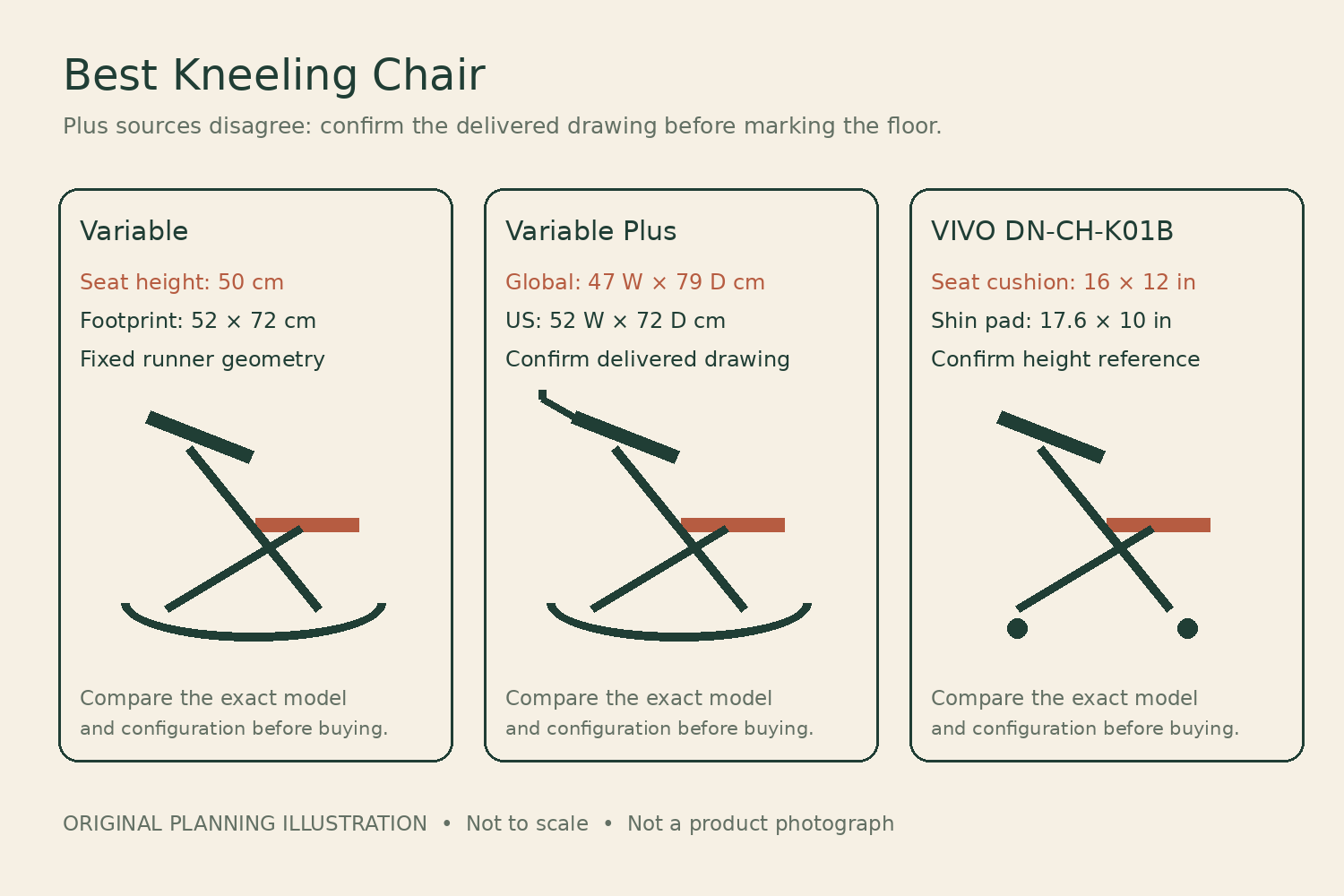
This guide is based on current manufacturer and US distributor information checked November 6, 2026. We have not tested these chairs, measured their pressure distribution, or established that they improve posture or treat pain. A kneeling chair changes how you sit; that does not make it a universal upgrade from a well-fitting task chair. Published specifications also contain ambiguities, which we identify rather than silently resolving them in a product’s favor.
Understand the contact points before shopping
A kneeling chair normally combines an inclined sitting surface with lower cushions that support the shins. The lower cushions are often labeled knee pads, but that label is not an instruction to kneel directly on the kneecaps. Read the model’s positioning instructions and make sure the intended contact is comfortable. If the arrangement causes pressure or discomfort, changing to a more expensive model with the same geometry may not solve it.
There are two distinct mechanisms in this shortlist. Curved runners let the whole frame rock as you shift position. An adjustable X-frame changes the relationship between its contact surfaces and may use wheels for movement. A photograph showing both at a desk can make them appear equivalent. In use, their setup, floor contact, and ease of changing positions are different.
Three designs, three fitting questions
| Model | Design priority | Published measurement to check | Question to settle |
|---|---|---|---|
| Varier Variable | Open rocking frame | 50 cm seat height; 52 × 72 cm footprint | Does the fixed geometry fit your desk? |
| Variable Plus | Runner frame with fixed backrest | Global: 47 W × 79 D cm; US listing: 52 W × 72 D cm | Obtain the delivered version’s written drawing before checking fit |
| VIVO DN-CH-K01B | Adjustable metal frame | 16 × 12 in upper cushion | Do pad spacing and height work together? |
Use the base Variable manufacturer page, global Variable Plus specifications, Variable Plus US listing, and VIVO model page as starting documents. The distinctions above are reasons to arrange a trial, not results of our own ergonomic testing.
1. Varier Variable Balans Kneeling Chair
Best for: Best for a rocking alternative to a task chair.
Variable is the option to examine if gentle rocking and a simple open frame are the reason you want a kneeling chair. It has curved wooden runners, a sloped seat, and separate shin cushions. There is no conventional height lever to solve a desk mismatch. Varier publishes a 50-centimeter seat height and a 52-by-72-centimeter footprint, making it a defined geometry that you should try rather than a highly adjustable chair to buy on faith.
The manufacturer's description explicitly allows several positions: shin support is one possibility, not an instruction to put all your weight on your knees. It suggests standard tabletop heights around 71–76 centimeters and calls its height guidance general. The lower cushions and runners still take up space beneath the desk even when the seat looks small. The current US distributor listing offered ordering and advertised a ten-year warranty, but selected finish and fabric determine dispatch.
Product Details
| Brand | Varier |
|---|---|
| Manufacturer seat height | 50 cm / approximately 19.7 inches |
| Manufacturer footprint | 52 W × 72 D cm |
| Manufacturer seat width | 41.5 cm |
| Current US advertised warranty | 10 years; terms apply |
Pros
- Open runner frame permits changes of position
- No complex mechanism to configure
- Primary manufacturer publishes seat height and footprint
Cons
- Fixed geometry cannot adapt to every desk
- Requires room for the shin supports and runners
Choose Variable for a supervised or otherwise appropriate personal trial as an alternative sitting position. Keep your existing task chair available. The manufacturer gives a 110-kilogram tested-user figure; ask the US seller to confirm the actual unit's rating and warranty terms rather than importing a different capacity from an unrelated marketplace listing.
2. Varier Variable Plus Kneeling Chair
Best for: Best when a backrest is part of the reason to switch.
Variable Plus addresses the most obvious objection to a backless kneeling chair: there is somewhere to lean back. The US product description identifies a fixed backrest with an upholstered cushion, while preserving the curved runners and lower shin supports. It is worth comparing if you want to move between a forward working posture and a supported pause without moving to another chair for every change.
Do not interpret the backrest as a full task-chair recline system. It does not add seat-height adjustment or make the runner footprint disappear. Varier's current global Variable Plus page lists 47 centimeters wide, 79 deep, and 92 high, with a 50-centimeter seat height and 41.5-centimeter seat width. The US distributor instead lists 52 wide, 72 deep, and 51 high. Neither page explains a different US revision or resolves this disagreement. Treat the delivered Plus footprint and overall height as unconfirmed until the seller supplies a written model-specific drawing. Do not borrow the base Variable's valid 52-by-72-centimeter footprint.
Product Details
| Brand | Varier |
|---|---|
| Back support | Fixed upholstered backrest |
| US listing warranty | 10 years; terms apply |
| Adjustment approach | Runner movement; no conventional gas-lift height adjustment |
| Global manufacturer dimensions | 47 W × 79 D × 92 H cm; seat height 50 cm |
| US distributor dimensions | 52 W × 72 D × 51 H cm; conflicts with global page |
| Delivered configuration | Written model-specific dimensions required before fit decision |
Pros
- Adds a fixed backrest to the runner concept
- Lets the buyer assess a supported leaning-back position
- Current US listing provides ordering and warranty information
Cons
- Backrest is fixed rather than independently adjustable
- Footprint and overall height conflict across global and US sources
Choose Plus only after trying both the forward and backward positions. The current US page offered ordering, a ten-year warranty, and a stated return window. Confirm the policy for your purchase channel and clarify model-specific dimensions before ordering. Paying more for a backrest is useful only if it meets your body where you want support.
3. DRAGONN by VIVO DN-CH-K01B Adjustable Ergonomic Kneeling Chair
Best for: Best adjustable-frame alternative to wooden runners.
DN-CH-K01B is the different construction to compare when you want an adjustable metal frame rather than a fixed wooden rocker. The manufacturer calls it the DRAGONN kneeling chair and lists a 16-by-12-inch seat cushion, a 17.6-by-10-inch knee-rest cushion, and a 250-pound capacity. Those contact surfaces are more useful to compare than a generic photograph of thick padding. They tell you where to check support during a trial.
VIVO publishes a 21–31-inch height-adjustment range, but does not clearly identify the measuring point in the text table. Do not treat the upper number as a verified loaded seat height or as evidence it will suit a drafting desk. Changing an X-frame's height can also change the relationship between the upper and lower pads. Try the actual combinations you need instead of comparing only the largest available height.
Product Details
| Brand | VIVO |
|---|---|
| Published height adjustment | 21–31 inches; confirm measuring point |
| Seat cushion | 16 × 12 inches |
| Shin-rest cushion | 17.6 × 10 inches |
| Capacity | 250 lb |
| Current warranty | 1 year |
Pros
- Adjustable-frame approach differs from fixed runners
- Published cushion sizes and load rating
- Current manufacturer listing indicated in stock
Cons
- Height label needs clarification for exact desk matching
- Adjustment does not guarantee ideal pad spacing
Choose this model if an in-person trial or useful return policy lets you establish the geometry. VIVO's current US page advertised a one-year warranty and linked assembly instructions. Follow those instructions, keep fingers away from adjustment points, and avoid using customer anecdotes or the manufacturer's posture marketing as evidence of medical benefit.
A trial worksheet built around five transitions
Bring the height of your desk, the depth of the opening beneath it, and a description of the floor. Test ordinary movements, not just the attractive upright position shown in advertising. Use your normal work clothes; a narrow skirt, bulky trousers, or shoes that change ankle position can affect whether the arrangement is practical.
- Enter: approach the chair and settle onto the upper surface using the manufacturer’s intended method. Note whether you have to twist, balance on one leg, or hold furniture. Keep the path clear before testing.
- Find contact: place the shins where instructed while keeping your weight supported comfortably by the seat. Record whether pressure feels broad and tolerable or concentrated at a bony area. Do not push through pain to complete the worksheet.
- Reach the task: bring the keyboard, mouse, paper, or craft work into position. Observe whether you can relax the shoulders without lifting your body away from the seat or bending down to a low surface.
- Change position: try the alternative positions the model actually permits. On a runner design, check forward and backward movement on the intended floor. On an adjustable frame, stop and make changes as instructed rather than improvising while loaded.
- Exit: move your legs clear and stand. Repeat this with the chair at the desk, since an empty showroom may hide a collision with drawers, a stretcher, or a keyboard tray.
Use a simple record with columns for position, pressure location, task reach, and exit difficulty. A note such as “upper pad is comfortable, but right shin presses at the edge while typing” is actionable. A note saying “good posture” is too vague to help compare the next chair. Keep the record for each model rather than relying on a favorable first minute.
Check the desk opening in three dimensions
The lower pads must occupy the same under-desk space as your legs. A central support bar, low drawer, or modesty panel can therefore rule out a chair whose upper seat height seems appropriate. Measure the distance from the front edge to the first obstruction and the width available at shin level. Compare the frame’s full footprint, not the cushion alone.
For Variable Plus, first obtain written overall width, depth, backrest height, model identifier, and revision for the configuration the seller will deliver. Use that confirmed drawing to mark the floor; do not choose between the conflicting website footprints because one fits your opening. Ask for the moving envelope as well as the stationary dimensions. If the seller cannot resolve the discrepancy, keep Plus off a space-constrained shortlist.
Runner designs also need space to move. Put removable tape around the confirmed footprint and check where the frame travels during a normal shift. Do not add a thick rug merely to hold a rocking chair still unless the manufacturer approves that surface. Protect a delicate floor only with a compatible accessory and confirm that it does not undermine the intended contact or movement.
A height-adjustable desk can help you find an appropriate work surface, but it does not make every lower-body arrangement suitable. First establish that the chair’s contacts and entry are comfortable. Then set the task height. Raising the desk cannot correct a shin pad that meets the wrong place or an upper seat that feels too small.
Plan for variation instead of an all-day conversion
Varier’s current guidance recommends starting with shorter periods and allowing time to become familiar with its different positions. That is a manufacturer instruction, not a fixed therapeutic schedule from this guide. Keep another useful seat available while deciding whether the new geometry suits you. You do not need to prove the purchase was worthwhile by abandoning your ordinary chair immediately.
For a reading task, a backrest may be useful; for close keyboard work, the same fixed support may be irrelevant or restrict a movement you enjoy. Test the tasks separately. If you repeatedly leave the chair to escape a contact point, regard that as fit information. Do not reinterpret discomfort as evidence that the chair is exercising or correcting you.
Read claims and specification conflicts carefully
Marketing commonly promises stronger cores, reduced pain, or automatic posture correction. This comparison does not validate those outcomes. A product page can describe a mechanism accurately while overstating what follows medically. If a health condition, recent surgery, balance difficulty, or joint limitation affects your sitting, discuss the proposed chair with an appropriate professional and use the model’s warnings.
Manufacturer pages should also be read literally. Varier’s global page gives a tested-user figure that differs from some US distributor weight claims. VIVO’s height field lacks a clear measuring reference. Variable Plus has an unresolved global-versus-US disagreement in width, depth, and overall height, not merely an ambiguous height label. The base Variable’s 52-by-72-centimeter footprint remains independently supported and must not be transferred to Plus. These are reasons to request written model-specific answers. Do not average conflicting numbers, assume the larger rating, or create a precise comparison from uncertain labels.
Before you place the order
Confirm the actual model, upholstery, frame finish, floor accessory, and warranty route. Variable and Variable Plus currently have active US ordering pages advertising ten-year warranties; VIVO lists one year for DN-CH-K01B. The warranty term does not establish return permission after a comfort trial. Ask whether assembled use is allowed, whether the carton must be retained, and who pays shipping if the geometry does not work.
Choose Variable if you want the runner concept with a simple open frame, Plus if its fixed backrest proves useful, or VIVO if its adjustable relationship fits better. In every case, the decisive evidence is a comfortable contact pattern and a workable transition back to standing, rather than a promise that one unusual sitting position should replace every other one.
Something unclear or out of date? Send a correction with this article’s title and the detail to check.
Sources, research & corrections policy ↗