Affiliate disclosure: As an Amazon Associate, Best Chairs for All earns from qualifying purchases. Read our disclosure. Amazon links below open matching US search listings; check the exact model, seller, configuration, availability, and checkout terms.
The best executive office chair depends on what actually happens in the office. Steelcase Gesture with the right arm and headrest configuration is the first candidate for a day split across several devices. Haworth Fern is the flexible-back alternative for a personal workstation. HON Pillow-Soft H2091.H.SR11.T is the traditional padded high-back choice when its fixed proportions already fit.
An executive title does not create a distinct set of body dimensions. In this guide, executive means a chair that must work within a formal office containing concentrated desk work, conversations, and transitions to meetings. Manufacturer specifications and active US purchasing routes were checked November 6, 2026. We have not conducted comfort trials, evaluated meeting performance, or tested the chairs in an executive suite.
Write a task brief before choosing a silhouette
A large desk, a tall back, and dark upholstery can produce a coherent room while leaving the main working position poorly fitted. Start by describing the work. An executive who spends most of the day editing documents needs a different evaluation from someone who primarily conducts calls or receives visitors. The goal is to make the chair useful at the tasks you perform frequently, not to attach status to the largest backrest.
List three recurring tasks and the equipment used for each. For example, budget review might require a keyboard and two displays; a call may involve notes and a phone; an in-person conversation may require swiveling away from the desk. Then ask the seller to demonstrate those transitions. An elaborate adjustment that does not help any task is a feature you can decline.
Compare the operating style
| Candidate | Operating approach | Why it belongs here | Main fitting constraint |
|---|---|---|---|
| Gesture | Manual task controls and repositionable arms | Frequent device changes | Try arm and headrest contact |
| Fern | Flexible back plus selected task controls | Movement in a dedicated office | Choose lumbar and arm package carefully |
| HON H2091 | Center tilt with fixed arms and depth | Traditional padded appearance | Geometry must already fit |
The Gesture manufacturer page separates its movement and optional features. Fern’s current US page provides headrest-specific dimensions and capacity changes. HON’s exact model table identifies center tilt, fixed arms, and usable depth. Those are more meaningful distinctions than calling all three luxurious.
1. Steelcase Gesture Office Chair with Headrest
Best for: Best for executives who move between several devices.
Gesture is my starting comparison for an executive whose day includes keyboard work, phone calls, and a tablet rather than mainly posing behind a desk. Its adjustable arm system is the distinguishing feature: it can reposition as the task changes, while height, depth, recline tension, and a variable back stop remain manual decisions. This is a working-chair recommendation based on controls, not a claim that the chair improves leadership or productivity.
The US store specification lists a 16–21-inch seat-height range and a 400-pound limit. Steelcase offers an integrated headrest that adjusts vertically, tilts, and rotates; the correct choice depends on whether it makes useful contact during your own recline. Fixed-arm and armless options also exist in the wider family, so request the actual adjustable-arm configuration. The manufacturer provides North American ordering and dealer routes, with lead time dependent on upholstery and options.
Product Details
| Brand | Steelcase |
|---|---|
| US seat height | 16–21 inches |
| US rated capacity | 400 lb |
| Arms | 360-degree adjustable configuration |
| Headrest | Optional integrated unit; specify at order |
| Warranty | Limited lifetime framework; 12-year multi-shift parts/labor described |
Pros
- Arm repositioning suits mixed device tasks
- Manual controls allow a repeatable setup
- Integrated headrest option for a deliberate recline trial
Cons
- More controls than some buyers want
- Headrest and upholstery alter the order and cost
Choose Gesture if its arm travel solves real tasks in your demonstration. Steelcase describes twelve-year multi-shift parts and labor within its limited lifetime framework; read current seller eligibility and exclusions. A premium executive budget is better spent on useful controls than on an accessory you cannot position comfortably. Ask the supplier about the headrest decision before finalizing the order rather than assuming a later retrofit is straightforward.
2. Haworth Fern Office Chair
Best for: Best flexible-back alternative for a dedicated personal office.
Fern belongs on the shortlist when a supported back with freedom around the shoulders matters more than a deeply padded traditional outline. Its structure uses a central stem and flexible fronds without an outer back frame. That is a construction distinction to explore during a fitting, not proof of superior comfort. Try reaching, turning to a visitor, and returning to the keyboard rather than judging it only in a still upright position.
The published depth range is 15.5–18.5 inches and the seat width is 19.9 inches. Fern can be ordered with or without a headrest, and Haworth publishes different overall heights for those choices. Four-direction arms and optional additional lumbar adjustment need to be selected explicitly. The active US direct page offered made-to-order purchasing; the actual fabric and accessory combination determines the delivery commitment. Do not confuse its vegan-leather option with genuine leather.
Product Details
| Brand | Haworth |
|---|---|
| Seat height | 16.5–21.5 inches |
| Seat depth | 15.5–18.5 inches |
| Width | 29 inches overall; 19.9-inch seat |
| Overall height | 41.5–47 without headrest; 45–53 with it |
| Warranty | 12-year limited; terms apply |
Pros
- Different back structure from a conventional padded executive chair
- Sliding depth useful for personal fitting
- Published dimensions distinguish headrest configurations
Cons
- Optional lumbar feel needs a trial
- Forward tilt reduces the published user rating
Choose Fern after testing whether the flexible back and selected support feel useful through your actual movements. Haworth describes twelve-year limited coverage. If your office includes a low credenza, narrow passage, or wall behind the chair, account for its 29-inch overall width and full recline path. A tall back can dominate a small room even when the seat itself fits well.
3. HON Pillow-Soft H2091.H.SR11.T Executive High-Back Chair
Best for: Best traditional presence when the fixed dimensions already work.
Pillow-Soft H2091 is the straightforward traditional executive candidate. Its black leather, high back, fixed arms, and padded seat prioritize the familiar formal-office appearance. The exact current HON page identifies center tilt and explicitly marks synchro-tilt false. If you prefer a simple whole-chair rocking relationship and do not need an adjustable arm system, that simpler arrangement may be the reason to investigate it.
Its usable depth is nineteen inches, so it is less adaptable than the sliding seats in this comparison. The listed fixed arm height is seven inches above the seat. Check those relationships with your own desk before ordering. The current page gives rounded 17–21-inch height endpoints alongside a 4.5-inch travel field; ask for a dimensional drawing if the lower endpoint determines fit. The checked exact-model Staples page had a purchase control, providing a current US retail route.
Product Details
| Brand | HON |
|---|---|
| Mechanism | Center tilt; not synchro-tilt |
| Arms | Fixed; listed 7 inches above seat |
| Usable seat depth | 19 inches, fixed |
| Height endpoints | 17–21 inches; rounded fields need confirmation |
| Warranty | Lifetime framework with component limits and wear exclusions |
Pros
- Formal padded leather appearance
- Simple center-tilt layout
- Exact model distinguishes leather from similarly named variants
Cons
- Fixed depth and arms cannot correct several fit problems
- No separate synchro-tilt relationship
Choose HON if the demonstration confirms that its fixed dimensions suit your body and office. The current warranty limits controls and cylinders to specified terms and excludes normal wear and chemical damage. Avoid buying only from the family name: related Pillow-Soft models can use different coverings and capacities. Record H2091.H.SR11.T on the order and compare it with the carton label when delivered.
A three-task executive-office worksheet
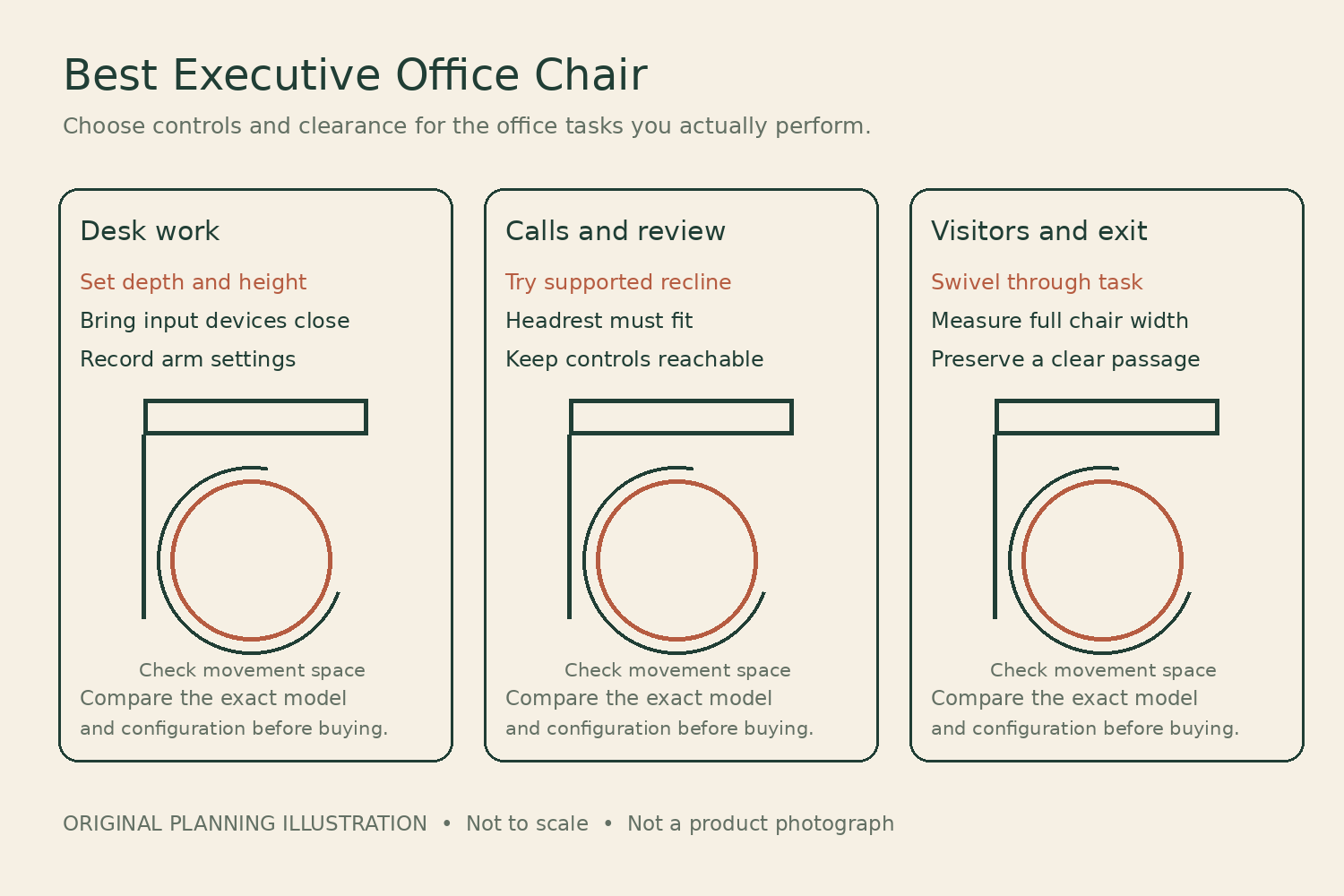
Take a tape measure and the following task record to a showroom or use it during a permitted home trial. Keep the desk in its actual arrangement. Moving every accessory out of the way can conceal the reason your current chair fails. A chair that performs well in an empty showroom bay still has to fit between your desk, storage, and visitor seating.
- Document task: record the loaded seat height, useful depth, arm-pad position, and distance to keyboard. Work with a real document rather than briefly touching the desk.
- Call task: lean back only as the manufacturer permits. Check the headrest if ordered, whether note-taking remains comfortable, and whether the arm support follows the useful position.
- Visitor task: swivel toward the actual visitor position, check foot placement and arm clearance, then return to work. Include a jacket or other ordinary clothing worn in that office.
- Exit: roll back the distance needed to stand. Measure the remaining passage and confirm the chair can be parked without blocking a door or cabinet.
- Reset: record the controls needed to return to your main working position. Decide whether that reset is easy enough to perform whenever the task changes.
Suppose a room provides a 32-inch gap between the desk return and a cabinet. Fern’s published 29-inch overall width leaves only three inches of nominal lateral difference before accounting for the way it is moved or turned. That is a prompt for a physical clearance trial, not confirmation of a comfortable passage. Gesture’s arm spread also changes its overall width, so measure the position you actually use rather than selecting the smallest listed width.
A headrest must earn its place
A headrest may be useful while leaning back for a call, but it can be irrelevant or intrusive in an upright keyboard position. Try both. If it pushes you forward during close work or misses your head in recline, its presence is not a benefit merely because it makes the chair look more executive. Ask the manufacturer which adjustments and installation choices apply to the exact headrest.
Gesture offers a vertically adjustable, tilting integrated headrest; Fern’s headrest changes the overall height to a published 45–53 inches. Those numbers are useful for storage and visual scale, but they do not establish where the contact will meet your body. A tall person can still find a particular headrest wrong, and a shorter person may prefer the chair without it. Fit the accessory rather than assigning it by job title.
Separate a conversation chair from a work chair
If the room contains a separate table or lounge area for lengthy conversations, the desk chair does not have to reproduce a lounge recliner. Preserve its keyboard function. Conversely, if every call occurs at the desk, evaluate the supported leaning-back position with the actual display, microphone, and note-taking method. The room layout determines which compromise matters.
Do not use published tilt angles from different chairs as a comfort ranking. A center-tilt chair moves the seat and back in a different relationship from a synchronous mechanism. The reference point used for an angle may also differ. During the demonstration, observe whether you retain a useful foot position, can return smoothly, and can reach the controls without twisting. Those observations are more actionable than choosing the biggest number.
Specify appearance after the control package
Once a candidate fits, consider the room’s finish and fabric. Sample the actual upholstery beside the desk and under the room’s lighting. With Fern, vegan leather is a synthetic material choice; with the selected HON, SR11 identifies leather. Gesture has a broad material program. A product family’s finish photography should not substitute for a written configuration with all the desired working controls.
For a shared leadership office, record more than one user’s settings. A chair that is excellent for its primary occupant may require a very different setup for another person. Do not buy identical chairs for several offices solely for visual consistency if their users need different dimensions. Coordinated materials can preserve a room’s appearance while allowing a different chair model where necessary.
Keep delivery and service in the decision
The checked Steelcase manufacturer page provided North American purchasing routes, Haworth offered current direct ordering, and HON’s exact model had an active US retail listing. Ask for a written dispatch estimate for the selected configuration. Custom material, headrest, and frame selections can carry different lead times, so a family-level quick-ship statement is insufficient.
Steelcase and Haworth describe substantial limited warranty coverage; HON separates component terms and exclusions. For an occupied office, ask how service is performed and whether an approved replacement part can be installed locally. Warranty duration does not guarantee uninterrupted use, and a return policy should be checked separately from a defect remedy.
Select Gesture for useful arm and device transitions, Fern for a flexible-back fitting that works through your movements, or HON for a traditional arrangement whose fixed geometry suits you. The best executive choice is the chair that completes your task brief and room-clearance worksheet without requiring daily workarounds.
Something unclear or out of date? Send a correction with this article’s title and the detail to check.
Sources, research & corrections policy ↗