As an Amazon Associate, we earn from qualifying purchases. Read our affiliate disclosure. Amazon buttons open searches for matching listings; they do not confirm seller, configuration, price or stock.
Under $300, start with the adjustment you cannot compromise on
The best ergonomic chair under $300 should solve a specific fit problem rather than simply display an ergonomic label. COLAMY ATLAS is the first comparison here when a sliding seat is essential. SIHOO M57 offers a mesh seat with manually positioned lumbar support and three-way arms. Staples Hyken ST63137 provides a shorter fixed mesh seat at a lower verified price, useful only when that fixed geometry already suits the user.
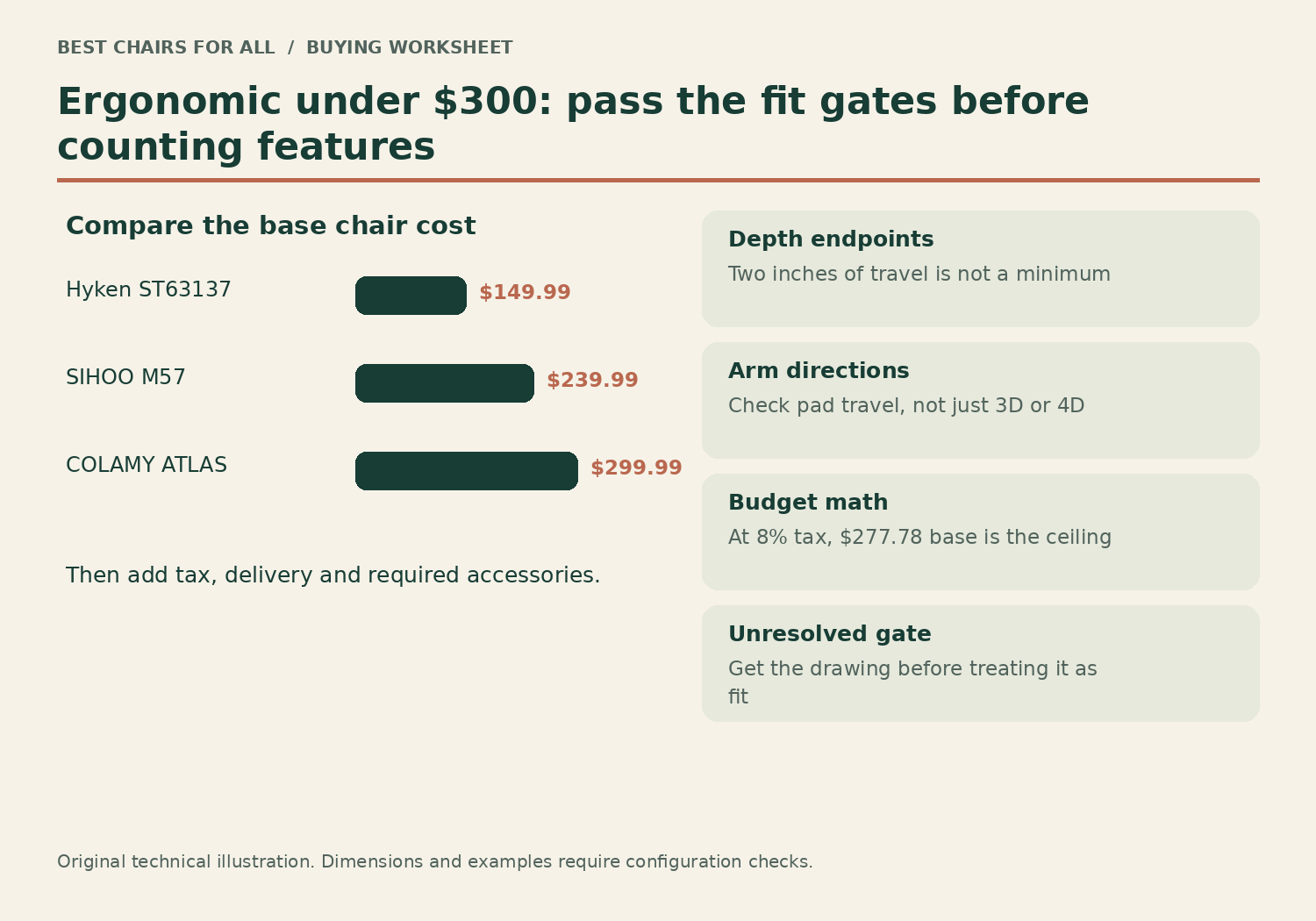
On November 6, 2026, the official US pages displayed $299.99 for dark-gray ATLAS, $239.99 for black M57 and $149.99 for black Hyken ST63137. These are before-tax base prices and may change. ATLAS has only one cent of room below the chair-price ceiling; tax or required charges can push it beyond a $300 total. We researched documentation and did not physically test any of these chairs.
| Main adjustment requirement | Candidate | What is still unresolved |
|---|---|---|
| Seat must slide | COLAMY ATLAS, $299.99 base | Minimum and maximum usable depth, not just travel |
| Want manual lumbar positioning and mesh | SIHOO M57, $239.99 base | Fit-critical seat dimensions and any slider claim |
| Known short fixed depth already fits | Hyken ST63137, $149.99 base | No slider to adapt if that 16.7-inch depth is wrong |
Three ways to spend the ergonomic budget
The lower-priced options remain conditional recommendations. A fixed seat can suit a particular user well, but it offers less ability to correct a mismatch. A sliding seat can offer more adaptability, yet its movement distance alone does not establish that it reaches the setting you need. Verify those endpoints before choosing by feature count.
Model specifications and ordering details were checked against COLAMY ATLAS official US adjustment and price details, SIHOO M57 official US store, Staples Hyken ST63137 official listing. These manufacturer documents support the configuration notes in this comparison; retrieved November 6, 2026.
1. COLAMY ATLAS Ergonomic High Back Mesh Office Chair
Best for: investigating sliding-seat adjustment at the base-price limit.
The ATLAS official US page displayed $299.99 for dark gray and lists two inches of seat-depth travel, 4.3 inches of height travel, four-way arms and adjustable lumbar support. These are meaningful fitting variables, particularly when fixed depth is the current problem.
Travel is not a minimum or maximum usable depth. The retrieved text did not establish those endpoints or a complete current capacity statement, so obtain the drawing and rating before ordering. Tax or required charges can put the base-price-eligible chair beyond a $300 total. This is a conditional shortlist, not a fit guarantee.
Product Details
| Brand | COLAMY |
|---|---|
| Seat-depth adjustment | 2 inches of travel; confirm endpoints |
| Seat-height adjustment | 4.3 inches of travel; confirm endpoints |
| Arms | 4D adjustable |
| Back tilt locks | 107°, 115°, 123°, 132° |
Pros
- Published sliding-seat travel
- Multiple support and arm adjustments
Cons
- Fit-critical endpoints and capacity need confirmation
- Almost no before-tax margin under $300
Choose it when the exact dimension and capacity checks pass and your actual cart meets the budget.
2. SIHOO M57
Best for: manual lumbar positioning with a mesh seat.
M57 provides a mesh seat and back, lumbar support adjustable vertically and horizontally, and arms that move in height, depth and rotation. Its official US page displayed $239.99 and states a 330-pound capacity. It gives a clear alternative to choosing a fixed back contour.
We did not establish a seat-depth slider from the retrieved model description. A reader who needs to shorten a seat should not assume that the lumbar controls accomplish the same thing. Verify current usable depth, minimum height and the actual mesh-edge feel before relying on the apparent feature value.
Product Details
| Brand | SIHOO |
|---|---|
| Seat construction | Mesh seat and back |
| Arms | 3D adjustable |
| Headrest | Height and angle adjustable |
| Capacity | 330 lb |
Pros
- Manual two-way lumbar positioning
- Three-direction arm adjustment
Cons
- Do not assume adjustable seat depth
- Numeric seat fit still needs verification
Choose it when those particular support controls matter and the unadjusted seat dimensions already suit you.
3. Staples Hyken ST63137
Best for: a known short fixed-seat geometry at a lower base cost.
Hyken ST63137 lists a 16.7-inch seat depth, 19.3-inch width and 17.2–20.9-inch height range. The black listing displayed $149.99. Its mesh seat, adjustable headrest and height-adjustable arms provide a specific simpler fit proposition.
The fixed seat means you cannot tune depth if the first fit fails. Staples rates this model for 275 pounds based on an eight-hour workday, which is a product-use condition rather than proof of all-day personal comfort. Do not transfer specifications from Hyken Pro or XL to this named build.
Product Details
| Brand | Staples |
|---|---|
| Seat height | 17.2–20.9 inches |
| Seat dimensions | 19.3 inches wide × 16.7 inches deep |
| Capacity | 275 lb based on an 8-hour workday |
| Construction | Mesh seat and back |
Pros
- Clear short fixed-depth specification
- Budget remains for necessary setup items
Cons
- No depth slider
- Arm adjustments are more limited
Choose it only when the documented geometry fits and you accept the adjustment limits deliberately.
Separate non-negotiable fit from adjustment debt
A non-negotiable is a condition that must be satisfied for the chair to be usable: sufficient capacity, appropriate sitting height, enough width, useful depth or the ability to approach the desk. Adjustment debt is the extra compromise you would need to live with because the chair cannot change another relationship. Examples include a pad that only moves vertically when you need it farther inward, or a back contour with no way to reduce its prominence.
Write the non-negotiables first and reject any chair that fails. Then list the adjustment debts that remain, explaining how they would affect actual work. This is more useful than adding up controls because ten controls that miss the one required setting do not fix the purchase. A very inexpensive chair can be the right answer if its fixed dimensions already match the person and task.
Do not assume an accessory will pay every debt. A thick seat cushion changes height and backrest contact. A lumbar pillow changes usable depth and support shape. A footrest supports feet but does not shorten the pan. Accessories can serve a specific planned purpose, but a collection of compensations may cost more and work worse than a chair with appropriate original geometry.
A worked depth problem: travel is not an endpoint
Suppose a user needs a usable seat around 16 inches deep to sit back with room behind the knees. They find ATLAS advertises two inches of depth adjustment and assume it passes. That conclusion is incomplete. A hypothetical range from 18 to 20 inches also has two inches of travel, yet would not reach the required 16-inch reference.
The official ATLAS text we retrieved confirms travel but does not establish the usable minimum and maximum in text. Ask the manufacturer for the current dimension drawing and its measurement reference, or inspect the actual chair. This missing endpoint is a purchase gate rather than permission to import a number from another COLAMY model or a third-party review.
Hyken’s listed 16.7-inch fixed depth gives a clearer but less adaptable comparison. It may be close enough for some users after trying the actual back contour, but there is no seat slider to make it shorter if it fails. M57’s mesh and lumbar adjustments do not establish a depth slider either. The choice depends on confirmed useful geometry, not the reassuring presence of other knobs.
The ergonomic gate sheet
Use one copy per exact chair and configuration. Mark each row pass, fail or needs confirmation. A needs-confirmation result is acceptable during research, but it should not be silently promoted to pass at checkout. Ask the seller a targeted question and save the reply with the product specification.
| Gate | Question to answer | Evidence that matters |
|---|---|---|
| Height | Can I reach my working setting with supported feet? | Actual lowest and highest sitting height |
| Depth | Can I sit back without front-edge knee contact? | Usable endpoints, not travel alone |
| Arm position | Can pads meet relaxed elbows and clear the desk? | Movement directions and actual task trial |
| Back contact | Can the support meet my preferred location? | Adjustment type and suitable contour |
| Budget | Does the necessary configured cart fit the limit? | Tax, charges and essential additions |
Distinguish arm directions before comparing the models
The term adjustable arms may mean only a height change. M57’s official page describes height, fore-and-aft movement and rotation. Hyken’s identified listing describes height-adjustable arms. ATLAS uses a four-way arm description, but you should still compare the actual travel and whether the pad or support structure moves in each direction.
If your current arms prevent approach to the desk, pad retraction may matter more than maximum height. If the pads sit too far apart for your torso, rotation alone may not produce the needed support. A pad can look narrow in an image while the underlying arm opening remains broad. Ask about the dimension that corresponds to your problem rather than relying on a 3D or 4D label.
For an armless alternative, the desk must provide a suitable input relationship without forcing raised shoulders or long reaches. Eliminating arms can solve a collision but cannot lower the keyboard. The OSHA chair guidance emphasizes relaxed shoulders, suitable seat fit and adjustment alongside the rest of the workstation. Those relationships remain useful at every price.
Turn an all-in budget into a maximum chair price
If $300 means the whole checkout total, work backward before shopping. With a hypothetical eight-percent tax rate and no other charges, the maximum before-tax chair price is $300 divided by 1.08, or approximately $277.78. That is a different search filter from under $300. Your real tax treatment and address must be used in the final calculation.
Under that example, ATLAS at $299.99 fails the all-in ceiling unless a verified applicable discount changes the actual cart. We have not counted optional codes toward eligibility, because availability, exclusions and checkout behavior can change. Its inclusion here is explicitly a base-price recommendation. A chair near the cap is not a hidden all-in bargain.
M57 and Hyken leave different margins, which may matter if a stable foot support or approved floor protection is required. Include those necessities before treating the remaining money as optional spending. If an essential fitting requirement cannot be met within the ceiling, consider a returnable used commercial option or a changed workstation plan rather than buying an unsuitable new chair just to complete the order.
What to verify about ATLAS specifically
ATLAS and ATLAS-01 are separately named products, with differences in materials described by COLAMY. Use the exact canonical ATLAS product page and seller specification rather than combining photographs and measurements from the two names. The original ATLAS page redirects to the current longer product title; that redirect is not evidence that every similarly named marketplace listing is the same build.
The official page lists seat-depth travel, height travel, adjustable lumbar support, arm adjustment and several back-lock angles. We have not verified certificate identifiers or performed a standards audit, so we are not using the certifications in the product title as a reason to claim better fit or health outcomes. A component’s adjustment is a more direct answer to the ergonomic buying question.
For fit-critical dimensions not visible in the retrieved text, request the drawing. Check capacity and actual clear sitting width as well as endpoints. Save the exact return conditions for the seller and configuration, keep the original packaging and inspect the parts before assembly. Do not let the abundance of published features replace an answer to the decisive missing measurement.
Make the decision in the order that prevents an expensive compromise
First identify the mismatch, then verify the dimension or control that could fix it. Next compare the complete budget, including the necessary configuration and costs. Only after those pass should the choice turn to material preference, appearance or an extra headrest. This order makes the recommendation defensible even when prices change.
Choose ATLAS for a sliding-seat comparison only after its endpoints and capacity fit the user. Choose M57 when its mesh surface and manual lumbar positioning suit you and the seat geometry is confirmed. Choose Hyken when the documented short fixed seat already passes a real fit check and its more limited adjustment is acceptable.
A budget ergonomic chair succeeds by fitting the person and task, not by imitating the feature list of a much more expensive chair. If no candidate passes the non-negotiables, keep the failure visible and revise the shortlist. Spending slightly less on a chair that cannot be adjusted into a useful position does not complete the ergonomic purchase.
Something unclear or out of date? Send a correction with this article’s title and the detail to check.
Sources, research & corrections policy ↗