As an Amazon Associate, we earn from qualifying purchases. Read our affiliate disclosure. Amazon buttons open searches for matching listings; they do not confirm seller, configuration, price or stock.
A home office needs an ergonomic reset that people will actually use
For a home office used by more than one adult or for more than one kind of work, choose a chair whose fit can be recovered quickly. Haworth Breck is worth comparing for its short sliding seat and weight-activated recline. Branch Ergonomic Chair Pro suits a user who wants deliberate lumbar and arm tuning. Steelcase Series 1 offers another compact task-chair approach with cylinder and arm options.
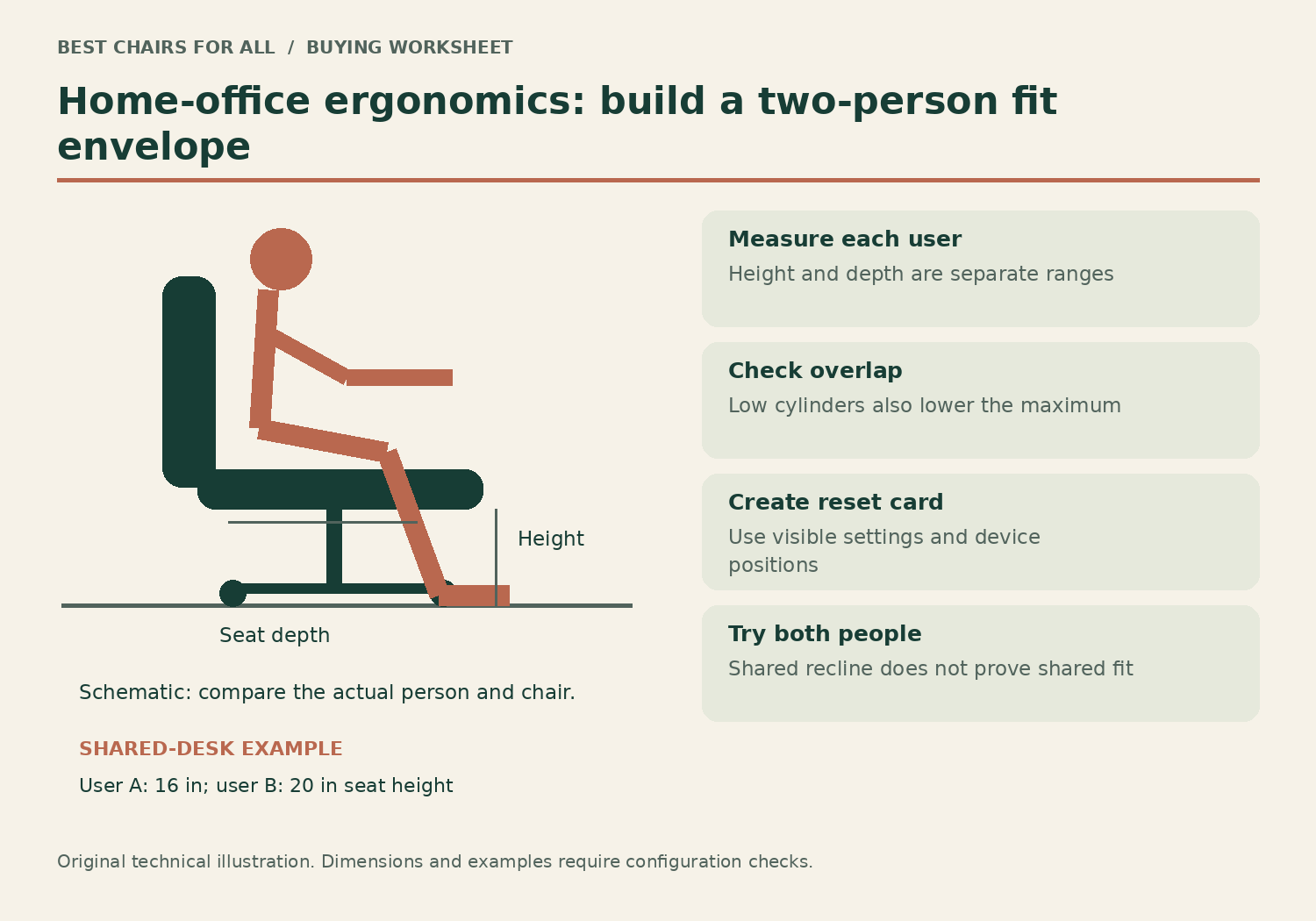
This guide focuses on the practical setup of a home workstation: shared-user ranges, docking a laptop and returning to a useful position. The recommendations come from official documents checked November 6, 2026, without physical testing. A chair can fit one adult and fail another even when both appear within a broad advertised height range. The purchase should be based on the actual range of needs in the household.
| Home-office priority | Candidate | Why to investigate |
|---|---|---|
| Shorter usable seat and easier recline reset | Haworth Breck | 15–17.25-inch listed seat depth; weight-activated mechanism |
| One user wants detailed manual tuning | Branch Ergonomic Chair Pro | Lumbar height/depth and five-way arms |
| Shared task chair with cylinder options | Steelcase Series 1 | Short sliding seat; standard or low-cylinder configuration |
Three chairs for an ergonomic home workstation
These are alternative approaches rather than identical room decorations. Breck has a flexible contoured plastic back; Branch Pro offers more independent support adjustments; Series 1 has its own weight-activated mechanism and arm choices. The right choice depends on who will use the desk and which settings need to change between them.
Model specifications and ordering details were checked against Haworth Breck US dimensions and mechanism, Branch Ergonomic Chair Pro specifications, Branch Ergonomic Chair Pro dimensional specification sheet, Steelcase Series 1 US product and options, Steelcase Series 1 dimensional specification guide. These manufacturer documents support the configuration notes in this comparison; retrieved November 6, 2026.
1. Haworth Breck
Best for: a shorter-seat home setup with weight-activated recline.
Breck's US store lists a 15–17.25-inch seat-depth range, 15.5–20.5-inch seat height and 325-pound capacity. Its weight-activated recline and flexible contoured back offer a relatively simple reset approach for a shared desk.
The back contour is built in rather than the same two-way lumbar adjustment found on Branch Pro. Both users should try it if the chair is shared. The listed US store build also has hard casters, so resolve any floor-specific requirement before ordering. A short maximum depth can be limiting for someone with longer thighs.
Product Details
| Brand | Haworth |
|---|---|
| Seat height | 15.5–20.5 inches, US store build |
| Seat depth | 15–17.25 inches |
| Seat width | 19.5 inches |
| Capacity | 325 lb |
Pros
- Short published usable-depth range
- Weight-activated recline
Cons
- Built-in contour may not suit both users
- Listed caster and maximum depth need checking
Start here for a measured short-seat requirement and a preference for fewer recline adjustments.
2. Branch Ergonomic Chair Pro
Best for: a personal home workstation requiring deliberate support control.
Branch Pro provides height- and depth-adjustable lumbar support, five-way arms and seat-depth adjustment. Its specification sheet lists 16.7–19.7-inch depth, with separate standard and tall cylinder ranges. These details are more useful than a broad all-heights marketing label.
The standard height range is 17–19.9 inches in the cited sheet; tall is 19.3–22.9 inches. The 275-pound capacity applies as a screening limit. A tall cylinder can help one person while excluding another, so choose it for actual measurements rather than assuming extra height is always beneficial.
Product Details
| Brand | Branch |
|---|---|
| Seat depth | 16.7–19.7 inches in cited sheet |
| Standard seat height | 17–19.9 inches |
| Tall seat height | 19.3–22.9 inches |
| Capacity | 275 lb |
Pros
- Two-way lumbar adjustment
- Broad arm-positioning options
Cons
- Cylinder ranges need deliberate selection
- Minimum seat depth may exclude shorter thighs
A better comparison for one user seeking specific tuning than for a household whose required ranges do not overlap.
3. Steelcase Series 1
Best for: a compact chair whose cylinder can be specified carefully.
Series 1 combines a short functional seat slider with weight-activated recline and arm configuration choices. The cited US guide shows 16.5–21.5 inches for the standard cylinder and about 14.75–18 inches for the low option. Functional depth is approximately 15.5–18 inches.
The lower option is useful only if its upper range also covers the intended user or users. The specification table and diagram differ slightly at the upper depth value, so confirm the current build. Choose the arms and caster explicitly rather than treating every quick-ship Series 1 as equivalent.
Product Details
| Brand | Steelcase |
|---|---|
| Standard seat height | 16.5–21.5 inches |
| Functional seat depth | 15.5–17.75 inches |
| Seat width | 19.5 inches |
| Arms | 4D configuration available |
Pros
- Short sliding-seat screen
- Standard and low-cylinder choices
Cons
- Low cylinder can exclude a taller second user
- Exact build differs across listings
Choose the documented configuration that covers the real household fit envelope and can be reset easily.
Create a two-person fit envelope
Ask each user to record a comfortable supported seat height, useful seat depth and preferred arm-pad position at the actual keyboard. Measure in the footwear normally used at home. Do not make the shorter person use the taller person’s settings as a compromise; the point of adjustment is to recover a suitable individual position.
Now compare the smallest and largest required values with each chair’s range. A chair must cover both users in a useful part of its adjustment, not merely touch one person’s requirement at an extreme that changes another relationship. Seat depth and height should be screened separately. A lower cylinder can solve height while leaving the seat too long or the upper range too low for the second user.
Finally add support preference to the envelope. One user may like a pronounced lumbar contour while another finds it intrusive. A manually adjustable or removable support gives a different negotiation path from a built-in contour. Breck’s weight-activated recline can simplify one reset, but its contoured back cannot be assumed to feel equally suitable to both people.
A worked shared-desk comparison
Suppose user A works comfortably near a 16-inch seat height and needs a usable depth around 15.5 inches. User B works near 20 inches and prefers roughly 17.5 inches of useful depth. These are hypothetical screening references, not recommended settings for readers of particular heights. The actual desk and body fit must be checked.
Breck’s US store lists 15.5–20.5 inches of height, covering those height references on paper. Its depth range is 15–17.25 inches, so user B’s preferred 17.5-inch reference remains unresolved rather than automatically passing. A quarter-inch difference might or might not matter in the real chair because measurement methods and back contour differ, but it deserves a trial.
Series 1’s standard listed height of 16.5–21.5 inches may be too high for user A’s feet without another workstation accommodation. Its low cylinder reaches about 14.75–18 inches in the cited guide, which would fail user B’s 20-inch reference. The low option is therefore not a universal shared-desk upgrade. Its approximate 15.5–18-inch functional-depth screen is promising, but height still needs resolving.
Branch Pro’s specification sheet lists 17–19.9 inches with the standard cylinder and 19.3–22.9 inches with the tall option, plus 16.7–19.7 inches of depth. Neither cylinder is a clear two-person fit for this example as written. More adjustments do not rescue a range that misses a user’s requirement. This household might need a changed keyboard/foot-support arrangement or separate chairs rather than one expensive compromise.
| Shared-user requirement | User A | User B | Screening result |
|---|---|---|---|
| Example seat height | 16 inches | 20 inches | Check both ends of chosen cylinder |
| Example usable depth | 15.5 inches | 17.5 inches | Do not substitute overall depth |
| Support preference | Write actual preference | Write actual preference | Try the same back design independently |
| Desk access | Check keyboard and thighs | Check keyboard and thighs | A shared top may need separate device positions |
Make a reset card with physical references
A useful home reset card need not assign invented numeric settings to every knob. Record visible references such as the seat-depth notch used, approximate arm-pad position and the correct back-stop mode. Include a reminder of the keyboard position and footrest location where relevant. The card is personal to the users and the actual chair.
Practice the changeover once during a trial. Can user A restore their seat without hunting beneath the chair? Can user B identify the recline setting and move the pads without accidentally changing height? Check the current manual rather than assuming a family-wide video includes every feature on the purchased build.
Keep the card near the desk and update it after deliberate changes. If recovering a usable setup takes too much effort, users may stop resetting it and work around the other person’s position. That is a practical reason to prefer simpler controls or separate chairs, not proof that one mechanism is universally more ergonomic.
Docking the laptop is part of the chair decision
A portable laptop can work at a kitchen table one day and a dedicated desk the next, but its screen and keyboard remain joined. Raising it to a preferred viewing height also raises its keyboard. A home office intended for regular work often needs separate input devices so display and hand positions can be chosen independently.
Before buying a chair, arrange a normal keyboard and mouse position and check the desk’s underside. Cable trays, drawers and crossbars can reduce the usable opening. A chair with excellent arm travel cannot create missing thigh clearance, and a tall cylinder does not fix a screen consistently positioned too far to one side.
The OSHA workstation desk guidance addresses reach and clearance, while its chair guidance connects chair adjustments to the whole workstation. Use those principles to decide which changes belong to the desk and which require a chair adjustment. The goal is a repeatable home setup rather than a collection of individually impressive products.
Home flooring and storage can change the correct build
Check the actual caster supplied. Breck’s US store describes hard casters in its listed build. That should not be silently treated as a hard-floor approval. If the home office has hardwood or another finish with special requirements, ask about a supported appropriate caster and follow the flooring maker’s protection policy.
Measure the chair’s occupied and parked footprint. Breck lists an overall width and depth of 28.5 inches; Branch Pro’s base diameter is 27.6 inches. The figure called chair width may not describe the wheels’ widest sweep. A small-looking seat can still block a drawer or walking route after work.
If the chair moves between rooms, compare the thresholds and available route rather than only the desk area. Store foot support where it can be reset easily without becoming an obstacle. A shared setup works better when its useful configuration is convenient to restore, including the accessories that support the feet or position the laptop.
Choose the configuration that both the room and users can recover
For a single user who wants detailed support tuning, Branch Pro can be a sensible first trial once its actual cylinder and depth fit. For a shorter-seat requirement and simpler recline reset, Breck deserves attention, provided the built-in back contour suits the user. Series 1 is a useful compact alternative when the selected standard or low cylinder matches the household’s real range.
When two users have incompatible requirements, recognize that before ordering. Two suitable simpler chairs may be more workable than one premium chair that leaves someone perching. A stable footrest or keyboard adjustment can address a specific relationship, but it should be planned rather than added reactively after the return period.
Save the full configuration, return policy and original packing materials, especially for special cylinders or materials. During the trial, let each user evaluate their normal tasks independently and practice the reset. The best ergonomic chair for this home office is the one that can repeatedly return to an appropriate setup for the people who actually use it.
Something unclear or out of date? Send a correction with this article’s title and the detail to check.
Sources, research & corrections policy ↗