Dispose of an office chair by checking reuse first, identifying supported parts recovery second, and confirming a local recycling or bulky-waste route for what remains. A chair contains several materials and often a pressure cylinder, so an overall recyclability claim does not establish that the complete chair belongs in your household recycling cart.
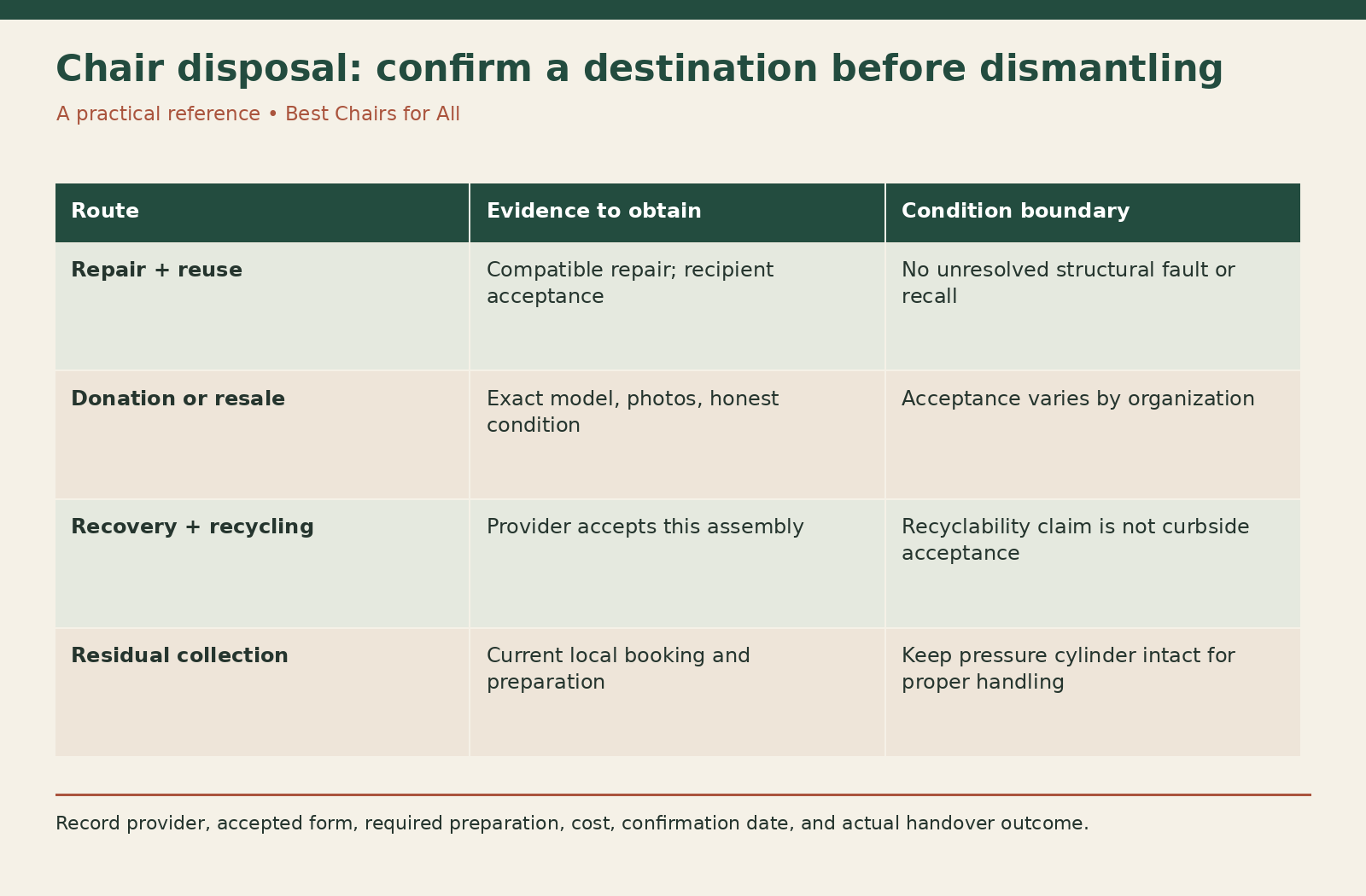
The most useful preparation is a condition-and-destination worksheet. It records whether the chair can still be used, what a repair provider or recipient will actually accept, and which local service has confirmed the final collection or drop-off arrangement. This avoids both unnecessary disposal and an unusable chair left at a donation center.
Start with condition, not the recycling symbol
Check whether the chair is structurally intact, holds its normal adjustments, and has usable contact surfaces. Separate cosmetic marks from a cracked base, failing back attachment, or unstable seat. A chair suitable for reuse needs an honest condition description rather than a claim that it only needs a quick clean.
Look up the manufacturer and model in the CPSC recall database and follow any matching notice. A recall can specify a remedy or handling process that takes priority over ordinary donation or recycling plans. Do not pass a recalled chair to another person as usable furniture while the remedy remains unresolved.
Keep unsafe items out of circulation during the decision. A curbside note does not ensure a passerby understands an internal fault. Ask the collection provider how to present a damaged chair under its rules and keep the condition record available until it has been collected.
Consider supported repair before retiring it
A worn pad or damaged caster may be replaceable without discarding an otherwise suitable chair. Identify the model and ask about the exact compatible part and installed repair cost. Do not assume that a premium brand is repairable in every condition or that an inexpensive chair has no service options.
Use the complete repair estimate, including labor, delivery, and downtime. A low part price does not establish that the chair can be restored economically or that it will fit the intended user afterward. Conversely, an expired warranty does not mean a supported paid repair is unavailable.
If you no longer need the chair, a recipient or refurbisher may still value a supported repair candidate. Describe that status clearly and ask before delivering it. A repair business that accepts certain models is different from a charity seeking ready-to-use furniture.
Make reuse acceptance explicit
The EPA’s waste-reduction guidance identifies reuse and donation as options for unneeded furniture. Acceptance remains local and organization-specific. Ask the intended recipient whether it accepts office chairs, which condition standards apply, and whether collection or drop-off is available.
Send clear photographs of the whole chair and any wear. State the brand, model, approximate dimensions, known repair history, and whether adjustments work. If you do not know the age or load limit, say so rather than inventing a specification to make the donation easier.
Do not leave furniture outside a closed donation center or assume a general furniture sign includes every upholstered task chair. Confirm an appointment or drop-off process and keep the chair dry until handover. A chair damaged by weather while waiting for collection can cease to meet the acceptance you arranged.
Describe resale and gifting accurately
A listing should identify the actual model and condition, including aftermarket parts and faults. Do not copy a new-product warranty claim unless you have confirmed what applies to the next owner. Avoid calling the chair certified, refurbished, or professionally serviced without supporting records.
Include photographs of the label and the main wear areas while protecting personal information on receipts or asset tags. Show the caster set and any replacement upholstery, because those details affect the next owner’s parts and care decisions. Keep vague phrases such as “works perfectly” out of a listing when a function has not been checked.
Arrange transport that protects the chair and the people handling it. A free chair can still be awkward to move through a doorway or down stairs. Give the recipient its dimensions and disclose any disassembly already performed so they can plan the collection appropriately.
Ask about manufacturer or dealer recovery services
For workplace quantities, contact the manufacturer, dealer, or a furniture-recovery provider with an inventory. Steelcase’s circularity information describes connecting customers with end-of-use service providers for reuse, repair, or recycling. It is a route to inquire about, not a promise that every household chair will receive free collection everywhere.
Provide model counts, condition groups, site access, available dates, and any existing asset identifiers. Ask whether the service accepts mixed brands, needs a minimum quantity, charges for removal, and provides a destination record. A service designed for building clearances may differ from a single-item household option.
Request a clear scope. Resale, donation, materials recycling, and disposal are different destinations. Ask how unusable items and residual materials are handled instead of treating the phrase sustainable removal as proof that every kilogram is recycled.
Understand the materials without dismantling first
An office chair can combine steel, aluminum, several plastics, foam, fabric, adhesives, and coatings. A molded recycling code on one component identifies that material category; it does not guarantee local acceptance of the assembled chair or even of that component in curbside collection.
Keep end-of-life percentages in context. A product may be designed for high theoretical recoverability where appropriate facilities exist. Collection systems, separation requirements, contamination, and local markets determine what can actually be recovered from your chair at your location.
Ask a recycler what form it accepts: complete chair, separated base, metal assembly, or another defined item. Do not disassemble everything in anticipation and then discover that the facility accepted the complete chair but will not handle loose mixed pieces.
Leave the pressure cylinder to an appropriate route
Tell the collection or recycling provider that the chair contains a gas-lift pressure cylinder if fitted. Ask whether it accepts the complete assembly and who should handle any required removal. A scrap-metal acceptance statement does not automatically answer that question.
Do not cut, drill, heat, open, crush, or attempt to depressurize the cylinder at home. Do not follow a destructive recycling disassembly guide as if it were an owner maintenance procedure. Get the manufacturer’s instructions and an appropriate professional or facility route where separation is necessary.
Likewise, powered accessories or batteries need their own documented handling if present. Identify them when requesting service rather than hiding them in upholstery or a general scrap load. Avoid removing an integrated component without the applicable procedure merely to make the item look simpler for collection.
Compare two real local-service frameworks
The New York City sanitation furniture page distinguishes bulky items that are mostly metal or plastic from other furniture and links to the relevant collection rules. That is a specific local classification; it is not a nationwide instruction for every chair’s material mix.
The San Francisco Environment bulky-item page presents reuse, eligible bulky-item pickup, drop-off, and special-facility options. It advises confirming donation acceptance. Eligibility, preparation, and destinations need checking through the appropriate service, rather than assuming another city’s free pickup applies to your address.
These examples show what to look for in your own city or county: the furniture category, accepted materials, booking or set-out requirements, and how mixed assemblies are handled. Check the current official local page or contact the service with the chair details before placing it outside.
Use a destination worksheet
Create rows for continued use after repair, resale or gifting, donation, professional parts recovery, materials recycling, and residual disposal. In each row record the named recipient or provider, condition accepted, preparation required, transport or collection cost, and confirmation date.
For a hypothetical sound chair with worn arm pads, the worksheet might favor a recipient who has agreed to accept it after compatible pad replacement. For a structurally broken chair, the reuse rows fail and a provider may confirm collection of the complete assembly for sorting. These examples illustrate decision logic, not guaranteed local acceptance.
Leave unconfirmed rows marked pending. A search result saying “we recycle furniture” is not enough to record a completed recycling destination. The practical evidence is the provider’s acceptance of this chair in its current condition and form, with a scheduled or completed handover.
Plan collection without transferring the problem
Keep the chair indoors and dry until the agreed set-out time where practical and consistent with local instructions. Protect building exits and pedestrian routes. If transport is required, plan the dimensions, weight, access, and suitable assistance rather than asking someone to drag it down steps at the last moment.
Follow the provider’s preparation instructions, including any labeling, booking reference, or separation it specifically requires. If those instructions appear to require pressure-cylinder work, ask who is qualified to perform it and arrange that service. Do not infer that a general request to dismantle furniture includes permission for hazardous disassembly.
Photograph the item at handover if useful for the record and retain the collection receipt or confirmation. For a workplace batch, reconcile the collected count with the inventory. This makes it possible to distinguish items reused from those sent for sorting or disposal without relying on a broad marketing label.
Keep outcome claims proportionate to evidence
If a charity accepts a sound chair, record it as donated for reuse. If a recycler collects it for sorting, describe that actual service rather than claiming a precise recovered percentage without documentation. If residual waste remains, acknowledge it as part of the process.
Keep useful part identifiers and service information with any component accepted for reuse. A salvaged arm or caster needs model and revision compatibility, not simply an assurance that it came from a good chair. Damaged structural parts should not be recirculated as serviceable spares.
A completed disposal plan ends with a confirmed destination and accurate condition disclosure. Repair and reuse preserve value when feasible; supported recovery and local collection handle what cannot remain in service. The worksheet helps you reach that result while keeping the pressure assembly intact and the local acceptance decision with the provider equipped to make it.
Something unclear or out of date? Send a correction with this article’s title and the detail to check.
Sources, research & corrections policy ↗