Wheelchair transport weight usually describes a reduced handling configuration, while total or standard weight describes a more complete chair under the manufacturer’s stated conditions. Neither label has one universal definition. Read the excluded parts and base configuration before comparing numbers or planning a vehicle-loading task.
Begin with the weight’s noun, not its number
A listing may report frame weight, transport weight, starting weight, standard-configuration weight, total weight or shipping weight. These can describe different objects. Shipping weight can include packaging; frame weight can omit components required for use. Transport weight may describe what remains after particular removable items are taken off, but the exact exclusions depend on the manufacturer.
Write the full label beside each value. If a retailer shows only a prominent number, look for the manufacturer’s specification sheet, order form and footnote. A number without its configuration is not ready for a side-by-side comparison. Preserve the original units and avoid converting a rounded kilogram value into an apparently precise pound value that the source never provided.
A current manufacturer example shows three distinct fields
The researched Sunrise Medical USA Nitrum page lists 18.3 pounds, a transport weight of 10.8 pounds and a transport weight without wheel locks of 9.7 pounds for the open-frame Nitrum. These are separate published fields, not three contradictory measurements of an identical ready-to-use chair. The selected size, options and actual delivered configuration still need confirmation.
Do not turn the lowest figure into a recommendation to remove wheel locks or other required equipment. A published weight condition can describe a comparison configuration without establishing an appropriate daily arrangement for a particular user. Ask the supplier which items are removed for the quoted transport figure and which can be removed by the intended handler under the manual. Keep the person’s prescribed configuration intact for use.
Read the reference configuration as carefully as the exclusions
The Permobil TiLite comparison brochure includes footnotes describing the chair size and excluded rear wheels for its transport figures. That brochure is a manufacturer document for its stated market and model generation; it should not be treated as a current US quotation for a different TiLite version. Its value here is demonstrating how much information a weight footnote can carry.
A larger frame, different upholstery, rigid back, side guards, arm supports, wheels or other options can change the finished weight. Do not assume a starting figure belongs to the size you are ordering. Ask the supplier to identify the reference chair and provide an estimate or measured value for the actual order, with any remaining uncertainty stated. Compare equivalent configurations rather than one stripped starting model against another fully equipped chair.
The heaviest handled piece can matter more than the sum
For vehicle loading, identify what the handler actually picks up at each stage. A chair separating into a frame and two wheels may have a smaller heaviest piece but more items to handle. Another chair may fold into one bundle. The total carried across all pieces and the largest single lift answer different practical questions. Record both without declaring one arrangement universally easier.
The location of the lift matters too: a low hatch opening, deep trunk, high sill or narrow apartment route can change the handling task. Arrange a supplier demonstration with the empty chair and the intended vehicle where practical. The handler’s abilities and any lifting aid require appropriate assessment. Do not infer a safe personal lifting limit from a chair’s catalog weight or from someone else’s experience loading it.
Document removable parts and their restoration
List only the parts the exact manual permits the user or attendant to remove for transport. Ask the provider to demonstrate release, designated carrying points and reinstallation. A component that can be unbolted for service is not automatically a routine transport-removal part. Avoid powered or structural disassembly to make a chair match an advertised weight.
Plan where detached parts go in the vehicle and how they remain protected and accounted for. Reattaching wheels, supports or a folding back is an essential part of the return-to-use process. A lower frame weight loses practical value if the routine creates uncertainty about secure reassembly. Never remove parts while someone remains seated, and do not lift an occupied chair by removable armrests or foot supports.
Accessories belong in the everyday record
Permobil’s Wheelchair Handbook treats components and accessories within the complete equipment process. When planning transport, include the prescribed cushion, back support, bags and any power-assist equipment that will actually travel. Some can be carried separately under their instructions; others remain attached. Do not quietly omit them from the vehicle plan because a catalog comparison excludes them.
Distinguish occupied load capacity from chair weight as well. A manufacturer’s maximum user or load rating is not the mass of the equipment and does not establish a lifting allowance for the handler. Ask how the model defines carried or attached items within its capacity. Keep heavy bags within the permitted arrangement rather than hanging them on the chair in ways that can change handling or stability.
Keep transport weight separate from transit approval
An empty chair light enough to load into a car is not thereby approved as an occupied seat in a moving vehicle. Wheelchair transit documentation, vehicle securement and occupant restraints are separate questions. Do not treat “transport brackets” or “transport weight” as a general occupied-travel approval; read the exact manufacturer’s terms and limitations.
For airline planning, the carrier may need the complete device weight, dimensions and battery information rather than the reduced frame mass. Give it the configuration that will actually be handed over, plus the permitted handling instructions. A stripped weight from a comparison table can mislead a transport provider just as easily as it can mislead a buyer if the exclusions are left off the record.
Ask for a configuration-matched comparison
Send each supplier the same intended setup and ask for the same fields: full chair weight, transport configuration, excluded items, heaviest removable piece, folded or dismantled dimensions and source date. Request the relevant manual pages for each removal operation. Mark any figure that is an estimate or starting value so it does not become a guarantee in your own notes.
Once a chair is selected, have the completed arrangement reviewed before relying on the loading plan. If the actual weight differs, identify which options or measurement conditions account for it. Do not remove prescribed supports to chase the marketing number. The useful decision is whether the appropriately configured chair and the documented handling routine work for the person and household, with service and assistance arranged where needed.
Wheelchair weight and handling comparison sheet
| Check | Evidence and decision |
|---|---|
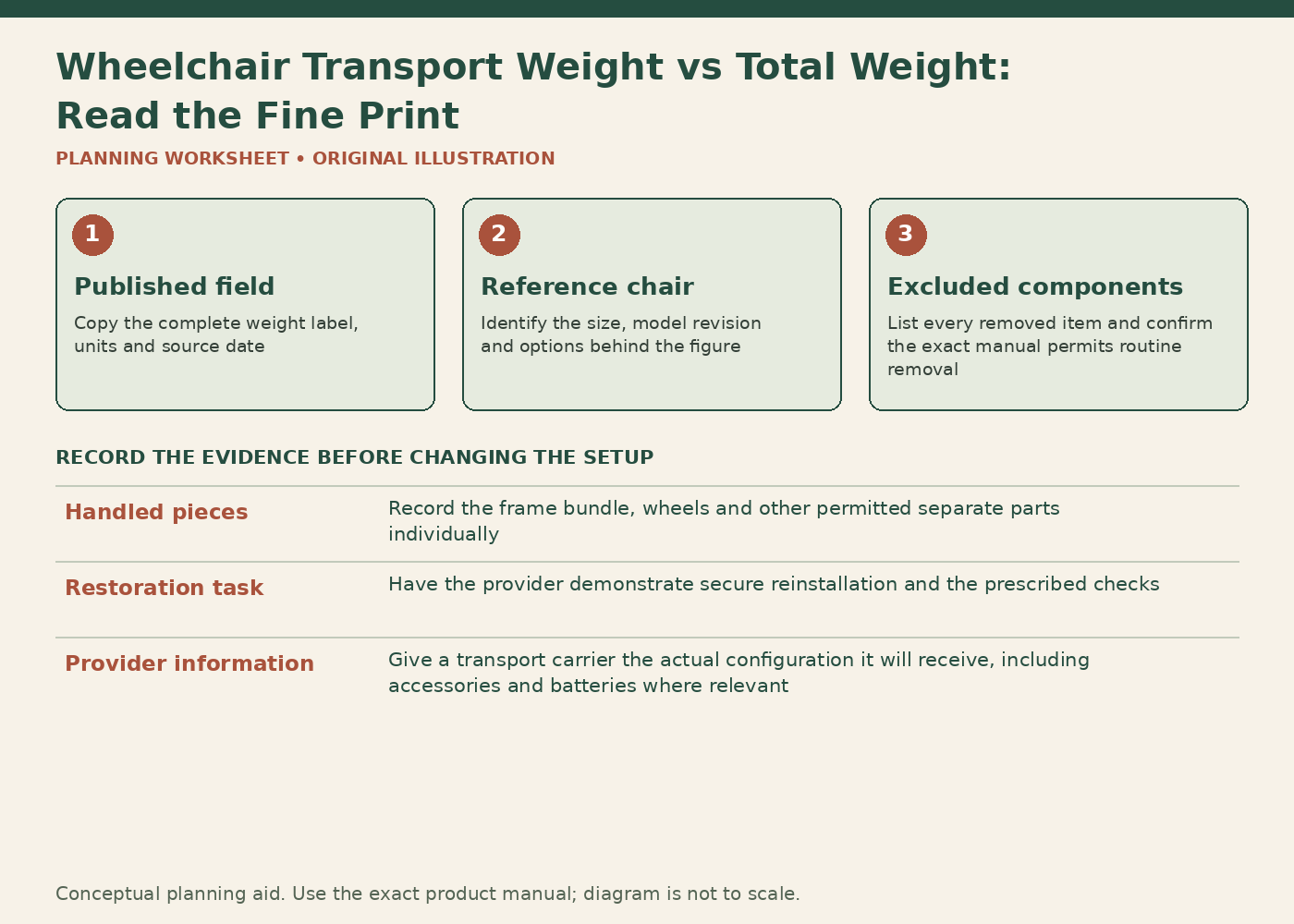
| Published field | Copy the complete weight label, units and source date. Distinguish total, standard, transport, frame and shipping values. A prominent number without its exclusions is an unresolved comparison entry. |
| Reference chair | Identify the size, model revision and options behind the figure. Ask whether the actual order differs. A starting configuration from another market or generation is not a measured weight for the delivered chair. |
| Excluded components | List every removed item and confirm the exact manual permits routine removal. Do not subtract required safety devices just because a manufacturer publishes a comparison weight without them. |
| Handled pieces | Record the frame bundle, wheels and other permitted separate parts individually. Identify the heaviest item and its carrying points. Total mass alone does not describe a lift into a high or deep vehicle opening. |
| Restoration task | Have the provider demonstrate secure reinstallation and the prescribed checks. Account for all detached parts and protected storage. A lighter transport state must be returned to the complete approved configuration before use. |
| Provider information | Give a transport carrier the actual configuration it will receive, including accessories and batteries where relevant. Keep occupied transit approval as a separate documented question from empty-chair transport weight. |
Worked example
The Nitrum example’s published 18.3-pound and 10.8-pound fields differ by 7.5 pounds arithmetically. That subtraction does not identify a universal set of parts weighing 7.5 pounds, establish the mass of the buyer’s options or authorize removing anything not described by the manual. It tells the buyer to obtain the configuration definitions behind both figures.
For a hypothetical loading worksheet, Chair A arrives as one 24-pound folded bundle. Chair B travels as a 17-pound permitted frame bundle plus two four-pound wheels. The total for B is 25 pounds, but its heaviest listed piece is lighter; it also requires separate wheel handling and restoration. Neither arrangement is automatically better. The vehicle opening, reach, carrying points, reassembly ability and user’s prescribed supports determine which task is workable. These invented chair weights illustrate equivalent-field comparison and do not establish a safe personal lifting amount.
If the provider weighs the completed chair, record what was on it and whether the scale reading includes the cushion, bag, wheels and attached accessories. Keep that measured record separate from the manufacturer’s starting specification. Ask the provider to resolve an unexpected difference rather than trying repeated lifts onto an unsuitable household scale. A useful weight record should be reproducible from its component list, so another caregiver can tell whether it describes the chair ready for use or the bundle prepared for loading.
Sources checked November 6, 2026
Use the current document for the exact model, market and production revision. These sources establish the cited instructions and distinctions; they do not certify an individual chair or replace a personal assessment where one is needed.
- Sunrise Medical USA: QUICKIE Nitrum weights and configuration documentation
- Permobil: TiLite comparison brochure and transport-weight footnotes
- Permobil: The Wheelchair Handbook
- Sunrise Medical: Manual wheelchair reference guide, weight footnotes and frame groups
Something unclear or out of date? Send a correction with this article’s title and the detail to check.
Sources, research & corrections policy ↗