As an Amazon Associate, we earn from qualifying purchases. Read our affiliate disclosure. For these installed systems, request a written survey, installation scope, warranty, and total quotation from an authorized provider.
The best stair lift chair is an installed access system that suits both the person and the surveyed staircase. For a straight indoor stairway, useful manufacturer-researched starting points are Bruno Elan, Stannah Siena 600, and Savaria K2. This is a shortlist for professional surveys and demonstrations, not an instruction to order a chair and rail independently. Curved stairs, intermediate landings, outdoor exposure, and complex user needs can require a different model or another access solution.
We checked the cited manufacturer and official sources on November 6, 2026. We have not ridden or installed these lifts. Installed prices, local requirements, and insurance or grant eligibility are not verified. A qualified installer must assess the building, while an appropriate occupational therapist or clinician should help evaluate seating, access, and assistance needs when those are uncertain. Capacity alone does not establish suitability.
Separate the staircase assessment from the user assessment
The staircase assessment concerns the rail route, fixings, clearances, landings, obstructions, electrical arrangements, and applicable local requirements. The user assessment concerns whether the person can use the proposed seating, controls, restraints, swivel arrangement, and access plan appropriately. Both need satisfactory answers. A technically installable rail does not prove that the chair is suitable for its intended user.
A seated stair lift also does not transport a wheelchair between floors. If a wheelchair or other mobility equipment is needed at both ends, include that in the access plan. Ask the assessment team how the entire journey will work, including reaching the lift, the landing arrangement, and access to equipment on the destination floor. We do not provide directions for transferring between devices.
Write down who will use the stairs without the lift as well. A folded chair and rail occupy space even when parked. The professional survey should evaluate circulation and any required clear route for the household. Do not assume a published minimum staircase width automatically resolves every person’s use of a narrow stairway or the applicable building requirements.
Three straight-stair models to discuss with installers
| Model | Verified manufacturer distinction | Reason to investigate | Critical condition |
|---|---|---|---|
| Bruno Elan | 300-pound published lift capacity | Conventional straight indoor shortlist with dealer installation | Exact current rail and chair configuration must be surveyed |
| Stannah Siena 600 | Nominal 14.5-inch folded depth on the US dimensions page | Published straight-model dimensional brief | Nominal dimensions are not a home-installation approval |
| Savaria K2 | 10.75-inch folded depth with standard L seat | Compact parked-chair discussion | Capacity changes with rail option and stair angle |
Bruno Elan: begin with a current dealer survey
Bruno’s current stairlift range identifies the Elan with a 300-pound capacity, distinguishing it from the Elite range’s 400-pound capacity. Those are separate products. Ask the authorized installer to identify the current Elan model, rail arrangement, seat dimensions, and included features in the proposal rather than borrowing details from an older online brochure.
Elan is worth investigating when a straight indoor stairway and the assessed user requirements match its intended configuration. Its limitation is that a familiar model name does not make an unsurveyed secondhand rail suitable for another home. Request the full installation drawing, seat specification, operating demonstration, and service terms. Do not assume a used lift can be moved between houses merely because the two staircases look straight and have a similar number of steps.
Stannah Siena 600: use the nominal dimensions as survey questions
Stannah’s US stairlift dimension guide shows the Siena 600 straight arrangement with a nominal 20.5-inch inside-arm width, 14.5-inch folded depth, and 25.9-inch unfolded depth. It identifies the straight configuration’s capacity as 350 pounds. The manufacturer expressly treats the measurements as nominal and configuration-dependent.
This is a useful candidate when the seat format and surveyed stair layout suit the user. Its limitation is that a single width figure cannot establish knee clearance, landing access, or a complete installation fit. Ask the surveyor to mark the actual proposed dimensions and parking position on the home drawing. Use the model-specific Stannah manual resource to confirm that the delivered manual applies to the 600 and selected seat, rather than a curved 260 arrangement.
Savaria K2: compact folding comes with configuration conditions
The Savaria K2 model page lists a 10.75-inch folded depth for the L seat and 11.25 inches for the V seat. Its current page describes a 350-pound capacity, reduced to 300 pounds with the flip-up rail option or for a stair angle above 45 degrees. The quoted configuration must retain those conditions.
K2 deserves consideration when its parked footprint and assessed seating suit a professionally surveyed straight staircase. The drawback is the temptation to combine the smallest folded dimension with an unrelated capacity or rail option. Ask the installer to identify seat choice, rail treatment, angle, actual capacity, and clearances together. A flip-up rail may address one landing issue while changing another specification; compare the whole installed system rather than choosing features independently.
Original artifact: the landing-to-landing access dossier
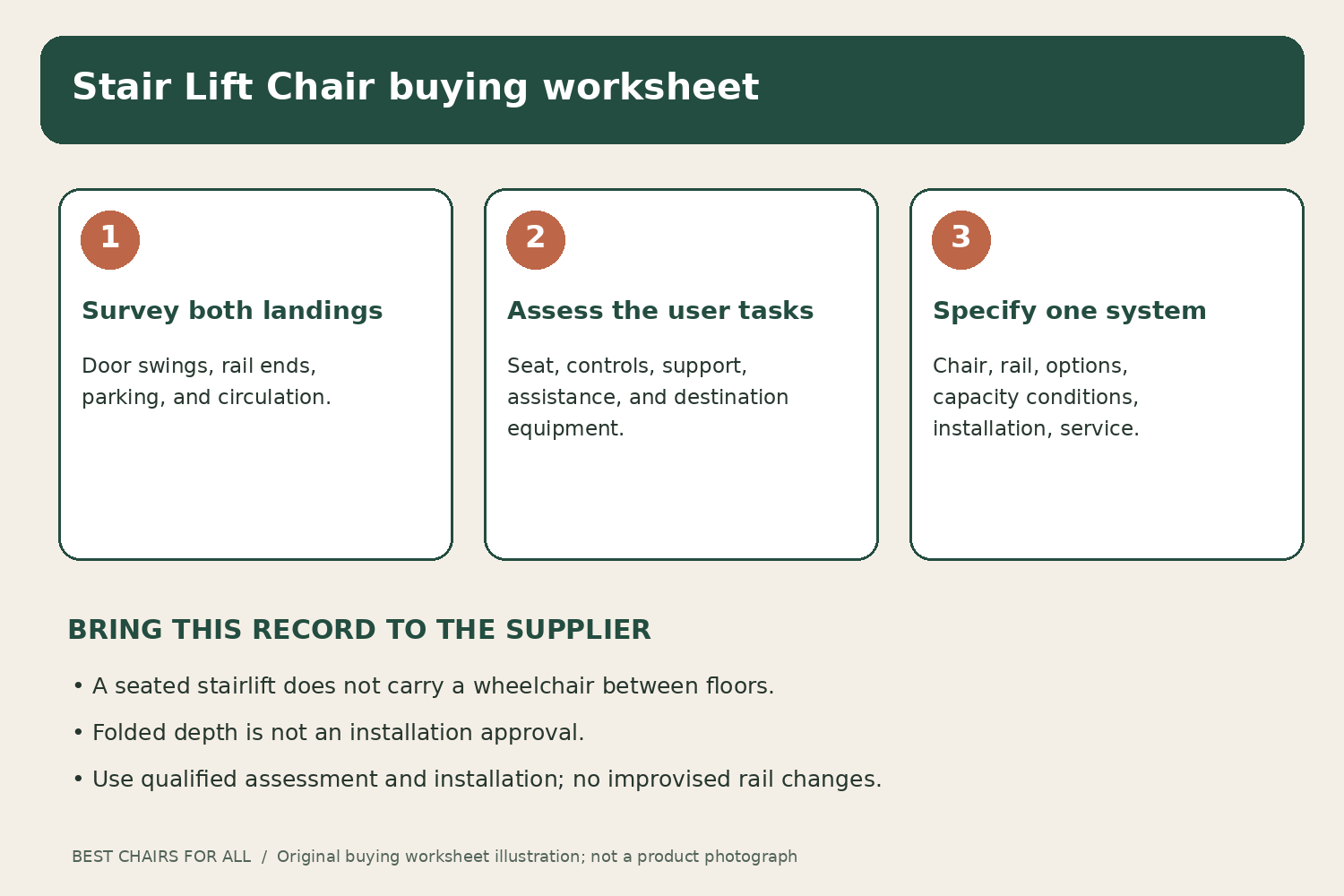
Create a drawing for the bottom landing, a side-view rail route, and a drawing for the top landing. In each landing drawing, mark doors, radiators, nearby furniture, circulation routes, and the proposed parking and access positions. Ask the surveyor to add the actual chair and rail envelope. A straight line on the stair treads leaves important questions unanswered at both ends.
Add three columns headed “user task,” “installed-system requirement,” and “confirmed by.” Examples of user tasks include reaching the chair, accessing the operating control, using the assessed seat arrangement, and reaching the destination floor’s mobility equipment. The installer supplies system requirements, and the appropriate assessment professional addresses individual access questions. This keeps the dossier from treating installation and user suitability as the same approval.
Use an invented landing example. A bottom doorway opens toward the proposed rail end. A rail extension could obstruct the door route, while a hinged or moving-rail option could alter the configuration and require additional evaluation. The correct next step is a documented alternative proposal from the installer, not cutting the rail or changing its supports. Ask how the proposed alternative affects capacity, operating tasks, maintenance, and clearance.
At the top landing, record the complete assessed access arrangement rather than assuming the chair’s swivel feature settles it. The exact permitted stopping position and available space matter. If the user cannot use the arrangement with the support identified during assessment, reconsider the proposal. An attractive price does not compensate for an unresolved essential task at either landing.
Compare quotations for the same scope
A meaningful installed quote identifies the exact chair, rail route, seat choice, controls, any powered options, required preparation, installation, demonstration, warranty, and service arrangements. Ask which survey assumptions remain conditional. If two quotes use different rail treatments or seating configurations, their totals do not represent the same purchase. Make those differences visible before comparing price.
Ask whether permits, inspections, electrical work, or other local requirements apply and who is responsible. The answer depends on the location and proposed installation, so this guide does not state a universal rule. Obtain the applicable requirements from the qualified installer and relevant local authority where needed. A manufacturer page’s standards language is not a substitute for that process.
Custom rails and installed equipment can have restrictive cancellation and return terms. Read them before paying a deposit. Request a written explanation of what happens if the survey changes, if the proposed configuration cannot be supplied, or if the user’s requirements change before installation. A short headline warranty is also incomplete without exclusions, labor terms, travel charges, and the identity of the servicing provider.
Powered options should solve an assessed task
A powered footrest or swivel may be relevant if the assessed user cannot manage an ordinary manual task. It should be evaluated in the actual model and landing arrangement, not added because more automation sounds better. Ask who operates the feature, where the control is, how it behaves, and what instruction is provided. The need for assistance may remain even when a feature is powered.
Likewise, remote call/send controls do not mean the lift can carry an unattended user or replace a care plan. Have the installer explain each control’s intended role from the exact manual. Include other household members who may need to understand parking and normal operation. Do not bypass interlocks, alter the restraint arrangement, or open the drive equipment to solve an unexplained operating fault.
Reliability includes charging and service access
Ask the installer to document the approved charging arrangement, parking requirements, and response to a power interruption. Battery-powered operation is not a promise of unlimited travel during an outage. The relevant capacity depends on the system and conditions. Have the user and household receive the applicable operating instructions and know whom to call if a fault occurs or the lift stops unexpectedly.
Get the maintenance schedule and service contact in writing. Ask whether the local provider supports the exact model, how urgent problems are handled, and which costs are outside the warranty. A household that depends on the lift needs an agreed contingency if it becomes unavailable. Do not assume the person can simply use the stairs while waiting for repair; discuss the alternative access and assistance plan with the relevant professionals.
Current notices and used equipment
Check manufacturer notices and the FDA medical-device recall database and CPSC recalls as appropriate, using the exact product identity. Ask the installer to verify identifying numbers and any required corrective action. This article does not certify an individual lift or rail as recall-free. A seller’s claim that a removed lift “worked when taken out” cannot establish suitability for a new installation.
For used equipment, have the authorized installer assess the device, rail compatibility, component history, documentation, and service support before buying. Do not install or modify stairlift hardware yourself based on generic measurements. The rail, supports, drive, seat, and controls form a system whose suitability must be evaluated together for the actual home.
Choosing the next step
Request an Elan proposal when its straight indoor format fits the assessed brief, a Siena 600 proposal when its seat and dimensional arrangement warrant evaluation, and a K2 proposal when its compact parked format is relevant with all capacity conditions retained. For curved or otherwise incompatible stairs, ask for a different surveyed solution. The best stair lift chair purchase is a complete, documented access system with appropriate user assessment, installation, instruction, and service.
Keep the installation handover together
At handover, retain the final installation drawing, actual model and serial identification, correct user manual, inspection or approval records where required, warranty, and servicing details in one folder. Ask the installer to identify which routine checks the user should perform and which tasks require service. If a control or parking arrangement differs from the assessed proposal, have the difference resolved and documented before relying on the lift. A verbal explanation should accompany the correct written instructions rather than replace them.
Something unclear or out of date? Send a correction with this article’s title and the detail to check.
Sources, research & corrections policy ↗