Affiliate disclosure: As an Amazon Associate, Best Chairs for All earns from qualifying purchases. Read our disclosure. Amazon links below open matching US search listings; check the exact model, seller, configuration, availability, and checkout terms.
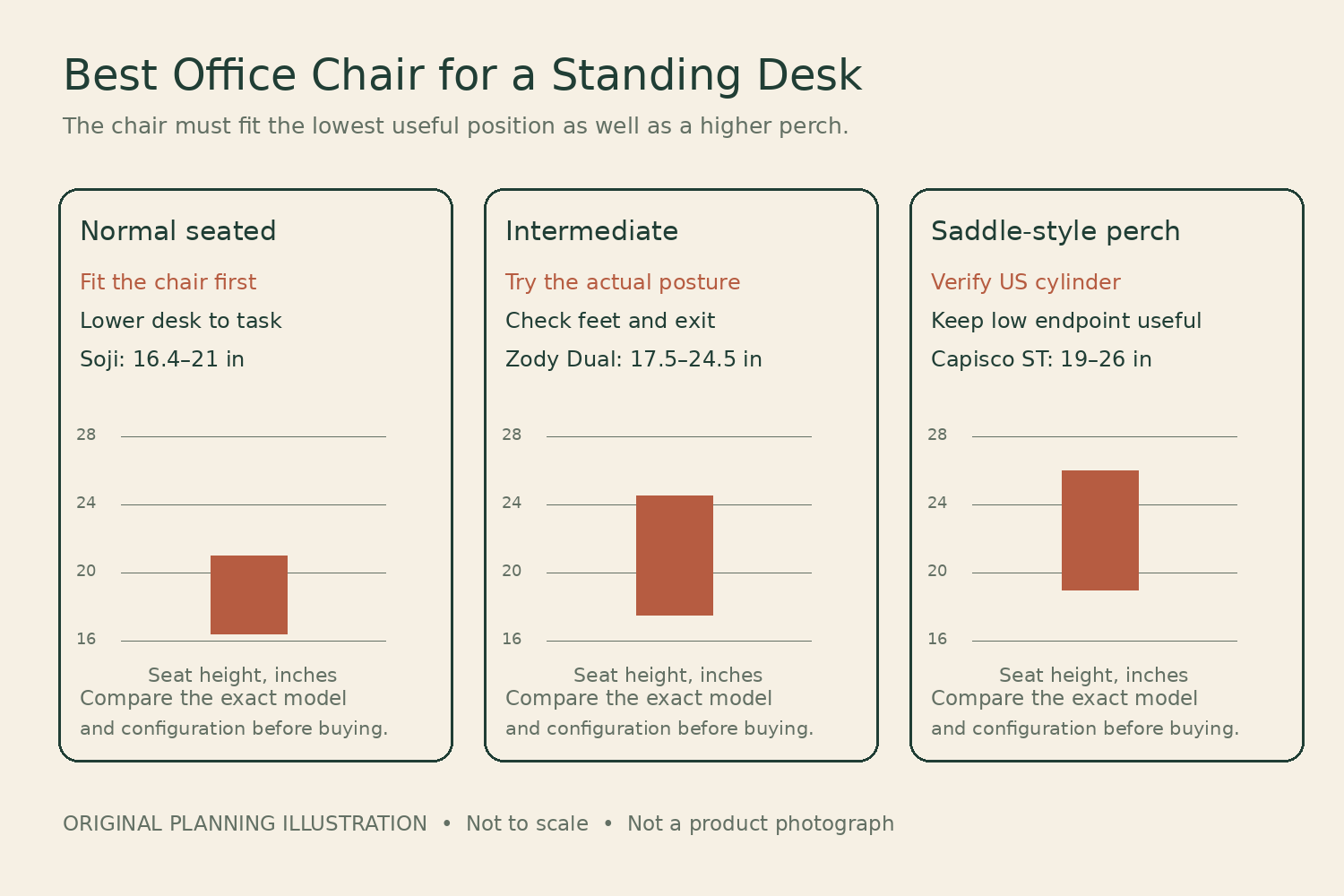
The best office chair for a standing desk is often a normal adjustable chair, provided the desk lowers to your seated working height. Haworth Soji is the conventional-seat comparison here. If you also want a supported intermediate perch, compare Haworth Zody Dual Posture and HAG Capisco 8106 with the appropriate US cylinder. Choose the positions you want before choosing the tallest chair.
This research guide uses manufacturer and current US retailer information checked November 6, 2026. We have not tested these chairs with motorized desks or measured health outcomes. A sit-stand label does not establish personal fit, an appropriate sitting duration, or compatibility with every adjustable desk. The important relationship is between your body, the chair’s full range, and the work surface’s full range.
Three different ways to use the same desk
Normal sitting, higher perching, and standing are distinct positions. Normal sitting may use a conventional task chair and a lowered desktop. Perching uses a different degree of support at an intermediate height. Standing removes the chair from beneath you. A desk that supports sitting and standing does not automatically need a chair that remains under you at the highest desktop setting.
Describe your intended routine without prescribing durations: for example, seated typing, standing calls, and an occasional higher supported position while reviewing a document. If you do not want the third position, a special high-range chair may be an unnecessary compromise. Its minimum height, seat shape, or foot support could make ordinary sitting less comfortable.
Range comparison for the identified configurations
| Candidate | Published seat-height range | Best reason to investigate | Failure condition |
|---|---|---|---|
| Soji | 16.4–21 in | Normal seated position with desk lowered | Desk cannot lower to the required work height |
| Zody Dual Posture | 17.5–24.5 in | Intermediate posture in a task-chair layout | Low endpoint or high target does not fit |
| Capisco, US sit-to-stand | 19–26 in | Saddle-style higher supported position | Minimum too high for normal sitting |
Check Soji’s current dimensions, the Zody Standard versus Dual table, and the US Capisco cylinder choices. These ranges describe chairs, not recommended desktop heights. Their endpoints are screening information and should be confirmed in the actual fitted position.
1. Haworth Soji Office Chair
Best for: Best conventional seated partner for a desk that lowers far enough.
Soji represents the ordinary task-chair route, which is often the right answer for an adjustable standing desk. You lower the work surface to the seated task rather than raising the chair to the standing setting. Haworth publishes a 16.4–21-inch height range and a 16.25–18.75-inch seat-depth range. Those are the figures to compare with your comfortable seated position, not the standing desk's maximum elevation.
The 20-inch seat width and configurable arms make it a straightforward fitting candidate for the seated half of a sit-stand routine. Check the exact lumbar, arm, and forward-tilt options rather than assuming the family name includes everything pictured. It will not create a higher perching position outside its range, and that is not a defect if you intend to stand whenever the desk is raised. The current US store offered ordering and a twelve-year warranty description.
Product Details
| Brand | Haworth |
|---|---|
| Seat height | 16.4–21 inches |
| Seat depth | 16.25–18.75 inches |
| Seat width | 20 inches |
| Warranty | 12-year limited; terms apply |
Pros
- Conventional seated fit without buying an unnecessarily tall stool
- Sliding depth for thigh-length adjustment
- Published range makes the desk-lowering check straightforward
Cons
- Cannot cover a separate high-perching target
- Option package must be checked
Choose Soji if your desk lowers to the height you need with a properly fitted normal chair. If it does not, identify whether a keyboard tray, a lower-range desk, or another workstation change is required. Do not buy a tall chair to conceal a seated-position mismatch while leaving the feet unsupported.
2. Haworth Zody Dual Posture Office Chair
Best for: Best for investigating an intermediate perching position.
Zody Dual Posture deserves a trial when you deliberately want an intermediate posture between normal sitting and standing. Its current US height range is 17.5–24.5 inches, compared with 16–21 for Standard Posture. The increased upper range is useful only if it reaches your intended perch; its higher minimum can also be a disadvantage for someone whose conventional seated height is low.
The chair retains a task-chair layout with a padded seat and back support. Haworth's PAL system and configuration-specific seat depth need the same fit attention at both intended heights. With lumbar support the published depth is 16.8–19.5 inches. The current manufacturer page offered ordering, but Dual Posture must be selected explicitly. A marketplace listing showing Zody without the posture designation is not enough to establish the extended range.
Product Details
| Brand | Haworth |
|---|---|
| Dual Posture seat height | 17.5–24.5 inches |
| Standard Posture for comparison | 16–21 inches |
| Seat depth with lumbar | 16.8–19.5 inches |
| Seat width | 19.5 inches |
| Warranty | 12-year limited; terms apply |
Pros
- Manufacturer identifies a dedicated intermediate-posture option
- One chair can be evaluated at two useful seated heights
- Current page separates Standard and Dual specifications
Cons
- Higher minimum may fail a low seated target
- Extended range is not universal standing-height seating
Choose Dual Posture after trying the full transition at your actual desk. Check foot contact, control reach, and exit at the higher setting. Capacity changes with the forward-tilt option, so obtain the exact configuration and rating. The chair's purpose is to add a usable position, not to force the desk into one height for the entire day.
3. HAG Capisco 8106 Sit to Stand Cylinder Chair
Best for: Best saddle-style alternative when its low endpoint also fits.
Capisco with the US sit-to-stand cylinder is the different seat-shape option for a higher perch. UPLIFT lists that range as 19–26 inches. The saddle and backrest support several working orientations, which should be tried deliberately with the tasks you perform. Do not assume a saddle is comfortable merely because it makes a standing-desk setup look cohesive.
The 19-inch minimum is a meaningful limitation. If you need a lower normal sitting position, the sit-to-stand configuration may fail even though its maximum suits the perch. The standard US cylinder is listed at 16.5–21.5 inches and the stool option at 22.5–32; they solve different height problems. The current US retailer page offered ordering with a lead time and specified footring compatibility only with the higher two cylinders.
Product Details
| Brand | HAG |
|---|---|
| US sit-to-stand height | 19–26 inches |
| US standard alternative | 16.5–21.5 inches |
| US stool alternative | 22.5–32 inches |
| Footring | Compatible with US sit-to-stand and stool cylinders |
| Warranty | US limited lifetime structural/mechanical framework; component terms apply |
Pros
- Distinct saddle-and-backrest arrangement
- Three US height choices can be screened explicitly
- Manufacturer and retailer identify accessory configurations
Cons
- Saddle contact requires a personal trial
- One cylinder may not cover both your desired positions
Choose Capisco only when the selected seat shape and range fit both the task and the transition. The US manufacturer brochure rates it to 300 pounds and describes its service framework. Confirm the actual US warranty and SKU rather than combining an overseas cylinder range with a US retailer's accessory list.
The two-position envelope worksheet
Rather than selecting by the desk’s maximum height, make an envelope of the positions you need. Use the actual desktop, keyboard, footwear, and floor mat. If several people share the workstation, complete the worksheet separately for each person. A range that suits one tall person may fail the shorter user’s normal sitting position.
- Normal sitting: establish a comfortable supported chair height and usable depth. Record the loaded height, foot support, and the keyboard height that works there.
- Desk minimum: lower the desk using its instructions and measure the actual typing surface. Include a thick desktop, a keyboard tray, or a converter platform rather than relying only on the frame’s advertised range.
- Intermediate position: if desired, establish it during a suitable chair trial and record the support height and task height. Check foot placement and whether you can enter and leave without awkward balancing.
- Desk maximum: check the standing task position with the equipment installed. Record whether the display and input devices can be used without repeated reaching.
- Transition path: move the chair to a storage position and check the desk’s full vertical travel. Include arms, backrest, drawers, power strips, and cable loops.
A worked screening example is a person who needs normal sitting near 17 inches and wants to try a higher position near 24 inches. Soji’s range covers the first but not the second. Zody Dual’s published minimum is above the first target even though its maximum includes the second. Capisco’s US sit-to-stand minimum is higher still. That does not establish a winner; it reveals that one-chair coverage may be the wrong requirement. Another configuration, separate seating, or abandoning the optional perch may be more appropriate.
The useful lesson is to preserve both endpoints. Do not round a low target upward merely because you like the high setting. A chair that can reach the desired perch but makes the main seated task uncomfortable is a poor trade unless there is another suitable normal seat available.
Check what the desk can actually lower beneath
The desktop is not the only moving object. An underside drawer, cable tray, frame rail, keyboard mechanism, or mounted computer can become the lowest obstruction. Measure the real knee opening at the seated position. If the chair arms strike the underside first, the desk may stop above the task height you intended.
Read the desk’s operating and collision-avoidance instructions. Do not rely on an anti-collision feature as the only protection for a chair placed beneath it. Move the chair clear when required and keep the travel path visible. A high headrest, arm pad, or perched seat left in the wrong place can create a collision even when the normal sitting setup fits.
Cables need slack at the highest setting and tidy routing at the lowest. Check the complete path rather than only lifting the desk once with an empty surface. A headphone cable connected to the chair’s user, a floor power strip, and a monitor arm can each change the available movement. Keep cords away from chair wheels and moving joints.
Foot contact changes with the position
A useful normal seated fit is not enough to establish a useful high perch. At the higher position, check where the feet rest and whether the seat shape allows the intended support. Follow the manufacturer’s guidance for any footring or base accessory; a foot support is not automatically an entry step.
For Capisco, the US retailer explicitly separates cylinder compatibility for the footring. For Zody Dual, ask the fitter to demonstrate the intended intermediate posture rather than treating the chair as a conventional drafting stool. Avoid adding aftermarket lifts, extensions, or improvised platforms to create a position outside the approved configuration.
If the higher position is uncomfortable or difficult to leave, remove it from the required routine. Owning an adjustable standing desk does not create an obligation to use every possible intermediate height. The purpose of the furniture is to make useful positions available, not to prove the versatility of the equipment.
Keep input and display height in the comparison
A chair adjustment changes the relationship to both keyboard and display. A laptop screen may need separate positioning from its keyboard to serve different heights. An external monitor may have enough vertical travel, or may become too low at standing height. Test the installed equipment before attributing the entire problem to the chair.
OSHA’s desk guidance treats clearance and working-surface arrangement as workstation concerns. Use that broader perspective when evaluating an adjustable desk. A chair cannot create missing knee space or make a low-range desk frame lower than its mechanical stop.
What to verify in the final order
The compared Haworth models had active US direct ordering pages, and the checked Capisco retailer page gave a lead time for its custom cover selection. Confirm the exact posture option or cylinder, arms, upholstery, casters, and support package. A search for Zody can return Standard rather than Dual Posture; Capisco can appear with three different US cylinders and overseas ranges.
Haworth describes twelve-year limited coverage for eligible purchases; the US Capisco warranty framework has its own structural, mechanical, and material conditions. Obtain the actual seller terms and a fit-return policy suitable for your two-position trial. Warranty length does not establish compatibility with your desk or comfort at both endpoints.
Choose the conventional Soji route when the lowered desk fits your normal chair position. Investigate Zody Dual or the correct Capisco configuration only when a higher supported position is a real requirement. The chair and desk should cover the positions you use without sacrificing the one in which you do most of your work.
Something unclear or out of date? Send a correction with this article’s title and the detail to check.
Sources, research & corrections policy ↗