As an Amazon Associate, we earn from qualifying purchases. Read our affiliate disclosure. Amazon buttons below search for matching listings; they do not confirm stock, an exact seller, or a current price.
The best bariatric wheelchair is a correctly fitted mobility system with an appropriate rated load and a practical route through the user’s environment. A higher capacity or wider seat does not automatically produce better fit. For a researched starting comparison, consider Karman KM-8520X, Drive Sentra EC Heavy-Duty, and Drive Sentra EC Extra-Extra-Wide. They occupy different size and capacity ranges and should not be treated as interchangeable alternatives.
We checked manufacturer specifications on November 6, 2026. We have not tested these chairs or evaluated a particular user. A qualified seating professional should assess the seating, propulsion, support, and access requirements. This guide does not prescribe seat dimensions, cushions, transfer methods, or a capacity margin. Current retail prices, availability, and insurance outcomes are not verified; obtain a quotation for the actual assessed configuration.
Start with the seating assessment, then the capacity requirement
The word bariatric is not a complete specification. It can describe a retail category containing very different frame widths, seat depths, capacities, and propulsion arrangements. Ask the assessment professional to document the user’s required seating and support and the intended mobility method. The supplier can then identify products and configurations meeting those requirements instead of selecting the chair with the largest number on a shopping page.
A seat can be too narrow, too wide, too deep, or otherwise unsuitable regardless of its rated load. Appropriate support and access to propulsion controls also matter. Discuss any discomfort, reduced sensation, skin concerns, posture needs, or difficulties with the current chair during assessment. This article cannot determine the appropriate cushion or frame geometry from a person’s weight alone.
The exact manufacturer’s load definition must be retained. Ask what is included in the rated load and which accessories or carried items affect it. Do not subtract equipment by guesswork or create a universal safety percentage. Have the supplier and assessment professional confirm the complete approved configuration, then keep that information with the order. A capacity claim for another size or version is not a substitute.
Three model families with the distinctions preserved
| Model | Verified manufacturer detail | Reason to investigate | Decision to resolve |
|---|---|---|---|
| Karman KM-8520X | 20-inch seat table; 35 pounds without riggings | Lighter folding package within its exact stated limits | Capacity wording differs within the manufacturer page |
| Drive Sentra EC Heavy-Duty | 450-pound capacity; 20-, 22-, and 24-inch seat listings | Conventional heavy-duty frame range | Actual dimensions of the selected stock number |
| Drive Sentra EC Extra-Extra-Wide | 700-pound capacity; 26-, 28-, and 30-inch listed versions | Wider assessed seating requirements | Environmental width and complete handling plan |
Karman KM-8520X: investigate handling weight without ignoring a specification conflict
Karman’s KM-8520X US product page lists 35 pounds without riggings, flip-back height-adjustable arms, quick-release axles, and removable footrests. Its measurement table describes a 20-by-18-inch seat and a 28-inch overall width. The introductory capacity is 352 pounds while the table says 350; obtain manufacturer confirmation for the exact ordered unit before relying on a limit.
This is relevant when its documented seating format and confirmed capacity meet the assessment and empty-chair handling is a concern. It is not a substitute for a higher-capacity chair when that is required. The limitation is that a lighter transport package and appealing feature list can distract from exact fit and labeling. Ask for the applicable instructions, final capacity, accessory compatibility, and delivered configuration in writing rather than resolving conflicting numbers yourself.
Check matching Karman KM 8520X wheelchair listings on Amazon (paid link)
Drive Sentra EC Heavy-Duty: match the full stock number to the seat
The Sentra EC Heavy-Duty manufacturer page lists a 450-pound capacity and 20-, 22-, and 24-inch seat variants with 18-inch depth. It describes detachable arm and front-rigging options and a dual axle with a 17.5–19.5-inch seat-to-floor range. The product family page includes multiple configurations, so verify the dimensions for the selected stock number.
Investigate it when a conventional heavy-duty chair in that size range meets the assessment. Its limitation is the effort and space involved in handling a substantial steel frame and the risk of treating one variant’s overall width as universal. Request the exact open width, overall length with selected rigging, folded dimensions, and complete empty weight. A broader seat is useful only if it is the right seat for the user and the environment can accommodate it.
Check matching Drive Medical Sentra EC Heavy Duty wheelchair listings on Amazon (paid link)
Drive Sentra EC Extra-Extra-Wide: environmental access becomes a major requirement
Drive’s Extra-Extra-Wide manufacturer sheet lists a 700-pound capacity and 26-, 28-, and 30-inch versions. Its 26-inch seat example is 20 inches deep with a 34.5-inch overall width. The sheet distinguishes chair weights by variant and notes that specified heavy-duty front riggings may need separate ordering.
This family is worth discussing when the assessment requires that wider seating range and capacity. It is unsuitable as a default “more room is better” upgrade. The wider frame makes complete route and vehicle planning essential, and separately ordered rigging can change the supplied package. Have the supplier confirm every included component and the actual dimensions of the selected version. Do not assume a dimension printed for the 26-inch example also describes the wider chairs.
Check matching Drive Sentra EC Extra Extra Wide wheelchair listings on Amazon (paid link)
Original artifact: the four-width access ledger
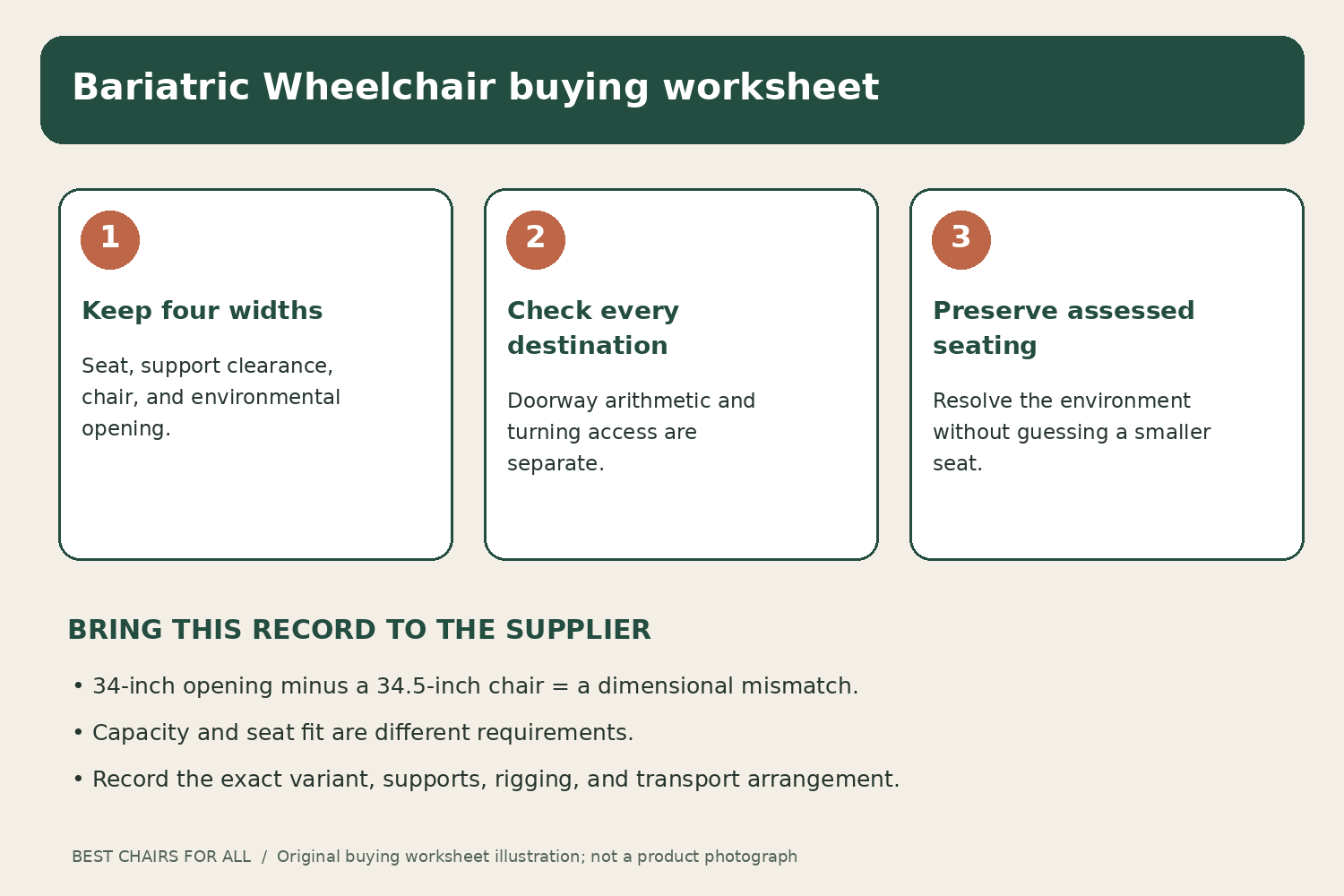
Create a ledger with four separate width rows: assessed seat width, usable width between supports, configured overall chair width, and the narrowest environmental opening. The first two concern the individual seating arrangement; the third concerns the machine; the fourth concerns the building or vehicle. Keeping them separate prevents a salesperson or family shopper from using the same word “width” for four different questions.
For an arithmetic example, use the manufacturer’s 34.5-inch overall-width figure for the cited 26-inch Sentra example. If a doorway’s measured clear opening were 34 inches, there would be a half-inch dimensional mismatch before considering alignment or hands. That does not suggest choosing a smaller seat against the assessment. It identifies an access problem to resolve through another assessed chair configuration, a suitable environmental change, or another professionally recommended solution.
If the opening were wider, access would still not be proven. The approach may require a turn, the door hardware may project, and occupied body space can matter. Add a column for approach geometry and a demonstration result. “Straight opening dimension recorded” is different from “necessary bathroom maneuver demonstrated.” A chair that reaches the bedroom but cannot use an essential destination has an unresolved mobility problem.
Add every regular destination: entry, sleeping area, bathroom, dining position, workplace if relevant, and transportation. Give each a status of confirmed, unresolved, or unsuitable in the proposed arrangement. Do not average those statuses into a score that hides an inaccessible essential location. The ledger should reveal the tightest constraint while keeping the person’s prescribed seating intact.
Propulsion and assistance must be evaluated together
Large rear wheels do not establish that every user can propel the chair effectively. Frame configuration, access to the handrims, support needs, surfaces, and individual ability all matter. Ask the assessment professional to determine the appropriate propulsion method and the supplier to demonstrate the relevant configured chair. Do not infer efficiency from frame weight alone or promise that a lighter option resolves shoulder symptoms.
If a companion will push, include that actual person in the practical evaluation. The task includes ordinary route management and empty equipment handling, not just moving a chair a few feet in a showroom. Ask which route surfaces are permitted and how the manufacturer expects normal controls to be used. This guide does not provide ramp, curb, stair, or transfer procedures.
An electric chair or another mobility arrangement may be appropriate when a manual setup cannot meet the assessed need. That is a discussion for the mobility team. Avoid forcing the choice into a manual-chair shortlist because the online price is lower or the frame folds. The equipment should follow the functional requirement, including any necessary support and control system.
Transportation requires more than folded width
Record the vehicle opening, cargo-floor shape, and how the complete empty chair and permitted removable pieces will be secured. A folded frame can remain long and heavy. Ask the supplier to identify manufacturer-approved removable components and handling points and to demonstrate the actual loading arrangement with the people who will do it. Do not attempt unapproved disassembly to fit a vehicle.
If the user will remain seated during vehicle travel, ask for a separate model-specific transit evaluation. A supplied lap belt, a retailer tie-down accessory, or a heavy-duty label does not establish crash protection. The supplier must identify the approved equipment and configuration and its compatibility with the vehicle arrangement. Treat empty cargo transport and occupied transportation as different requirements in the ledger.
Seating accessories belong in the original quote
Ask the professional to specify compatible seating and supports before the final chair configuration is ordered. A cushion added later can change occupied height and the relationship to armrests, foot supports, desks, and tables. A generic large cushion is not automatically appropriate because it covers the seat. Preserve the completed seating specification with the chair’s order form.
Likewise, confirm the arm style and front rigging rather than assuming every heavy-duty frame is supplied complete. The Extra-Extra-Wide family’s separate-rigging note is a reminder to check the delivered package. Request exact compatible part numbers and who is responsible for fitting. Missing or mismatched supports should be resolved before use, not replaced temporarily with an improvised component.
Service, recalls, and acceptance
Ask the dealer which casters, wheels, upholstery, supports, and frame parts are serviceable locally and how repairs are arranged. Record the exact chair identity and the service contact. A large configured chair can be difficult to ship, so transport and labor terms deserve attention alongside the warranty headline. If daily mobility depends on it, ask about a contingency during repair.
Check the FDA medical-device recall database and current manufacturer notices using the exact model and identifying details. Ask the supplier to confirm whether the individual device is affected by any action. This guide does not provide serial-specific recall clearance. Used equipment with unreadable labels, undocumented modifications, or mixed parts needs those uncertainties resolved before it can be considered for the assessment.
Get an itemized quotation with the selected size, arms, rigging, seating, accessories, fitting, delivery, and return restrictions. Confirm coverage directly with the relevant payer and provider. At acceptance, compare the actual label, dimensions, and components with the agreed specification, especially where the online manufacturer table contained conflicting capacity language.
Which route should you investigate?
Consider KM-8520X when its exact confirmed limits and seating fit and a lighter empty package is relevant. Investigate Sentra EC Heavy-Duty when its documented conventional size range matches the assessment. Discuss the Extra-Extra-Wide family when the wider seating and rated-load range are actually needed and environmental access can be resolved. The best bariatric wheelchair choice closes the seating, load, route, propulsion, and transport questions together.
Something unclear or out of date? Send a correction with this article’s title and the detail to check.
Sources, research & corrections policy ↗