As an Amazon Associate, we earn from qualifying purchases. Read our affiliate disclosure. Amazon buttons below search for matching listings; they do not confirm stock, an exact seller, or a current price.
The best commode chair is one that fits the user, the toileting location, the professionally assessed access method, and the household’s cleaning arrangements. For an initial researched shortlist, consider the Drive 11148-1 folding commode, Medline Guardian G1-200X1 folding commode, and Medline Guardian G1-301DPX1 padded drop-arm model. The third is a different configuration category; a drop arm is relevant only when it belongs in the individual’s assessed plan.
Manufacturer information was checked on November 6, 2026. We have not tested these commodes or assessed an individual user. This guide does not prescribe transfer techniques, promise independent toileting, verify current prices, or guarantee benefits. An occupational therapist or other appropriately qualified professional should assess seating, access, and assistance needs where these are uncertain. Choosing by load capacity alone leaves several essential questions unanswered.
Name the intended use precisely
A bedside commode collects waste in a removable container. Some products also have manufacturer-approved configurations for placement over a toilet or use as a toilet support arrangement. Those functions must be confirmed for the exact item and setup. A frame that looks as if it straddles a toilet is not automatically a verified fit, and a bedside pail configuration is not the same as an over-toilet configuration.
Write down the intended location and whether it will change. A commode kept in one assessed bedside position raises different practical questions from one moved daily between rooms. The user may need a particular arm arrangement, seat opening, back support, or assistance plan. Explain those requirements to the professional and supplier instead of asking for a generic “three-in-one” chair.
Also distinguish a stationary commode from a rolling shower commode. The models discussed here are stationary products. They should not be treated as transport equipment, and their use in a shower should not be assumed unless the exact manufacturer instructions permit it. If bathing and toileting need to be combined in one system, ask for an assessment of the appropriate category rather than repurposing a bedside frame.
Comparison of three documented models
| Model | Verified specification | Reason to investigate | Main limitation |
|---|---|---|---|
| Drive 11148-1 | 13.5-by-15-inch seat; 7.5-quart pail package | Conventional folding bedside arrangement | Seat dimensions do not establish arm clearance or opening fit |
| Guardian G1-200X1 | 19 inches inside arms; 21-inch overall width | Folding frame with detailed 2026 catalog dimensions | Overall width does not prove over-toilet compatibility |
| Guardian G1-301DPX1 | Padded drop arms; 20–25-inch listed seat-height range | Professionally specified drop-arm arrangement | Higher range and narrower arm gap need careful fit assessment |
Drive 11148-1: conventional folding storage and a defined pail package
The Drive 11148-1 manufacturer sheet lists a folding powder-coated steel frame, snap-on plastic seat and lid, and an included 7.5-quart bucket, cover, and splash shield. The listed seat is 13.5 by 15 inches, with a 350-pound capacity and a 13.5-pound product weight.
Investigate it when a conventional stationary bedside configuration matches the assessment and folding storage is useful. Its limitation is that a compact seat measurement is not a complete occupied-fit specification. Ask for the seat-opening dimensions, inside-arm clearance, available height settings, and full floor footprint. Confirm the exact stock number and included accessories. A bucket cover and splash shield serve different purposes; the supplier should explain the manufacturer-approved configuration for the intended use.
Check matching Drive Medical 11148 1 commode listings on Amazon (paid link)
Guardian G1-200X1: compare inside-arm width with overall frame width
Medline’s 2026 durable-medical-equipment catalog identifies G1-200X1 as a folding steel commode with a 16–22-inch seat-height range, 14.5-inch seat depth, 19-inch inside-arm width, and 21-inch overall width. It lists the seat, lid, bucket, and splash guard as included components of the three-in-one range.
This is a useful candidate when those dimensions meet the assessed requirement and a folding conventional frame is appropriate. The tradeoff is that over-toilet fit still needs the actual toilet and frame dimensions, including obstructions and the correct accessory arrangement. Do not confuse this standard model with elongated or other Guardian variants. Have the quote retain the full code, and ask the supplier to identify the matching manual and replacement parts.
Check matching Medline Guardian G1 200X1 commode listings on Amazon (paid link)
Guardian G1-301DPX1: drop arms and padding require their own evaluation
The Guardian G1-301DPX1 manufacturer listing describes padded drop arms, a removable cushioned seat, a 20–25-inch seat-height range, 16.75 inches between the arms, and a 350-pound capacity. These are that listing’s figures, rather than settled dimensions for every delivered unit. Medline’s 2026 DME catalog, page 59, lists the same G1-301DPX1 code with a 19–23-inch seat-height range and 20-inch inside-arm width; both sources state 350 pounds. We cannot establish which dimensional set applies to the offered configuration. Require written manufacturer or authorized-supplier confirmation of the delivered configuration’s height range and usable inside-arm measurement before relying on either set for an assessed fit requirement. This is not simply the standard folding model with softer upholstery added.
Consider it when an assessment calls for a compatible drop-arm layout and its height and occupied geometry suit the user. It is less appropriate if the unusually high lower setting does not match the assessed requirement or if the arm gap is unsuitable. Ask the supplier to demonstrate the ordinary arm controls and their secured state. A product feature does not authorize a lateral transfer technique for everyone; obtain individual instruction from the qualified professional involved.
Check matching Medline Guardian G1 301DPX1 commode listings on Amazon (paid link)
Original artifact: the commode configuration passport
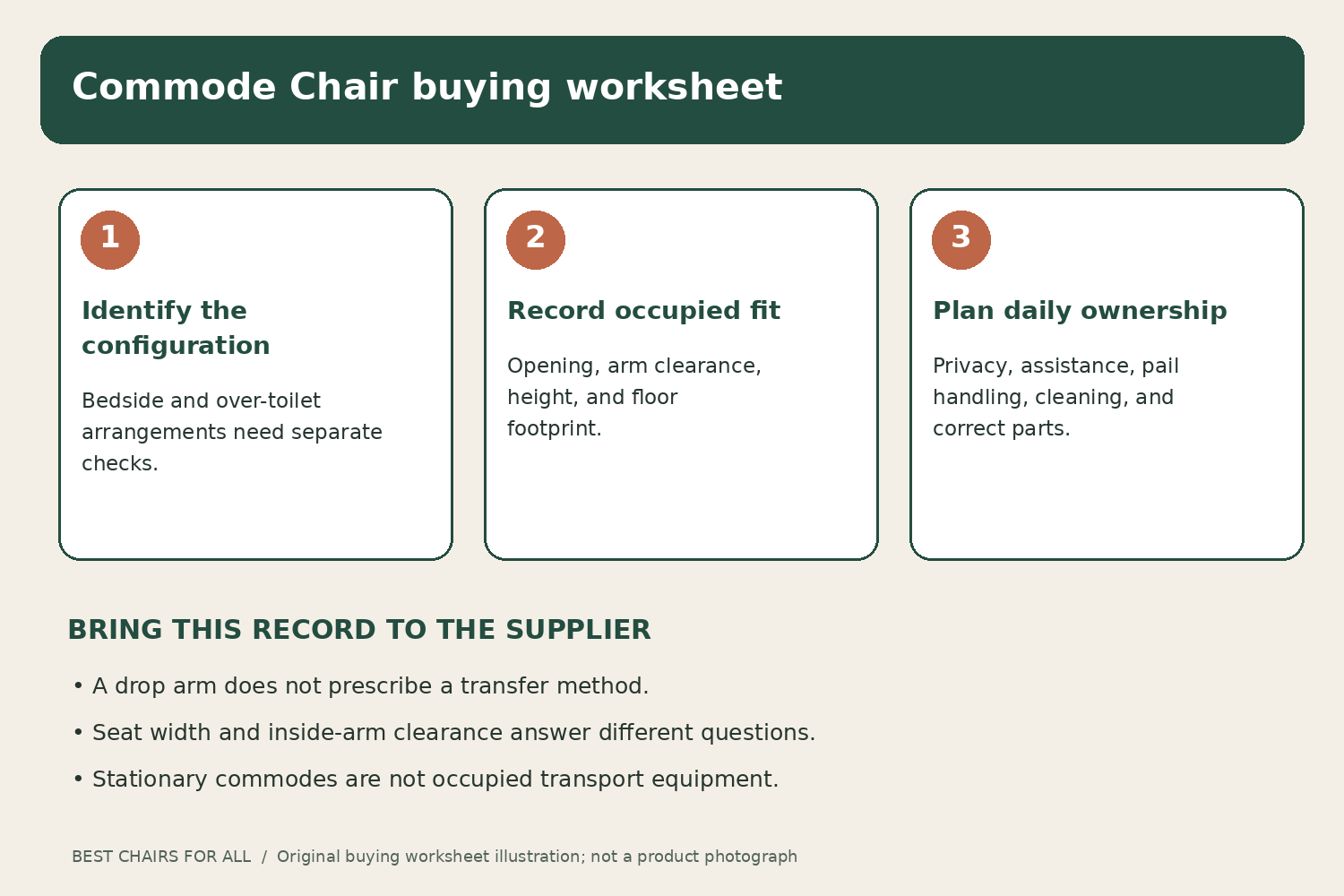
Make one page that travels with the equipment record. At the top, write the exact item number, manual version, intended location, and approved use configuration. Add separate fields for the seat height, inside-arm width, seat opening, overall footprint, back arrangement, and included pail or over-toilet accessories. Have the assessment professional and supplier supply the relevant information rather than filling gaps from a visually similar listing.
The next section records the location drawing. For bedside use, mark the agreed approach space, bed position, door route, lighting arrangement, and any assistance area specified by the professional. For over-toilet use, mark the actual toilet, surrounding fixtures, frame-clearance questions, and correct waste-path arrangement. Keep those two drawings separate if both uses are intended; a successful bedside evaluation does not validate the toilet installation.
The final section is a responsibility record: who positions and checks the frame, who assists if required, who empties and cleans the pail, and who contacts the supplier about damage. Privacy is part of that conversation. The user should know what assistance is available and how to request it without relying on an assumption that someone will hear from another room.
A passport with blank fields is still useful. “Opening dimensions unknown” is an actionable question for the supplier. “Night-time assistance not arranged” is an issue for the care team. Hiding either under a general claim that the commode is convenient makes the purchase harder to evaluate. Close essential gaps before the equipment is put into service.
Worked comparison: the widest headline can mislead
Imagine a user whose assessment includes a specific arm-clearance requirement and an appropriate height range. One candidate has a broad seat label but no confirmed inside-arm measurement. Another documents 19 inches inside the arms. A padded option documents a smaller gap and starts at a higher setting. The comparison should retain all those distinctions rather than awarding the padded model a universal comfort advantage.
Next imagine that the selected frame must also fit over a toilet in a small room. The overall width may fit between the vanity and wall, yet the crossbars, bowl shape, lid, or required splash arrangement can prevent the intended configuration. Ask the supplier to identify the necessary clearances and inspect the actual layout. Do not raise the frame beyond the assessed setting or remove a structural component to resolve a collision.
The correct worksheet result can be “candidate suitable for further demonstration” rather than “winner.” A demonstration should use the approved setup and address the individual access plan. If neither standard nor drop-arm equipment meets the need, the assessment may identify another configuration or category. The shopping comparison should make that conclusion possible instead of forcing one of three products to be selected.
Hygiene should be planned before the first use
Request the model-specific cleaning instructions for the frame, seat, padding, pail, and lid. These are different materials and surfaces. Ask which cleaning and disinfecting agents are permitted and whether any components have particular drying or inspection requirements. Do not assume a padded surface can tolerate the same process as a bare molded seat. Shared equipment requires an appropriate protocol established by the responsible care provider.
If disposable liners are proposed, verify compatibility and the intended waste-handling process. A liner is not a substitute for inspecting and cleaning equipment according to instructions. Discuss ongoing supply needs and storage with the person responsible, including how replacements will be obtained. We do not prescribe a waste-disposal method for every household or care setting; follow applicable local requirements and professional guidance.
Medline offers a specified replacement seat-and-lid part listing compatible commode item numbers. That is a useful example of why exact identity matters. A seat that clips onto the frame is not necessarily an approved replacement merely because it appears to fit. Keep the supplier’s parts contact and replace damaged components through the correct model-specific route.
Folding and moving are separate from occupied use
A folding frame is useful for storing empty equipment, but the correct assembled state must be established again before use. Have the supplier demonstrate the manufacturer’s ordinary setup and inspection points. Record who is responsible if the commode is routinely moved or stored. A household member should not change the prescribed height or arm arrangement simply to make the frame easier to put away.
These stationary commodes are not general-purpose chairs for carrying a seated person between locations. If movement while occupied is required, ask the assessment team about equipment designed for that task. Do not add casters or substitute unrelated feet to create a mobile version. The intended use and support arrangement should remain visible on the configuration passport.
Recall and purchase checks
Consult the FDA medical-device recall database and manufacturer notices, and ask the supplier to check the exact identifying information. This guide does not establish that an individual commode or replacement part is recall-free. Used equipment with missing labels, mixed components, or no matching manual needs those uncertainties resolved before consideration for an assessed plan.
Obtain the full seller quotation, included parts list, delivery and setup arrangements, and hygiene-product return policy. Confirm any coverage with the relevant payer and provider; a billing code or account-eligibility label cannot guarantee payment. At delivery, compare the exact model and components with the passport and resolve any damaged, missing, or substituted part before use.
Choose Drive 11148-1 or Guardian G1-200X1 when the conventional folding layout matches the assessed need and full fit is confirmed. Investigate Guardian G1-301DPX1 when its drop-arm configuration, height range, and padding are specifically relevant. The best commode chair purchase leaves the user with an appropriate toileting arrangement and a workable privacy, assistance, and hygiene plan.
Keep the user’s preferred terms and privacy requests in the passport as well. A technically suitable frame is easier to incorporate into daily life when everyone involved understands how the person wants assistance offered.
Something unclear or out of date? Send a correction with this article’s title and the detail to check.
Sources, research & corrections policy ↗