As an Amazon Associate, we earn from qualifying purchases. Read our affiliate disclosure. Amazon buttons below search for matching listings; they do not confirm stock, an exact seller, or a current price.
The best shower chair for an older adult is determined by their bathing routine, support needs, preferences, and bathroom. Age alone does not select the right seat. For a supported-chair discussion, our manufacturer-researched candidates are the Drive 12445KD-1 with padded removable arms, Moen DN7100 with a mesh seat and integrated storage accessories, and Medline MDS89745RAH with a documented adjustable-height range. None replaces an individual bathing-access assessment.
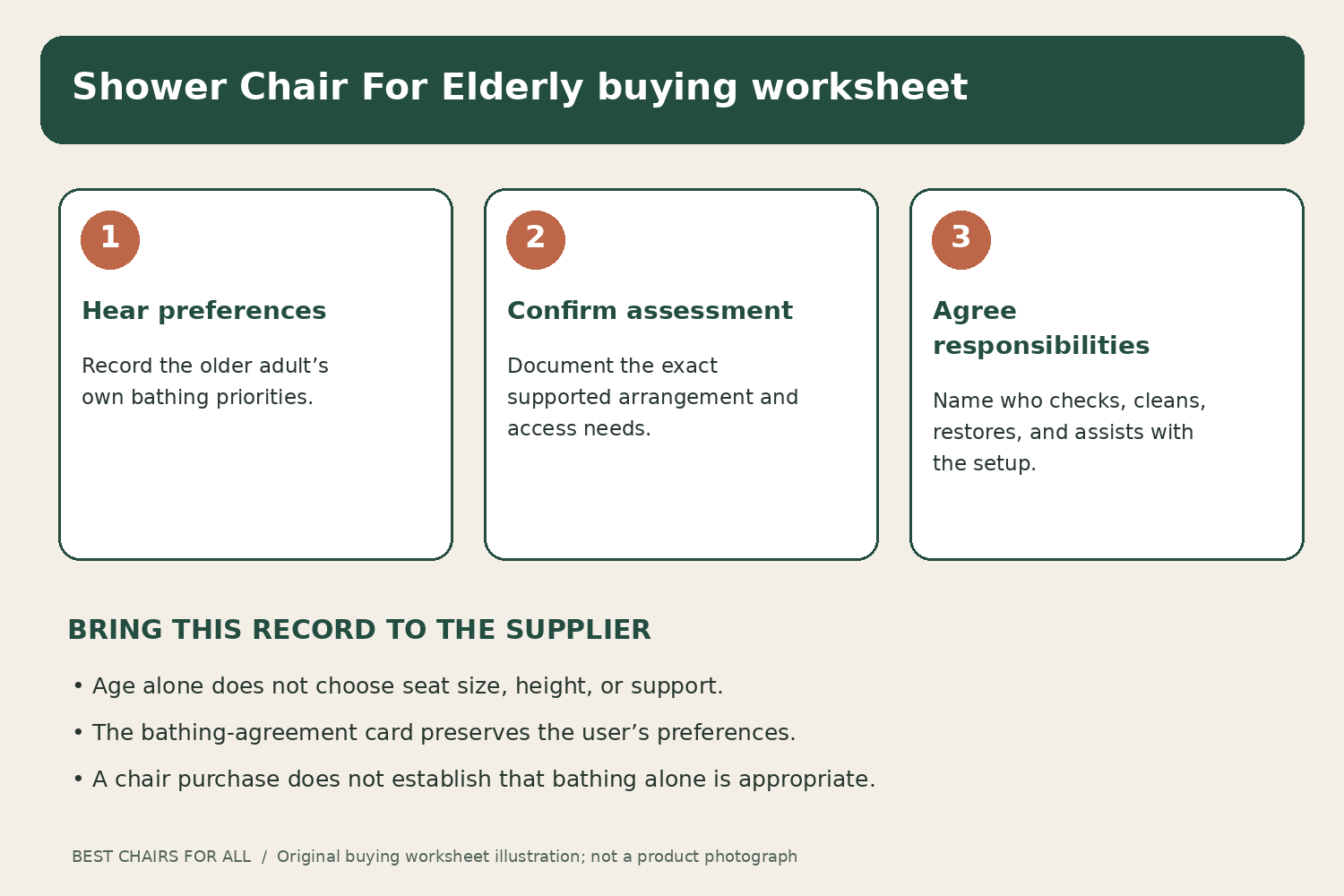
We checked manufacturer information on November 6, 2026 and have not tested these products. We do not promise that a chair prevents falls, treats a condition, or allows someone to bathe alone. Prices and reimbursement are not verified. This guide helps an older adult, family member, and qualified professional turn a general shopping request into a documented bathing arrangement.
Start with the person who will use it
Ask the older adult which part of bathing they want to change. They may be concerned about standing for a full wash, reaching supplies, feeling cold on a seat, sharing a bathroom, or losing privacy. Those concerns are concrete design questions. A relative’s preference for the chair that stores most neatly may not match the user’s need for a backrest or arms. Record the user’s priorities before comparing product photographs.
Then distinguish preference from an unresolved support requirement. A person may prefer a small stool, but the assessment may identify a need for a different supported arrangement. Conversely, a large chair with many features may obstruct a routine that otherwise works. A qualified occupational therapist or appropriate clinician can help assess the person, the bathing environment, and the assistance needed without making age the deciding criterion.
If falls, dizziness, new weakness, pain, confusion, or difficulty entering the shower have prompted the purchase, bring those concerns to a healthcare professional. Do not assume a seat alone solves the cause. The shopping task can continue by collecting dimensions and manuals, but the final support and assistance plan should reflect the assessment rather than a retail description.
Three models for a supported-seat shortlist
| Model | Verified distinguishing feature | Useful question | Potential drawback |
|---|---|---|---|
| Drive 12445KD-1 | Padded removable arms; 18.5-inch gap between arms | Does the arm layout match the assessed need? | Published specifications must match delivered labeling |
| Moen DN7100 | 19-by-17.7-inch mesh seat; 15–21-inch height range | Are mesh and integrated accessories preferred? | Broader seat needs a real bathroom-fit check |
| Medline MDS89745RAH | Arms and back; 16–21-inch seat height | Does its specific geometry fit the person? | Similar item names can conceal different dimensions |
Drive 12445KD-1: examine the padded-arm layout
Drive’s 12445KD-1 manufacturer sheet documents removable padded arms, 18.5 inches between the arms, and leg-height adjustments in one-inch increments. The retrieved sheet lists 350 pounds, while older specifications elsewhere can differ. Have the supplying dealer confirm the delivered unit’s labeling and current instructions rather than resolving a conflict by choosing the larger number.
This is worth discussing when arm padding and the documented arm clearance are relevant to the individual assessment. The limitation is that arm clearance does not establish seat depth, full footprint, or appropriate access. Request missing dimensions and the correct manual. Removable arms should be used only in the approved configuration identified for the person; do not infer a transfer method from the fact that an arm can detach.
Check matching Drive Medical 12445KD 1 shower chair listings on Amazon (paid link)
Moen DN7100: mesh and storage can change the bathing experience
The Moen DN7100 product page lists a 19-by-17.7-inch seat, 18-inch leg width, and a 15–21-inch height range. Moen’s technical specification identifies the mesh construction and requires proper assembly and adjustment, with all four legs locked at the same height. It also directs users to seek healthcare advice appropriate to their needs.
Consider DN7100 when the user prefers the mesh-seat format and its accessory arrangement, provided the assessed dimensions work. The tradeoff is that a larger seat and attached storage still need a complete enclosure check. Mesh construction is not proof of comfort or skin suitability for a particular person. Ask how the exact seat and accessories should be cleaned and inspected, and confirm the whole chair fits without obstructing required bathroom space.
Check matching Moen DN7100 shower chair listings on Amazon (paid link)
Medline MDS89745RAH: keep the full code with the assessment
Medline’s MDS89745RAH manufacturer listing states a 16–21-inch seat-height range in one-inch increments, arms and backrest, a 350-pound capacity, and seat dimensions of 13.5 by 16 inches. Ask the supplier to identify width and depth and demonstrate the usable space in that exact model.
It belongs on the shortlist when its dimensions and supported configuration match the assessment. Its limitation is the temptation to treat all Medline bath benches as equivalent. Retain the complete item code and matching instructions when discussing a purchase with relatives or ordering through a marketplace. A similarly named model may have another seat shape or height range. The relevant comparison is the assessed person in the intended configuration, not the similarity of the product photographs.
Check matching Medline MDS89745RAH shower chair listings on Amazon (paid link)
Original artifact: the bathing-agreement card
Create a one-page card with four areas: the user’s preferences, the assessed support arrangement, the room setup, and who does what. In the preferences area, write the person’s own words where possible. “I want my soap and handheld shower within the agreed seated reach” is actionable. “Make bathing safer” is a goal but does not specify a product feature or a household task.
The assessed-support area records the professional’s equipment recommendation and assistance requirements. It should not be completed from this article. Include the exact chair configuration, relevant height setting, approved accessories, and the person to contact if needs change. The purpose is to keep a family shopper from replacing a specified supported chair with an attractive stool without recognizing the change.
The room-setup area records where supplies belong and which fixtures or routes must remain clear. Mark the agreed chair position and the manufacturer’s placement requirements. If the bathroom is shared, record which components may be moved for another user and who restores the assessed setup. A removable chair that is repeatedly stored and reassembled needs a reliable return-to-use arrangement.
The “who does what” area identifies the person responsible for assembly checks, cleaning, assistance, and contacting the supplier about damage. Do not assume a family member will be available every morning if that has not been arranged. If the assistance plan is unresolved, leave that box visibly open and take it to the assessment team. Buying a chair is not evidence that the assistance requirement has disappeared.
A worked example of choosing by routine
Imagine an older adult who wants to sit for washing and prefers support under the forearms. Their daughter shops online, while another relative cleans and stores the bathroom equipment. The first question is whether the professional assessment supports a stationary chair and the proposed access arrangement. If entry over the curb remains unresolved, none of these three purchases should be treated as the answer to that problem.
Suppose stationary seated bathing is appropriate. The user can then compare the padded-arm feel of one option, mesh seating of another, and the dimensions of the third in a proper demonstration. The daughter records the full item code rather than only the brand. The relative responsible for storage receives the correct instructions and an agreed record of the assembled configuration.
The decision card might finish with “supported chair selected; exact model documented; bathroom position confirmed; cleaning responsibility agreed.” If instead it reads “chair selected, but no one has confirmed setup after weekend storage,” the purchase process is incomplete. This example is about organizing responsibilities, not prescribing how the individual should enter or leave the chair.
Bathroom fit should include the helper and the door
Measure the shower’s usable floor rather than relying on the nominal enclosure size. Record the door or screen opening, floor shape, drain, fixtures, and curb. Obtain the chair’s full outside footprint at the selected height. Arms and back may extend beyond the apparent seat area. Mark any unknown dimension for confirmation by the supplier.
If assistance is required, the professional needs to assess working space as well as chair space. A chair that occupies the available floor can leave no practical place for the agreed helper. Likewise, a door may open fully when the shower is empty but strike the installed chair. Photographs and a simple scale drawing can help the assessment discussion, but do not substitute for a necessary home evaluation.
Keep chair arms separate from fixed bathroom supports in the decision. A removable shower chair is not automatically a substitute for a properly specified and installed grab bar or other environmental change. Ask the assessment team which supports are required and who should install them. Do not use towel rails or unrelated fittings as if they were assessed support equipment.
Care and changes over time
Keep the manufacturer’s care instructions beside the purchasing record. Specify approved cleaning products and inspection points for the chosen model, including its feet, seat, joints, mesh if present, and accessories. Do not apply an aggressive disinfectant or heat treatment because it is permitted for a different plastic chair. A visibly damaged component should be referred to the supplier for the correct remedy before use.
Revisit the arrangement when the person’s needs or bathroom change. A new mobility aid, different support requirement, or change in available assistance can invalidate the original routine even when the chair remains intact. Contact the assessment professional rather than compensating by removing supports or improvising a new transfer technique. The card should make it easy to see what has changed.
Recall, quotation, and acceptance questions
Check manufacturer notices and official recall resources, including the FDA medical-device database and CPSC recall search, as appropriate to the product. Provide the exact model and identifying details to the supplier. This guide does not establish a serial-specific recall clearance. Hand-me-down equipment needs its own identity and condition check rather than relying on the prior owner’s experience.
Request the actual seller’s total and return policy, especially for an opened hygiene product. Confirm any benefits directly with the relevant payer. At delivery, compare the label, components, and manual with the agreed model. Have assembly and ordinary adjustments demonstrated, and resolve any conflict between instructions and labeling with the manufacturer before use.
For the final choice, investigate Drive when padded removable arms match a documented need, Moen when its mesh and accessory layout are preferred and fit, and Medline when its specific supported geometry is appropriate. The best result is a bathing arrangement the older adult understands and accepts, with the necessary assessment, room setup, and household responsibilities all recorded.
Something unclear or out of date? Send a correction with this article’s title and the detail to check.
Sources, research & corrections policy ↗