Affiliate disclosure: As an Amazon Associate, Best Chairs for All earns from qualifying purchases. Read our disclosure. Amazon links below open matching US search listings; check the exact model, seller, configuration, availability, and checkout terms.
The best drafting chair must match a high work surface while giving your feet a useful support point. For a familiar task-chair arrangement, compare Steelcase Series 1 Stool. For an exact configuration with adjustable arms and a short published usable seat, consider HON Ignition 2.0 HITSM.S1.A.H.IM.CU10.AL.SB.T. For a compact armless starting point with a larger height range, compare Safco Vue 3395BV.
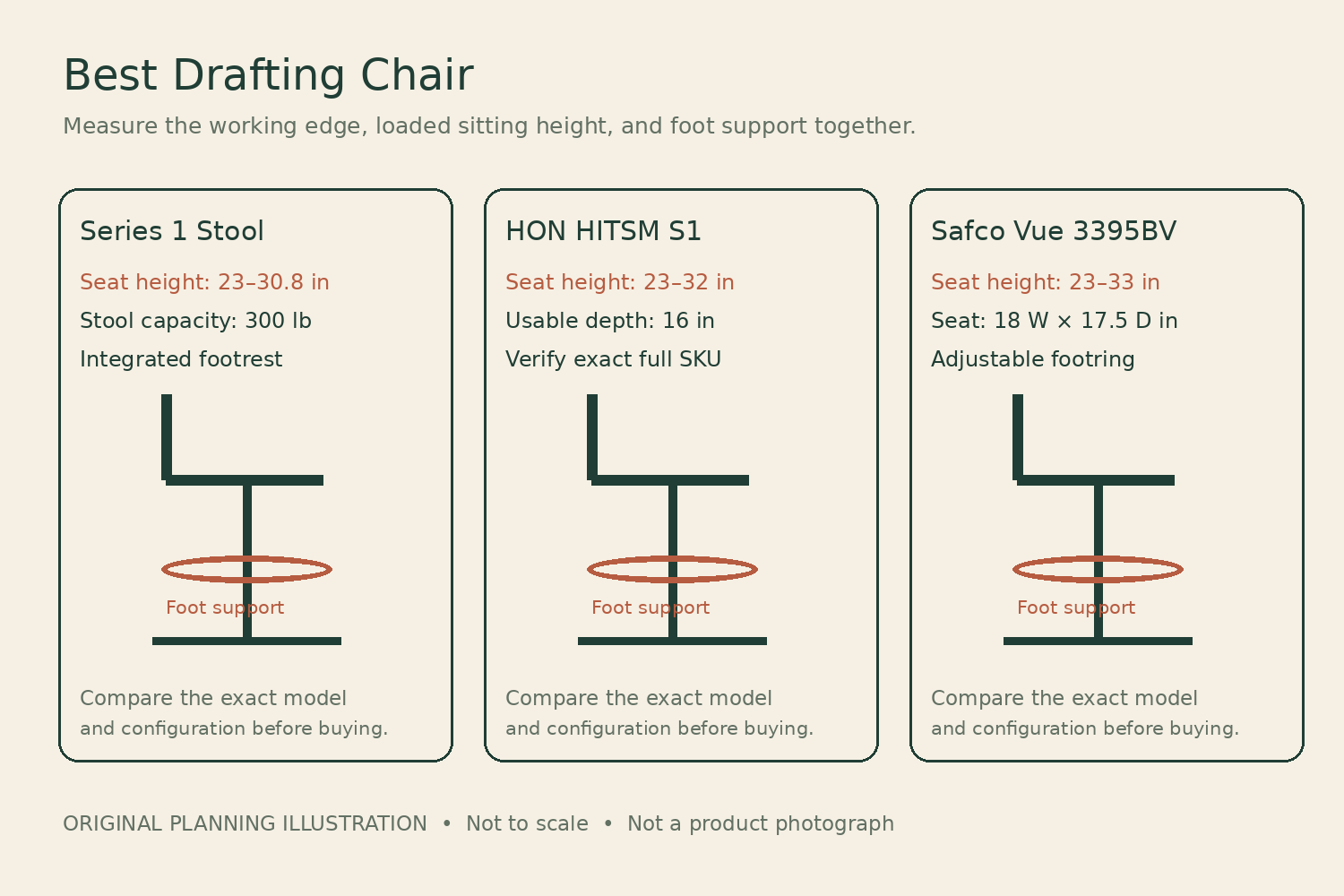
This guide uses manufacturer specifications and current US listing information checked November 6, 2026. We have not tested these stools, measured their stability, or judged their cushions during a work shift. The comparisons identify fitting candidates for elevated drawing tables, counters, and benches. A drafting stool is a different configuration from an ordinary desk chair, and its rating and minimum height must be checked separately.
Start with the working edge, not the tallest point
A tilted drafting top has several relevant heights. The front edge may sit considerably below the far edge, and the actual drawing area can move as the top tilts. Measure where your hands normally work, the front edge, and the underside obstruction separately. A chair that reaches the top’s maximum height may still be wrong for the normal working position.
At a fixed-height bench, the hand task matters too. Fine drawing, keyboard input, light assembly, and viewing a monitor do not require identical elbow positions. Establish the task relationship during a fitting instead of using a generic table-height-to-stool-height formula. Then verify that the chair can reach it without leaving the feet unsupported or squeezing the thighs beneath the edge.
Stool-specific comparison
| Model | Seat-height range | Published capacity | Detail to verify |
|---|---|---|---|
| Steelcase Series 1 Stool | 23–30.8 in | 300 lb | Continuous integrated footrest |
| HON exact HITSM model | 23–32 in | 300 lb | 16-in usable seat depth |
| Safco Vue 3395BV | 23–33 in | 275 lb | Adjustable footring; arms separate |
These values come from the current Steelcase stool listing, HON’s exact model specification, and Safco’s 3395 page. The conventional office-chair versions may have different heights and ratings. A shared family name is not permission to reuse their figures.
1. Steelcase Series 1 Stool
Best for: Best for familiar task-chair controls at a higher work surface.
Series 1 Stool is the first comparison when you want the general behavior of a task chair at a higher work surface. The current US store lists a 23–30.8-inch seat-height range, a continuous integrated footrest, weight-activated recline, upright back lock, and height-adjustable lumbar support. It is a dedicated stool configuration rather than an ordinary Series 1 chair raised with an aftermarket cylinder.
The stool's listed load limit is 300 pounds. That is a crucial distinction from ratings you may see for the conventional chair in the same family. The store also lists a 27-inch width and a 21–23.8-inch overall depth; these are room measurements, not usable seat depth. The checked US page accepted orders with a build-to-ship estimate, and noted longer lead times for selected fabrics. Verify the selected wheels and upholstery as part of the order.
Product Details
| Brand | Steelcase |
|---|---|
| Current US seat height | 23–30.8 inches |
| Overall width | 27 inches |
| Overall depth | 21–23.8 inches |
| Stool weight limit | 300 lb |
| Current listing warranty | Limited 12-year parts and labor; terms apply |
Pros
- Task-chair adjustment concept at drafting height
- Integrated footrest and upright back lock
- Current US stool-specific dimensions and rating
Cons
- Does not lower to ordinary desk-chair height
- Footrest must meet your feet at the working setting
Choose Series 1 Stool if you need a seat in its actual height range and want that control scheme. The current retail page describes limited twelve-year parts and labor coverage; read the applicable terms. Try reaching the footrest and leaving the chair at the height required by your bench, rather than testing only at its lowest showroom position.
2. HON Ignition 2.0 Mesh Back Task Stool HITSM S1 A H IM CU10 AL SB T
Best for: Best when adjustable arms and a short published seat suit the task.
This specific Ignition 2.0 stool is worth comparing when arm positioning and a short usable seat are important. HON's model-specific page identifies adjustable lumbar support, height- and width-adjustable arms, a footring, limited synchro-tilt, and a 23–32-inch seat-height range. It publishes a 16-inch usable seat depth for the selected model. Check that depth carefully if your thighs need substantially more supported length.
The detailed SKU matters because the Ignition family includes different backs, mechanisms, and arms. Do not borrow a seat-slider feature from another configuration. The exact page lists a 300-pound capacity and describes the stool as warranted for continuous use, but the intended workload should still be checked against the actual purchase terms. We found a current US manufacturer configuration and a US retail listing; neither establishes the inventory of a differently configured Amazon result.
Product Details
| Brand | HON |
|---|---|
| Exact model seat height | 23–32 inches |
| Published usable seat depth | 16 inches |
| Capacity | 300 lb |
| Arms | Height and width adjustable |
| Warranty | Full Lifetime framework; controls/cylinder and textiles have shorter terms |
Pros
- Published exact-SKU information
- Adjustable arms and lumbar support
- Higher maximum seat height than the Series 1 listing
Cons
- Sixteen-inch usable depth may be short for some users
- Broad family naming makes mistaken configuration comparisons easy
Choose it if the specified short seat, arms, and ring work at your bench. HON's current warranty framework is not identical lifetime coverage for every part: seating controls and pneumatic cylinders have a twelve-year term, while seating textiles have five years. Verify current model and seller eligibility and retain the full SKU when requesting support.
3. Safco Vue Extended Height Chair 3395BV
Best for: Best compact armless configuration with an adjustable ring.
Vue 3395BV is the practical alternative when you want an extended-height seat without arms in the way of a broad drawing surface or bench. Safco lists a 23–33-inch seat-height range, an adjustable footring, and an 18-by-17.5-inch seat. The BV configuration has a vinyl seat and mesh back. Optional loop arms are a separate order, so do not assume they are included because a retailer uses an armed photograph.
The base is listed at 25 inches in diameter and the capacity at 275 pounds. That can help in a tight workstation, but a smaller frame still needs sufficient turning and exit clearance. The manufacturer's current page identified the model as Quick Ship; confirm stock with the actual US seller. The fixed seat dimensions should be tested with your pelvis against the back rather than judged while perched forward at the bench edge.
Product Details
| Brand | Safco |
|---|---|
| Seat height | 23–33 inches |
| Seat size | 18 W × 17.5 D inches |
| Base diameter | 25 inches |
| Capacity | 275 lb |
| Arms | Optional loop arms 3396BL sold separately |
| Warranty | Component-specific lifetime/10/5/3-year framework; terms apply |
Pros
- Armless base configuration leaves the work edge accessible
- Published seat size and ten-inch height range
- Adjustable footring
Cons
- Lower rating than the other two stools
- Optional arms and cover codes need careful ordering
Choose Vue when its basic geometry fits and you prefer this compact armless arrangement. Safco's current warranty separates components and use intensity; it is not uniform lifetime coverage for upholstery, casters, and cylinders. Confirm the current statement and authorized seller rather than relying on an old one-line retailer summary.
A drafting-station worksheet
Record measurements at the desk as it is normally used. Include tools or equipment beneath it and the position of your lamp or monitor. If you share the station, make a separate worksheet for each person and task. A stool with a wide overall adjustment range is useful only if the seat, back, arms, and foot support can fit together at the settings you need.
- Surface map: write down front-edge height, usual hand-task height, underside clearance, and knee-space depth. For a tilting top, repeat at your normal low and high tilt positions.
- Working seat height: use an appropriate adjustable demonstration stool to find a comfortable position for the task. Record the loaded height rather than estimating it from your standing height.
- Seat contact: check usable depth and width with the back supporting you. A short seat may help one person approach the work but leave another wanting more thigh support.
- Foot support: locate both feet on the manufacturer-provided ring or support. Check whether the ring’s height and radius let you rest the feet without folding the legs uncomfortably beneath the seat.
- Arm clearance: move the arms through the positions used for a ruler, mouse, or drawing board. Test the full range of the task rather than resting the elbows for a photograph.
- Exit path: lower or position the stool as instructed and practice leaving it. Keep the route clear of the ring, base, cables, drawers, and adjacent stored materials.
A worked screening example shows why the minimum is as important as the maximum. Suppose a person tests a bench and finds a useful loaded seat height around 28 inches. All three published ranges include that number, so the next checks are seat geometry and foot support. If the same stool must also work at an ordinary desk requiring a seat near 19 inches, none of these three published minimums covers both settings. The answer may be separate seating or changing the work surface, not selecting the stool with the largest maximum.
The footring is part of the fit
At drafting height, the floor is often too far below to support the feet in a normal sitting position. A ring must therefore be evaluated under the actual user, not treated as a decorative circle on the stem. Check the relationship between the seat and ring, whether both feet can rest comfortably, and whether the ring interferes with approaching the work edge.
Do not assume a footring is an entry step. Use the manufacturer’s instructions for mounting, adjustment, and leaving the stool. A ring designed to support resting feet does not automatically permit standing on one edge. Avoid improvised extensions or moving a ring beyond its intended clamping area to obtain extra height.
If a product page gives only “adjustable footring” without its travel range, ask for that range before buying for a specific person. Two stools with identical seat-height ranges may still fit differently because their rings differ in diameter and adjustment. A large seat can also make the feet reach farther outward before meeting the ring.
Arms and back support for drawing versus keyboard work
Arms can support a pause but obstruct broad hand movement across a drawing. Test the actual work motion with the arms fitted. HON’s selected model provides height and width adjustment; Safco’s loop arms are optional; the ordered Steelcase configuration should be checked against the desk. Removing an arm should follow the manufacturer’s configuration options, not an improvised alteration.
Similarly, a backrest is useful only if you can reach the task while using it. A high counter may encourage perching at the front of the cushion. If you never contact the back, investigate whether the surface, stool position, or depth is wrong rather than paying for more prominent lumbar shaping. For frequent changes between close work and viewing, try both positions before deciding which mechanism suits you.
Floor, wheels, and stability questions
Specify the floor and manufacturer-approved wheels or glides when ordering. A rolling chair on a suitable smooth floor behaves differently from one on a thick rug or a mat edge. Keep the working area level and clear. Check whether the stool can be moved into position without snagging the base beneath a cabinet or leaving a caster on a transition strip.
A tall cylinder is not a home upgrade project. The stool’s base, mechanism, ring, and rating are selected together. Do not turn a conventional chair into a drafting stool by installing an unverified replacement lift. If you need another height range, ask the manufacturer or dealer for an approved configuration and its complete rating.
Current ordering and component coverage
The Steelcase US listing provides build-to-ship information, HON has an active manufacturer configuration and a current US retailer listing, and Safco identifies its Vue model as Quick Ship. Those checks establish active purchasing routes, not a promise about later Amazon stock. Verify the full model, cover, arms, wheels, and delivery date in the checkout summary.
Read component coverage carefully. HON’s warranty schedule assigns different terms to textiles, controls, and cylinders despite the Full Lifetime heading. Safco’s current statement likewise separates parts and defines the use intensity that applies. Neither a high rating nor a long headline warranty proves a stool is appropriate for a particular workload.
Choose Series 1 for its task-chair approach, the exact HON configuration when its short seat and adjustable arms fit, or Vue for its compact armless setup. Make the buying decision from the working-height worksheet and the foot-support trial. The tallest chair on the page is not necessarily the one that lets you draw or work comfortably.
Something unclear or out of date? Send a correction with this article’s title and the detail to check.
Sources, research & corrections policy ↗