Affiliate disclosure: As an Amazon Associate, Best Chairs for All earns from qualifying purchases. Read our disclosure. Amazon links below open matching US search listings; check the exact model, seller, configuration, availability, and checkout terms.
The best saddle chair is the one whose seat shape, cylinder range, and task height work together. Humanscale Pony is my compact backless comparison, Salli Twin is the split-seat option to try deliberately, and HAG Capisco 8106 adds a backrest and more positional flexibility. None should be selected by standing height alone or treated as an automatic replacement for a conventional task chair.
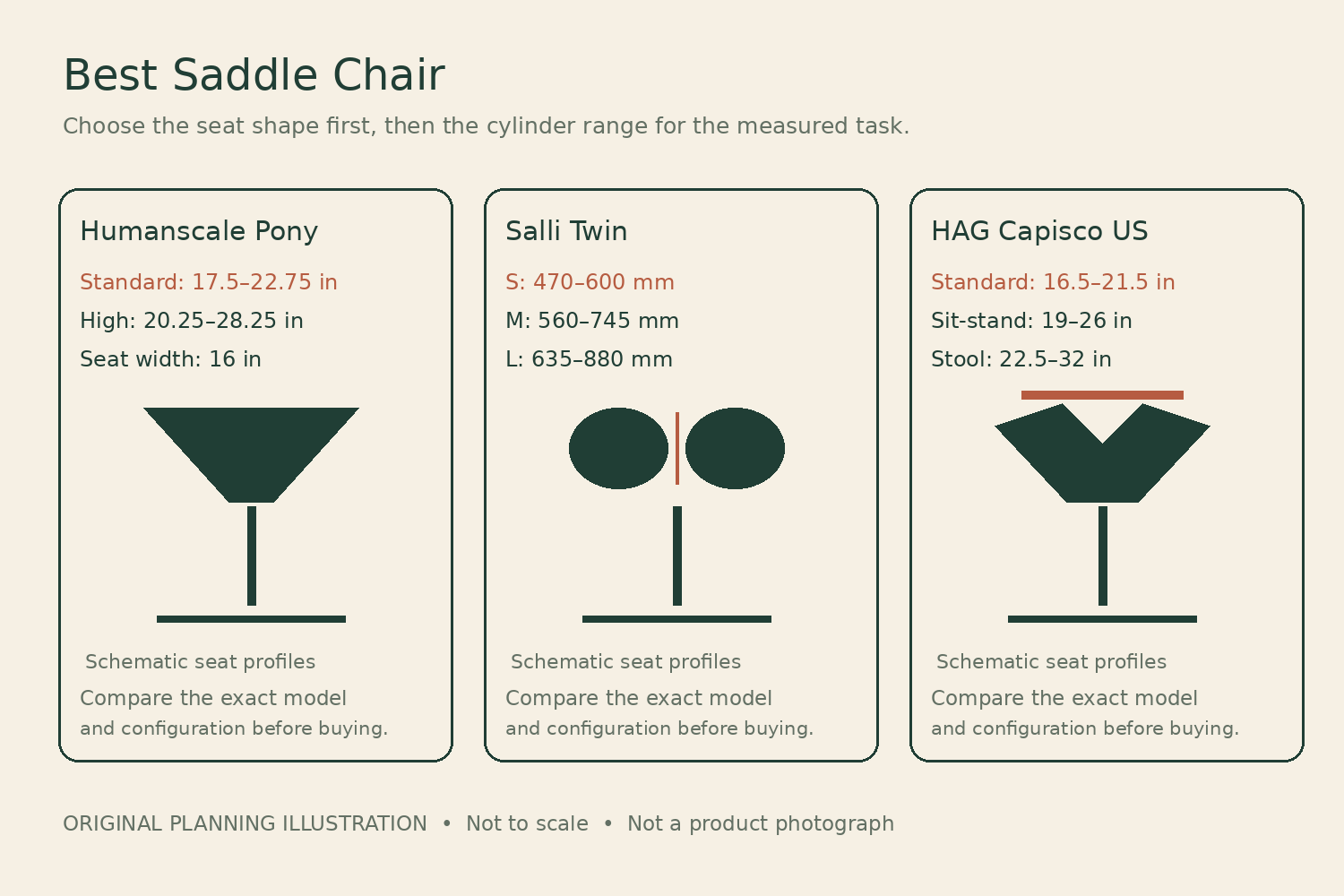
This is an online research comparison checked November 6, 2026, using manufacturer documents and current US purchasing pages. We have not tested the seats, measured muscle activity, or verified claims about pain, circulation, or productivity. Our recommendations concern configuration and practical fit. US and international height ranges can differ, so the exact seller’s model and cylinder are identified where possible.
Choose a contact pattern, then choose a height
Saddle seating is a broad category. A triangular stool, a split two-part saddle, and a saddle chair with a backrest do not put the same surface beneath you. The useful first question is whether the contact shape is comfortable and permits your intended leg position. Only then does it make sense to compare the largest adjustment range or the number of available upholstery colors.
A saddle’s contours also change the relationship between a stated seat width and usable support. A 16-inch shaped seat is not equivalent to a 16-inch flat rectangle. Ask to try the specific model, not simply another stool from the same brand. If you use restrictive clothing, a tool belt, or work garments with thick seams, wear them during the fitting.
The configuration comparison
| Option | Seat approach | Height choices to investigate | Critical limitation |
|---|---|---|---|
| Humanscale Pony | Compact shaped stool | 17.5–22.75; 20.25–28.25; 23–33 in | Backless; confirm cylinder |
| Salli Twin | Split saddle with inclination | 470–600; 560–745; 635–880 mm | Caster choice changes height |
| HAG Capisco 8106, US | Saddle seat and backrest | 16.5–21.5; 19–26; 22.5–32 in | Footring incompatible with standard cylinder |
The Humanscale brochure explicitly measures the compressed cushion center. Salli’s Twin specifications distinguish cylinders and caster effects. The current US Capisco configuration page identifies its own ranges. Treat those measuring conventions as part of the specification rather than silently assuming every number means the same thing.
1. Humanscale Freedom Pony Saddle Stool
Best for: Best compact saddle seat for a precisely specified height.
Pony is the compact starting point when you want a saddle-shaped stool without a large backrest. Humanscale distinguishes its 16-inch Pony seat from the 22-inch full Saddle. Those are different contact areas, not merely two names for one stool. The smaller seat may be useful when the task requires close access, but the shape still needs a trial with your own body and clothing.
The manufacturer's technical brochure measures height to the compressed center of the cushion: 17.5–22.75 inches for standard, 20.25–28.25 for high, and 23–33 for extra-high. This is unusually useful information because an unloaded edge measurement can mislead a close height decision. The current US featured-products page offered Pony and Saddle purchasing routes. Confirm the actual cylinder and footring rather than assuming a photograph represents the configuration selected in the cart.
Product Details
| Brand | Humanscale |
|---|---|
| Seat width | 16 inches, Pony; full Saddle is 22 inches |
| Standard published height | 17.5–22.75 inches to compressed cushion center |
| High published height | 20.25–28.25 inches |
| Extra-high published height | 23–33 inches |
| Warranty | 15 years components / 5 years cushions and textiles; confirm US terms |
Pros
- Compact seat distinguished clearly from full Saddle
- Several manufacturer height configurations
- Replaceable cushion and a simple backless layout
Cons
- No backrest for a supported pause
- Seat width alone does not establish straddle comfort
Choose Pony for the smaller contact surface and specified height, not for an unverified claim of all-day benefit. Humanscale's brochure separates 15-year component coverage from five-year cushion and textile coverage; verify the current US warranty and seller eligibility. The separate Active Pony adds movement, so it should not be substituted casually for this standard model.
2. Salli Twin Saddle Chair
Best for: Best split-seat design to compare in a fitting.
Twin is the option for someone who specifically wants to assess a two-part saddle seat and inclination adjustment. It is a more specialized contact pattern than a broad triangular stool. The manufacturer lists three gas-spring ranges: S at 470–600 millimeters, M at 560–745, and L at 635–880. Pick the range from a measured working position; do not order the tallest because the product is described as ergonomic.
Salli notes that industrial or inline casters increase chair height by 35 millimeters. That detail can move a seemingly correct low setting beyond what your body or desk needs. The published maximum load is 120 kilograms. We found a current US retailer listing with fulfillment information, but it distinguishes stocked choices from other configurations. Ask the seller to confirm actual inventory and lead time for the selected cylinder, upholstery, base, and casters.
Product Details
| Brand | Salli |
|---|---|
| S cylinder height | 470–600 mm |
| M cylinder height | 560–745 mm |
| L cylinder height | 635–880 mm |
| Maximum load | 120 kg |
| Warranty | 10 years; terms apply |
Pros
- Split saddle and inclination adjustment provide a distinct fitting option
- Three published cylinder ranges
- Manufacturer identifies caster-related height change
Cons
- Specialized seat contact makes a personal trial important
- Accessories and casters change configuration requirements
Choose Twin after testing the split-seat contact and an ordinary entry and exit. Its manufacturer advertises ten-year coverage; obtain the exact US terms and claim route. Product and retailer descriptions include broad health language that this guide does not validate. A different seat shape is a fitting choice, not evidence of a medical outcome.
3. HAG Capisco 8106 Saddle Chair
Best for: Best when saddle seating needs a backrest and multiple positions.
Capisco 8106 is the choice to investigate when you want a shaped saddle seat plus a backrest. Its unusual back allows different working orientations, while the chair includes seat and back adjustments rather than behaving like a simple fixed stool. That flexibility is useful only if the surfaces and controls fit the tasks you actually perform. It does not make an uncomfortable saddle shape disappear.
The current US UPLIFT configuration lists standard height at 16.5–21.5 inches, sit-to-stand at 19–26, and stool height at 22.5–32. It specifies that a footring is available with the latter two heights and incompatible with the standard cylinder. These US configurations should not be mixed with similarly named European ranges. The checked Canter Vinyl listing was orderable with a stated lead time, so custom upholstery should not be mistaken for an immediate-stock shipment.
Product Details
| Brand | HAG |
|---|---|
| Current US standard height | 16.5–21.5 inches |
| Current US sit-to-stand height | 19–26 inches |
| Current US stool height | 22.5–32 inches |
| US capacity | 300 lb, manufacturer brochure |
| US warranty | Limited lifetime structural and mechanical; material exclusions apply |
Pros
- Backrest adds a supported alternative to a bare stool
- Three clearly identified US cylinder configurations
- More adjustment than a basic saddle seat
Cons
- Wide back and base require workspace clearance
- Extra movement and controls need a careful trial
Choose Capisco if its backrest and movement justify the added complexity. The US manufacturer brochure rates it to 300 pounds, and the US warranty covers qualifying structural and mechanical defects under its limited lifetime framework. Verify textile and other exclusions with the seller. A generic overseas ten-year warranty summary may describe a different market.
A task-height worksheet with a worked example
Use an adjustable demonstration seat or an existing surface that lets you establish a comfortable saddle-like working position without improvising unstable supports. Have a fitter help if the arrangement is unfamiliar. Record your actual working surface height and the vertical distance from the supported sitting point to your relaxed elbow. That personal distance is more informative than a chart assigning one cylinder to everyone above a certain height.
- Task: name the actual work, such as keyboard input, examining objects, or light assembly. Record where the hands need to be; different tasks may require different relationships to elbow height.
- Surface: measure the working height and the lowest obstruction beneath it. Include drawers, crossbars, equipment, and anything you wear on your lap.
- Seat position: find the comfortable supported height during a trial. Check both feet or the manufacturer-approved support arrangement, not just whether the chair reaches the desktop.
- Adjustment reserve: compare that height with the selected cylinder’s full range. Leave usable travel for shoes, different tasks, and other users instead of buying a chair already at its stop.
- Movement: check the complete base diameter and the foot position needed to swivel or leave. A compact cushion can still sit above a large star base.
For illustration, suppose a user measures a 38-inch task surface and, during a comfortable fitting, needs the sitting support about ten inches below that surface. The target is approximately 28 inches. This is arithmetic from that person’s trial, not a universal ergonomic formula. A US Capisco sit-to-stand range topping out at 26 inches would miss that target; the stool range could include it. A high Pony range ending at 28.25 inches includes it near the upper limit. A Twin M range of 560–745 millimeters is roughly 22–29.3 inches and also includes it before any caster change.
The example eliminates unsuitable configurations before you compare upholstery. It does not prove which of the remaining seats will feel best. If the task height can change, record a second target for the lower setting and see whether one cylinder covers both. A taller lift that suits the high bench may no longer lower enough for an ordinary desk.
Backrest, tilt, and foot support are separate decisions
Backless Pony and Twin prioritize access around the seat; Capisco provides another support surface. Decide whether your work includes periods when you want to lean back and observe rather than keep the hands over a surface. A backrest can help with that task, but it also changes clearance behind the chair and how you approach it.
Seat inclination or active tilt is not the same as backrest recline. Ask the demonstrator which part moves, how far, and how it is controlled. Do not buy a moving version solely because motion sounds beneficial. Some users want a predictable stationary surface for precise hand work. Others want a little movement during a conversation. The right mechanism follows the task.
At higher sitting positions, establish where the feet are supported according to the manufacturer’s configuration. A ring may be an approved accessory, but it is not automatically an entry step. Capisco’s US listing explicitly limits footring compatibility to certain cylinders. Do not transplant an accessory, cylinder, or caster because it appears to fit the stem diameter; ask for manufacturer approval.
Check the professional-use requirements explicitly
If the chair will be used in a clinic, laboratory, salon, or workshop, identify the required cleaning products and surface properties before choosing upholstery. A product sold to healthcare buyers is not proof that every fabric option tolerates every disinfectant. Ask for the exact cover’s care instructions and any formal requirements your workplace uses.
Similarly, an ESD version is a configuration, not a universal property of the model name. Salli lists specialty versions and accessories separately. Do not describe an ordinary upholstered chair as electrically suitable for a controlled workstation without the correct model documentation. Ordinary home buyers can avoid paying for specialized features they do not need, while professional buyers should verify them directly.
Availability, warranty, and a sensible trial
The current Humanscale US featured listings provide purchase routes, the US Salli retailer distinguishes fulfillment timing, and UPLIFT lists a lead time for the checked Capisco upholstery. None establishes the stock of a later Amazon search result. Confirm the exact chair, lift, covering, base, casters, and accessories in the order summary.
Get the applicable warranty separately from the return policy. Humanscale’s published technical material separates components from textiles; Salli lists ten years; 9to 5 Seating’s US terms explain the Capisco purchase route’s qualifying coverage and exclusions. Ask whether a used or open-box unit remains eligible, and whether an assembled comfort trial is allowed under the seller’s return rules.
Start with the configuration that fits the measured work, then arrange a trial of the actual seat shape. Pony is the compact option, Twin provides split-saddle contact, and Capisco adds a backrest. The correct outcome may still be to keep a conventional task chair and use saddle seating only where it makes a particular task easier.
Something unclear or out of date? Send a correction with this article’s title and the detail to check.
Sources, research & corrections policy ↗