As an Amazon Associate, we earn from qualifying purchases. Read our affiliate disclosure. Amazon buttons below search for matching listings; they do not confirm stock, an exact seller, or a current price.
A transport wheelchair is principally a companion-pushed chair. The best choice therefore has to work for two people: the seated user and the person pushing, folding, storing, and loading the empty equipment. Our researched shortlist is the Drive Aluminum Transport Chair ATC19, Drive TranSport TS19, and Medline Ultralight MDS808200F3 series. Each deserves a different question about seating space, arm access, and ownership support.
Manufacturer documents were checked on November 6, 2026. We have not pushed these chairs, assessed their comfort, or measured the force required on a slope. We do not verify a current price or declare any model suitable for an individual based on capacity alone. A clinician or qualified mobility professional should help establish appropriate seating, access, and assistance requirements, especially when the chair will be used frequently.
Begin with the companion arrangement
Write down who will push the chair on ordinary outings. If the answer is “whoever happens to be available,” ask whether each likely companion can manage the selected model’s controls and empty-chair handling. A product that is manageable for one helper may be impractical for another. The user should also understand that small-wheeled transport seating generally does not provide the same independent propulsion arrangement as a manual wheelchair with handrims.
Then identify the longest realistic seated period. A short trip from a parked car into a clinic is different from a full museum visit or a day at an airport. Discuss seating and pressure-management needs with the assessment professional; do not use a compact folding chair as a substitute for equipment needed for prolonged sitting. If the person requires substantial postural support, the best next step may be a different seating category.
Finally, name the route surfaces. A smooth appointment corridor, a broken sidewalk, and a gravel parking area create different practical questions for the supplier. Small transport wheels do not make rough routes disappear. Ask for an appropriate demonstration and a route plan that respects the model’s instructions. Avoid interpreting a weight rating as approval for every surface or handling maneuver.
Three models and the details that change the decision
| Model | Verified manufacturer detail | Reason to shortlist | Potential mismatch |
|---|---|---|---|
| Drive ATC19 | 19-by-16-inch seat; 22-inch overall width | Conventional compact transport layout | 17-inch width between arms differs from seat width |
| Drive TS19 TranSport | Removable flip-back arms; 17.5 pounds without footrests | Arm layout warrants an access assessment | 24.5-inch open width needs checking |
| Medline MDS808200F3 | 19-inch seat series in current manual | Identifiable manual and replacement-parts route | Similar older item numbers need distinction |
Drive ATC19: investigate the usable space between the arms
Drive’s ATC19-BL specifications list a 19-by-16-inch seat, a 22-inch overall width, a 19-pound chair weight, and 17 inches between the arms. The published folded dimensions are 33 by 9 by 28 inches. It has 8-inch wheels and swing-away footrests.
The distinction between seat width and arm clearance is the reason this model deserves a deliberate fit check. A buyer reading only “19-inch seat” might expect more usable upper-body space than the arms permit. Consider it when the assessed dimensions and conventional layout work. Its limitation is that the published compactness cannot establish occupied comfort or the companion’s ability to maneuver it. Confirm the precise stock number and have the supplier demonstrate its controls and folded cargo arrangement.
Check matching Drive Medical ATC19 transport chair listings on Amazon (paid link)
Drive TS19 TranSport: examine the arm arrangement
The TS19 manufacturer sheet describes removable flip-back arms, a folding back, and a 19-by-16-inch seat. It states 17.5 pounds without footrests, a 250-pound capacity, and 24.5-inch open width. These figures describe a different package from the ATC19 despite the similar seat-width label.
Investigate the TS19 when the assessed access method calls for an arm arrangement that can move away. That feature does not itself teach or authorize a transfer technique; ask the professional assessing the user to confirm the required arrangement. The wider published frame also deserves attention in narrow approaches. Its lower without-footrests weight cannot be treated as a directly measured advantage over a competitor’s complete-chair figure. Request the actual empty cargo weight and the full dimensions of the configuration offered.
Check matching Drive Medical TS19 TranSport chair listings on Amazon (paid link)
Medline Ultralight MDS808200F3: identify the series precisely
Medline’s current Ultralight transport-chair instructions identify MDS808200F3R, F3B, F3BK, and F3S as 19-inch-seat versions with a 300-pound capacity. Medline also maintains a transport-chair parts finder that distinguishes supported series and discontinued item numbers. That distinction is useful when comparing marketplace listings.
This is a candidate for a buyer who values a traceable manual and an identifiable service route. Its limitation is that a familiar product name can cover old and new codes. Have the seller provide the full item number, applicable instructions, current specifications, and parts support before ordering. Do not import a weight figure from an older “Ultralight” listing into the current chair’s comparison without checking its definition. Appearance and color alone do not resolve the model identity.
Check matching Medline MDS808200F3 transport chair listings on Amazon (paid link)
Original outing audit: follow the journey from start to finish
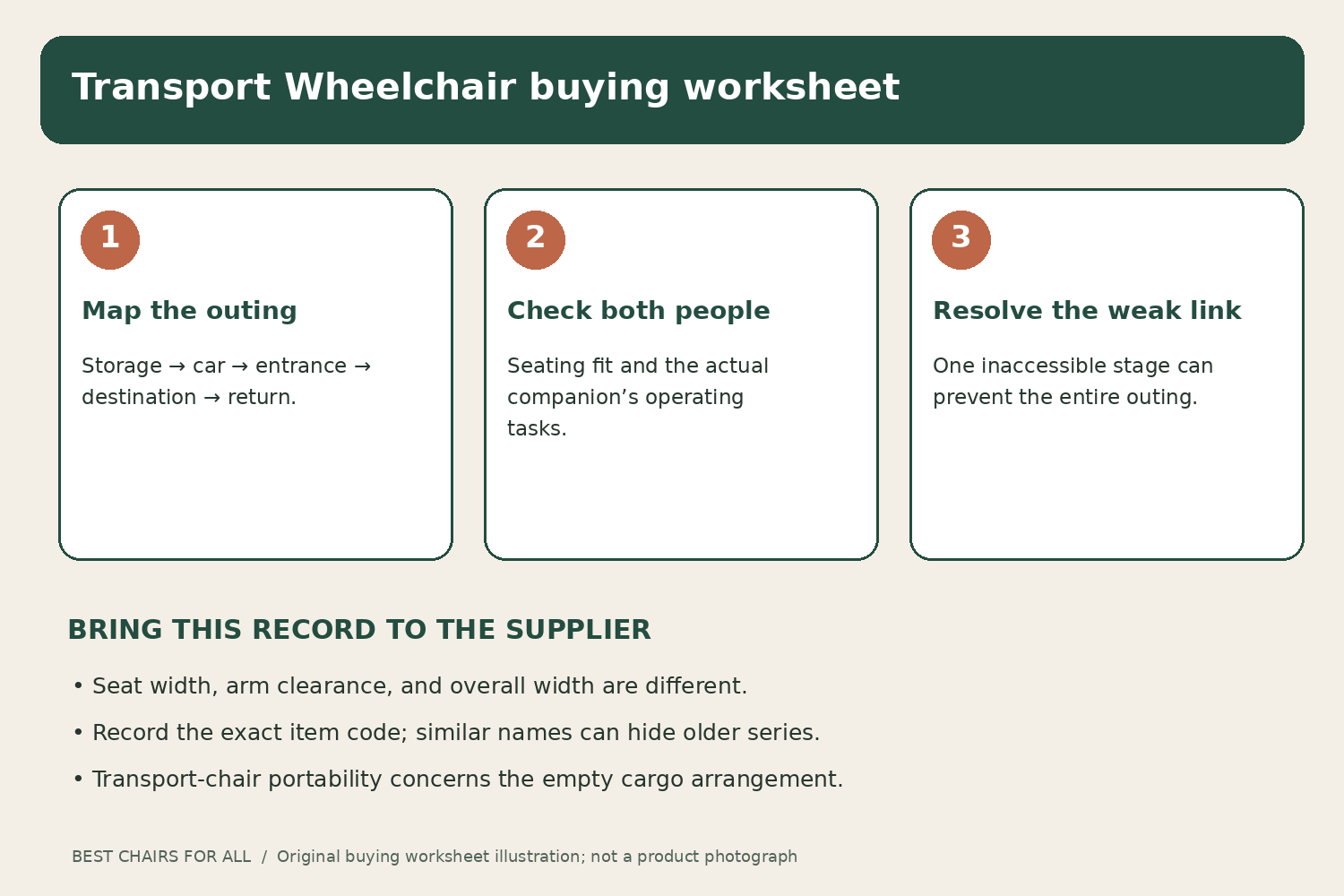
A transport chair purchase is easier to evaluate as a chain of tasks. Make six rows: storage at home, empty loading, parking-to-entrance route, time seated at the destination, return journey, and cleaning before storage. For every row, write who performs the task, what equipment dimensions matter, and what remains unconfirmed. This is more useful than assigning an overall convenience score.
For an appointment example, imagine a chair kept in a hallway closet and carried empty in a sedan. The closet may accept a narrow folded frame, but the trunk opening may be too low for the folded back. The appointment entrance may be accessible while the parking lot route includes an unsuitable surface. Each stage is a separate question. One successful showroom fold cannot prove that the whole outing will work.
Put the seated user’s comfort and support needs in the destination row. If the appointment routinely involves long waits, record that explicitly rather than describing the outing as “just a short trip.” Ask the seating professional whether the chair and compatible seating meet that use. The companion row should include the actual person available, not an idealized helper with unlimited time and strength.
A completed audit might say: “Closet dimensions confirmed; empty trunk loading demonstrated with the intended helper; entrance route still needs checking; seating duration discussed with clinician.” The remaining route question stays open until resolved. Do not order merely because the other rows are satisfactory. The audit is designed to catch the one weak link that could prevent the outing.
Read three different width measurements
Seat width describes the seat surface under the manufacturer’s definition. Width between arms describes another occupied constraint. Overall width determines part of the environmental fit. These numbers may differ substantially, as the ATC19 example illustrates. Ask the supplier to identify all three for the exact model; do not replace a missing arm-clearance figure with the advertised seat size.
Measure the narrowest clear opening along the intended route, including the door in its normal open position and any hardware that protrudes. Also record the approach space. A chair can fit through a straight opening yet struggle to line up from a narrow corridor. Bring a simple floor sketch and photographs to the supplier so a representative maneuver can be demonstrated without guessing.
For the car, keep cargo dimensions separate from occupied dimensions. A folded chair may be narrow but still long, and loose footrests need their own secure storage arrangement. Ask the supplier which parts the manufacturer permits users to remove for ordinary transportation and where the chair may be held. This article does not provide a carrying or stair-negotiation procedure.
Controls, slopes, and professional instruction
Have the dealer demonstrate the exact wheel locks and any attendant controls on the selected chair, using its own manual. Different control designs can look similar while serving different purposes. The companion needs instruction for ordinary operation and the limits on ramps, thresholds, and other obstacles. If a regular route is unsuitable, plan another route or another equipment solution with the professional involved.
Do not assume a transport chair can be occupied while someone carries it or negotiates stairs. Likewise, a lap belt supplied with a chair is not evidence of crash protection in a vehicle. If remaining seated during vehicle travel is required, obtain a model-specific transit assessment and documentation from the supplier. A folding transport chair carried empty as cargo is a different situation.
Service and hygiene affect the total purchase
Ask whether replacement footrests, upholstery, ferrules where applicable, wheels, and control parts can be obtained for the exact item number. Medline’s published distinction between current and discontinued series shows why that question matters. For any brand, record the service contact and model identification before discarding the shipping box or invoice. The model name alone can be insufficient when parts are ordered later.
Request the cleaning instructions for the actual upholstery and frame, then decide where the chair will dry and be stored. Do not apply a generic chemical or hot-water process based on another chair’s material. If several people will share equipment, the responsible provider should establish an appropriate cleaning protocol using the manufacturer’s directions. A product advertised as easy to clean still needs a specific method.
Recall and acceptance record
Use the FDA medical-device recall database to research the manufacturer and model, and ask the supplier to check identifying numbers against current notices. This guide does not clear any individual chair or replacement component. That is particularly relevant for used equipment with incomplete documentation or mismatched parts. Preserve the manual, receipt, and label information together.
At delivery, compare the full item code and included components with the quote. Have any unexpected looseness, damaged upholstery, missing parts, or control problem resolved before use. Confirm the return policy in advance, including whether assembly, use, or hygiene rules limit returns. No model here has a verified current price, so compare written totals rather than assuming a budget category from an old listing.
Choosing among the three
Start with ATC19 when its measured occupied space and compact conventional frame fit the assessed outing. Investigate TS19 when movable arms are a relevant requirement and its wider open frame is acceptable. Consider the Medline F3 series when the exact current item number and parts route can be confirmed. The final decision should close every essential row of the outing audit for both the user and the actual companion.
When arranging an outing with a different companion, share the manufacturer instructions and confirm that the person has received the appropriate demonstration. A familiar destination does not remove the need to understand a different chair’s controls. Keep the agreed support arrangements attached to the outing record rather than relying on a last-minute handover in a parking lot.
Something unclear or out of date? Send a correction with this article’s title and the detail to check.
Sources, research & corrections policy ↗