As an Amazon Associate, we earn from qualifying purchases. Read our affiliate disclosure. Amazon buttons below search for matching listings; they do not confirm stock, an exact seller, or a current price.
The best electric wheelchair is the one that matches the user’s seating and control needs while working on the routes they actually travel. Our manufacturer-researched starting points are the Pride Jazzy Carbon for an empty-chair folding and lifting discussion, WHILL Model C2 for a more substantial portable base with seating-size choices, and Pride Go Chair for a take-apart configuration. None is automatically appropriate for complex positioning or alternative control requirements; those needs call for a qualified mobility and seating assessment.
We checked the cited manufacturer information on November 6, 2026. This is a document-based buying guide, not hands-on testing. We do not verify current prices, promise insurance coverage, or turn advertised range into a real-world guarantee. The comparison is deliberately organized around three practical problems: moving through a home, completing a journey, and transporting the empty chair.
Three electric-wheelchair routes
| Model | Documented distinction | Investigate when | Main question |
|---|---|---|---|
| Pride Jazzy Carbon | 43.6 pounds with its battery; folding design | The empty chair must be loaded regularly | Does its standard seating fit? |
| WHILL Model C2 | 16-, 18-, and 20-inch seating options; take-apart portability | Seating choices and a substantial base matter | Can the actual components be transported? |
| Pride Go Chair | 36-pound heaviest piece; take-apart design | Several smaller packages suit the vehicle | Can all pieces be handled and stored? |
Pride Jazzy Carbon: a starting point for regular empty-chair loading
Pride’s Jazzy Carbon specification page lists a 39.6-pound base and 4-pound battery, totaling 43.6 pounds. The standard seat is 17 by 17 inches; the listed turning radius is 24 inches. Its folding format makes it worth investigating for a buyer whose assessment permits that seating and whose main logistical problem is carrying an empty chair.
The tradeoff is that portability does not supply an individually configured seating system. Do not assume an added cushion or support will be compatible simply because it physically fits. Ask the supplier about the required occupied seating setup and the exact folded package. Pride’s published maximum range is conditional, so assess the intended route and charging plan rather than using the headline mileage as a commitment.
Check matching Pride Jazzy Carbon electric wheelchair listings on Amazon (paid link)
WHILL Model C2: consider the base and the loading work together
WHILL’s US power-chair comparison lists the Model C2 with 16-, 18-, and 20-inch seating choices, four-wheel independent suspension, a 29.9-inch turning radius, and take-apart portability. The same comparison gives a 116-pound device figure; the exact selected configuration and component weights still need confirmation with the supplier.
This model belongs on a shortlist when its seating choices and chassis arrangement warrant an in-person trial. It is less attractive if the buyer expects to lift the complete device as a single lightweight package. Ask to see the approved separation process and the heaviest resulting component for the actual version quoted. A description such as portable is not a statement that the entire chair is easy for every person to lift.
Check matching WHILL Model C2 power wheelchair listings on Amazon (paid link)
Pride Go Chair: several pieces can solve a different transport problem
The Go Chair specification table identifies a 36-pound rear section as its heaviest piece, a 31.4-pound battery weight, and a 30-pound standard seat. Listed seat choices are 18 by 17 inches or 20 by 18 inches. Its 25.5-inch turning-radius specification is another starting point for a demonstration, not a promise that a particular bathroom layout works.
The case for this model is a vehicle and helper arrangement that can accommodate the approved individual components. Its limitation is the number of packages to manage: compare cumulative loading work and available cargo space, not just the heaviest number. Confirm the exact model name, because similarly named products can have different specifications. Ask the dealer to demonstrate assembly, ordinary controls, and the complete storage arrangement.
Check matching Pride Go Chair power wheelchair listings on Amazon (paid link)
Build a route map before a range comparison
Write down three representative journeys. One might be bedroom to bathroom to kitchen. Another might be the route from an apartment to a nearby store. A third might involve a car journey followed by a large indoor venue. For each, identify narrow passages, turning approaches, thresholds, surfaces, charging access, and the point where assistance would be available. This turns “indoor and outdoor use” into a useful purchase brief.
Do not turn a published obstacle or incline limit into a target to try. Ask the supplier to compare the actual route with the manufacturer’s operating requirements. A curb, a steep approach, a side slope, or a drainage channel may require another route even when part of a specification appears favorable. Weather resistance also has a defined scope; it does not authorize driving through standing water or ignoring storage and charging requirements.
For the home route, take photographs and measurements of the approach to each tight turn. A turning-radius figure alone does not describe the full path of foot supports, arms, controller, and user. Demonstrate a representative layout with the actual seating position. If the chair cannot reach a necessary destination without repeated contact or difficult maneuvering, pause the purchase and resolve the environmental mismatch with the assessment team.
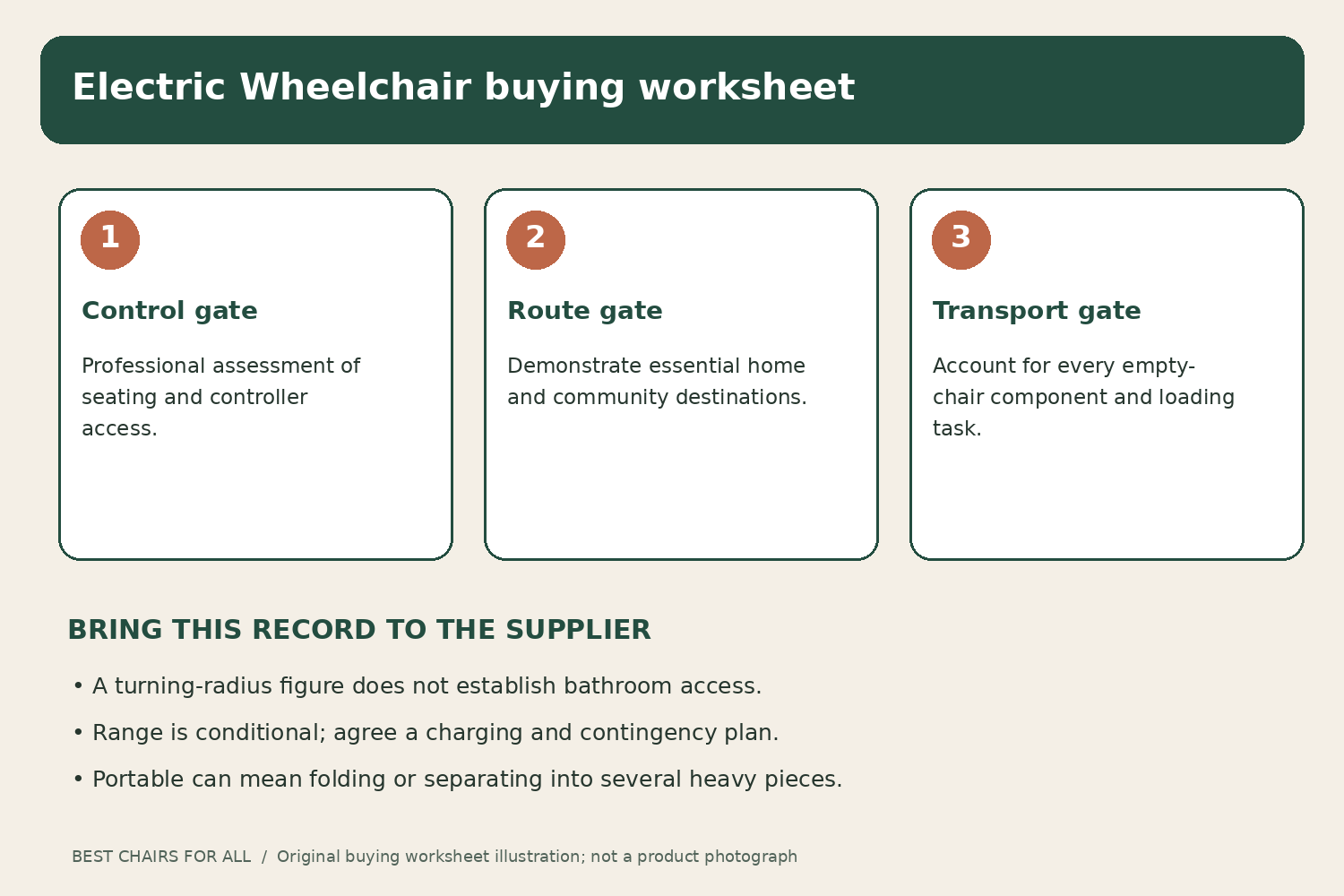
Original artifact: a three-gate demonstration scorecard
Use a page divided into “control,” “route,” and “transport.” The control gate records whether the assessed user can operate the selected controller and ordinary functions reliably during a supervised demonstration. Include the hand used, controller mounting position, and any questions for the clinician. This is not a self-administered clinical test; it is a record of what the professional demonstration needs to establish.
The route gate lists the necessary destinations, not an overall star score. Give each destination one of three results: demonstrated, unresolved, or unsuitable in the proposed configuration. For example, “kitchen entry demonstrated; bathroom approach unresolved; porch route unsuitable as shown” is more informative than “handles well.” One essential unresolved route can outweigh several attractive optional features.
The transport gate records the empty-chair loading plan. List every component, its documented or demonstrated weight, the person who will handle it, and its assigned position in the vehicle. For a folding chair, record the entire folded package and any removed battery separately. For a take-apart chair, make sure “heaviest piece” has not hidden the storage requirements of the remaining pieces.
Only close the scorecard when all essential tasks have a documented answer. If a supplier cannot reproduce a critical route, ask what additional evidence or assessment is needed. Do not substitute a promotional video for a demonstration of the required fit and controls. The scorecard is designed to preserve uncertainty instead of allowing an enthusiastic first impression to erase it.
Battery planning without false precision
Begin with the longest ordinary day and the opportunities to charge using the approved charger in an appropriate location. Ask how the manufacturer defines the published range and what factors shorten it. Occupant load, surfaces, temperature, starts, stops, slopes, and battery condition can make a simple miles-per-charge comparison misleading. An unusually long day should have an agreed contingency rather than depend on reaching the advertised maximum.
A useful dealer conversation starts with your itinerary: “This route includes a return journey and no confirmed charging stop; what would you need to establish an appropriate margin?” The answer should consider the model’s instructions and the actual user and route. We do not prescribe a universal percentage reserve or guarantee a distance. If the route cannot be supported confidently, consider another charging or transport plan.
For air travel, obtain the exact battery identification and watt-hour information, manufacturer travel documents, and the carrier’s current requirements. A product page’s travel claim does not complete the airline process. Confirm arrangements for the actual journey before booking or relying on assistance at the airport. Keep the contact details and written instructions with the travel paperwork.
Seating and controls come before convenience accessories
The user should be assessed for the seating and control system needed to operate the chair. A joystick is not appropriate for everyone, and a basic portable chair may not provide required postural support or powered positioning. If the evaluation calls for those functions, broaden the search to the appropriate prescribed equipment rather than trying to adapt a convenient travel model using unrelated accessories.
Ask whether the intended cushion, back support, arm arrangement, and controller placement are approved for the exact chair. A seating change can alter occupied height and access to tables or switches. Have the supplier record the delivered setup and provide the manual that applies to it. This guide cannot determine clinical suitability from body weight or diagnosis alone.
Service, recalls, and the final quote
A power-chair quote should identify the supplier responsible for setup, fitting, battery support, and repairs. Ask who can diagnose electrical faults, how parts are obtained, and what happens if the chair is unavailable for service. A manufacturer warranty is valuable only when you understand the exclusions, transport arrangements, and contact process. Do not open powered drive assemblies or battery packs to troubleshoot an unexplained fault.
Consult the FDA medical-device recall database for manufacturer and model searches and ask the supplying dealer to check the exact identifying details. Current checks are particularly important for used equipment or replacement components. This article provides no serial-specific recall clearance. Preserve notices, purchase records, and battery documentation so the manufacturer can identify the device if a later action occurs.
Request a written total including the exact chair version, compatible seating, battery, charger, delivery, setup, and any return restrictions. Confirm coverage directly with the relevant payer and provider; product classification and billing codes do not guarantee reimbursement. Ask whether a demonstration unit and the quoted chair use the same configuration before treating their dimensions as equivalent.
Which electric wheelchair should you investigate first?
Start with the Jazzy Carbon if folding transport is central and the assessed seating needs fit its format. Put Model C2 on the demonstration list when its seating choices and base deserve evaluation and a heavier take-apart package is workable. Consider Go Chair when several manageable pieces suit the vehicle better than one folded unit. The best result is a documented match across control, route, and transport, with a service plan that supports daily use.
Document the charging location
Include the proposed charging location in the route record. Ask the supplier to compare its access, ventilation, temperature, electrical supply, and cable placement with the model’s charging instructions. The battery and charger must remain the approved combination; a connector that seems to fit is not evidence of compatibility. Decide who will notice a charging fault and which service contact should be called. This small ownership detail can determine whether the chair is ready for an ordinary morning journey, even when its range specification looks sufficient on paper.
Something unclear or out of date? Send a correction with this article’s title and the detail to check.
Sources, research & corrections policy ↗