As an Amazon Associate, we earn from qualifying purchases. Read our affiliate disclosure. Amazon buttons below search for matching listings; they do not confirm stock, an exact seller, or a current price.
A lightweight wheelchair should make a particular task easier: independent propulsion, empty-chair loading, or storage. Those goals overlap, but they are not the same. For a researched shortlist, consider the QUICKIE Nitrum for an individually configured rigid frame, Motion Composites HELIO A6 for a configurable folding frame, and Karman S-ERGO 115 for a simpler folding package with documented fixed dimensions. The right choice still depends on an individual assessment and a demonstration of the intended tasks.
Our comparison uses manufacturer information checked on November 6, 2026. We have not weighed or tested these chairs. No current retailer price or coverage decision is established here. The purpose is to help you ask better questions about weight definitions and configuration, rather than promise that the lightest headline number produces the best wheelchair for your body.
Choose the weight question before choosing the chair
For someone who self-propels, the occupied chair’s configuration matters throughout the day. For a companion who loads the empty chair, the difficult moment may be lifting a frame over a trunk lip. For someone storing the chair in a small apartment, folded shape can matter more than a few pounds. State which of those problems you need to solve and rank the others afterward.
A useful request to the supplier is: “Please identify the weight of the exact delivered chair, the weight of the part I will lift, and everything removed to reach that second figure.” Get both numbers on the same quote. Otherwise you can mistakenly compare one manufacturer’s bare transport frame with another manufacturer’s functional chair. Labels such as ultralight or travel do not settle that accounting question.
Compare complete-chair and transport weights before deciding which parts a caregiver would actually need to lift.
The removal process matters too. A very light frame is less convenient if the person doing the loading cannot manage the permitted removable parts or has nowhere to put them. The demonstration should include the real storage plan, not just a representative lifting motion in an open showroom. Ask the supplier to explain manufacturer-approved handling points and ordinary removal procedures; leave configuration and stability adjustments to qualified personnel.
Model comparison with the weight definitions retained
| Model | Manufacturer’s stated weight | Why investigate | Important limit |
|---|---|---|---|
| QUICKIE Nitrum | 18.3 pounds product; 10.8 pounds transport | Rigid-frame configuration for an assessed user | Options change the delivered result |
| HELIO A6 | 25.4-pound lightest functional configuration; 15.1-pound transport configuration | Folding frame with detailed published weight conditions | Both figures refer to a specified 16-by-16 setup |
| S-ERGO 115 | 25 pounds without riggings | Folding package with several seat widths | Do not call that the fully assembled lifting weight |
QUICKIE Nitrum: an option when rigid-frame fit leads the decision
The Sunrise Medical Nitrum page lists the open-frame version at 18.3 pounds, with a 10.8-pound transport figure. It offers 12–20-inch seat widths and depths. Nitrum and Nitrum Hybrid are distinct configurations; the manufacturer lists different weights and capacities for them. Confirm which one appears on your quote.
A rigid frame is worth considering when individualized fit and propulsion are the priority and the empty frame can be accommodated in the vehicle. It does not fold across the seat like a conventional cross-brace chair, so a narrow storage slot may favor another layout. Ask for the weight of your selected back, cushion, wheels, arm supports, and accessories together. This is a fitting-led purchase, not a guarantee that every online Nitrum listing weighs the published starting amount.
Check matching QUICKIE Nitrum wheelchair listings on Amazon (paid link)
HELIO A6: a folding option with unusually explicit weight accounting
Motion Composites specifies a HELIO A6 15.1-pound transport configuration that excludes the rear wheels, armrests or sideguards, cushion, anti-tippers, and footrests. Its 25.4-pound lightest functional figure describes a 16-by-16-inch chair with specified components. Available seat widths span 14–22 inches, with depths from 14–20 inches.
That distinction makes the A6 useful for a careful lifting comparison. It does not prove your chair will match either figure: a different size or accessory combination changes the package. Investigate it when you want a configured folding chair and can verify the approved removable-component routine. Its limitation is the work needed to translate a starting specification into a delivered order. Have the supplier list the parts remaining on the frame you will actually place in the car.
Check matching Motion Composites HELIO A6 wheelchair listings on Amazon (paid link)
Karman S-ERGO 115: a simpler candidate when the fixed dimensions work
The Karman S-ERGO 115 sheet states 25 pounds without riggings, a 17-inch seat depth, and 16-, 18-, or 20-inch seat widths. Overall widths increase with seat width, and the listed folded width is 12 inches. Its fixed arm arrangement should be part of the access discussion.
Consider this model when those dimensions fit the assessed requirement and a less elaborate ordering process is useful. It is a poor substitute for a custom configuration if you need dimensions or supports outside the documented choices. The seating-frame design does not establish an individual pressure-management outcome. Compare the complete package, ask about approved cushion compatibility, and confirm whether the arm layout suits the professionally assessed method of getting into and out of the chair.
Check matching Karman S ERGO 115 wheelchair listings on Amazon (paid link)
Original worksheet: the three-weight ledger
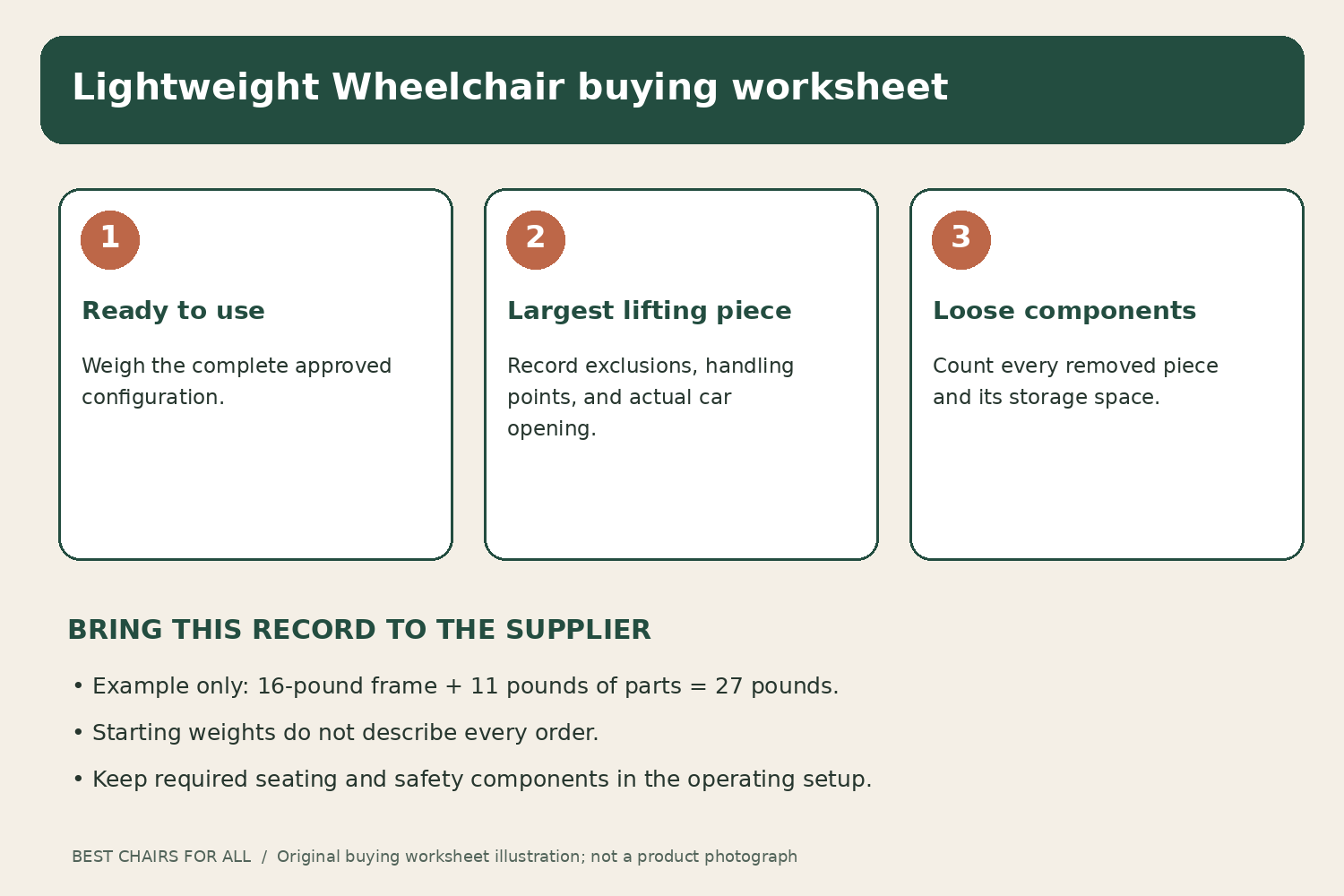
Create three rows named “ready to use,” “largest lifting piece,” and “all loose pieces.” In the first row record the chair with every component needed for ordinary use. In the second, record the manufacturer-approved empty transport configuration that the actual loader will handle. In the third, record wheels, footrests, cushion, and other removed items separately. The last row is about space and organization as well as mass.
For example, imagine a supplier demonstrates an empty transport frame of 16 pounds and removable items totaling 11 pounds. The ready-to-use total is 27 pounds before any additional carried belongings. That is an invented arithmetic example, not a measurement of a reviewed chair. Calling the purchase a “16-pound wheelchair” would omit much of the equipment. Yet the 16-pound figure could still be the most useful one for the person whose limiting task is loading that frame.
Add a fourth column for the handling sequence: where the chair is parked, where loose components go, and whether the vehicle can still carry the other required luggage. Ask the supplier to demonstrate the approved routine without rushing. A lightweight frame that must occupy the rear seat may be unsuitable if that seat is needed by another passenger. Physical volume can veto a purchase even when the mass looks attractive.
Record the date, exact chair configuration, and source of every weight. “Manufacturer starting specification” is different from “dealer weighed the actual configured demonstration chair.” Neither should be labeled an independent test by this site. If the order differs from the demonstrated chair, ask what effect the changes will have before relying on the result.
Folding versus rigid: use your vehicle as the comparison space
A folding chair can become narrower across the seat, which may be valuable for upright storage. A rigid chair with approved removable wheels can leave a relatively open frame that suits a different loading route. Neither description tells you the dimensions of the resulting package. Obtain its length, height, and width in the exact transport state and measure the vehicle opening, not just the interior cargo floor.
Consider the trunk lip and the distance to the final resting place. A package may fit inside the trunk but be awkward to pass through its opening. For the demonstration, show the supplier the vehicle and describe who will load it and how often. Ask for an alternative arrangement if the proposed handling feels impractical. Do not compensate for a poor loading match by attempting unapproved disassembly or using a detachable part as a lifting handle.
Also account for wet or dirty wheels. The frame may fit neatly while loose wheels consume the space needed for groceries or other mobility equipment. A written storage sketch is surprisingly useful: draw the frame, wheel positions, cushion, and bags. If the plan requires stacking heavy objects on the chair or trapping components under luggage, revise it with the supplier.
Do not trade away essential seating for a lower number
A cushion, back support, arm support, or anti-tip component should not be removed from the user’s prescribed operating setup merely to match a brochure figure. The appropriate question is whether a different approved configuration can meet the requirement while reducing handling burden. The answer may be another frame, another transport arrangement, or a different mobility category, rather than subtracting necessary equipment.
A seating professional should evaluate propulsion position and support needs. If the user reports discomfort, skin concerns, shoulder symptoms, or instability, document those concerns during assessment. This article does not prescribe axle location, seat slope, cushion type, or exercise. Those decisions depend on the individual and the chair. A low mass alone cannot prove that a chair will be efficient or comfortable for that person.
Delivery, recall checks, and ownership cost
Before buying new or used equipment, consult the FDA device-recall search and ask the manufacturer or authorized supplier to check identifying details. Search by manufacturer and model rather than relying on a retailer’s statement. Record any applicable action and verify whether the individual chair is affected. We have not established a serial-specific recall clearance for any chair in this guide.
Ask which components can be replaced, who carries parts locally, and whether the supplier services the model. A configured chair’s return rules can differ from a stock item’s rules. Obtain the itemized chair and seating quotation, fitting arrangements, delivery charge, cancellation conditions, and repair contact before ordering. Do not treat a listed reimbursement code as confirmation of your benefits.
The shortlist decision
Start with Nitrum when a rigid individually configured chair is the assessed direction and your vehicle accepts its transport form. Investigate HELIO A6 when folding storage and configuration both matter, with its weight ledger fully specified. Consider S-ERGO 115 when its documented dimensions suit the user and a simpler folding option is appropriate. Whichever route you choose, retain the three-weight ledger. It makes the reason for choosing a lightweight wheelchair concrete and reviewable.
When a second chair is being considered
If this purchase will supplement an existing wheelchair, write down which trips the second chair must cover and which seating requirements must carry over. A lighter backup still needs appropriate fit and support; it should not be treated as exempt because it will be used less often. Ask the assessment team whether changing between chairs introduces any practical concerns for the user. Then compare the second chair’s transport ledger with the current one. The benefit should be specific, such as a different empty loading package or storage footprint, rather than a vague promise that all lightweight chairs feel easier to use.
Something unclear or out of date? Send a correction with this article’s title and the detail to check.
Sources, research & corrections policy ↗