As an Amazon Associate, we earn from qualifying purchases. Read our affiliate disclosure. Amazon buttons open searches for matching listings; they do not confirm seller, configuration, price or stock.
A $300 shortlist with four genuinely different tradeoffs
The best office chair under $300 depends on what the extra money needs to buy. SIHOO M57 is worth comparing for a mesh seat and adjustable lumbar support. SIHOO Doro C300 Standard offers a different, self-adaptive back-support approach. Branch Multitask Chair focuses on simple everyday controls and adjustable arms, while Branch Daily Chair suits a lighter user who prioritizes a less imposing home-office design.
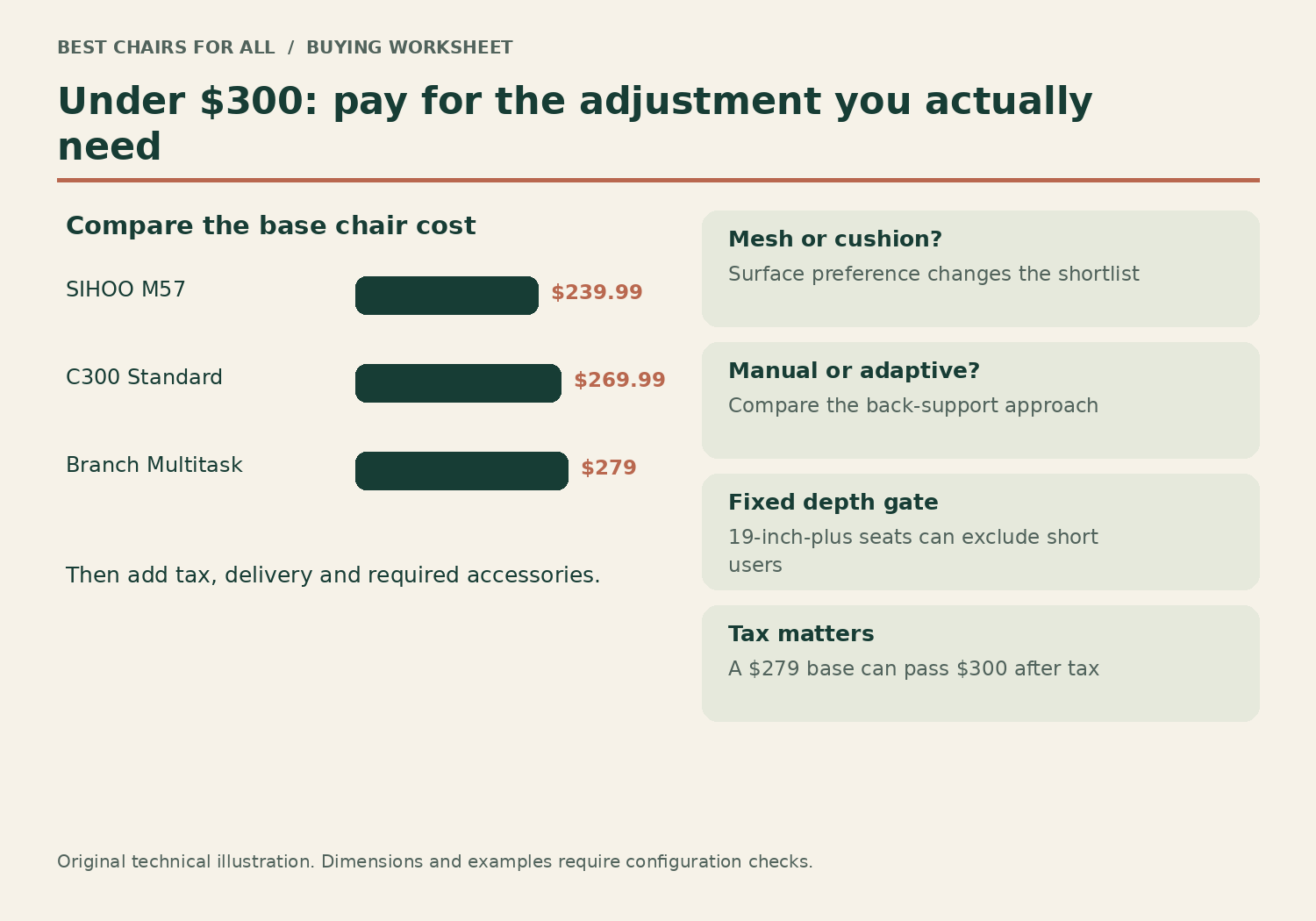
These are research-based selections using official US product pages checked on November 6, 2026. The displayed base prices were $239.99 for black M57, $269.99 for black Doro C300 Standard, $279 for Multitask and $259 starting price for Daily. These qualify as chair-only prices below $300, before tax, delivery or added headrests. They do not establish any Amazon price or guarantee that a configured cart stays below $300. We have not sat in or laboratory-tested these chairs.
| Model | Verified displayed base price | Reason to compare |
|---|---|---|
| SIHOO M57, black | $239.99 | Mesh seat with manually adjustable lumbar |
| SIHOO Doro C300, Standard black | $269.99 | Adaptive lumbar and different recline design |
| Branch Multitask, base | $279 | Simple controls and three-way arms |
| Branch Daily, starting configuration | $259 | Residential appearance and removable arms |
The product shortlist
Do not compare these solely by their number of adjustments. A manually adjustable support and a self-adaptive one solve fitting differently; neither automatically wins. The two Branch models have fixed listed seat depths, which can be a decisive limitation even when their base prices are attractive. Choose a candidate only after checking your own measurements.
Model specifications and ordering details were checked against SIHOO M57 official US store, SIHOO Doro C300 Standard official US store, Branch Multitask Chair US specifications, Branch Daily Chair US specifications. These manufacturer documents support the configuration notes in this comparison; retrieved November 6, 2026.
1. SIHOO M57
Best for: mesh seating with manual lumbar adjustment.
The M57 official US page displayed $239.99 for black. It has mesh across both seat and back, three-way adjustable arms, a height- and angle-adjustable headrest, and lumbar support adjustable vertically and horizontally. Its stated capacity is 330 pounds.
This is the candidate to compare when moving away from a warm foam seat is the main objective. Mesh does not guarantee a comfortable seat edge, and the retrieved US page did not establish a useful sliding-seat range. Obtain the actual dimensions when thigh length or minimum height is a deciding issue.
Product Details
| Brand | SIHOO |
|---|---|
| Seat construction | Mesh seat and back |
| Arms | 3D adjustable |
| Headrest | Height and angle adjustable |
| Capacity | 330 lb |
Pros
- Verified base price leaves some budget room
- Manual lumbar positioning
Cons
- Do not assume seat-depth adjustment
- Mesh frame feel requires a trial
Choose it for its specific surface and control approach, subject to the final cart and fit.
2. SIHOO Doro C300 Standard
Best for: trying adaptive lumbar support under the ceiling.
Doro C300 Standard displayed $269.99 for black at the official US store. Its self-adaptive lumbar and weight-sensing recline distinguish it from M57. The official page also specifies four-way arms, a multi-adjustable headrest and a 330-pound capacity.
Select the Standard version deliberately: the page also offers a Footrest version, and C300 Pro and other similarly named chairs are different products. A more elaborate support system is useful only if it stays comfortable through your own tasks. A rigid $300 after-tax limit can leave very little margin at this base price.
Product Details
| Brand | SIHOO |
|---|---|
| Support | Self-adaptive lumbar |
| Arms | 4D adjustable |
| Recline | Weight-sensing mechanism |
| Capacity | 330 lb |
Pros
- Adaptive-support alternative
- Four-way arm adjustment
Cons
- Version names are easy to confuse
- Small budget margin after tax
Shortlist the exact Standard build and try it without assuming automatic support will suit every user.
3. Branch Multitask Chair
Best for: a simple task-chair setup for users who fit its deeper seat.
Multitask displayed $279. Its published 18–21.6-inch seat height and 19.4-inch fixed depth are central purchase facts. The three-way arms and weight-activated tilt offer a practical everyday layout without a large collection of controls to tune.
The 275-pound capacity and fixed dimensions are limits, not evidence that it fits everyone in a broad height range. A short-legged user can find it both too high and too deep. If the dimensions work, a breathable mesh back, cushioned seat and straightforward mechanism make this a sensible comparison for a shared desk.
Product Details
| Brand | Branch |
|---|---|
| Seat height | 18–21.6 inches |
| Seat depth | 19.4 inches, fixed |
| Capacity | 275 lb |
| Arms | 3D adjustable |
Pros
- Simple weight-activated tilt
- Three-way adjustable arms
Cons
- Fixed relatively deep seat
- Base price may exceed $300 after tax
Choose it for simplicity after clearing the dimensions, not as a universal ergonomic upgrade.
4. Branch Daily Chair
Best for: a lighter user prioritizing home-office appearance.
Daily starts at $259 on Branch's US comparison and product information. It has a 17–21-inch height range, a 19-inch fixed seat depth and removable height-adjustable arms. Its 225-pound capacity is lower than the other chairs here and must be respected.
This is the residential-design option rather than the most adjustable recommendation. Check the exact material price; a starting price does not cover every upholstery choice. If you require sliding depth, lumbar-depth adjustment or a higher capacity, eliminate it instead of trying to solve those requirements with accessories.
Product Details
| Brand | Branch |
|---|---|
| Seat height | 17–21 inches |
| Seat depth | 19 inches, fixed |
| Capacity | 225 lb |
| Arms | Height adjustable; removable |
Pros
- Removable arms
- Lower minimum height than Multitask
Cons
- 225-pound capacity
- Fixed depth and light rather than extensively adjustable lumbar
Consider it when its size and lighter-duty personal fit align with your room and budget.
What your extra $100 should buy
Moving from a $200 limit to $300 is useful only if it solves a particular problem. If a foam seat is the issue, M57 introduces a mesh sitting surface. If arms need to move back and rotate, compare the actual arm travel rather than assuming every product with adjustable arms offers the same directions. If lower-back pressure needs deliberate positioning, manual height and depth control may be easier to evaluate than an automatic system.
Some readers need a seat slider more than any of those features. Neither a $279 price nor a long warranty can make a 19.4-inch fixed seat shorter. If your current chair is too deep, prioritize a verified shorter seat or sliding-seat model, potentially including a carefully inspected used commercial chair. Do not spend the entire increased budget on a model that preserves the old mismatch.
For a shared room, the upgrade might instead be practical support and fewer controls to reset. Multitask’s weight-activated tilt is designed to reduce manual tension adjustment, but people can still prefer different recline feel. A shared-chair trial must include both users and their normal tasks; a manufacturer’s broad recommended height range is only a starting screen.
The fit-and-feature decision grid
Make a four-row grid before opening any retailer search. The rows are minimum seat height, useful seat depth, arm position and back-support preference. For each candidate, mark confirmed fit, unresolved or fail. Eliminate a fail before counting optional features. An unresolved measurement that determines whether you can reach the backrest should stay unresolved until the manufacturer or a physical trial supplies an answer.
For example, a buyer with a comfortable 17-inch seat height and a relatively short thigh length should treat Multitask’s 18-inch minimum and 19.4-inch fixed depth cautiously. A stable footrest could support the feet, but it would not shorten the seat. Daily starts lower at 17 inches, yet still has a 19-inch fixed depth and a lower 225-pound capacity. A different fit problem remains after the height improves.
A buyer who already uses a 19-inch-deep seat comfortably could reach the opposite conclusion. If their main complaint is an awkward arm pad and complicated controls, Multitask’s simple design may be a reasonable upgrade. The same dimensions that exclude one reader can suit another. This is why a clear fit screen is more informative than a universal numeric ranking.
| Check | Write this down | Do not substitute |
|---|---|---|
| Height | Your supported working seat height | Overall chair height |
| Depth | Back contact with clearance behind knees | External front-to-back footprint |
| Arms | Pad position at relaxed elbows | Only armrest height from floor |
| Back | Preferred contact location and adjustment type | A generic ergonomic badge |
A worked $300 purchase comparison
Suppose the chair must cost less than $300 including a hypothetical eight-percent sales tax and no delivery charge. M57 at $239.99 becomes approximately $259.19, leaving $40.81. Doro C300 at $269.99 becomes about $291.59, leaving only $8.41. Multitask at $279 becomes $301.32, so it fails that particular all-in ceiling even before accessories.
Daily at a $259 base becomes $279.72 under the same example assumptions. That may leave room for a small necessary item, but an upgraded material or delivery charge could change the answer. The example is a budgeting exercise rather than a statement of your applicable rate. Use checkout for your address and exact selected material, and do not assume a displayed starting price covers every swatch.
This arithmetic helps identify when the cheaper chair is the more complete purchase. If you need a footrest to reach a high keyboard surface, include it from the beginning. If a headrest is optional, keep it optional until the basic fit works. A bundle discount is not useful if the bundle adds things you did not need or removes a workable return option.
Manual versus adaptive support at this price
M57 provides lumbar support that moves vertically and horizontally according to its official page. That gives you controls to change where contact occurs and how prominent it feels. Doro C300 describes self-adaptive lumbar support and a weight-sensing recline mechanism. Its appeal is a different interaction with movement, not a proven superiority for every back or work style.
To compare them, sit fully back with a suitable seat height and perform the same short ordinary task. Observe whether the support stays comfortable when reaching the mouse, leaning back to read and returning to the keys. Do not try to force your back into the support because a product description calls it ergonomic. If a contact point remains intrusive through normal use, another design may be a better purchase.
The OSHA chair selection guidance emphasizes an adjustable setup and trying different chairs. It does not endorse a specific automatic mechanism. A well-positioned fixed contour can suit a particular person, while a more adjustable mechanism can still miss the desired position. Treat support type as a fit variable that needs a trial.
Returns, assembly and replacement parts
At this budget a difficult return can erase the apparent bargain. Save the seller-specific policy before ordering, including whether return shipping is covered, whether custom colors are excluded and when the window starts. A manufacturer website offer may differ from the terms attached to an Amazon marketplace search result. Match the actual seller and configuration, not just the product name.
Assemble according to the included instructions and retain the label, hardware list and carton. Photograph any damaged parts before continuing. Do not attempt to remove or modify a gas cylinder to make a wrong chair fit. Ask the seller about replacement arms, casters and seat components if those are relevant to keeping the chair useful, and distinguish a parts warranty from a free return period.
Use the first normal workdays to assess the specific upgrade you wanted. Choose M57 for manually tunable mesh seating, C300 Standard for an adaptive-support comparison, Multitask when its fixed dimensions fit and simpler controls appeal, or Daily for its lighter-capacity home-office role. The best value is the chair that passes your fit screen and complete budget, with a practical way to return it if the trial fails.
Something unclear or out of date? Send a correction with this article’s title and the detail to check.
Sources, research & corrections policy ↗