As an Amazon Associate I earn from qualifying purchases. If you buy through our links, we may earn a commission at no additional cost to you. How our links work.
The best office chair for a tall person is the one whose seat, backrest and arms line up with that person’s proportions. A tall backrest alone does not solve a short seat or a low cylinder. Start with three candidates: the Steelcase Gesture for adjustable arm positioning, the Haworth Fern for a taller flexible back, and the Herman Miller Aeron Size C for people who want a larger fixed-depth mesh seat.
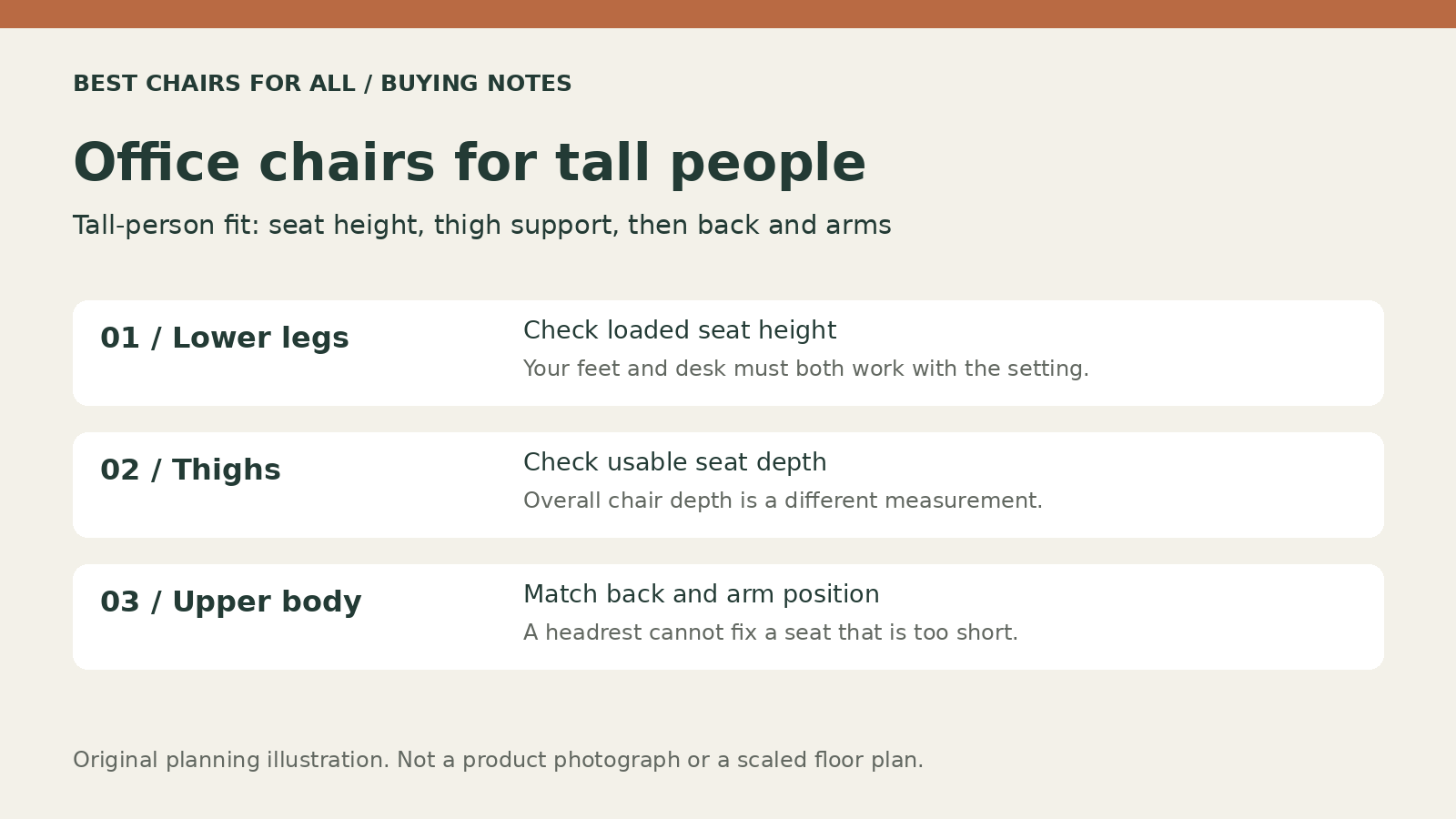
This is a research-based shortlist, not a report of hands-on testing. We checked manufacturer documents and explain the compromises those specifications imply. We have not measured these chairs under load, assessed their cushions over months, or verified comfort for every body type. Prices, options and seller terms change; compare the exact configuration before ordering.
The shortlist: three different fit priorities
| Chair | Why shortlist it | What can rule it out |
|---|---|---|
| Steelcase Gesture | Adjustable arms and seat for a workstation with several input positions | The standard height range may still be too low for your lower legs |
| Haworth Fern | Flexible back and adjustable seat depth | Its maximum seat depth may leave long thighs insufficiently supported |
| Herman Miller Aeron Size C | A larger mesh seating size | Fixed seat depth and a defined seat perimeter require an especially careful fit check |
These are starting points for a fitting appointment, rather than a universal first-to-third ranking. Someone with a long torso and average-length thighs can prefer a different chair from a person of identical standing height with longer legs. Weight capacity is a separate filter: being tall does not automatically mean needing a bariatric chair, and a high capacity does not establish good seat dimensions.
Steelcase Gesture: shortlist it when the arms are the hard part
Steelcase’s Gesture specifications list a seat-height range of 16 to 21 inches and describe adjustments for seat depth and arm positioning. That makes it worth investigating when your present chair’s arms prevent you from working close to the desk.
Our reason for shortlisting Gesture is the relationship between arm adjustment and a tall user’s workspace. First set the chair to support your legs, then see whether the arms can meet your relaxed elbows without your shoulders lifting. If a keyboard tray, mouse platform or deep desktop requires different forearm positions, assess every position you actually use. A chair that fits only while you demonstrate an upright pose in a showroom has not passed that task.
The deciding limitation is height. A published maximum of 21 inches is not proof that it suits everyone above six feet. Compare it with the height you already need, allowing for cushion compression and the shoes you wear while working. If you need more range, ask the dealer about approved configurations; do not assume a taller replacement gas lift is compatible.
Choose it if: arm positioning is your main unresolved problem and a fitting confirms sufficient seat height and thigh support. Pass if: the chair is already at its height or depth limit during the fitting. Buying an expensive chair with no adjustment left in the direction you need is an avoidable gamble.
After checking the published ranges, use the tall-user chair setup guide to compare thigh support, backrest position, and desk clearance in the same seated posture.
Haworth Fern: shortlist it for back movement, then check the seat
The US Haworth Fern product page lists seat height of 16.5–21.5 inches, seat depth of 15.5–18.5 inches, and overall height without a headrest of 41.5–47 inches. Its flexible back construction is a different approach from a rigid perimeter. Options include additional lumbar adjustment and a headrest.
For a tall buyer, the important question is whether the back feels appropriately positioned while the seat still supports the legs. Do not select Fern merely because it looks tall in photographs. Sit with your pelvis against the back and move the seat forward only until the front edge leaves comfortable knee clearance. Then recline and return to typing. If you immediately slide forward to escape the lumbar area, the apparent back height has not solved the fit.
There is a useful stopping rule here: if the seat is fully extended and you still want appreciably more thigh support, remove it from the shortlist. A headrest does not extend the seat. Equally, do not buy the headrest to fix a backrest mismatch before trying its height and angle in your usual recline position.
Choose it if: the adjustable seat range fits and you prefer the feel of a flexible back during a trial. Pass if: the seat must be pushed beyond its intended range or the optional support meets the wrong part of your back. Verify the selected configuration’s load rating and return terms, especially when adding forward tilt.
Aeron Size C: shortlist it when a larger fixed seat fits your legs
Herman Miller’s Aeron specifications distinguish three sizes. Size C is the larger option. The Aeron product sheet lists a Size C seat depth of 18.9 inches and notes cylinder-dependent seat-height ranges. Confirm current values for the version being sold; older and current listings can differ.
A fixed-depth seat has a straightforward benefit and cost: once it fits, you do not need a sliding seat adjustment, but you cannot make an unsuitable depth fit by moving the pan. This is especially relevant when ordering used. A seller’s statement that a chair is “large” does not establish its size, generation or cylinder.
During a fitting, keep your back supported and check the front edge while both feet rest securely. Then shift slightly left and right as you would when reaching for a notebook. Pay attention to where the seat perimeter meets your thighs. An upright position that works for five minutes is only one of the positions you will use in a workday.
Choose it if: Size C’s seat depth and perimeter fit your body and you specifically want mesh seating. Pass if: the depth is wrong or the perimeter restricts your normal movement. Do not move up a size solely because you are tall; verify the complete fit and the current manufacturer’s size guidance.
Measure your present setup before comparing more chairs
You can narrow the field without pretending that a tape measure predicts comfort perfectly. Use an existing chair as a reference, even if you dislike it. Record its loaded seat height, usable depth and the problem you are trying to correct. “I want a bigger chair” is vague; “my knees sit much higher than my hips at maximum seat height” gives a dealer something concrete to address.
For height, measure from the floor to the supporting surface while seated, rather than to the top of an empty cushion. For depth, measure the distance you actually occupy with your back supported. Overall chair depth is a different dimension and can include the back, mechanism and projecting base. Confusing these measurements can turn an apparently deep chair into a disappointing purchase.
Record elbow height too. Place your hands where the keyboard normally sits and let your shoulders settle. If the desk forces your shoulders upward, buying more chair adjustments will not necessarily fix the workstation. The right purchase can be an adjustable desk or keyboard position rather than a fourth chair.
OSHA’s chair guidance emphasizes supported feet, appropriate seat depth and a backrest that supports the user. It explains that an overly short seat can inadequately support a taller person’s legs. Use those fit principles as a check on the product label, not as a promise that a chair prevents pain.
A fitting sequence that exposes the wrong chair quickly
- Set height with your usual footwear and both feet supported.
- Set usable depth while keeping your pelvis against the backrest.
- Position lumbar support, where adjustable, without changing the first two settings.
- Bring the arms to your relaxed elbows and approach the actual desk height.
- Type, mouse, reach, recline and stand up rather than remaining still.
- Write down which control reached its limit and what still felt wrong.
Take a simple task to a showroom: type a paragraph, use a mouse and read a page while leaning back. A salesperson can demonstrate the mechanism, but only you can tell whether the chair obstructs those movements. Ask permission to spend enough time to notice pressure developing; a brief sit often tells you only whether the cushion initially feels soft.
At home, preserve the packaging until the chair has passed the trial. Read whether returns require disassembly, whether freight is deducted and whether custom upholstery changes eligibility. These are purchase conditions to verify with the seller, not assumptions to make from the manufacturer’s general warranty page.
Common shortcuts that lead tall buyers astray
Choosing from standing height alone. Two people at six feet four can need different seat depths. Use height recommendations as a broad filter, then check your lower-leg length, thigh support and back alignment. A spreadsheet with real measurements is more useful than a generic “tall approved” badge.
Substituting a headrest for a fitting. A headrest only helps if it meets the head in the position you use. If it pushes your head forward during typing, an apparently generous height adjustment has introduced a new compromise. Compare the chair without that option before deciding it is essential.
Buying an oversized seat to gain height. Extra width can move the arms away from your elbows, while extra depth can prevent contact with the back. Look for the dimension you lack rather than increasing every dimension together. Tall and narrow builds particularly benefit from separating these decisions.
Which should you buy?
Start with Gesture when you need to solve forearm positioning, Fern when you want to evaluate a flexible high back, and Aeron Size C when a larger fixed-depth mesh seat is the specific attraction. Bring your current chair measurements and reject a candidate if the necessary adjustment is already at its limit.
If none fits, ask an office-seating specialist about approved taller cylinders, deeper-seat models or a different workstation arrangement. There is no prize for choosing the most famous model. The useful result is a chair that supports your legs and back while letting you reach your work without rearranging your body around the furniture.
Compare matching retailer listings
The links below search by model name. They do not certify a particular seller or configuration. Match the product specifications above before buying.
- Compare Steelcase Gesture listings on Amazon (paid link) — verify model, configuration, seller and return eligibility.
- Compare Haworth Fern listings on Amazon (paid link) — verify model, configuration, seller and return eligibility.
- Compare Herman Miller Aeron Size C listings on Amazon (paid link) — verify model, configuration, seller and return eligibility.
Something unclear or out of date? Send a correction with this article’s title and the detail to check.
Sources, research & corrections policy ↗