As an Amazon Associate I earn from qualifying purchases. If you buy through our links, we may earn a commission at no additional cost to you. How our links work.
The best office chair for a small space must fit two places: your body while working and the room when you push it away. Those requirements are different. A narrow seat can still sit above a wide five-star base, and an armless chair can still project far into a walkway. Our research shortlist is the Herman Miller Sayl, Steelcase Series 1 and armless IKEA FLINTAN, each for a different kind of constraint.
This guide uses manufacturer specifications and editorial layout analysis. We have not tested these chairs in person or measured their rolling clearance. The recommendations identify candidates to investigate, rather than claiming one fits every apartment. Dimensions can vary with options; verify the exact model and use a taped outline before ordering.
Choose the chair for your actual bottleneck
| Candidate | Most useful reason to investigate | Tradeoff to check |
|---|---|---|
| Herman Miller Sayl | A relatively compact listed width with adjustable-depth configurations | Seat-depth and arm options vary; not every listing has the same adjustments |
| Steelcase Series 1 | Task-chair adjustment without a large executive-chair profile | Arm position changes overall width; measure the ordered setup |
| IKEA FLINTAN, armless | No arms to strike a low desk apron | A 28-inch listed footprint is not especially narrow |
Before choosing among them, describe the obstacle in a sentence. “My chair arms stop at the drawer” calls for different changes from “the base blocks the doorway.” If your knees cannot approach the desk, a narrower backrest will not help. If the room doubles as a dining area, the amount of chair left visible after parking can matter as much as its upright width.
Herman Miller Sayl: a candidate for a narrower task-chair setup
The Herman Miller Sayl store listing gives an overall width of 24.5 inches and seat width of 18 inches. It distinguishes fixed and adjustable seat-depth options; the adjustable range shown is 16–18 inches. Check the selected options rather than assuming every Sayl has that range.
Our reason for shortlisting it is straightforward: compare its listed width with the gap available beside your desk, then confirm the arms and base stay within the space you have marked. A chair that saves an inch or two at the relevant obstruction can make a practical difference, but only if the obstruction really is width. The number does not describe the clearance needed to roll backward or recline.
Start the fitting with the seat, then check the desk. If you select fixed arms, make sure their parked height works with the desk apron at your working seat height. Adjustable arms can offer more flexibility, but they still need somewhere to go. Do not repeatedly lower the whole chair just to store it unless readjusting it is a routine you are willing to maintain.
Choose it if: the listed width suits your layout and the chosen configuration fits your body. Pass if: the fixed-depth configuration is too short or deep, or the arms still collide with the furniture. The smallest order total is not a saving if you omit the adjustment you need to make the chair usable.
Steelcase Series 1: compare the arm position, not just the minimum width
The Steelcase Series 1 dimension sheet lists overall width of 23.5–27 inches and standard chair seat height of 16.5–21.5 inches. It also identifies adjustable functional seat depth. The width range is the key small-room detail: a minimum figure is not the width of every working configuration.
Series 1 is worth considering when you want a conventional adjustable task chair and need to compare a bounded width range against a tight location. During a trial, put the arms where your elbows actually need them. Measure that setup, rather than sliding them inward only to obtain the smallest possible number. The chair should fit the room while you use it.
A second check is how far the chair must retreat before you can stand. A small base is of little benefit if the desk shape traps your thighs and you need a long backward roll. Try the sequence with a similar chair: move back, rotate, plant your feet and stand. Tape the furthest wheel position, then check what remains of the walkway.
Choose it if: your working arm setting stays within the available width and the seat adjusts to your dimensions. Pass if: fitting it requires squeezing your elbows inward or removing a useful adjustment. Its less imposing outline is a visual benefit; it is not evidence that it occupies no working space.
IKEA FLINTAN without arms: useful for an apron problem, not a narrow aisle
IKEA’s US FLINTAN listing specifies a 28-inch overall width and depth. It is sold without arms on this listing, with arms available separately. Listed seat dimensions are 18⅛ inches wide and 19¼ inches deep; the seat-height range is 17¾–22⅞ inches.
FLINTAN earns a place here because “small space” often means a chair must tuck beneath a shallow desktop. Removing the arm collision can solve that particular parking problem without needing a folding chair. However, the base remains a substantial object. In a genuinely narrow aisle, its 28-inch footprint can rule it out immediately.
Consider the seat dimensions just as critically. A relatively deep fixed seat is not automatically suitable for a shorter person, even in an armless configuration. If you must perch forward to reach the keyboard, a chair that stores neatly has failed its working role. Try the chair at IKEA where possible and bring the height of your desk’s lowest obstruction.
Choose it if: arm clearance is your main issue, the footprint fits, and the fixed seat suits you. Pass if: you need a substantially narrower rolling base or a shorter adjustable seat. This is a specific alternative for one layout problem, not our automatic recommendation for the smallest room.
The three outlines you should tape on the floor
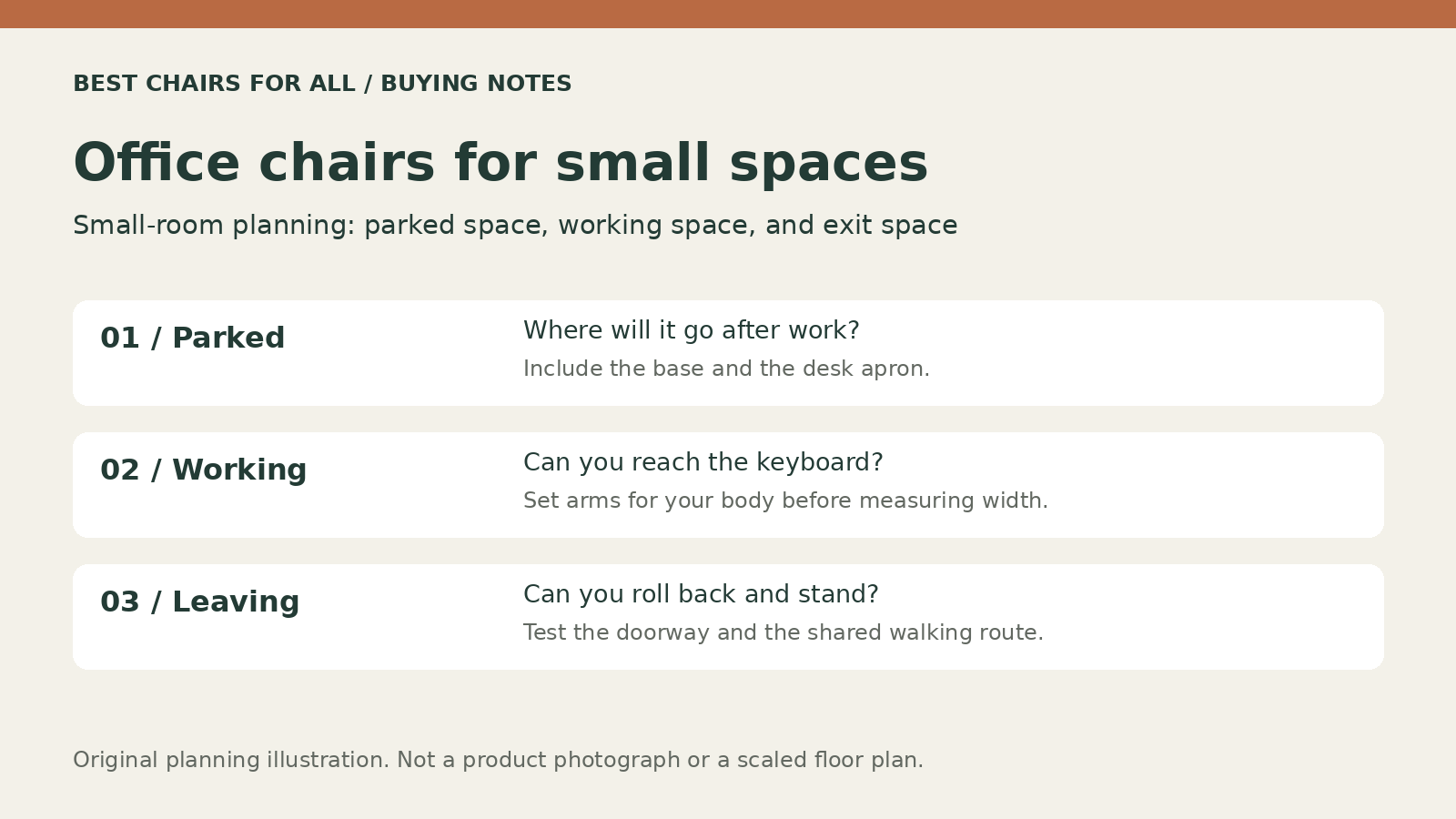
First mark the parked outline: where the chair sits when you are finished. Include the base, not just the cushion. Put a strip of tape where the chair’s back is likely to stop at the desk. Check whether a door can still open and whether the chair obstructs drawers or storage you use every day.
Next mark the working outline. Sit at the desk with a chair you already own, bring the keyboard and mouse into position, and note where your body and chair actually settle. This is a planning exercise, not a standardized furniture-clearance test. Its purpose is to reveal whether you have been comparing product dimensions with an unrealistically tight rectangle.
Finally mark the exit outline: the space you occupy while rolling back and standing. If another person uses the path behind the chair, test the arrangement together. Do not assume that a gap sufficient for you to squeeze past a parked chair is sufficient while someone is sitting there.
Write all three measurements on your shopping notes. A chair can pass one and fail another. For example, an armless chair may park deeply beneath a desk but still need a broad sideways swing to leave the workstation. That is a better reason to change the desk position than to keep searching for a chair with an impossibly small seat.
Check the underside of the desk before you remove the arms
Measure from the floor to the lowest obstruction: a drawer, support bar or apron, rather than the desktop surface. Then measure the chair arm at the seat height you use. A decorative apron can make a seemingly generous desk opening unusable for chair arms even when there is plenty of width.
Removing arms is not always the best first step. If it leaves you resting your forearms on a hard edge or reaching forward, you have traded a storage problem for a working problem. OSHA’s chair guidance recommends arm positioning that lets the shoulders relax and elbows remain close to the body. Keep that aim when assessing an armless setup.
Also check where the feet go. A computer tower, storage basket or crossbar under the desk reduces usable space. OSHA’s desk guidance discusses clearance and the effects of working too far from computer components. Clear the obstruction before concluding that the chair itself is too large.
What to prioritize when the room has several uses
In a bedroom office, check the route between bed and door with the chair occupied. In a living-room nook, decide whether you are willing to move the chair whenever you open a cabinet. In a shared room, confirm that everyone can restore a workable seat setting; a chair that only one person knows how to adjust creates recurring friction.
Appearance matters, but distinguish visual openness from physical clearance. A perforated or mesh back lets more of the room remain visible. That can reduce the visual bulk without reducing the base diameter. Use images to choose the look and dimensions to test the layout; neither should stand in for the other.
A folding dining chair can be convenient for occasional paperwork, but replacing a daily task chair with one changes the support and adjustments available. If daily work is the priority, first reconsider desk depth, storage position and furniture placement. The chair need not carry every space-saving compromise by itself.
A purchase checklist that catches expensive mistakes
- Confirm whether the listed width includes the base and selected arm configuration.
- Match the exact seat-depth option to your body.
- Check arm height against the lowest desk obstruction.
- Test parked, working and exit positions with tape.
- Verify casters are suitable for the floor.
- Read return packaging, collection and customization conditions before ordering.
Ask a seller a precise question if the listing is ambiguous: “What is the maximum width of this configuration with arms in their normal adjustment range?” is more useful than “Is it compact?” Request a dimension drawing when available. Do not treat a photograph beside an unusually large desk as evidence of scale.
Keep the shortlist small. Sayl is a reasonable first fitting for the narrower-chair problem; Series 1 deserves a comparison when adjustable task seating is the priority; armless FLINTAN is relevant when desk-arm interference is the obstacle. The final choice should pass both the body-fit check and your three room outlines. If it cannot, change the layout before sacrificing the fit you need for daily work.
Compare matching retailer listings
The links below search by model name. They do not certify a particular seller or configuration. Match the product specifications above before buying.
- Compare Herman Miller Sayl listings on Amazon (paid link) — verify model, configuration, seller and return eligibility.
- Compare Steelcase Series 1 listings on Amazon (paid link) — verify model, configuration, seller and return eligibility.
Something unclear or out of date? Send a correction with this article’s title and the detail to check.
Sources, research & corrections policy ↗