An ANSI/BIFMA claim is useful when you can connect it to the exact chair, the relevant standard, and evidence covering the chair’s configuration. A badge beside a product photograph is only the beginning of that check. It does not tell you whether the claim refers to the whole chair, a component, a different version, or an unrelated environmental program.
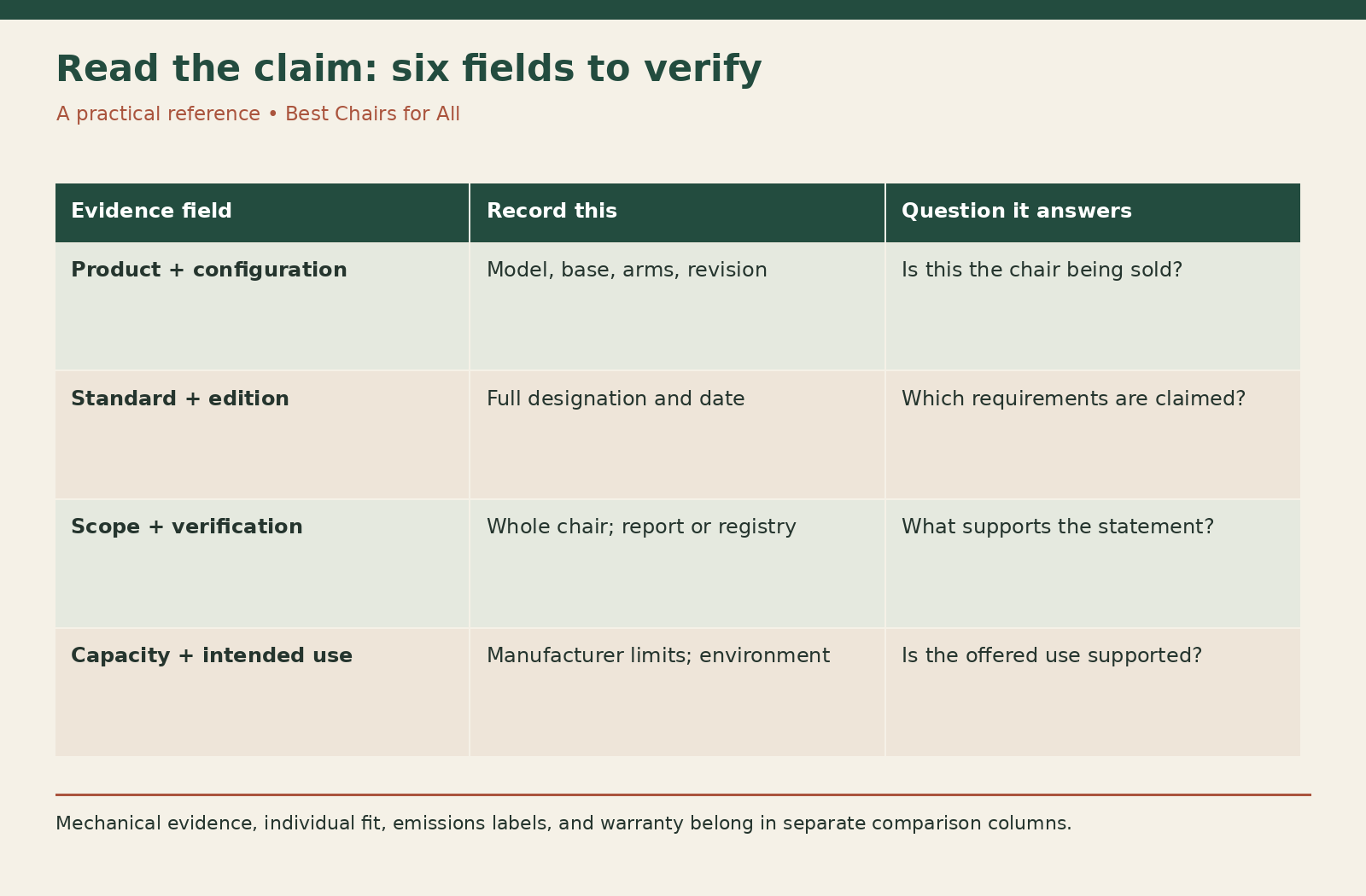
For office chairs, the familiar standards primarily concern mechanical performance, including matters such as strength, stability, and durability under defined tests. They do not personally fit the chair to you. This guide explains the vocabulary and provides a practical evidence-request worksheet you can use before approving a purchase.
Understand the names before reading the badge
ANSI is the American National Standards Institute. BIFMA is the Business and Institutional Furniture Manufacturers Association, which develops furniture standards. An ANSI/BIFMA designation identifies a particular consensus standard; it is not a model name or a promise that every chair with that phrase has been independently certified in the same way.
Start with BIFMA’s descriptions of its standards. They distinguish general-purpose office chairs from large-occupant office chairs, public seating, emissions standards, and other furniture categories. Those distinctions matter because a product can have a valid claim that answers a different purchasing question from the one you intended to ask.
Do not infer the precise test procedures or pass criteria from a short summary. The actual standard and supporting report contain the detail. A consumer can request a useful compliance statement without purchasing every technical standard, but a specification writer or laboratory may need the full document to resolve scope and test questions.
Match the standard to the chair category
X5.1 concerns general-purpose office chairs. X5.11 addresses general-purpose large-occupant office chairs. Other designations cover other seating categories and furniture. Check the current official descriptions and record the edition supplied by the seller. Standards can be revised or reaffirmed, so the suffix and date are part of the claim.
A stool, unusual motion seat, or chair configured for a specialized task may raise scope questions. Ask the manufacturer which standard applies to the delivered configuration and why. Do not force a product into a familiar category simply because a marketplace listing calls everything an ergonomic office chair.
Also read the manufacturer’s stated user capacity and intended use separately. Test loads and cycles are not a consumer instruction to exceed a published capacity. A large number shown beside a component photograph may refer to a component test rather than the complete chair. Request a whole-chair capacity statement for the exact configuration you are considering.
Distinguish a standard from a verification program
A standard describes requirements and test methods. A compliance claim says the product meets requirements. A registry or certification program provides a defined way to substantiate and communicate particular claims. These are related ideas, but the words do not substitute for one another.
The BIFMA Compliant program is a registry of standards-conforming furniture with program requirements for participating manufacturers. Its page identifies covered mechanical standards and explains the program structure. A seller’s generic statement that its chair was tested to BIFMA should not automatically be treated as a registry listing.
Conversely, absence from a particular registry does not by itself prove a chair failed testing. It tells you that you need to examine the evidence behind the actual claim being made. Ask whether the seller is asserting a test report, a declaration of conformity, or a named program listing. Save the answer with the quotation.
Read the scope of the evidence
Your central question is, “Does this evidence cover the chair that will arrive?” A useful document identifies the manufacturer, model or family, relevant configuration, standard and edition, and the nature of the result. Depending on the claim, supporting material may include a laboratory report or a registry record.
Product families can contain several bases, arm assemblies, mechanisms, and seat sizes. A report may legitimately cover a documented family, but you should not assume every option is covered. Ask how the offered stool-height cylinder, alternative base, headrest, or replacement component relates to the tested configuration. The manufacturer should explain rather than asking you to reverse-engineer a laboratory report.
A report date is also informative. Older evidence may still be relevant to an unchanged product and a stated edition. It should trigger a configuration and revision check, rather than an automatic rejection or automatic acceptance. If a seller has changed the chair while retaining the marketing copy, request confirmation for the current version.
Use a six-field evidence request
Send a short request that asks for six things: exact product identifier; standard designation and edition; whole-chair versus component scope; configuration coverage; verification route; and the manufacturer’s stated capacity and use limits. Ask for links or documents that remain accessible after checkout.
For a small purchase, a clear manufacturer compliance statement plus an independently checkable program listing may answer your needs. For a workplace specification, your procurement policy may require a particular laboratory, accreditation, edition, or declaration format. Follow that policy rather than inventing a lower requirement because the seller’s marketing looks convincing.
Keep questions neutral. For example: “Please confirm whether chair model A, with the five-spoke base and adjustable arms in quotation 214, is included in the supplied X5.1 evidence, and identify the edition.” That is more productive than asking whether a chair is “fully ANSI certified,” a phrase that can invite another ambiguous marketing answer.
Work through this hypothetical comparison
Suppose Chair A’s listing says “BIFMA tested” with no model-specific documentation. Chair B’s manufacturer supplies a statement identifying the offered model, the relevant mechanical standard and edition, and a registry entry whose configuration matches the quotation. Both chairs may look similar and have the same advertised user capacity.
Your evidence worksheet would mark A’s mechanical claim as unresolved and B’s as documented within the stated scope. That conclusion does not establish that A is unsafe or that B will be comfortable. It identifies which purchasing claim you can verify now and which needs clarification before you rely on it.
Now suppose B’s retailer offers upgraded aftermarket roller casters. Ask whether those wheels are approved for the chair and included in the relevant configuration or supported replacement instructions. A well-documented original chair does not make every later modification equally well documented. Keep the supplied parts and the certification claim connected throughout the purchase.
Keep mechanical performance separate from fit
A mechanically conforming chair can still have a seat that is too deep, arms that block your desk, or a minimum height that leaves your feet unsupported. Check the adjustment range and try the chair where possible. You need room to change position and operate controls as well as a structure designed for its intended use.
The OSHA workstation checklists offer a separate framework for examining the chair and surrounding workstation. Use those questions alongside the mechanical evidence. Neither a standards badge nor a long feature list answers whether your desk, keyboard, and chair work together.
For shared seating, list the users and tasks that must be accommodated. Ask whether adjustment ranges suit that group and whether staff will receive usable adjustment instructions. A compliant chair that nobody knows how to set can remain badly arranged all day. Training and fit checks solve a different problem from laboratory performance evidence.
Keep environmental labels in their own column
GREENGUARD concerns chemical emissions within its certification scope. BIFMA LEVEL concerns a broader sustainability certification framework. Those claims answer different questions from the mechanical chair standards discussed here. A sustainability logo should not be counted as proof that a chair meets a specific mechanical standard.
Make your comparison sheet use separate columns for mechanical evidence, emissions evidence, fit, warranty, parts availability, and cost. This avoids accidentally rewarding a chair twice for the same vague badge or treating an environmental claim as a substitute for a missing whole-chair capacity statement.
If a supplier offers several documents, label each by the question it answers. A fabric supplier’s emissions certificate can be relevant without certifying the entire chair. A caster test can be useful without establishing the performance of the base and mechanism. Evidence becomes clearer when its boundaries are written beside it.
Recognize claim wording that needs clarification
Phrases such as “built with BIFMA parts,” “ANSI quality,” or “meets commercial standards” are too broad to support a specific purchasing requirement on their own. A photo of a test rig is likewise insufficient without identifying what was tested and the result. Ask for the missing scope rather than guessing.
Be careful with a certificate image that is cropped to hide the model, dates, or issuing organization. Request the complete document or a direct registry link. If the seller cannot provide enough information, record the claim as unverified and decide whether your purchase policy permits proceeding. Do not turn uncertainty into a claimed failure test.
A clear answer may also say that a configuration has not been included in a named program. That candor is useful. You can then compare the chair on the evidence actually available instead of carrying an unsupported assumption into a workplace order.
Save a usable purchasing record
Before ordering, retain the model identifier, configuration, quoted capacity, standard edition, supporting link or document, and supplier’s written clarification. Record the date you checked the listing. For a large order, make the evidence requirement part of the order specification so substituted products can be reviewed.
After delivery, compare the labels and supplied configuration with the order. Keep the assembly and care instructions and use approved service parts. A mismatch should be resolved with the supplier before the chair enters normal use, particularly where the difference affects base, cylinder, seat, or arms.
The practical value of an ANSI/BIFMA claim is a traceable answer to a defined question about performance. You get that value by checking scope, not by counting logos. Once the mechanical claim is documented, make the remaining purchase decision using fit, support, serviceability, and the real conditions in which the chair will be used.
Something unclear or out of date? Send a correction with this article’s title and the detail to check.
Sources, research & corrections policy ↗